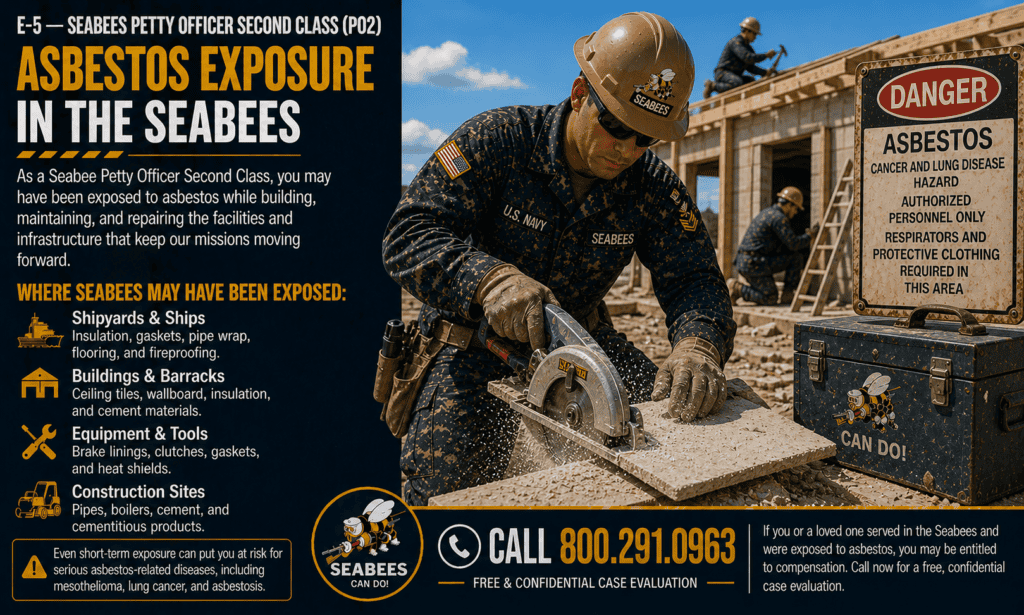
E-5 – Seabees Petty Officer Second Class (PO2) Asbestos Exposure
Asbestos Exposure Risks for Construction & Utilities Crew Leaders in the U.S. Navy Seabees
The U.S. Navy Seabees (Naval Construction Battalions) have played a critical role in building, repairing, and maintaining military infrastructure across every major conflict since World War II. Their work took them to remote islands, forward bases, disaster recovery zones, and aging naval installations worldwide. For decades, this work placed them in close contact with asbestos-containing materials (ACMs) found in insulation, piping, boilers, generators, roofing, flooring, electrical components, and demolition debris.
By the time a Seabee reaches E-5, Petty Officer Second Class (PO2), they have moved well beyond apprentice and journeyman tradesman status. They serve as crew leaders, technical specialists, and supervisors responsible for planning and executing complex construction projects. These leadership duties meant PO2s were regularly exposed not only to the asbestos they handled directly—but also to the asbestos disturbed by the crews they supervised.
This in-depth page explains:
-
The essential leadership role PO2s play in construction and utilities operations
-
Why pipe systems, boiler insulation, generators, and demolition created high exposure
-
How supervisory responsibilities increased long-term asbestos risk
-
Health risks associated with Seabee asbestos exposure
-
VA disability eligibility, compensation pathways, and trust fund options
Role and Responsibilities of an E-5 Seabees PO2
Typical Duties
🛠️ Crew leader for construction and utilities teams
PO2s serve as team leaders for Seabee construction ratings, including:
BU – Builder
-
structural carpentry
-
framing
-
siding and roofing
-
interior finishing
-
concrete and masonry
UT – Utilitiesman
-
plumbing and pipefitting
-
boiler and steam system maintenance
-
HVAC repair
-
water distribution systems
CE – Construction Electrician
-
electrical system installation
-
panel upgrades
-
conduit work
-
generator setup and repair
CM – Construction Mechanic
-
generator maintenance
-
vehicle repair
-
pump and compressor servicing
EO – Equipment Operator
-
excavation and demolition support
-
utilities trenching
-
debris removal
SW – Steelworker
-
welding and cutting
-
metal framing
-
structural repairs
Because PO2s supervise crews, they are present during:
-
pipe repair
-
structural demolition
-
boiler and generator overhauls
-
utility installations in old buildings
-
renovation of deteriorated Navy facilities
Almost all these tasks involved ACMs prior to 1980.
Why E-5 PO2s Had Some of the Highest Exposure Levels in the Seabees
PO2s worked in environments where asbestos was used heavily, particularly in:
-
steam systems
-
water distribution lines
-
electrical equipment
-
generators and boilers
-
base housing
-
forward-deployed structures
-
WWII-era and Vietnam-era facilities
Additionally, crew leaders had prolonged exposure because they rotated between worksites, responding to multiple problems in a single day. This meant repeated asbestos contact across:
-
pipe systems
-
mechanical rooms
-
demolition areas
-
generator sheds
-
boiler houses
-
construction zones
Below is a breakdown of the primary exposure sources.
Exposure Source #1: Pipe-System ACM
As late as the 1980s, pipe insulation in Navy and Marine Corps buildings was overwhelmingly asbestos-based. This included:
-
pipe wrap
-
block insulation
-
elbows and fittings
-
mastic
-
cloth lagging
-
steam-line asbestos blankets
How PO2s Encountered Pipe-System Asbestos
PO2 Utilitiesmen, Builders, and even Electricians were exposed while:
-
cutting into walls to access pipes
-
repairing leaks in steam lines
-
removing degraded pipe wrap
-
replacing insulation
-
entering crawl spaces filled with deteriorating lagging
-
inspecting mechanical rooms
-
supervising junior personnel performing pipe repairs
Pipe coverings often deteriorated into powder, releasing fibers when touched, brushed, or vibrated by nearby tools.
In confined utility spaces, asbestos dust remained airborne long after work ended.
Exposure Source #2: Demolition Oversight
Because PO2s supervised construction teams, they were physically present throughout demolition work—one of the highest-risk activities for asbestos exposure.
Demolition disturbed materials including:
-
drywall joint compound
-
asbestos flooring
-
asbestos roofing
-
siding (especially transite panels)
-
insulation in walls and ceilings
-
electrical panel fireproofing
-
boiler components
-
HVAC duct wrap
Why Oversight Roles Increased Exposure
PO2s were exposed not only during active demolition—but also during:
-
pre-demolition inspections
-
safety briefings inside the structure
-
progress checks
-
troubleshooting construction obstacles
-
post-demolition walk-throughs
-
cleanup evaluation
These are situations where asbestos fibers remain airborne due to:
-
vibration from tools
-
air movement
-
unsettled dust from previous shifts
Even if PO2s were not the ones swinging the sledgehammer, they stood in contaminated airspace multiple times per day, accumulating dangerous fiber loads.
Exposure Source #3: Generator and Boiler Insulation Work
Mechanical systems used by the Seabees—especially in remote or temporary bases—contained high concentrations of asbestos.
Generators used asbestos for:
-
heat shielding
-
wiring insulation
-
gasket materials
-
brake linings (for generator engines)
Boilers used asbestos in:
-
refractory insulation
-
firebrick
-
pipe connections
-
valve gaskets
-
expansion tanks
-
flue linings
PO2 Construction Mechanics (CM), Utilitiesmen (UT), and Electricians (CE) frequently:
-
disassembled generators
-
removed or replaced boiler components
-
scrapped old mechanical parts
-
worked in tight rooms with deteriorating insulation
-
supervised repair or replacement work
Dried, cracked insulation around boilers and generators shed fibers constantly—especially when systems were running hot.
Exposure Source #4: Cross-Trade Supervision and Multi-Mission Operations
E-5 PO2s rotated across multiple projects, meaning they encountered ACM from various trades in a single workday.
For example:
-
morning: supervise drywall demolition
-
afternoon: inspect generator malfunction
-
late shift: oversee pipe repair in an old barracks
-
next day: re-roofing damaged structures
This multi-exposure work pattern created cumulative risk far higher than tradesmen in civilian construction.
Furthermore, Seabee deployments often involved:
-
rebuilding bomb-damaged structures
-
restoring old island bases
-
repairing aging Pacific WWII installations
-
humanitarian missions in deteriorated buildings
Many of these facilities used imported asbestos materials, increasing exposure variability and intensity.
Long-Term Health Risks for E-5 Seabee PO2 Veterans
Asbestos fibers, once inhaled or swallowed, lodge permanently in body tissues. Diseases appear 20–50 years after exposure.
Conditions affecting Seabee PO2s include:
-
Mesothelioma (extremely aggressive cancer almost exclusively linked to asbestos)
-
Asbestos-related lung cancer
-
Asbestosis (lung scarring)
-
Pleural plaques
-
Pleural thickening
-
Respiratory damage
Because Seabee PO2s were exposed in both field deployments and home-station construction, their cumulative dose can be far greater than typical Navy personnel.
Thousands of former Seabees have since been diagnosed with asbestos diseases due to years of unprotected exposure.
VA Disability Benefits for Seabee PO2s
The VA recognizes Seabee ratings as high-risk MOS occupations for asbestos exposure.
PO2s have strong claim eligibility based on:
-
leadership roles in demolition and construction
-
direct work with asbestos-containing materials
-
exposure in mechanical rooms and pipe systems
-
construction projects in WWII-era and Cold War-era bases
-
documentation showing involvement in utilities or engineering roles
Evidence that strengthens a VA claim:
-
personnel records showing construction/utility rating
-
deployment or duty logs
-
statements from former unit members
-
medical diagnosis confirming asbestos disease
-
proof of service in pre-1980 facilities
Mesothelioma qualifies automatically for 100% disability.
Asbestos Trust Funds and Legal Compensation for Seabees
More than $30 billion remains available for veterans exposed to asbestos through commercial products used in:
-
pipe systems
-
boilers
-
generators
-
drywall compounds
-
roofing
-
pumps and gaskets
These claims are filed against manufacturers, not the Navy or the federal government.
Seabee PO2 veterans may qualify for:
-
asbestos trust fund payouts
-
settlements from product manufacturers
-
survivor benefits
-
VA disability + legal compensation (allowed simultaneously)
Many veterans receive compensation even if exposure happened overseas or during short deployments.
📞 Free Case Review for E-5 Seabee PO2 Veterans
If you served as an E-5 Seabees Petty Officer Second Class (PO2) and later developed mesothelioma, asbestos-related lung cancer, or asbestosis, you may be entitled to significant compensation.
📞 Call 800.291.0963 now for a free, confidential case review.
A specialist can confirm exposure pathways and help determine all benefits available to you.