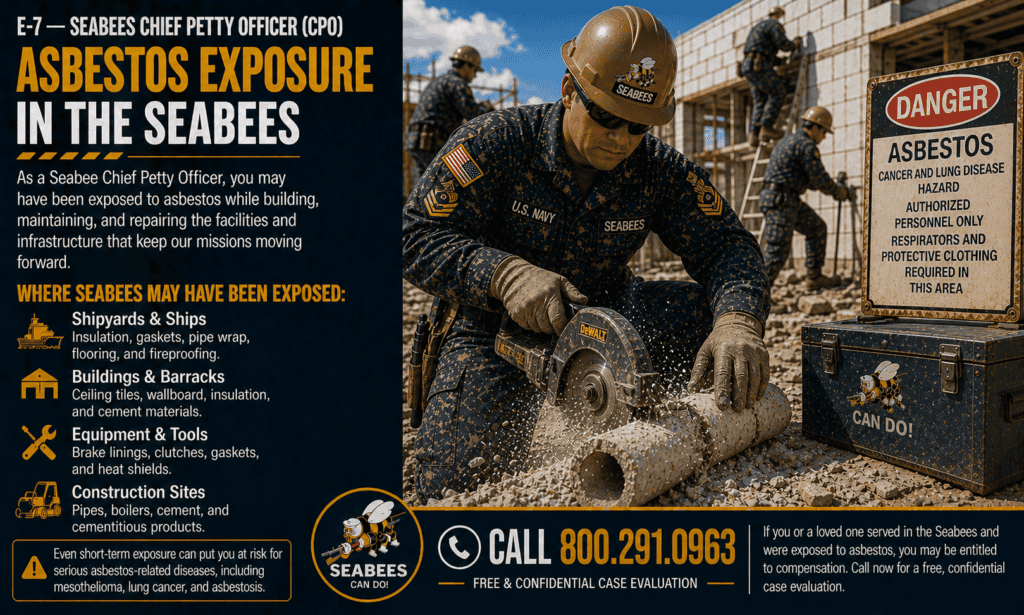
E-7 – Seabees Chief Petty Officer (CPO) Asbestos Exposure
Typical Duties
🛠️ Construction supervisor, project leader, shop chief
Asbestos Exposure
-
Legacy base buildings
-
Mechanical-room ACM
-
Supervision in contaminated job sites
Asbestos Exposure Risks for Seabees Chief Petty Officer (CPO)
A Seabees Chief Petty Officer (CPO) is one of the most essential leaders in the Naval Construction Force (NCF). As an E-7, the CPO is responsible for directing major engineering operations, supervising construction teams, ensuring quality standards, and managing mission execution for projects ranging from base infrastructure repairs to combat-zone construction.
Because Seabees work in renovation, utilities, structural repair, and heavy construction, CPOs were consistently placed in environments where asbestos was present—and often disturbed—on a daily basis. Their leadership role required them to spend long hours on job sites, mechanical rooms, power plants, and building interiors constructed before the 1980s, where asbestos-containing materials (ACM) were widely used throughout U.S. Navy installations.
This page outlines:
✔ The full scope of CPO leadership duties
✔ Why supervising construction exposes CPOs to asbestos dust
✔ Specific ACM sources such as mechanical rooms, duct systems, boilers, flooring, roofing, siding, and structural materials
✔ Long-term health risks associated with asbestos exposure
✔ VA disability qualification and compensation options for Seabees
The Senior Leadership Role of a Seabees CPO
A Chief Petty Officer is not simply a skilled tradesman—they are a technical authority, project manager, and leadership anchor who oversees entire construction detachments. CPOs embody Navy engineering experience and are relied upon for decision-making, training, and operational excellence.
Typical Responsibilities Include:
-
Supervising major construction and renovation projects
-
Leading shops for carpentry, electrical, plumbing, HVAC, steelwork, and equipment
-
Managing utilities and mechanical system repairs
-
Conducting inspections of mechanical rooms, power generation sites, and infrastructure
-
Developing work schedules, material lists, and engineering plans
-
Ensuring compliance with Navy regulations and safety standards
-
Training junior Seabees and enforcing proper trade techniques
-
Overseeing demolition and reconstruction missions
-
Coordinating logistics and equipment readiness
-
Reporting to officers on project status and engineering issues
Because CPOs inspect work sites, walk through debris, evaluate structural problems, and supervise repairs, they often encounter asbestos directly—especially in older Navy buildings and forward-deployed facilities.
Why Seabees CPOs Faced Significant Asbestos Exposure
From World War II through the mid-1980s, asbestos was used widely across Navy construction because it was durable, fire-resistant, and cheap. Surface buildings, mechanical systems, barracks, hangars, steam plants, and operational facilities all contained ACM.
CPOs were exposed because they routinely supervised or performed work involving:
-
Demolition of old Navy structures
-
Repairs to utility and mechanical systems
-
HVAC and electrical panel inspections
-
Boiler-room and mechanical-room operations
-
Renovation of legacy buildings and barracks
-
Construction on older naval bases overseas
-
Emergency repairs in contaminated spaces
Even without directly handling ACM, the Chief absorbed airborne dust created by cutting, grinding, removing, or disturbing asbestos materials.
Exposure Source #1: Legacy Base Buildings Built Before 1980
Virtually every Navy installation built during WWII, Korea, and Vietnam-era expansion used asbestos in:
-
Roofing shingles
-
Siding (transite asbestos boards)
-
Ceiling and wall panels
-
Drywall and joint compound
-
Vinyl flooring tile and adhesives
-
Insulation around pipes, ducts, and structural beams
How CPOs Were Exposed in Legacy Buildings
CPOs were responsible for:
-
Conducting inspections
-
Verifying structural issues
-
Approving renovation plans
-
Training crews on replacement tasks
-
Supervising demolition shifts
-
Monitoring safety compliance
Any deterioration—cracking plaster, broken tiles, peeling insulation—released asbestos fibers. Since CPOs spent extended hours supervising indoor projects, exposure was unavoidable.
Even simple tasks such as:
-
Checking progress
-
Evaluating wall integrity
-
Inspecting ceiling damage
-
Overseeing tile removal
could expose them to airborne asbestos dust.
Exposure Source #2: Mechanical Rooms and Utilities Infrastructure
Mechanical rooms are among the highest-risk asbestos environments on any Navy base. These areas contained concentrated ACM because asbestos was used extensively for heat resistance and insulation in systems such as:
-
Boilers
-
Chillers
-
Steam lines
-
Hot water systems
-
HVAC ductwork
-
Pumps, valves, and compressors
-
Fireproofing wraps and blankets
How CPOs Were Exposed in Mechanical Rooms
A Chief Petty Officer often entered these spaces to:
-
Inspect system failures
-
Approve repairs
-
Evaluate safety hazards
-
Train junior utilities personnel
-
Review completed maintenance work
Mechanical rooms are typically confined, poorly ventilated, and coated in decades of accumulated asbestos dust. Every step inside dislodged fibers into the air.
Even brushing against insulation or opening panels released asbestos particles small enough to remain airborne for hours.
Exposure Source #3: Supervision of Contaminated Work Sites
CPOs rarely work from behind a desk. They stand in the debris, walk the job site, and evaluate project progress hands-on.
When supervising:
-
Demolition
-
Siding removal
-
Flooring replacement
-
HVAC system upgrades
-
Steam plant overhauls
-
Electrical room renovation
they are directly exposed to dust clouds created by:
-
Cutting transite boards
-
Removing asbestos tiles
-
Grinding adhesives
-
Breaking old cement board
-
Disturbing insulation around pipes and boilers
Supervisors often breathe more asbestos than workers because they return repeatedly to the contaminated site throughout the day.
Exposure Source #4: Airborne Dust from Construction and Demolition
Construction dust is the most consistent exposure source for Seabees personnel.
Activities that release asbestos include:
-
Sweeping debris in old buildings
-
Sawing through asbestos cement board
-
Drilling into asbestos-backed walls
-
Knocking out old tile or roofing
-
Breaking plaster mixed with asbestos fibers
-
Sanding drywall joint compound
-
Removing pipe insulation
Even small renovations—such as installing electrical outlets or replacing deteriorated flooring—could generate harmful airborne fibers.
Since CPOs frequently performed spot checks, walkthroughs, and quality inspections, they inhaled asbestos regularly.
Exposure Source #5: Overseas Construction in War Zones
Seabees deployed worldwide to Korea, Vietnam, Iraq, Afghanistan, and dozens of remote bases. Many of these locations contained:
-
Improvised structures insulated with asbestos
-
Older U.S. military buildings left from earlier decades
-
Partner-nation facilities constructed with unregulated ACM
-
Damaged structures from combat or natural disasters releasing asbestos debris
CPOs led reconstruction, repair, and fortification missions in these hazardous conditions.
Long-Term Health Risks for Seabees Chief Petty Officers
Asbestos fibers lodge permanently in the lungs and abdominal linings. CPOs often face:
-
Mesothelioma
-
Asbestos-related lung cancer
-
Asbestosis
-
Pleural thickening
-
Chronic shortness of breath
-
Persistent chest pain
Symptoms typically appear 20–50 years after exposure. Many Seabees diagnosed today were exposed decades earlier while supervising routine construction work.
VA Disability Benefits for Seabees CPOs
The VA recognizes SeaBee construction ratings as high-risk occupations for asbestos exposure. CPOs often qualify for:
-
100% disability for mesothelioma
-
Benefits for asbestos-related lung cancer
-
Compensation for asbestosis and pleural disease
-
Survivor benefits for families
Documentation such as service records, construction logs, or statements from shipmates strengthens claims.
Asbestos Trust Fund & Legal Compensation
Over $30 billion is available in asbestos trust funds. Claims target manufacturers, not the Navy.
CPO veterans can often receive compensation from:
✔ VA disability benefits
✔ Multiple asbestos trust funds
✔ Legal claims against asbestos product manufacturers
Many Seabees qualify for all three.
📞 Free Case Review for Seabees CPO Veterans
If you served as a Seabees Chief Petty Officer and later developed mesothelioma, lung cancer, or another asbestos-related illness, compensation may be available.
📞 Call 800.291.0963 now for a free, confidential case review.