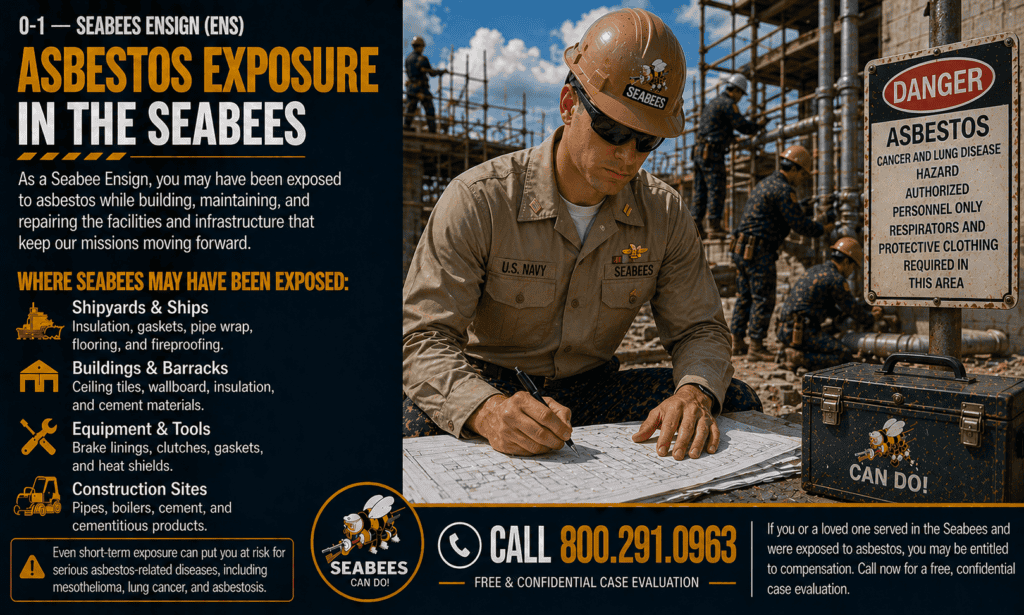
O-1 – Seabees Ensign (ENS) Asbestos Exposure
Typical Duties
🛠️ Junior construction officer, project oversight
Asbestos Exposure
Pre-1980 administrative buildings
Utility-room ACM
Training facilities
Asbestos Exposure Risks for Seabees Ensign (ENS)
A Seabees Ensign (ENS) is the entry-level commissioned officer within the Naval Construction Force, responsible for assisting in the management of construction operations, overseeing engineering projects, directing small units, conducting inspections, and coordinating planning and logistics. As junior officers, ENSs gain firsthand experience by frequently visiting work sites, administrative areas, training facilities, mechanical rooms, and utilities spaces to understand the full scope of Seabees engineering missions.
Because many Navy and Marine Corps facilities were constructed decades before asbestos regulations, ENS officers working in pre-1980 administrative buildings, mechanical spaces, and training environments were regularly exposed to asbestos-containing materials (ACM). Their oversight responsibilities required them to walk through aging structures, review repair projects, supervise training activities, and shadow senior engineers—often in environments where insulation, flooring materials, pipe wrap, duct linings, and ceiling systems contained friable asbestos.
This page details:
✔ Duties and responsibilities of a Seabees Ensign
✔ How legacy Navy infrastructure led to routine asbestos exposure
✔ Key ACM sources such as insulation, pipe wrap, electrical components, and structural materials
✔ Long-term health risks for ENS personnel
✔ Eligibility for VA disability, asbestos trust funds, and legal compensation
The Leadership and Training Role of a Seabees Ensign
Although junior in rank, ENS officers serve in critical leadership and project-management roles while learning every aspect of construction and engineering operations.
Typical Responsibilities Include:
Assisting in planning and executing construction missions
Supervising small engineering teams and work sections
Reviewing engineering drawings, schedules, and safety procedures
Conducting site visits for project progress and compliance
Inspecting administrative, utilities, and mechanical areas
Supporting quality assurance and safety enforcement
Coordinating logistics, materials, and equipment needs
Gaining competency in utilities, structural systems, and engineering oversight
Participating in facilities inspections and readiness evaluations
Shadowing senior officers during large-scale infrastructure assessments
These daily tasks required ENSs to physically enter older facilities, mechanical rooms, training buildings, and utility areas—many of which contained asbestos materials in deteriorating condition.
Why Seabees ENS Officers Faced Significant Asbestos Exposure
Asbestos was heavily used in naval construction from the 1940s through the 1980s, especially in administration buildings, utility rooms, and training facilities. ENS officers were frequently exposed because early-career training required them to familiarize themselves with all aspects of Seabees engineering operations.
Common ACM locations included:
Ceiling tiles
Pipe insulation
HVAC duct linings
Boiler-room insulation
Flooring adhesives and vinyl tile
Cement-board wall systems
Electrical panels and wiring insulation
Transite siding
Fireproof coatings
ENS officers encountered asbestos during:
Project oversight walkthroughs
Base-facility inspections
Training exercises in older buildings
Shadowing utilities and mechanical crews
Administrative assignments in pre-1980 offices
Renovation planning and workspace evaluations
Even brief exposures accumulated over time as ENSs rotated through multiple facilities and job sites during their early training and leadership development.
Exposure Source #1: Pre-1980 Administrative Buildings
ENS officers often worked daily inside older administrative buildings used for:
Project planning
Engineering meetings
Training briefings
Recordkeeping and logistics
Asbestos-containing materials commonly found in these structures included:
Vinyl asbestos tile (VAT)
Ceiling tiles
Drywall joint compound
HVAC insulation
Pipe wrap
Transite wall panels
Fireproof door cores
Deterioration or renovation activities easily released airborne fibers.
Exposure Source #2: Utility Rooms and Mechanical Spaces
ENS officers regularly followed utilities technicians into high-risk environments to learn system operation, maintenance needs, and emergency procedures.
These areas included:
Boiler rooms
Electrical vaults
HVAC spaces
Pump rooms
Steam-line access corridors
Mechanical spaces frequently contained:
Pipe insulation
Valve packing
Gaskets and seals
Refractory boiler insulation
Electrical panel ACM
These confined areas allowed asbestos fibers to remain suspended in the air long after work was completed.
Exposure Source #3: Training Facilities
ENS officers underwent extensive leadership and technical training, often inside older buildings used for:
Classroom instruction
Field exercises
Skills demonstrations
Utilities and equipment training
Many of these facilities contained ACM in:
Ceiling systems
Wall panels
Flooring materials
HVAC ducts
Insulation inside utility demonstration rooms
Training in such environments resulted in repeated low-level exposure.
Exposure Source #4: Project Oversight and Renovation Walkthroughs
ENS officers were routinely assigned to monitor renovation or repair projects, placing them in close proximity to disturbed ACM.
High-risk activities included:
Removing ceiling tiles or flooring
Cutting into walls for utilities access
Replacing HVAC units
Repairing steam lines
Inspecting mechanical damage
Monitoring demolition progress
These walkthroughs often occurred while debris remained airborne.
Exposure Source #5: Early-Career Rotations Through Multiple Facilities
Because ENS officers rotate widely across base operations, they repeatedly entered buildings of varying age and condition.
This rotation exposed them to:
Long-term asbestos dust accumulation
Cracked insulation in utility spaces
Aging flooring and ceiling materials
Deteriorated fireproof coatings
Mechanical debris and ventilation contamination
Even short visits added to cumulative exposure.
Long-Term Health Risks for Seabees ENS Officers
Asbestos fibers remain permanently embedded in the body. Diseases often appear 20–50 years after early-career exposure.
Common illnesses include:
Mesothelioma
Asbestos-related lung cancer
Asbestosis
Pleural thickening and plaques
Chronic respiratory impairment
Many ENS officers exposed early in their careers are being diagnosed decades later.
VA Disability Benefits for ENS Asbestos Exposure
The VA recognizes construction, engineering, and facility-based roles—as well as service in pre-1980 buildings—as high-risk for asbestos exposure.
ENS officers may qualify for:
100% VA disability for mesothelioma
Disability compensation for asbestos-related cancer
Benefits for asbestosis or pleural disease
DIC benefits for surviving dependents
Evidence That Strengthens Claims:
Service in Seabees engineering operations
Work in pre-1980 buildings or mechanical areas
Participation in inspections or training involving ACM
Deployment or base rotation records
Medical documentation linking asbestos to illness
Asbestos Trust Fund & Legal Compensation
Over $30 billion is available in asbestos trust funds.
Claims target manufacturers—not the U.S. military.
A Seabees ENS may qualify for:
✔ VA disability benefits
✔ Multiple asbestos trust fund claims
✔ Legal compensation through asbestos litigation
Many veterans receive compensation through all three avenues.
📞 Free Case Review for Seabees ENS Veterans
If you served as a Seabees Ensign and later developed mesothelioma, lung cancer, or another asbestos-related illness, you may be entitled to significant compensation.
📞 Call 800.291.0963 now for a free, confidential case review.