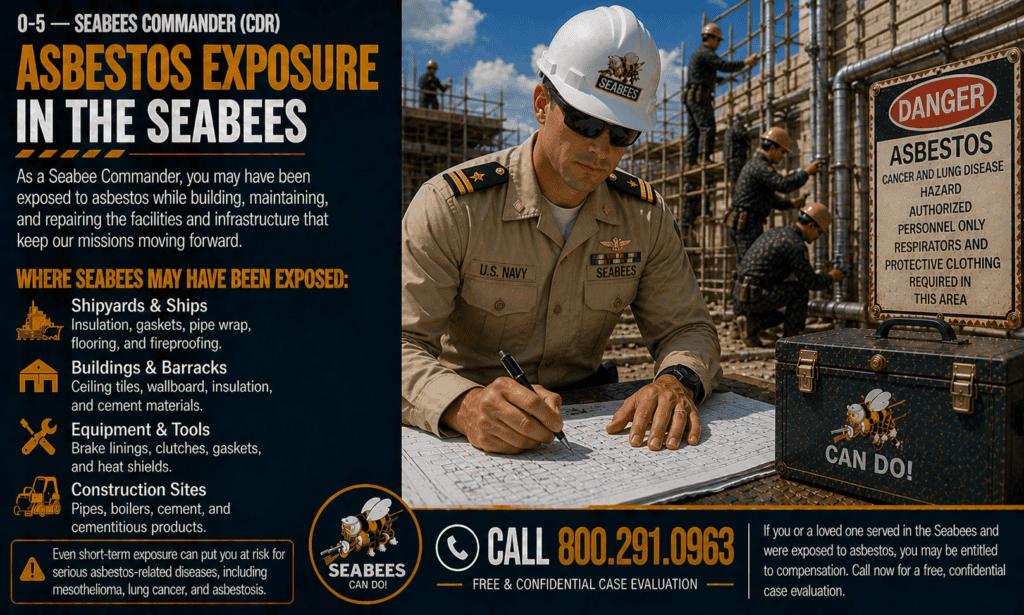
O-5 – Seabees Commander (CDR) Asbestos Exposure
Typical Duties
🛠️ Battalion commander, senior CEC officer
Asbestos Exposure
Legacy office spaces
Shipyard support buildings
Old barracks and housing
Asbestos Exposure Risks for Seabees Commander (CDR)
A Seabees Commander (CDR) is a senior commissioned officer who typically serves as a battalion commander, executive leader of major construction units, or senior Civil Engineer Corps (CEC) officer responsible for planning, directing, and evaluating engineering operations across entire installations or regions. CDRs oversee strategic infrastructure decisions, supervise large-scale construction efforts, inspect aging facilities, and manage readiness across multiple engineering departments.
Because CDRs operate extensively within legacy office spaces, shipyard support buildings, and older barracks or housing units built long before asbestos regulations, they were consistently exposed to asbestos-containing materials (ACM). Their executive oversight duties required frequent travel through administrative buildings, mechanical rooms, utilities corridors, shipyard facilities, and base housing—many of which contained deteriorating asbestos insulation, ceiling tile, flooring materials, siding, gaskets, electrical insulation, and HVAC components.
This page details:
✔ The leadership and engineering responsibilities of a Seabees Commander
✔ How legacy Navy buildings and shipyard environments contributed to ACM exposure
✔ Key asbestos sources found in housing, administrative facilities, and shipyard structures
✔ Long-term health risks associated with service as a CDR
✔ Eligibility for VA benefits, trust-fund claims, and legal compensation
The Senior Leadership & Infrastructure Role of a Seabees CDR
CDRs provide top-tier engineering leadership, directing operations at the battalion level or serving as senior advisors to installation commanders.
Typical Responsibilities Include:
Commanding Seabees battalions and major engineering forces
Overseeing large-scale construction and infrastructure programs
Inspecting base facilities, utilities plants, and operational buildings
Managing readiness, safety, compliance, and technical standards
Reviewing engineering reports and long-term infrastructure plans
Coordinating renovation, modernization, and demolition efforts
Supervising senior officers, warrant officers, and technical experts
Establishing policy for construction, maintenance, and facility management
Providing engineering leadership during humanitarian and contingency missions
Interfacing with shipyards, public works departments, and installation leadership
These senior roles required frequent entry into older Navy structures—many laden with friable asbestos.
Why Seabees CDRs Faced Significant Asbestos Exposure
Most Navy facilities built between WWII and the 1970s contained asbestos across virtually all mechanical, structural, and administrative components. CDRs—responsible for evaluating infrastructure and overseeing major engineering programs—were repeatedly exposed throughout their careers.
Common asbestos locations included:
Legacy office buildings
Shipyard support facilities
Old barracks and family housing
Utilities and mechanical rooms
Cement-board siding and transite panels
HVAC duct insulation
Vinyl flooring and adhesives
Ceiling tile and acoustical panels
Electrical insulation and breaker backboards
Exposure occurred during:
Facility inspections
Operational readiness assessments
Renovation oversight
Shipyard coordination
Housing habitability checks
Damage evaluation after storms or deployments
Senior officers were often present during briefings or walkthroughs carried out inside older buildings with deteriorating ACM.
Exposure Source #1: Legacy Office Spaces
CDRs frequently worked inside outdated administrative buildings for:
Staff meetings
Planning sessions
Operations oversight
Engineering reviews
Legacy office spaces commonly contained ACM in:
Ceiling tiles
Flooring materials
Drywall compound
HVAC ductwork
Pipe insulation
Electrical insulation
Fireproof coatings
Even daily occupancy in these offices exposed CDRs to airborne fibers, especially when older ventilation systems circulated contaminated dust.
Exposure Source #2: Shipyard Support Buildings
Seabees Commanders often coordinated with shipyards or naval industrial facilities supporting construction and repair operations.
Shipyard support spaces frequently contained:
Asbestos pipe wrap
Thermal insulation
Cement-board wall panels
Dust from ship-repair work
Electrical panel ACM
Boiler-room and steam-line insulation
Shipyards historically had the highest asbestos levels of any Navy environment, making walkthroughs or briefings in these buildings especially hazardous.
Exposure Source #3: Old Barracks and Housing
CDRs frequently inspected or supervised work in aging Navy barracks and family housing.
Common ACM materials included:
Floor tile and mastics
Ceiling tiles
Drywall compound
Transite siding
HVAC insulation
Roofing tar and shingles
Plumbing and heating insulation
Housing renovations and habitability inspections routinely disturbed ACM, increasing exposure risk for senior officers.
Exposure Source #4: Utilities and Mechanical Infrastructure Oversight
CDRs evaluated major infrastructure systems, often entering contamination-heavy mechanical spaces such as:
Boiler rooms
Electrical vaults
Chiller and HVAC plants
Power-generation buildings
pump rooms
Steam distribution corridors
These environments were lined with:
Pipe lagging
Gaskets and seals
Refractory insulation
Breaker backings
Asbestos-coated ductwork
Confined ventilation made these areas particularly dangerous.
Exposure Source #5: Renovation, Modernization & Demolition Projects
CDRs supervised or approved large-scale renovation projects where ACM disturbance was unavoidable.
High-risk tasks included:
Removing flooring or ceiling systems
Cutting cement board
Replacing HVAC systems
Demolishing walls, siding, and roofing
Upgrading utilities and steam lines
CDRs often visited sites mid-project, when asbestos levels were at their highest.
Long-Term Health Risks for Seabees CDRs
Asbestos fibers collect permanently in the lungs, with diseases typically developing 20–50 years after exposure.
Associated illnesses include:
Mesothelioma
Asbestos-related lung cancer
Asbestosis
Pleural plaques
Chronic respiratory damage
Senior officers who served across multiple decades are particularly at risk.
VA Disability Benefits for CDR Asbestos Exposure
The VA recognizes leadership roles involving infrastructure oversight as high-risk for asbestos exposure.
CDRs may qualify for:
100% disability for mesothelioma
Compensation for asbestos-related lung cancer
Ratings for asbestosis or pleural disease
DIC benefits for surviving families
Evidence That Strengthens Claims:
Service in pre-1980 facilities
Shipyard coordination roles
Infrastructure inspections
Renovation or demolition oversight
Medical documentation linking disease to asbestos
Asbestos Trust Fund & Legal Compensation
More than $30 billion is still available in asbestos trust funds.
Legal claims target manufacturers—not the U.S. Navy.
A Seabees Commander may qualify for:
✔ VA disability benefits
✔ Multiple asbestos trust fund claims
✔ Legal compensation from asbestos companies
Many senior officers receive compensation from all three avenues.
📞 Free Case Review for Seabees CDR Veterans
If you served as a Seabees Commander and later developed mesothelioma, lung cancer, or another asbestos-related disease, you may be entitled to significant financial compensation.
📞 Call 800.291.0963 now for a free, confidential case review.