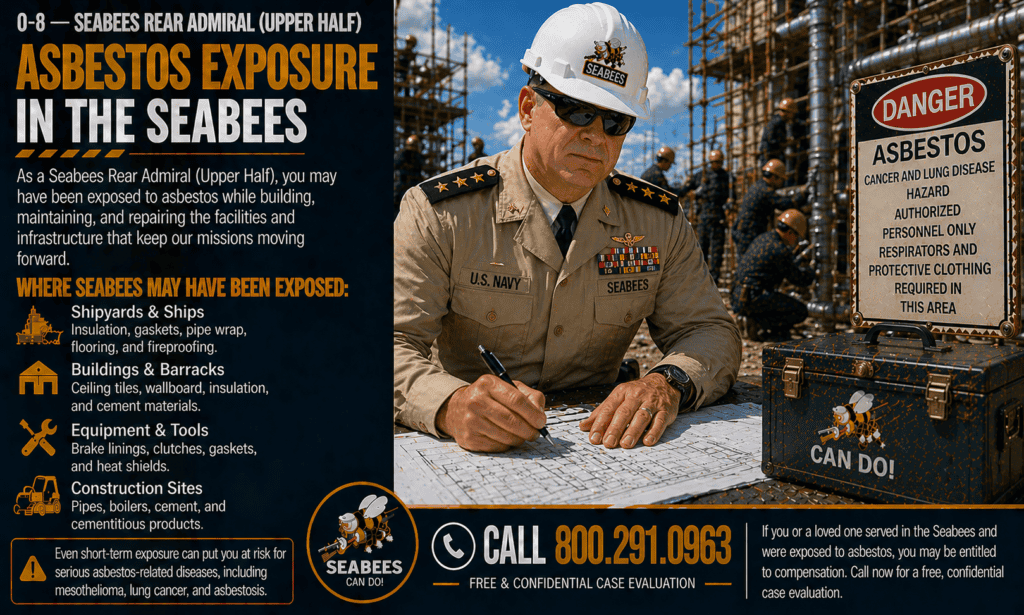
O-8 – Seabees Rear Admiral Upper Half (RADM) Asbestos Exposure
Typical Duties
🛠️ Senior Navy engineering leadership
Asbestos Exposure
Long-term presence in older command facilities
Aging infrastructure with ACM
Administrative complexes built before asbestos restrictions
Asbestos Exposure Risks for Seabees Rear Admiral Upper Half (RADM)
A Seabees Rear Admiral Upper Half (RADM) is a senior Flag Officer responsible for high-level command, strategic engineering oversight, global Naval Construction Force (NCF) operations, major infrastructure policy, and long-term facility planning across the U.S. Navy. RADMs provide leadership over multiple regions or commands, guide multi-billion-dollar construction programs, and shape Navy-wide engineering standards, modernization priorities, and operational readiness.
Because RADMs spent significant time inside older Navy command headquarters and administrative complexes constructed before asbestos regulations, they experienced chronic exposure to asbestos-containing materials (ACM). Their roles required regular inspections, strategic reviews, planning sessions, command briefings, and oversight visits inside facilities where insulation, flooring, ceiling materials, HVAC systems, and mechanical infrastructure contained friable asbestos.
This page details:
✔ RADM senior leadership and engineering responsibilities
✔ How older headquarters and command centers led to asbestos exposure
✔ Specific ACM sources found in administrative complexes and aging mechanical systems
✔ Long-term health risks for senior flag officers
✔ Eligibility for VA disability, asbestos trust funds, and legal compensation
The Executive Engineering Role of a Seabees RADM
At the O-8 level, RADMs hold expanded leadership authority over entire engineering regions, NCF commands, and strategic infrastructure programs.
Typical Responsibilities Include:
Directing regional or global Naval Construction Force operations
Setting long-range engineering and infrastructure priorities
Reviewing major construction, repair, and modernization programs
Conducting leadership inspections of command facilities
Evaluating base readiness, safety standards, and environmental compliance
Supervising senior CEC officers, CAPTs, CDRs, and engineering directors
Managing budgetary and resource decisions for Navy-wide engineering operations
Coordinating with NAVFAC, fleet commanders, and DoD agencies
Overseeing global humanitarian and expeditionary engineering missions
Providing high-level command presence in administrative headquarters
These leadership responsibilities placed RADMs in older facilities with known ACM usage.
Why Seabees RADMs Faced Significant Asbestos Exposure
The majority of Navy administrative buildings, command headquarters, and engineering facilities built pre-1980 were constructed with ACM. RADMs—who frequently occupied these facilities during high-level command duties—were regularly exposed.
Common asbestos locations included:
Command headquarters
Planning and operations centers
Administrative office buildings
Mechanical and electrical rooms
HVAC systems
Boiler and utilities spaces
Older barracks and support buildings
Exposure occurred during:
Command inspections
Facilities evaluations
Strategic meetings
Damage assessments
Infrastructure planning sessions
Renovation and modernization oversight
Although RADMs performed no manual labor, their long-term presence in ACM environments created measurable exposure risk.
Exposure Source #1: Older Navy Command Facilities
Buildings used for command and control functions commonly contained asbestos in:
Ceiling panels and acoustic tiles
Vinyl asbestos tile (VAT)
Pipe and duct insulation
Drywall mud and compound
Electrical panel backings
Transite wallboard
Fireproof construction materials
Ventilation systems often spread asbestos dust throughout occupied office areas.
Exposure Source #2: Aging Infrastructure With ACM
As senior engineering leaders, RADMs routinely evaluated:
Power-generation systems
Water and wastewater plants
Heating and steam infrastructure
Electrical vaults
HVAC distribution networks
Base utilities systems
These systems contained ACM such as:
Pipe wrap
Thermal insulation
Valve packing
Gaskets and seals
Boiler refractory materials
Duct insulation
Brief inspections in these areas—repeated over many years—contributed to cumulative exposure.
Exposure Source #3: Administrative Complexes Built Before Asbestos Restrictions
Large administrative buildings—built rapidly during WWII, Korea, and Vietnam—were major ACM sites.
Common materials included:
Asbestos ceiling tile
Vinyl asbestos flooring
Cement board panels
Fireproof coatings
HVAC insulation
Wallboard and plaster compound
RADM-level activities (briefings, planning sessions, oversight visits) occurred regularly in these aging complexes.
Exposure Source #4: Oversight of Renovation & Modernization Projects
RADM duties included reviewing or approving:
Major renovations
Demolition plans
Base modernization strategies
Infrastructure project proposals
Engineering inspection findings
Visits to bases undergoing construction often exposed RADMs to disturbed asbestos fibers.
Exposure Source #5: Lengthy Military Careers
Flag officers often serve 30–35 years, accumulating exposure through:
Multiple command tours
Frequent headquarters assignments
Routine presence in pre-1980 buildings
Leadership visits to mechanical and utilities areas
Participation in modernization efforts across aging bases
The combination of long service and repeated building occupancy increased lifetime exposure risk.
Long-Term Health Risks for Seabees RADMs
Asbestos-related diseases typically develop 20–50 years after exposure.
Associated illnesses include:
Mesothelioma
Asbestos-related lung cancer
Asbestosis
Pleural plaques
Chronic respiratory impairment
Senior officers often receive diagnoses after retirement due to decades of low-level exposure.
VA Disability Benefits for RADM Asbestos Exposure
The VA recognizes that senior Navy officers stationed in older command facilities face significant asbestos exposure.
RADM veterans may qualify for:
100% disability for mesothelioma
Compensation for asbestos-related lung cancer
Ratings for asbestosis or pleural diseases
Dependency and Indemnity Compensation (DIC) for surviving spouses
Evidence That Strengthens Claims:
Service in pre-1980 Navy headquarters
Engineering oversight responsibilities
Infrastructure evaluation duties
Multiple command assignments across older installations
Medical evidence linking disease to asbestos exposure
Asbestos Trust Fund & Legal Compensation
More than $30 billion is available in asbestos trust funds.
Claims are filed against manufacturers—not the U.S. Navy.
RADM veterans may qualify for:
✔ VA disability benefits
✔ Asbestos trust fund claims
✔ Legal compensation from manufacturers
Most veterans receive compensation from all three categories.
📞 Free Case Review for Seabees RADM Veterans
If you served as a Seabees Rear Admiral Upper Half and developed mesothelioma, lung cancer, or another asbestos-related illness, significant compensation may be available.
📞 Call 800.291.0963 now for a free, confidential case review.