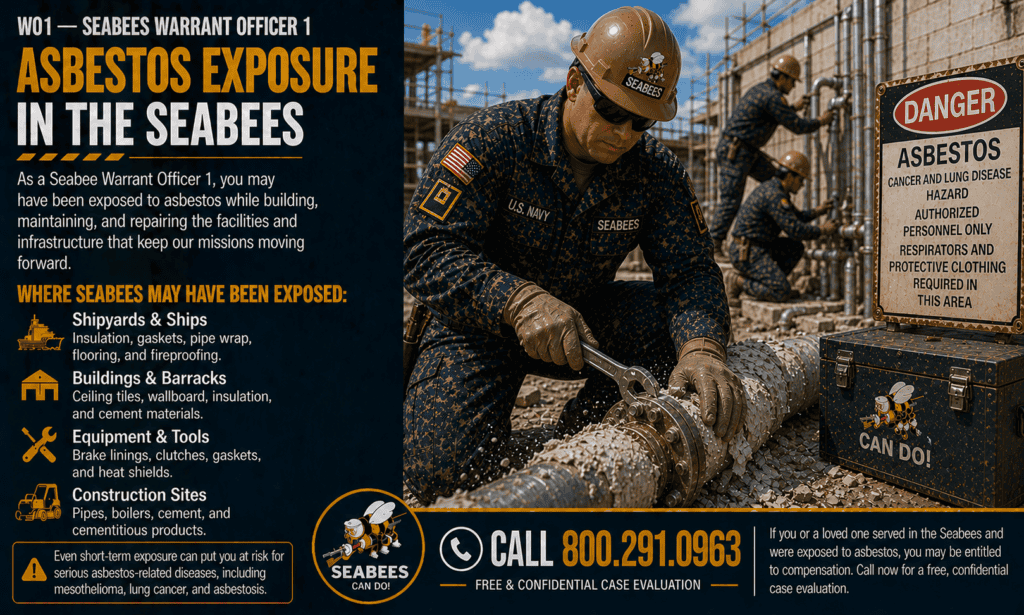
WO1 – Seabees Warrant Officer 1 Asbestos Exposure
Typical Duties
🛠️ Engineering technician, utilities specialist
Asbestos Exposure
Pipe insulation ACM
Panel insulation
Boiler-room exposure
Asbestos Exposure Risks for Seabees Warrant Officer 1 (WO1)
A Seabees Warrant Officer 1 (WO1) is a highly skilled technical expert within the Naval Construction Force, specializing in engineering systems, utilities, equipment maintenance, structural assessments, and complex troubleshooting. As a warrant officer, the WO1 bridges the gap between enlisted leadership and commissioned officers, providing deep technical insight while supervising hands-on repair, maintenance, and field engineering operations across Navy and Marine Corps facilities.
Because Seabees were historically assigned to build, repair, and maintain thousands of pre-1980 structures—many packed with asbestos—WO1s frequently operated in high-risk mechanical spaces, boiler rooms, power-generation facilities, and aged infrastructure. Their role required constant inspections, diagnostics, and oversight of utilities, heating systems, electrical components, and mechanical equipment, all of which were heavily insulated with asbestos materials during much of the 20th century.
This page details:
✔ Full technical duties and responsibilities of a WO1
✔ Why utility systems and mechanical environments contained extreme levels of ACM
✔ Specific asbestos sources: boilers, pipe lagging, electrical panels, gaskets, HVAC insulation, and cement boards
✔ Long-term health risks facing Seabees Warrant Officers
✔ Eligibility for VA benefits, trust funds, and legal compensation
The Technical Leadership Role of a Seabees WO1
A Warrant Officer 1 is the Navy’s premier technical specialist in construction engineering. Unlike enlisted Seabees who perform direct labor or senior enlisted ranks who supervise crews, WO1s focus on diagnosing system failures, planning repairs, ensuring technical compliance, and overseeing high-risk engineering operations.
Typical Responsibilities Include:
Performing advanced diagnostics on utilities and mechanical systems
Supervising engineering repair teams and technical operations
Inspecting structural, electrical, and mechanical deficiencies
Developing solutions for utilities, water, power, and HVAC systems
Reviewing and modifying engineering plans and schematics
Ensuring safe handling of hazardous materials, including ACM
Coordinating specialty tools, materials, and system upgrades
Advising officers on technical readiness and maintenance priorities
Overseeing major renovations, equipment replacements, and system overhauls
Providing subject-matter expertise during overseas construction missions
These duties required WO1s to enter deteriorating, asbestos-filled environments daily—where insulation, tiles, gaskets, and mechanical components frequently released airborne fibers.
Why Seabees WO1s Faced High Asbestos Exposure
From the WWII era through the late 1980s, asbestos was considered essential for fireproofing and heat resistance. Because WO1s specialized in utilities, heating systems, electrical networks, and mechanical equipment, they routinely worked in areas where asbestos was most concentrated.
Asbestos was used in:
Boilers and steam pipes
HVAC duct systems
Pipe wrap and lagging
Electrical insulation
Cement board and wall panels
Floor tiles and adhesives
Gaskets, packing, and valve components
Mechanical-room fireproofing
Refractory boiler materials
WO1s encountered asbestos through:
Equipment diagnostics
Emergency mechanical repairs
System shutdowns and rebuilds
Boiler-room inspections
Electrical troubleshooting
HVAC failures and ductwork evaluations
Power-generation maintenance
Project supervision in contaminated structures
Even without performing manual labor, simply entering these confined, contaminated environments exposed WO1s to significant asbestos fiber concentrations.
Exposure Source #1: Pipe Insulation and Utility Systems
Seabees Warrant Officers were heavily involved in diagnosing and repairing utilities—areas where asbestos was used extensively.
WO1s routinely worked around:
Steam and hot-water lines
High-pressure pipe systems
Pump assemblies
Valve networks
Main distribution lines in older bases
Common ACM in These Systems:
Asbestos pipe wrap
Thermal lagging
Elbow and joint insulation
Gasket materials
Rope packing for valves
Pump housing insulation
When insulation deteriorated or repairs required cutting or removal, asbestos fibers became airborne immediately. WO1s performing diagnostics or supervising these repairs faced heavy exposure.
Exposure Source #2: ACM in Electrical Panels and System Components
Electrical infrastructure on pre-1980 Navy bases contained multiple asbestos products.
WO1s frequently inspected or repaired:
Switchboards
Breaker panels
Motor controllers
Generator systems
Power-distribution rooms
Transformers and conduit insulators
ACM in these areas included:
Arc-proof asbestos panels
Wire insulation
Fire-resistant mounting boards
Breaker-panel backings
Electromagnetic shielding materials
Even minor electrical troubleshooting could disturb asbestos dust that settled behind panel covers or inside conduits.
Exposure Source #3: Boiler-Room and Mechanical-Space Insulation
Mechanical rooms were among the most dangerous asbestos environments. WO1s supervised, inspected, or repaired:
Boilers
Steam systems
Turbines and generators
HVAC units
Chillers and condensers
Water-heater systems
Compressor rooms
ACM Found in Mechanical Rooms:
Refractory boiler insulation
Asbestos pads and blankets
Pipe lagging
Valve packing
Gaskets and seals
Pump insulation
Fireproof cement coatings
Confined spaces allowed fibers to linger, exposing WO1s long after work was completed.
Exposure Source #4: Construction, Renovation, and Demolition Oversight
Because WO1s evaluated system failures and planned upgrades, they directly oversaw some of the most hazardous asbestos-disturbing activities:
Removing pipe insulation
Replacing HVAC systems
Cutting asbestos board panels
Breaking up tile or mastics
Repairing water-damaged structures
Overseeing mechanical system replacements
Examples of high-risk tasks WO1s supervised:
Transite panel removal
Grinding floor adhesives
Steam-line insulation replacement
Boiler and refractory tear-outs
Ceiling and wall demolition during repairs
Their daily presence at multiple contaminated job sites led to repeated cumulative exposure.
Exposure Source #5: Overseas Deployment Hazards
Seabees WO1s deployed worldwide, often to older bases or damaged structures where asbestos regulation was nonexistent.
High-risk locations included:
Vietnam and Southeast Asia
Korea
Iraq and Afghanistan
WWII Pacific installations
Old NATO facilities
Humanitarian or disaster-recovery zones
Partner nations using unregulated ACM
WO1s often restored utilities and mechanical systems in these environments, dramatically increasing exposure risk.
Long-Term Health Risks for Seabees WO1s
Asbestos fibers remain in the body permanently. Diseases typically appear 20–50 years after exposure.
Conditions include:
Mesothelioma
Asbestos-related lung cancer
Asbestosis
Pleural plaques
Chronic breathing problems
Many WO1s are being diagnosed decades after service.
VA Disability Benefits for WO1 Asbestos Exposure
The VA recognizes engineering, utilities, and construction specialties—especially within the Seabees—as high-risk roles.
WO1s may qualify for:
100% disability for mesothelioma
Disability for lung cancer or asbestosis
Compensation for pleural disease
DIC benefits for surviving spouses
Evidence That Strengthens Claims:
Seabees engineering or utilities specialty
Frequent work in mechanical spaces
Service in pre-1980 facilities
Deployment records and buddy statements
Medical documentation linking asbestos to disease
Asbestos Trust Fund & Legal Compensation
Over $30 billion remains available for asbestos victims.
Claims target asbestos manufacturers—not the U.S. Navy.
A Seabees WO1 may qualify for:
✔ VA disability benefits
✔ Multiple asbestos trust fund claims
✔ Legal compensation from asbestos companies
Most veterans qualify for more than one compensation path.
📞 Free Case Review for Seabees WO1 Veterans
If you served as a Seabees Warrant Officer 1 and later developed mesothelioma, lung cancer, or any asbestos-related illness, you may be entitled to significant financial compensation.
📞 Call 800.291.0963 now for a free, confidential case review.