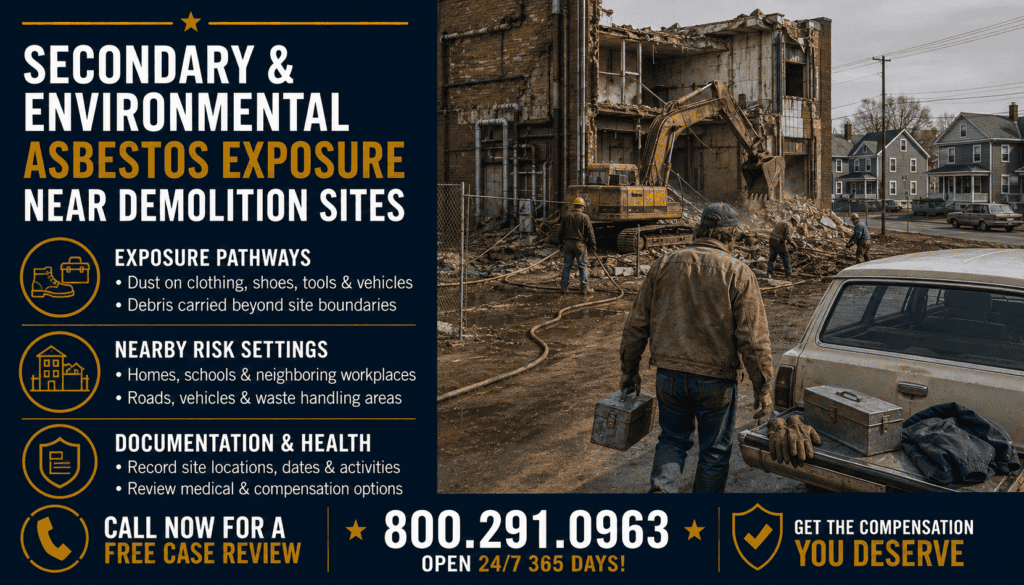
🌬️ Secondary & Environmental Asbestos Exposure Near Demolition Sites
Nearby workers, residents, pedestrians, and family members were exposed to asbestos through airborne dust from demolition sites and contaminated clothing, vehicles, and equipment.
Asbestos exposure from demolition was not limited to workers on site. When older buildings, factories, bridges, and public structures were torn down, asbestos fibers were released into the air and carried by wind, traffic, and daily activity. These microscopic fibers traveled far beyond the demolition zone, exposing surrounding neighborhoods, businesses, schools, and families who had no idea they were being put at risk.
In many cases, people were exposed simply by living, working, or passing near a demolition site—or by coming into contact with workers who unknowingly brought asbestos dust home.
🧱 How Asbestos Spread Beyond Demolition Sites
Asbestos fibers escaped demolition zones through:
🌬️ Wind & Air Currents
Outdoor demolition allowed wind to carry fibers across streets, blocks, and neighborhoods.
🚗 Traffic & Equipment Movement
Vehicles driving through dusty areas stirred asbestos into the air and carried it on tires and surfaces.
🏢 Building Ventilation Systems
Nearby offices, stores, and apartments pulled asbestos dust inside through open doors and HVAC systems.
👕 Contaminated Clothing
Workers brought asbestos fibers home on clothes, boots, hair, and tools.
🚪 Settled Dust
Fibers settled on sidewalks, cars, lawns, playgrounds, and porches and became airborne again when disturbed.
This created exposure pathways far beyond the original job site.
👥 Who Was Affected by Secondary & Environmental Exposure
Secondary and environmental asbestos exposure affected:
🏠 Nearby Residents
People living near demolition sites inhaled drifting asbestos dust.
🏢 Local Workers & Businesses
Office staff, retail workers, and restaurant employees near demolition zones were exposed.
🚶 Pedestrians & Commuters
People walking, biking, or driving through demolition areas inhaled airborne fibers.
🧒 Children & Schools
Dust settled on playgrounds, yards, and school grounds near demolition projects.
👨👩👧 Family Members of Workers
Spouses and children inhaled asbestos from contaminated clothing and vehicles.
Many of these individuals never knew asbestos was present.
⚠️ How Secondary Exposure Occurred
Secondary exposure happened through:
👕 Take-Home Exposure
Dust on clothing and shoes contaminated homes, furniture, and laundry areas.
🧼 Household Cleaning
Sweeping and vacuuming asbestos-contaminated dust re-aerosolized fibers.
🚪 Open Windows & Doors
Homes and businesses near demolition sites pulled dust inside.
🌳 Outdoor Play
Children played in yards or parks where asbestos dust had settled.
🚗 Shared Vehicles
Cars used to commute from demolition sites became contaminated.
This meant entire households could be exposed even if only one person worked near demolition.
🌫️ Why Environmental Exposure Was Dangerous
-
Fibers were invisible and odorless
-
People had no warning or protection
-
Exposure could happen daily over long periods
-
Dust settled and became airborne again
-
Children and elderly were especially vulnerable
Many people did not learn they were exposed until decades later.
🫁 Health Risks from Secondary & Environmental Exposure
Inhaling asbestos fibers—even indirectly—can cause:
🧠 Mesothelioma
A rare cancer of the lung, abdominal, or heart lining.
🫁 Lung Cancer
Risk increases with any asbestos exposure.
🫁 Asbestosis
Permanent lung scarring and breathing problems.
🫁 Other Cancers
Including throat, ovarian, and digestive cancers.
Symptoms often appear 20–50 years after exposure.
📋 Common Exposure Scenarios
-
A child plays outside near a demolition site.
-
Wind carries dust into nearby homes.
-
A spouse washes contaminated work clothes.
-
A worker’s car fills with asbestos dust.
-
Office workers breathe dust from nearby demolition.
❓ Frequently Asked Questions (FAQs)
1. Can you get mesothelioma without working in demolition?
Yes. Many people were exposed environmentally or secondhand.
2. Was take-home exposure common?
Yes. It affected thousands of families of construction and demolition workers.
3. Could children be exposed?
Yes. Dust settled on playgrounds, yards, and schools.
4. Is brief exposure dangerous?
Yes. Even short-term exposure can increase disease risk.
5. Is there any safe asbestos exposure level?
No.
⚖️ How a Lawyer Can Help After Secondary Exposure
If you were exposed environmentally or through a family member, a lawyer can:
🧾 Investigate Exposure
Identify job sites, dates, and contamination paths.
🏭 Identify Responsible Parties
Manufacturers, contractors, property owners, and employers.
📁 File Claims
Lawsuits, trust fund claims, or wrongful death cases.
💰 Seek Compensation
For medical bills, lost income, pain, and suffering.
👨👩👧 Support Families
File claims for loved ones.
📞 Free Case Evaluation – Get Help Today
If you or a loved one was exposed to asbestos from demolition sites—directly or indirectly—and later developed mesothelioma or another asbestos-related illness, help is available.
📞 Call Now for a FREE Case Evaluation: 800-291-0963
📌 Key Takeaways
-
Demolition dust exposed entire communities.
-
Wind and clothing spread asbestos fibers.
-
Families and children were affected.
-
Diseases appear decades later.
-
Legal options exist for compensation.