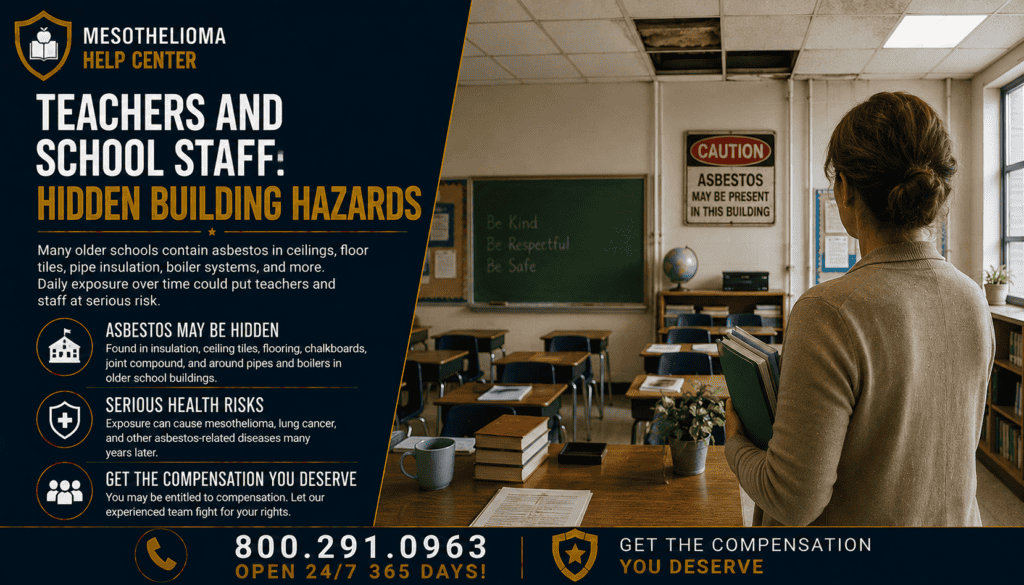
🧑🏫 Teachers & School Staff Hidden Asbestos Building Hazards
Teachers and school employees can spend years or decades in classrooms, offices, libraries, gymnasiums and other school spaces. In some older school buildings, asbestos-containing materials may have been installed in flooring, ceilings, insulation, mechanical systems, roofing and other building components.
Employment in an older school does not by itself prove asbestos exposure. EPA explains that undamaged asbestos-containing material that is properly managed in place generally presents little health risk to school occupants. A concern can arise when asbestos-containing material is damaged or disturbed and fibers become airborne.
For a historical exposure investigation, the goal is to connect a specific employee, school, building area, date, activity or renovation project and asbestos-containing material.
This page is part of the Educational Buildings Asbestos Exposure hub. See also School Buildings Asbestos Exposure for a broader building-focused review.
📍 School Areas and Building Systems to Investigate
School employees may work in many areas over a long career. Each location can have a different construction and renovation history.
🏫 Classrooms
Historical flooring, ceiling systems, wall materials and renovation work may warrant investigation depending on the building and era.
📚 Libraries and Media Centers
Library renovations may involve floors, ceilings, lighting and mechanical systems. See Library Buildings Asbestos Exposure.
🏀 Gymnasiums and Assembly Areas
Large school spaces may have distinctive ceiling, roofing, mechanical and surfacing systems that should be evaluated from actual building records.
⚙️ Boiler Rooms and Mechanical Areas
Maintenance and custodial employees may work around heating equipment, piping, valves and other mechanical components. EPA’s school asbestos rules specifically address asbestos-containing materials in routine maintenance areas.
🛠️ Maintenance and Storage Facilities
EPA states that school-system maintenance, storage or utility facilities essential to school operations can fall within AHERA’s definition of a school building. These areas should not automatically be excluded from an exposure history.
🏢 Administrative Offices and Staff Areas
Offices, lounges and administrative areas may undergo repeated remodeling, flooring replacement or above-ceiling work.
👷 Which School Employees May Have Had Exposure Opportunities?
Potential exposure varies substantially by duties. A teacher working in a finished classroom should not be treated as having the same exposure circumstances as a custodian or maintenance employee who directly disturbed building materials.
- Teachers — potential exposure may require evidence of damaged or disturbed material in or near classrooms and work areas.
- Custodians — duties may include cleaning, floor work and routine activities near building materials.
- Maintenance workers — may repair ceilings, walls, pipes, boilers and mechanical systems.
- School engineers — may work in boiler rooms and utility areas.
- Administrators and office staff — potential exposure generally depends on nearby disturbance or building conditions.
- Library and media-center staff — may have worked through renovation or modernization projects.
- Food-service workers — kitchen and cafeteria remodeling may involve plumbing, flooring, ceilings and mechanical systems.
- Outside contractors — electricians, plumbers, HVAC technicians, roofers and construction trades may directly disturb installed materials.
For broader occupational information, see High-Risk Jobs for Asbestos Exposure.
📋 AHERA Management Plans, Notices and School Records
EPA states that the Asbestos Hazard Emergency Response Act (AHERA) and its regulations require covered public school districts and nonprofit schools to inspect school buildings for asbestos-containing building material, develop and maintain asbestos management plans and take action to prevent or reduce asbestos hazards.
These requirements can provide unusually useful historical records for an exposure investigation. EPA says covered schools must re-inspect asbestos-containing material every three years and conduct periodic surveillance of known or suspected asbestos-containing building material. EPA guidance describes the periodic surveillance interval as every six months.
📄 Teachers and Employees Can Inspect the Management Plan
EPA states that parents, teachers and school employees, or their representatives, have the right to inspect a school’s asbestos management plan. Schools must make the plan available for inspection within five working days after a request.
📣 Annual Asbestos Notifications
Covered schools must provide annual notification to parent, teacher and employee organizations concerning the availability of the asbestos management plan and asbestos-related actions taken or planned.
🗺️ What the Management Plan May Reveal
EPA describes management-plan records that can include the school building, types and locations of asbestos-containing building materials, inspections and reinspections, response actions, periodic surveillance, analysis information and steps taken to inform workers, teachers and students or guardians.
See Asbestos in Schools & Public Buildings for additional AHERA and public-building information.
🔨 Renovation, Maintenance and Custodial Work
Renovation and maintenance are important because asbestos risk depends heavily on whether asbestos-containing material was disturbed. OSHA’s asbestos construction standard applies to work including demolition, removal or encapsulation, construction, alteration, repair, maintenance and renovation involving asbestos.
EPA also requires covered schools to provide asbestos-awareness training to custodial and maintenance employees. Current EPA guidance states that maintenance and custodial staff who may work in a building containing asbestos-containing building material must receive at least two hours of asbestos-awareness training, with additional training for staff whose activities will disturb asbestos-containing building material.
When reconstructing a teacher or staff member’s exposure history, investigate projects such as:
- Summer classroom renovations.
- Flooring removal and replacement.
- Ceiling and lighting work.
- Electrical and communications upgrades.
- Boiler and pipe repairs.
- HVAC replacement.
- Roofing work.
- Building additions and demolition.
See Historic Building Renovation Job Sites Asbestos Exposure for additional investigation strategies.
📂 How to Document a Teacher or School Employee Exposure History
A useful reconstruction moves beyond “I taught in an old school” toward:
Person → School → Building/Room → Job or Activity → Material → Disturbance → Date
- List every school and the years worked there.
- Identify classrooms, offices and other routine work areas.
- Record the employee’s position and duties.
- Identify major renovations and maintenance projects.
- Request or locate the school’s asbestos management plan when applicable.
- Review inspection, reinspection and periodic-surveillance records.
- Look for abatement and response-action documents.
- Identify contractors and trades performing nearby work.
- Locate facilities work orders, plans and project records.
- Identify coworkers, custodians, maintenance staff or administrators who remember the conditions.
These records can help distinguish a general concern about an older school from a documented exposure pathway involving a particular material and disturbance event.
See Steps to Prove Asbestos Exposure in Older Buildings for a broader evidence framework.
🫁 Health Risks and Potential Legal Options
Asbestos exposure is associated with serious diseases including mesothelioma, asbestos-related lung cancer and asbestosis. These diseases can be diagnosed many years after exposure.
A diagnosis does not establish that a particular school caused the exposure. A complete investigation may need to examine other employers, buildings, construction projects, products, military service and household or residential exposure sources.
When evidence connects exposure to identifiable asbestos-containing products or potentially responsible companies, legal options may be investigated. See Mesothelioma Lawsuit and Asbestos Exposure Lawsuit for additional information.
Compensation is not guaranteed and depends on the facts, applicable law and filing deadlines.
❓ Teachers & School Staff Asbestos Exposure Questions
Can teachers be exposed to asbestos in school buildings?
Potentially. Exposure requires a pathway by which asbestos fibers became airborne and were inhaled. Working in an older school alone does not establish exposure.
Is asbestos in a school automatically dangerous?
No. EPA states that undamaged asbestos-containing material properly managed in place generally presents little health risk. The concern increases when material is damaged or disturbed.
Can teachers inspect a school’s asbestos management plan?
Yes. EPA states that parents, teachers and school employees, or their representatives, have the right to inspect the plan, and it must be made available within five working days after a request.
How often are covered schools required to reinspect asbestos-containing materials?
EPA states that covered schools must reinspect asbestos-containing material every three years and perform periodic surveillance of known or suspected asbestos-containing building material.
Do school custodians receive asbestos-awareness training?
Covered schools have training requirements for custodial and maintenance staff. EPA states that employees who may work in buildings containing asbestos-containing building material must receive asbestos-awareness training, with additional training when their work will disturb those materials.
What school records can help reconstruct historical exposure?
Asbestos management plans, inspection and reinspection reports, surveillance records, response-action and abatement documents, building plans, work orders and contractor records can be useful.
What if a teacher worked at several schools?
Each school should be evaluated separately because building age, asbestos records, renovations and work areas can differ substantially.
🚀 Turn a School Career Into a Clear Exposure Record
📞 Review the Schools, Work Areas, Renovations and Asbestos Records
If you or a loved one worked as a teacher or school employee and later developed mesothelioma or asbestos-related lung cancer, a focused review can help identify possible exposure sources and surviving records.
- Schools — school names, buildings, classrooms and employment dates.
- Work — job title, duties, maintenance activity and renovation projects.
- Exposure — damaged or disturbed insulation, flooring, ceilings and mechanical systems.
- Evidence — AHERA management plans, inspections, work orders, abatement files and witnesses.
Call 800.291.0963 now, use live chat 24/7/365, or Submit Your Case for a free, confidential case review.
Compensation is not guaranteed. Potential legal options depend on the diagnosis, exposure evidence, potentially responsible parties, applicable law and filing deadlines.
⚕️ Legal & Medical Information Disclaimer
This page provides general educational information and is not legal or medical advice. Working as a teacher or school employee does not by itself prove asbestos exposure, disease causation, legal liability or eligibility for compensation.