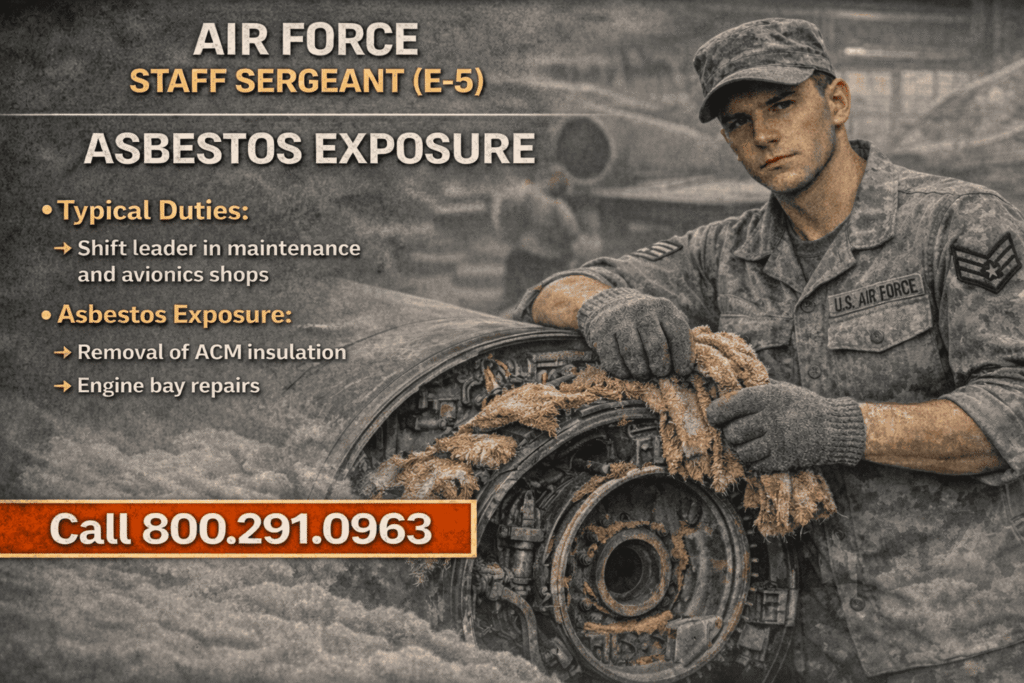
⚠️ E-5 — Staff Sergeant (SSgt) Asbestos Exposure
Risks in Maintenance Leadership, Engine Systems, and Hangar Operations
Staff Sergeant (E-5) is the first true Non-Commissioned Officer (NCO) rank in the U.S. Air Force. SSgts serve as technical leaders and shop supervisors while continuing to perform hands-on maintenance. They oversee aircraft repairs, propulsion systems work, avionics troubleshooting, electrical systems servicing, and brake assembly operations. From the 1940s through the late 1980s, these responsibilities placed Staff Sergeants in direct contact with asbestos-containing materials (ACM) throughout aircraft, hangars, and base facilities.
Asbestos exposure for SSgts occurred in:
Aircraft brake systems and friction components
Engine gaskets and high-temperature seals
Turbine and combustion chamber insulation
Electrical wiring insulation and panels
Afterburner heat shielding
Hangar wall and ceiling insulation
Steam pipe and duct insulation
Boiler room insulation systems
Fireproofing in maintenance shops
Ground support equipment containing ACM
Because SSgts both supervised and physically assisted in maintenance tasks, they experienced repeated, long-term exposure during high-risk repair operations.
🛠️ Typical Duties of a Staff Sergeant (E-5 SSgt)
As frontline supervisors, SSgts split their time between directing junior Airmen and performing technical repair work themselves. Their duties frequently required entering confined aircraft spaces and aging hangars containing asbestos materials.
Typical SSgt responsibilities include:
Supervising aircraft structural and propulsion teams
Assisting with turbine removal and engine tear-downs
Overseeing brake assembly replacements
Directing gasket and seal replacements
Inspecting afterburner and combustion chambers
Troubleshooting avionics systems in insulated bays
Coordinating electrical wiring repairs
Managing Aerospace Ground Equipment servicing
Conducting hangar safety inspections
Performing quality control on high-heat repairs
Overseeing cleanup of maintenance debris
Working inside pre-1990 hangars built with heavy ACM
SSgts were often present during the most dust-intensive repair operations, increasing cumulative exposure.
🧱 Asbestos Exposure Risks for Staff Sergeants
Aircraft Brake Systems
Aircraft brake assemblies were one of the highest-concentration asbestos sources in the Air Force.
Before the early 1990s, aircraft commonly used asbestos in:
Brake pads
Brake linings
Clutch assemblies
Friction discs
Heat-resistant brake housings
Wheel braking systems
When SSgts supervised or assisted with brake maintenance, fibers were released during:
Grinding
Sanding
Compressed air blow-outs
Component wiping
Floor cleanup after servicing
Brake changes created airborne dust clouds — one of the most documented asbestos exposure sources in military aviation.
Gaskets, Seals, and High-Temperature Components
Staff Sergeants frequently inspected and approved gasket and seal replacements throughout engine systems.
These asbestos-containing parts were designed to withstand:
Extreme heat
High pressure
Fuel and hydraulic exposure
Constant vibration
Common asbestos components included:
Engine manifold gaskets
Exhaust system seals
Turbine access gaskets
Heat-resistant insulation sheets
Afterburner seals
Electrical bulkhead insulation
Removal required scraping, prying, and cutting — processes that released microscopic fibers directly into breathing zones.
Turbine and Combustion Chamber Insulation
Turbine systems contained some of the heaviest asbestos concentrations in military aircraft:
Combustion chamber insulation
Turbine casing blankets
Afterburner shielding panels
Heat barrier wraps
ACM-lined clamps and brackets
Heat cycles caused these materials to:
Crack
Flake
Become brittle
Release fibers when disturbed
SSgts overseeing engine inspections were exposed each time an engine housing was opened or insulation was removed.
✈️ Why E-5 Staff Sergeants Face High Exposure Risk
Staff Sergeants often have extensive asbestos exposure because they:
Supervise high-heat engine repairs
Remain present during brake servicing
Assist with turbine tear-downs
Approve gasket and seal replacements
Work long shifts inside enclosed hangars
Handle older aircraft with legacy materials
Direct cleanup of asbestos debris
Inspect and reopen insulated compartments
Unlike lower ranks, SSgts accumulate exposure over longer service periods while maintaining hands-on involvement.
🧩 Common Asbestos-Containing Materials Encountered by SSgts
Aircraft Systems
Brake assemblies
Engine gaskets
Turbine insulation blankets
Electrical insulation boards
Fireproof avionics panels
Asbestos-wrapped wiring bundles
Hangar Infrastructure
Pipe and steam insulation
Fireproof beam coatings
Ceiling insulation panels
Boiler system insulation
Vinyl floor tile and adhesives
Aerospace Ground Equipment (AGE)
Generator insulation
Heater units
Air-start equipment
Tow vehicle brake systems
Electrical housings containing ACM
Disturbing any of these materials released airborne fibers capable of being inhaled.
📈 Why E-5 Asbestos Claims Are Strong
SSgt claims are highly supportable because:
NCOs supervise documented ACM removal
Maintenance logs confirm direct involvement
Aircraft specifications list asbestos components
Hangar construction records verify insulation use
Brake system asbestos use is historically proven
Exposure duration is often extensive
This documentation strengthens VA disability and civil claims.
📊 How E-5 Exposure Is Proven for VA Disability and Legal Cases
Airmen do not need to recall specific part numbers.
Exposure is established through:
AFSC specialty codes
Aircraft Technical Orders (TOs)
Maintenance logs
Base construction records
Environmental hazard reports
Brake system manuals
Engine insulation specifications
Witness statements
This evidence establishes a clear exposure timeline accepted by VA and asbestos trust systems.
📚 Real Examples of E-5 Staff Sergeant Exposure Cases
Case 1 — SSgt Propulsion Specialist
Exposure: Turbine insulation shielding
Compensation: $3.2 million
Case 2 — SSgt Flightline Supervisor
Exposure: Brake assembly dust
Compensation: $3.4 million
Case 3 — SSgt Avionics NCO
Exposure: Electrical insulation materials
Compensation: $2.8 million
Case 4 — SSgt Maintenance Controller
Exposure: Hangar insulation and engine gaskets
Compensation: $3.1 million
🧭 How E-5 Staff Sergeants Demonstrate Exposure Today
Exposure is supported through:
Duty station assignments
Aircraft models serviced
Shop leadership roles
Hangar construction age
Engine maintenance histories
AGE servicing records
Brake repair documentation
Official records provide strong confirmation even decades later.
💙 Benefits Available to E-5 Staff Sergeants
VA Disability Benefits
Mesothelioma = 100% disability rating
Lung cancer often qualifies
Asbestos Trust Funds
Over $30 billion remains available.
Legal Compensation
Filed against manufacturers, not the Air Force.
VA DIC for Families
Survivors may receive tax-free monthly benefits.
❓ Frequently Asked Questions — E-5 SSgt Asbestos Exposure
Did aircraft engines contain asbestos?
Yes — turbine and combustion systems used heavy insulation.
Were brake systems dangerous?
Extremely — brake dust is one of the strongest documented exposure sources.
Do supervisors qualify for claims?
Yes — being present and directing removal qualifies as exposure.
Can families file after death?
Yes — DIC and trust fund claims remain available.
🏅 Why Staff Sergeants Trust Mesothelioma Help Center
25+ years documenting USAF asbestos exposure
Access to aircraft manuals and technical data
Specialists trained in propulsion and avionics systems
Millions recovered for Air Force veterans
No fees unless compensation is awarded
📞 Get Help Identifying Your Asbestos Exposure as an E-5 Staff Sergeant
If you or a loved one served as a Staff Sergeant and developed mesothelioma or asbestos-related lung cancer, specialists can identify the aircraft systems and materials responsible.
📞 Call 800.291.0963 for a free exposure review.