Army Bases Asbestos Exposure
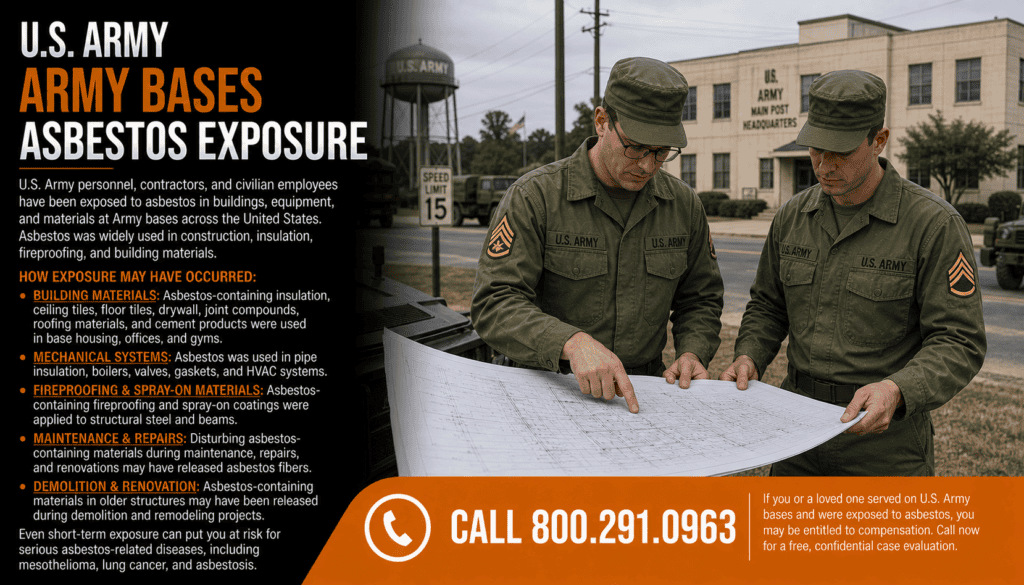
Army bases have served as the backbone of the U.S. Army for more than a century, providing housing, training, maintenance, logistics, medical care, aviation support, and deployment operations for millions of soldiers. During much of the twentieth century, asbestos was extensively used throughout Army installations because it resisted heat, fire, moisture, chemicals, and electrical hazards. Although these materials were intended to improve safety and durability, many later proved hazardous when damaged, repaired, renovated, or removed.
Thousands of Army veterans may have encountered asbestos while living in barracks, maintaining vehicles in motor pools, repairing equipment in maintenance shops, training on military installations, working in power plants, handling supplies in warehouses, or serving in medical facilities. Exposure was not limited to mechanics or construction workers. Infantry soldiers, engineers, electricians, firefighters, medics, aviation personnel, and administrative staff often worked in older buildings containing asbestos insulation, flooring, pipe coverings, roofing materials, boilers, and electrical equipment.
Family members living in military housing may also have experienced exposure through deteriorating building materials or asbestos fibers carried home on uniforms, boots, and work clothing.
If you or a loved one developed mesothelioma, asbestos-related lung cancer, asbestosis, or another asbestos disease after Army service, documenting where you lived and worked on Army installations may help identify potential sources of exposure.
Call 800.291.0963 to discuss Army base asbestos exposure, military records, VA benefits, and potential legal options.
🪖 What You’ll Learn
This guide explains:
- Why asbestos was widely used on Army bases
- The types of Army installations where asbestos was commonly found
- Buildings and facilities that presented higher exposure risks
- Occupations that frequently worked around asbestos
- How family members could experience secondhand exposure
- Diseases associated with asbestos exposure
- VA benefits available to eligible veterans
- Legal options involving asbestos manufacturers
- Army records that may help document exposure
Throughout this guide you’ll also find links to detailed pages covering specific Army facilities, occupations, equipment, housing, and legal topics.
🏗️ Why Asbestos Was Used on Army Bases
From World War II through much of the late twentieth century, asbestos was considered an essential construction material throughout military installations. Army bases required buildings capable of withstanding heavy use, harsh climates, fire hazards, and constant maintenance.
Because of these demands, asbestos was incorporated into thousands of military construction products.
Common reasons asbestos was used included:
- Fire resistance
- Thermal insulation
- Electrical insulation
- Moisture resistance
- Chemical resistance
- Low manufacturing cost
- Long service life
- Sound reduction
- Structural durability
Army engineers, architects, and contractors routinely specified asbestos-containing materials in barracks, hospitals, warehouses, motor pools, maintenance shops, training buildings, utility systems, and family housing.
Although these materials often remained relatively stable when undisturbed, maintenance, remodeling, demolition, aging, and deterioration could release microscopic asbestos fibers into the air.
🏕️ Types of Army Installations
The Army operates a wide variety of installations that support combat readiness, logistics, training, healthcare, aviation, communications, engineering, and family services.
Potential asbestos exposure could occur at:
- Large Army bases
- Army posts
- Army forts
- Training centers
- Airfields
- Aviation facilities
- Ammunition depots
- Warehouses
- Motor pools
- Maintenance facilities
- Medical centers
- Barracks
- Family housing
- Administrative buildings
- Engineering facilities
- Power plants
- Utility buildings
- Overseas installations
- National Guard facilities
- Reserve centers
Each installation contained its own combination of buildings, utility systems, industrial equipment, and maintenance operations.
Veterans often served at multiple Army bases throughout their careers, increasing opportunities for exposure.
🏢 Common Army Buildings That Contained Asbestos
Many Army buildings constructed before the widespread regulation of asbestos incorporated asbestos into numerous construction products.
Potential asbestos-containing materials included:
- Pipe insulation
- Boiler insulation
- HVAC insulation
- Roof shingles
- Roofing felt
- Vinyl floor tile
- Floor adhesives
- Ceiling tiles
- Joint compound
- Drywall systems
- Cement siding
- Fire doors
- Fireproof wall panels
- Acoustic insulation
- Electrical insulation
- Spray-applied fireproofing
- Pipe gaskets
- Valve packing
- Mechanical insulation
Personnel working inside these buildings were not always exposed.
The greatest risks generally occurred when asbestos-containing materials were damaged, repaired, drilled, cut, sanded, removed, or deteriorated with age.
⚠️ How Asbestos Exposure Occurred on Army Bases
Asbestos fibers were generally released when asbestos-containing materials became disturbed.
Examples include:
- Building renovations
- Demolition projects
- Pipe repairs
- Boiler maintenance
- HVAC replacement
- Electrical upgrades
- Roofing repairs
- Flooring replacement
- Plumbing repairs
- Vehicle maintenance
- Equipment rebuilding
- Fire damage
- Water damage
- Utility work
Construction workers were not the only people at risk.
Dust generated during renovation could travel through ventilation systems, hallways, utility tunnels, and adjoining work areas.
Personnel working nearby may have inhaled fibers even though they never handled asbestos directly.
🏠 Army Barracks and Living Quarters
Millions of soldiers have lived in Army barracks during training and active service.
Older barracks frequently contained asbestos in:
- Ceiling systems
- Pipe insulation
- Floor tile
- Heating systems
- Roofing materials
- Cement products
- Utility tunnels
- Mechanical rooms
- Boiler systems
- Fireproof construction materials
Veterans can learn more on the dedicated Army Barracks Asbestos Exposure page.
Large renovation projects involving barracks often disturbed aging building materials.
Personnel living nearby may have been exposed during maintenance, remodeling, or demolition activities.
🏡 Army Base Housing
Military family housing represented another potential source of exposure.
Older Army housing could contain asbestos in:
- Vinyl flooring
- Ceiling texture
- Pipe insulation
- Heating systems
- Roofing
- Exterior siding
- Wallboard
- Joint compound
- Insulation
- Utility systems
Children and spouses living in military housing generally had no reason to suspect asbestos hazards.
Veterans and families can explore:
- Army Base Housing Asbestos Exposure
- Army Dependent Housing Asbestos Exposure
- Army Barracks & Base Housing Asbestos Exposure
for more detailed information.
🎯 Major Army Installations
Large Army installations often contained hundreds or even thousands of buildings constructed over many decades.
These installations frequently included:
- Barracks
- Family housing
- Motor pools
- Warehouses
- Training facilities
- Airfields
- Medical centers
- Administrative offices
- Maintenance facilities
- Utility systems
- Communications buildings
- Engineering facilities
The dedicated Major Army Installations Asbestos Exposure page explores how exposure risks varied among major Army bases.
Rather than one building, many installations functioned as entire communities containing numerous potential asbestos sources.
🪖 Army Training Facilities
Training installations exposed soldiers to many different environments.
Potential asbestos-containing structures included:
- Classrooms
- Barracks
- Obstacle course buildings
- Maintenance shops
- Weapons storage
- Utility buildings
- Vehicle maintenance areas
- Training towers
- Boiler rooms
Training itself did not necessarily expose soldiers to asbestos.
However, older facilities undergoing repairs or modernization could disturb asbestos-containing building materials.
The Army Training Facilities Asbestos Exposure and Army Training Camps Asbestos Exposure pages provide more detailed information about these environments.
✈️ Army Airfields
Army aviation installations included:
- Hangars
- Maintenance buildings
- Control facilities
- Fuel systems
- Utility buildings
- Storage structures
- Fire stations
- Aircraft maintenance shops
Potential asbestos sources included insulation, roofing, pipe systems, boilers, electrical equipment, and aircraft maintenance materials.
The Army Airfields Asbestos Exposure page examines these aviation environments in greater detail.
🚚 Motor Pools and Maintenance Buildings
Motor pools represented one of the most significant industrial areas on many Army bases.
Personnel maintained:
- Trucks
- Jeeps
- Tanks
- Armored vehicles
- Recovery vehicles
- Engineering equipment
- Generators
- Heavy machinery
Potential asbestos products included:
- Brakes
- Clutches
- Gaskets
- Insulation
- Packing
- Electrical components
- Heat shields
The following detailed pages provide additional information:
- Army Motor Pools Asbestos Exposure
- Army Maintenance Buildings Asbestos Exposure
Mechanics, electricians, welders, heavy equipment operators, and maintenance workers frequently performed repairs capable of disturbing asbestos-containing components.
⚡ Utility and Industrial Facilities
Many Army bases operated their own utility systems.
Potential exposure locations included:
- Power plants
- Boiler plants
- Steam systems
- Water treatment facilities
- Pump houses
- Electrical substations
- Utility tunnels
Large utility equipment often incorporated asbestos insulation because of high operating temperatures.
Related pages include:
- Army Power Plants Asbestos Exposure
- Army Boiler Equipment Asbestos Exposure
- Army Generator Equipment Asbestos Exposure
These facilities often required regular maintenance, insulation replacement, and mechanical repairs.
📦 Warehouses and Ammunition Depots
Army warehouses and ammunition storage facilities generally contained fewer heat-producing systems than power plants or maintenance shops, but asbestos was still used in many building materials.
Potential sources included:
- Roofing
- Floor tile
- Insulation
- Pipe coverings
- Heating systems
- Fireproof construction
Learn more from:
- Army Warehouses Asbestos Exposure
- Army Ammunition Depots Asbestos Exposure
These facilities frequently supported logistics operations and long-term equipment storage.
🏥 Army Medical Facilities
Army hospitals and medical facilities often incorporated asbestos into:
- Boilers
- Mechanical rooms
- Pipe insulation
- HVAC systems
- Flooring
- Ceiling systems
- Fireproof construction
Healthcare workers generally did not handle asbestos directly.
However, maintenance work and building renovations could release fibers into occupied areas.
The Army Medical Facilities Asbestos Exposure page examines these risks in more detail.
🌎 Specialized Army Installations
Army personnel also served at specialized installations, including:
- Overseas bases
- Cold-weather installations
- Desert bases
Different climates required different construction methods, but asbestos-containing products remained common throughout much of the twentieth century.
Supporting pages include:
- Army Overseas Bases Asbestos Exposure
- Army Cold Weather Installations Asbestos Exposure
- Army Desert Bases Asbestos Exposure
These facilities often contained the same insulation, utility systems, heating equipment, and construction materials found at domestic installations.
👷 Army Occupations with Higher Asbestos Exposure Risk
Although asbestos was present in many Army buildings, certain occupations experienced substantially greater opportunities for exposure because they routinely repaired, maintained, installed, or removed equipment and building materials.
Higher-risk occupations included:
- Mechanics
- Engineers
- Electricians
- Construction units
- Heavy equipment operators
- Maintenance workers
- Supply personnel
- Firefighters
- Aviation maintenance personnel
- Boiler operators
- Utility workers
- Welders
- Plumbers
- Pipefitters
- HVAC technicians
- Power plant workers
Many of these occupations worked in enclosed maintenance buildings, motor pools, power plants, warehouses, and industrial facilities where asbestos-containing insulation, gaskets, brakes, clutches, pipe coverings, and electrical components were common.
Learn more through:
- Army Mechanics Asbestos Exposure
- Army Engineers Asbestos Exposure
- Army Electricians Asbestos Exposure
- Army Construction Units Asbestos Exposure
- Army Maintenance Workers Asbestos Exposure
- Army Heavy Equipment Operators Asbestos Exposure
- Army Supply Personnel Asbestos Exposure
- Army Firefighters Asbestos Exposure
🚚 Army Mechanics
Army mechanics maintained nearly every type of military vehicle and equipment.
Common repair duties included:
- Brake replacement
- Clutch replacement
- Engine rebuilding
- Generator repairs
- Cooling system repairs
- Fuel system maintenance
- Hydraulic repairs
- Transmission rebuilding
- Gasket replacement
Many older replacement parts contained asbestos.
Mechanics frequently removed worn brake linings, scraped old gaskets, cleaned clutch housings, and replaced insulation around engines and exhaust systems.
Dust generated during these repairs could remain suspended in enclosed maintenance shops for extended periods.
🏗️ Army Engineers and Construction Units
Army engineers helped construct, repair, renovate, and demolish military facilities around the world.
Construction activities that may have disturbed asbestos included:
- Demolition
- Remodeling
- Roofing
- Plumbing
- Electrical work
- HVAC replacement
- Concrete cutting
- Utility repairs
- Bridge construction
- Building rehabilitation
Engineers often worked on older structures built before asbestos regulations changed.
Asbestos insulation, floor tile, roofing materials, pipe coverings, and cement products could all become airborne during renovation.
⚡ Army Electricians
Electrical personnel maintained:
- Switchgear
- Electrical panels
- Generators
- Wiring
- Motors
- Transformers
- Communications systems
Older electrical equipment frequently incorporated asbestos because it resisted both electricity and heat.
Electricians might disturb asbestos while:
- Opening electrical cabinets
- Replacing wiring
- Repairing generators
- Removing electrical insulation
- Rebuilding motors
Many electrical rooms were also located adjacent to boiler rooms, utility tunnels, and mechanical spaces containing additional asbestos materials.
🚜 Heavy Equipment Operators
Heavy equipment operators worked around:
- Bulldozers
- Excavators
- Cranes
- Loaders
- Graders
- Earth-moving equipment
- Construction machinery
Potential asbestos sources included:
- Brake linings
- Clutches
- Engine gaskets
- Exhaust insulation
- Hydraulic systems
- Heat shields
Maintenance personnel servicing this equipment often experienced greater exposure than operators alone.
🔥 Army Firefighters
Firefighters faced two separate asbestos hazards.
The first involved older firefighting equipment that sometimes incorporated asbestos-containing materials.
The second occurred while responding to building fires, aircraft incidents, vehicle fires, or industrial accidents involving damaged asbestos-containing construction products.
Potential exposure sources included:
- Fireproof clothing
- Fire blankets
- Burning insulation
- Pipe coverings
- Roofing materials
- Ceiling systems
- Mechanical rooms
Emergency response following explosions or structural collapse could also disturb asbestos that had remained intact for decades.
📦 Army Supply Personnel
Supply personnel often worked inside:
- Warehouses
- Storage depots
- Distribution centers
- Equipment storage buildings
Although they did not normally repair equipment, they frequently handled:
- Replacement parts
- Crated machinery
- Building supplies
- Vehicle components
- Maintenance materials
Older warehouses themselves could contain asbestos insulation, flooring, roofing, and pipe systems.
✈️ Army Aviation Personnel
Army aviation personnel served in:
- Aircraft maintenance hangars
- Airfields
- Aviation repair facilities
- Fuel systems
- Flight operations buildings
Potential asbestos-containing materials included:
- Aircraft brakes
- Engine insulation
- Fireproof materials
- Electrical insulation
- Hangar construction products
- Boiler systems
- Mechanical rooms
Mechanics generally experienced greater exposure than pilots, although other aviation personnel may also have worked near maintenance activities.
⚙️ Equipment Commonly Found on Army Bases
Many Army installations relied upon industrial equipment that historically incorporated asbestos.
Examples included:
- Boilers
- Generators
- Pumps
- Valves
- HVAC systems
- Electrical equipment
- Compressors
- Heavy machinery
- Welding equipment
- Fuel system equipment
- Water pumps
- Air compressors
- Steam systems
These systems were often insulated to reduce heat loss and prevent fires.
Maintenance frequently required workers to remove asbestos insulation, replace gaskets, or rebuild machinery.
Additional information is available on:
- Army Boiler Equipment Asbestos Exposure
- Army Generator Equipment Asbestos Exposure
- Army Electrical Equipment Asbestos Exposure
- Army HVAC Equipment Asbestos Exposure
- Army Heavy Machinery Asbestos Exposure
- Army Welding Equipment Asbestos Exposure
- Army Fuel System Equipment Asbestos Exposure
🏗️ Why Army Bases Presented Long-Term Exposure Risks
Unlike civilian construction sites, Army bases remained active for decades.
Buildings constructed during World War II often continued operating through Korea, Vietnam, the Cold War, Desert Storm, Iraq, and Afghanistan.
As facilities aged, repeated renovations disturbed older asbestos-containing materials.
Exposure could occur during:
- Maintenance
- Utility upgrades
- Pipe replacement
- HVAC modernization
- Roof replacement
- Flooring removal
- Building demolition
- Fire restoration
- Water damage repairs
Veterans serving many years apart could therefore encounter asbestos at the same installation.
👨👩👧 Family Members and Household Exposure
Army families sometimes encountered asbestos through two primary pathways.
Military Housing
Older military housing could contain asbestos in:
- Floor tile
- Ceiling systems
- Pipe insulation
- Roofing
- Heating systems
- Cement siding
Renovations or deterioration could release fibers into occupied homes.
Take-Home Exposure
Workers who repaired vehicles, boilers, generators, or construction materials sometimes carried asbestos dust home on:
- Uniforms
- Boots
- Gloves
- Jackets
- Tool bags
- Vehicle interiors
Spouses washing uniforms and children living in contaminated homes could unknowingly inhale asbestos fibers over many years.
🫁 Diseases Associated with Army Base Asbestos Exposure
Asbestos exposure has been associated with several serious diseases.
Mesothelioma
Mesothelioma is a rare cancer affecting the lining surrounding the lungs, abdomen, heart, or testes.
Most cases are linked to asbestos exposure.
Asbestos-Related Lung Cancer
Long-term asbestos exposure can increase lung cancer risk.
Smoking further increases the risk, although smoking does not cause mesothelioma.
Asbestosis
Asbestosis is permanent lung scarring caused by inhaling asbestos fibers.
Symptoms may include:
- Shortness of breath
- Persistent cough
- Chest tightness
- Reduced exercise tolerance
Pleural Disease
Asbestos may also contribute to:
- Pleural plaques
- Pleural thickening
- Pleural effusions
These conditions affect the lining surrounding the lungs and may reduce breathing capacity.
⚠️ Symptoms Army Veterans Should Discuss With Their Doctor
Many asbestos diseases develop slowly over several decades.
Veterans should seek medical evaluation for persistent symptoms such as:
- Shortness of breath
- Chest pain
- Persistent cough
- Fatigue
- Weight loss
- Difficulty swallowing
- Fluid around the lungs
- Abdominal swelling
- Unexplained abdominal pain
Veterans should always tell their healthcare provider about:
- Army service
- Base assignments
- Occupational specialty
- Building maintenance work
- Vehicle maintenance
- Construction duties
- Boiler work
- Utility work
- Known asbestos exposure
A complete military exposure history can assist physicians when determining appropriate testing and treatment.
📁 Army Records That Can Help Document Asbestos Exposure
Many Army veterans cannot remember the exact building, product, or manufacturer responsible for their asbestos exposure. Fortunately, military records often help reconstruct a veteran’s service history and identify where exposure may have occurred.
Useful records include:
- DD Form 214
- Official Military Personnel File (OMPF)
- Duty station records
- Permanent Change of Station (PCS) orders
- Unit assignment records
- Military Occupational Specialty (MOS) records
- Performance evaluations
- Training records
- Engineering records
- Base construction records
- Maintenance logs
- Vehicle maintenance records
- Equipment maintenance records
- Army Corps of Engineers documents
- Medical records
- VA claim records
Veterans should also create a timeline listing:
- Every Army base where they served
- Barracks where they lived
- Buildings where they worked
- Vehicle maintenance duties
- Construction projects
- Renovation work
- Boiler rooms
- Utility systems
- Motor pools
- Warehouses
- Airfields
- Power plants
Even seemingly minor details may later help identify asbestos-containing products used at a particular installation.
🏭 Identifying Asbestos Manufacturers Used on Army Bases
Army installations purchased construction materials and industrial equipment from hundreds of private manufacturers.
Potential asbestos-containing products included:
- Pipe insulation
- Boiler insulation
- Floor tile
- Ceiling systems
- Cement products
- Roofing materials
- Electrical insulation
- Gaskets
- Packing
- Pumps
- Valves
- Boilers
- Generators
- Compressors
- HVAC equipment
- Fireproofing materials
Veterans usually do not know the names of the manufacturers responsible for these products.
Exposure investigations often rely on:
- Military engineering records
- Construction specifications
- Procurement documents
- Equipment manuals
- Building renovation records
- Witness statements
- Historical product catalogs
Multiple manufacturers may be associated with a single Army installation because buildings were renovated repeatedly over several decades.
🗂️ How Exposure Investigations Are Conducted
Documenting asbestos exposure often involves combining information from several sources.
Investigators may review:
- Service records
- Base assignments
- Occupational specialty
- Unit history
- Building construction dates
- Maintenance records
- Equipment inventories
- Engineering drawings
- Historical procurement records
- Witness statements
- Medical documentation
A veteran does not need to remember every asbestos product used during military service.
Instead, investigators often identify likely exposure sources based upon the veteran’s duties, work environment, and Army installation history.
🎖️ VA Benefits for Army Veterans
Army veterans diagnosed with an asbestos-related disease may qualify for Department of Veterans Affairs benefits when the illness is connected to military service.
Potential benefits include:
- VA Disability Compensation
- VA Health Care
- Dependency and Indemnity Compensation (DIC)
- Survivor benefits
- Special Monthly Compensation
- Aid and Attendance benefits
A successful VA claim generally requires evidence of:
- A diagnosed asbestos-related disease.
- Asbestos exposure during military service.
- A medical opinion linking the illness to that exposure.
Supporting documentation may include service records, occupational history, installation assignments, medical records, and physician opinions.
Veterans can often pursue VA benefits separately from legal claims involving asbestos manufacturers.
⚖️ Legal Options for Army Veterans
Veterans diagnosed with mesothelioma or another asbestos disease may have legal options against manufacturers and suppliers of asbestos-containing products.
Potential claims include:
- Mesothelioma lawsuits
- Lung cancer lawsuits
- Asbestos trust fund claims
- Wrongful death lawsuits
- Product liability claims
These claims generally involve private companies that manufactured or supplied asbestos products—not the U.S. Army or the federal government.
Potential compensation may include:
- Medical expenses
- Lost income
- Future treatment costs
- Pain and suffering
- Travel expenses
- Home care costs
- Funeral expenses
- Family losses
Each case depends on the veteran’s diagnosis, service history, documented exposure, product identification, and applicable filing deadlines.
⏳ Statutes of Limitations
Every state has laws limiting the amount of time available to file an asbestos claim.
These deadlines generally begin after:
- A mesothelioma diagnosis
- Diagnosis of another asbestos-related disease
- Discovery that an illness may be related to asbestos exposure
- The death of a family member from an asbestos disease
Because mesothelioma often develops 20 to 50 years after exposure, filing deadlines usually begin at diagnosis rather than at the time of military service.
Veterans should avoid unnecessary delays because important records and witnesses may become more difficult to locate over time.
👨👩👧 Family Members and Survivor Rights
Spouses and family members may have legal rights if an Army veteran dies from an asbestos-related disease.
Depending on the circumstances, surviving family members may qualify for:
- VA survivor benefits
- Dependency and Indemnity Compensation (DIC)
- Wrongful death lawsuits
- Asbestos trust fund claims
Helpful records include:
- DD Form 214
- Marriage certificate
- Death certificate
- Medical records
- Pathology reports
- Military service records
- Exposure history
- Prior VA decisions
Preserving these records can simplify future claims.
❓ Frequently Asked Questions
Which Army bases contained asbestos?
Many Army installations built before the 1980s contained asbestos in buildings, utility systems, maintenance facilities, barracks, housing, and industrial equipment. The amount and location varied by installation and construction history.
Can soldiers who never repaired buildings still be exposed?
Yes. Personnel working, training, or living near renovation projects, damaged insulation, aging mechanical systems, or maintenance activities may have inhaled asbestos fibers without directly handling asbestos materials.
Can Army family members develop asbestos diseases?
Yes. Some spouses and children experienced secondhand exposure from contaminated work clothing or by living in older military housing where asbestos-containing materials were later disturbed.
Can veterans receive VA benefits and file a lawsuit?
In many situations, yes. VA disability claims and legal claims against asbestos manufacturers are separate processes because lawsuits generally target private companies rather than the military.
Do I need to know exactly which asbestos product exposed me?
No. Military records, engineering documents, witness statements, and historical research often help identify likely asbestos-containing products associated with a veteran’s Army service.
🧠 What You Should Do Next
If you believe you were exposed to asbestos while serving at an Army installation, taking action now may help preserve important evidence.
Recommended steps include:
- Write down every Army base where you served.
- List your Military Occupational Specialty (MOS).
- Record your unit assignments and dates.
- Identify barracks, housing, maintenance shops, motor pools, or other facilities where you worked.
- Gather your DD Form 214 and other military records.
- Obtain copies of medical records and pathology reports.
- Inform your healthcare provider about possible asbestos exposure.
- Review potential VA benefits.
- Explore asbestos trust fund eligibility and legal options.
- Preserve photographs, maintenance records, and witness information whenever possible.
Even if your exposure occurred decades ago, those records may still help establish where and how asbestos exposure happened.
📞 Army Bases Asbestos Exposure Help
For generations, Army bases supported America’s military readiness through housing, training, maintenance, logistics, healthcare, aviation, and engineering operations. Unfortunately, many of those same installations contained asbestos in buildings, utility systems, industrial equipment, and construction materials.
If you or a loved one has been diagnosed with mesothelioma, asbestos-related lung cancer, asbestosis, or another asbestos disease after Army service, documenting your base assignments and occupational history is an important first step.
We can help review:
- Army base assignments
- Military Occupational Specialty (MOS)
- Barracks and housing history
- Maintenance and construction duties
- Motor pool assignments
- Airfield service
- Utility and power plant work
- Medical records
- Military service records
- VA benefit options
- Asbestos trust fund claims
- Mesothelioma and lung cancer legal options
Call 800.291.0963 to discuss Army base asbestos exposure, available records, and potential next steps.