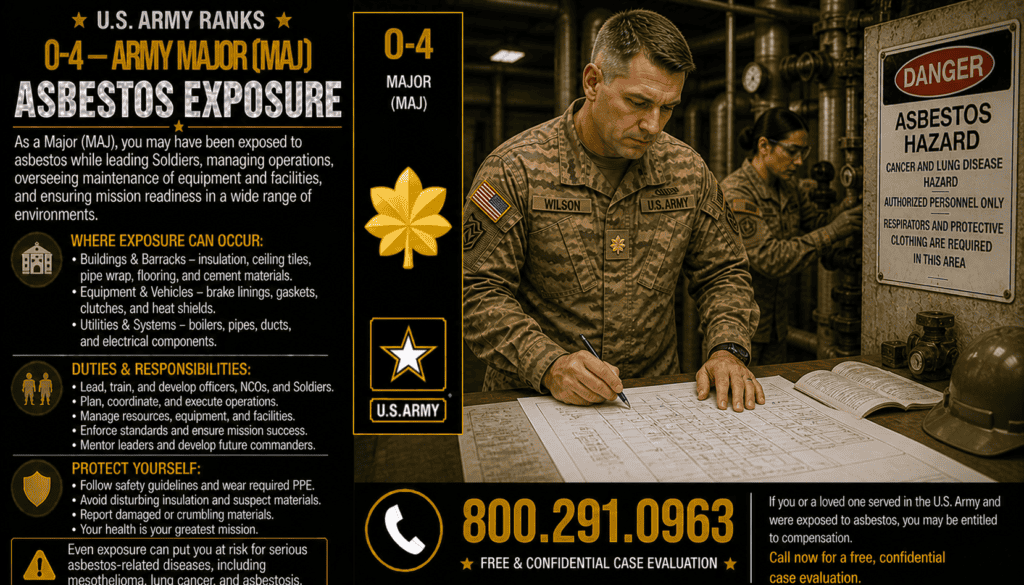
⚠️ O-4 Army Major (MAJ) Asbestos Exposure
Risks for Operations Officers
Army Majors (MAJs) serve as critical mid-level leaders, overseeing operations, planning, logistics, and unit readiness at the battalion and brigade level. While MAJs are not typically engaged in hands-on mechanical work, they spend extensive hours inside headquarters buildings, operations centers, planning rooms, staff wings, and support facilities—many of which were built before 1980 with significant amounts of asbestos-containing materials (ACM).
Asbestos exposure for Majors commonly occurred in:
-
HVAC systems and ductwork above office ceilings
-
Steam lines running through headquarters wings
-
Mechanical and utility rooms that MAJs inspected or walked past
-
Aging staff buildings used for operations briefings
-
Pre-1980 command posts with deteriorating wall and ceiling materials
-
Ventilation systems circulating fibers from damaged insulation
-
Renovation zones inside administrative buildings
Because MAJs work long hours—including evenings, weekends, and wartime operational cycles—these exposures often lasted for years.
Today, many retired Majors are being diagnosed with mesothelioma, asbestos-related lung cancer, and asbestosis, often traced back to their prolonged time in aging Army facilities.
🛠️ Typical Duties of an Army Major (MAJ)
As mid-level field grade officers, Majors serve in both command and staff roles such as:
-
Battalion or brigade Operations Officer (S-3)
-
Executive Officer (XO) at the battalion level
-
Strategic planning and coordination
-
Oversight of training facilities and administrative buildings
-
Supervision of maintenance, readiness, and safety compliance
-
Managing mission planning centers
-
Conducting walkthroughs of command posts and operations facilities
-
Coordinating with engineers and installation managers
-
Leading large staff sections
Because MAJs oversee entire units’ operations, they frequently move among multiple facilities each day—exposing them to HVAC ducts, steam lines, and insulated structural systems throughout the base.
🧱 Asbestos Exposure Risks for Army Majors (MAJs)
HVAC Systems in Headquarters Buildings (Primary Exposure Source)
Most Army staff buildings used HVAC systems insulated with asbestos-containing materials, especially:
-
Duct insulation
-
Air-handler linings
-
Asbestos tape and wrap
-
HVAC joint sealants
-
Mechanical closet insulation
As these systems aged, fibers entered ventilation channels and dispersed throughout:
-
Operations centers
-
Staff meeting rooms
-
Administrative wings
-
Officer planning areas
-
Briefing rooms
-
Map rooms and TOC-style planning spaces
Majors spending long hours inside these buildings inhaled airborne fibers daily.
Old Ductwork in Staff and Admin Facilities
Deteriorating ductwork is one of the least recognized sources of asbestos exposure for officers.
Pre-1980 duct systems often contained:
-
Asbestos-insulated panels
-
Cement board duct barriers
-
Fiberboard ducting
-
High-temperature insulation layers
When ducts were repaired, replaced, or simply aged, asbestos fibers were released into circulating air systems.
Because MAJs frequently:
-
Conducted briefings
-
Maintained long office hours
-
Led operations center activities
-
Coordinated mission plans into the night
They accumulated prolonged, low-level exposure inside these contaminated buildings.
Steam Lines and Heating Systems
Steam lines running through headquarters wings, hallways, utility corridors, mechanical rooms, and basement levels were widely insulated with ACM.
As materials cracked with age, the insulation flaked and released fibers that migrated:
-
Into hallways
-
Through ventilation
-
Across administrative offices
-
Into operations centers
-
Toward briefing and planning rooms
MAJs conducting inspections, coordinating building improvements, or checking readiness in such areas were exposed regularly.
✈️ Why O-4 Majors Were at Higher Risk Than Expected
Even though MAJs were not mechanics or engineers, their exposure risk is significant because:
-
MAJs spend more hours inside offices than junior officers
-
Staff buildings were older and heavily insulated with ACM
-
Operations centers often had poor ventilation
-
Renovations were common during modernization periods
-
Duct repairs frequently occurred while buildings remained occupied
-
Staff briefs and mission planning occurred in older HQ wings
-
War-time cycle operations meant long daily exposure
Many Majors served two or more tours in administrative-heavy assignments, multiplying exposure time.
🧩 Common Asbestos-Containing Materials Encountered by MAJs
Inside Headquarters and Operations Buildings
-
HVAC duct insulation
-
Fireproof ceiling panels
-
Asbestos floor tiles
-
Wallboard and joint compound
-
Pipe insulation
-
Acoustic panels
-
Cement board
-
Boiler room insulation
Inside Utility and Mechanical Spaces
-
Steam pipe lagging
-
High-temperature duct insulation
-
Furnace and boiler wrap
-
Electrical insulation boards
-
Fire-rated wallboard
During Renovation and Construction Periods
-
Ceiling tile demolition
-
Floor tile removal
-
HVAC removal and replacement
-
Office reconfiguration
-
Ductwork replacement
-
Wallboard demolition
MAJs regularly worked in or near these environments.
📈 Why O-4 Exposure Creates Strong VA and Legal Claims
Claims for O-4 officers are strong because:
-
Headquarters buildings were heavily asbestos-based
-
HVAC systems circulated airborne fibers daily
-
Renovations during the 1980s–1990s increased exposure
-
Operations officers often spent 10–14 hours/day in contaminated facilities
-
Officers are documented as being regularly present in staff buildings
-
Exposure occurred over multi-year command cycles
This combination provides clear, traceable, and legally recognized exposure paths.
📊 How O-4 Exposure Is Proven for VA Disability & Legal Claims
Majors do not need asbestos expertise or recollections.
Exposure is proven using:
-
Building construction dates
-
Base environmental surveys
-
HVAC and steam system documentation
-
Renovation records
-
Duty location and service years
-
Battalion and brigade headquarters histories
-
Army engineering records
-
Known ACM inventories
This creates a complete exposure profile without requiring MAJs to identify specific materials.
📚 Real Examples of O-4 Asbestos Exposure Cases
Case 1 — Battalion Operations Officer (S-3)
Exposure: HVAC duct insulation in operations center
Compensation: $3.1 million
Case 2 — Brigade-Level MAJ
Exposure: Steam line insulation in administrative building
Compensation: $2.9 million
Case 3 — MAJ in Training & Readiness Oversight
Exposure: Old ducts and aging wall insulation
Compensation: $2.6 million
Case 4 — Executive Officer (XO)
Exposure: Renovation dust from ceiling tile removal
Compensation: $2.7 million
🧭 How O-4 Veterans Demonstrate Exposure Today
Exposure analysis is based on:
-
Duty position (MAJ, S-3, XO, etc.)
-
Assignment locations
-
Building type and age
-
Renovation history
-
HVAC or steam system use
-
Environmental hazards recorded by the Army
-
Known ACM in headquarters buildings
Veterans do not need to remember seeing asbestos.
💙 Benefits Available to O-4 Veterans
VA Disability Benefits
-
Mesothelioma = 100% rating
-
Lung cancer frequently qualifies
Asbestos Trust Funds
Over $30 billion still available.
Legal Compensation
Claims target manufacturers—not the Army.
VA DIC for Families
Survivors may qualify for monthly tax-free compensation.
❓ Frequently Asked Questions — O-4 Asbestos Exposure
Did office buildings really have asbestos?
Yes—most pre-1980 Army headquarters and staff buildings contained ACM.
Does ductwork exposure count?
Absolutely—HVAC and duct systems are major asbestos sources.
Do MAJs qualify even without hands-on work?
Yes—office exposure is fully recognized.
Can families file after a veteran’s death?
Yes—VA DIC and trust fund claims remain available.
🏅 Why Army Majors Trust Mesothelioma Help Center
-
25+ years documenting Army facility asbestos exposure
-
Access to historic engineering and HVAC records
-
Extensive officer-level claim experience
-
Millions recovered for Army families
-
No fees unless compensation is awarded
📞 Get Help Identifying Your Asbestos Exposure as an O-4 Army Major
If you or a loved one served as an Army Major and later developed an asbestos disease, specialists can identify exactly where and how exposure occurred—even decades later.
📞 Call 800.291.0963 for a free exposure review.