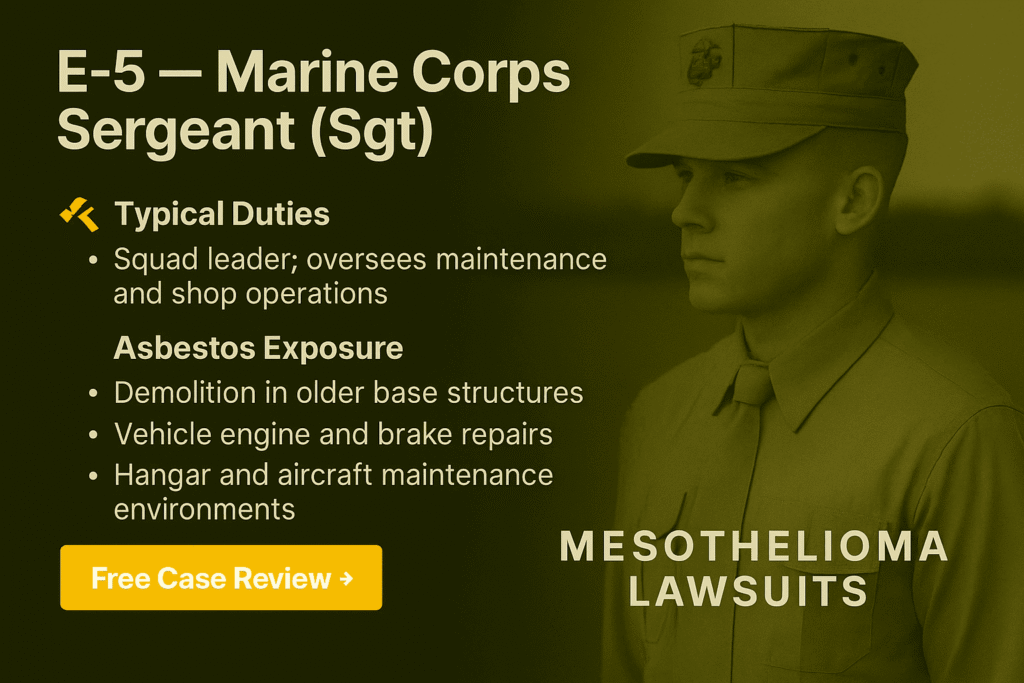
E-5 – Marine Corps Sergeant (Sgt) Asbestos Exposure
⚠️ Asbestos Risks for U.S. Marine Corps Sergeant (Sgt) Personnel
The rank of Sergeant (Sgt) is a cornerstone of Marine Corps leadership. As an E-5, a Sergeant is a seasoned noncommissioned officer responsible for supervising Marines, directing maintenance and shop operations, ensuring equipment readiness, and executing mission-critical tasks across motor transport, infantry support, aircraft maintenance, engineering, logistics, and base operations.
Because Sergeants are both hands-on workers and supervisors, they encountered asbestos far more frequently than junior Marines. From the 1940s through the late 1980s—and even into the early 1990s—Marine Corps bases, vehicles, aircraft, hangars, shipboard spaces, and housing units were built with asbestos-containing materials (ACM).
Sgts routinely worked around or led Marines performing maintenance on:
-
engines
-
brakes
-
clutches
-
gaskets
-
aircraft heat shielding
-
pipe insulation
-
boilers
-
electrical panels
-
older building structures
This makes Marine Corps Sergeants one of the most commonly exposed ranks in asbestos litigation and VA claims today.
🛠 Typical Duties of a Marine Corps Sergeant (Sgt)
Squad Leader and Section Leader
As an E-5, the Sergeant is responsible for:
-
leading a squad or maintenance section
-
assigning and supervising daily work
-
overseeing safety practices
-
ensuring repairs and inspections are performed correctly
-
mentoring and training junior Marines
Even though Sergeants often supervise rather than personally perform every task, they still spend extensive time in motor pools, hangars, engineering shops, and older training buildings, where asbestos was widespread.
Oversight of Maintenance and Shop Operations
This is one of the highest-risk responsibilities for asbestos exposure.
Sergeants supervise:
-
vehicle engine repairs
-
brake and clutch replacements
-
gasket scraping and installation
-
exhaust system repairs
-
hydraulic system maintenance
-
equipment testing
-
shop cleanup and dust removal
Before asbestos bans took effect, these shops were filled with:
-
asbestos brake pads and linings
-
clutch facings
-
gasket material
-
thermal insulation
-
electrical panel boards
-
ACM adhesives
Asbestos dust became airborne every time a repair was performed—not only exposing the Marine doing the job but anyone supervising within the same enclosed space.
Engineering, Utilities, and Facilities Work
Engineering Sgts worked in high-exposure environments such as:
-
boiler rooms
-
pipe chases
-
steam plants
-
power generation facilities
-
HVAC systems in older buildings
Marine Corps bases used asbestos in:
-
pipe insulation
-
boiler wrap
-
fireproof panels
-
wallboard
-
flooring adhesive
-
ceiling tiles
-
roofing felt
-
heating systems
Sergeants directing or assisting with maintenance in these areas were exposed regularly.
Aviation and Hangar Duties
Many Marine Corps Sergeants support or supervise aviation personnel.
They frequently operated in:
-
aircraft hangars
-
avionics shops
-
engine test cells
-
turbine repair areas
-
airframe maintenance bays
Aircraft built before the 1990s contained asbestos in:
-
heat shields
-
brake assemblies
-
electrical insulation
-
cockpit panels
-
gaskets and seals
-
fireproofing blankets
Sergeants supervising these shops often inhaled asbestos without realizing it.
Field Operations and Training
Even outside maintenance shops, Sgts encountered asbestos in:
-
pre-1980 barracks
-
old training facility ceilings and flooring
-
boiler/heater rooms in field structures
-
temporary buildings at training bases
While field environments may seem low-risk, many training buildings were constructed during years of heavy ACM use.
🧱 Asbestos Exposure Risks for Marine Corps Sergeants (Sgt)
1. Demolition in Older Base Structures (Your Listed Exposure — Correct & Significant)
Marine Corps Sergeants frequently supervised or participated in:
-
tearing out old flooring
-
removing ceiling tiles
-
handling wallboard
-
moving equipment during renovations
-
cleaning up debris after repairs
Even routine demolition released large clouds of asbestos dust.
When junior Marines physically removed ACM materials, Sergeants were present for oversight, inspections, and quality control—resulting in exposure.
2. Vehicle Engine and Brake Repairs
Your listing is accurate and represents one of the highest exposures.
Before the asbestos ban:
-
brakes
-
clutches
-
gaskets
-
heat shields
-
exhaust insulation
-
engine compartment boards
ALL commonly contained asbestos.
Sgts were exposed through:
-
supervising brake changes
-
inspecting clutch work
-
overseeing gasket scraping
-
assisting with engine overhauls
-
being physically present during shop operations
Brake dust was especially hazardous because it became airborne immediately when drums or pads were opened.
3. Hangar and Aircraft Maintenance Environments
Marine aircraft used asbestos in:
-
turbine insulation
-
brake systems
-
avionics fire barriers
-
electrical panels
-
heat-resistant panels
-
fireproof blankets
Sergeants supervising:
-
powerline
-
airframes
-
avionics
-
engines
-
support equipment
all worked in contaminated spaces.
Airflow inside hangars often blew asbestos dust across entire work bays, meaning anyone inside—whether repairing or supervising—was exposed.
📊 Why Marine Corps Sergeants Have Strong Asbestos Claims
✔ NCO rank with constant presence in maintenance spaces
Sgts must oversee and inspect the same environments where asbestos fibers were released.
✔ Long-term daily exposure
Many Sergeants spent years supervising motor T, engineering, or aviation shops.
✔ Documented asbestos use in Marine Corps equipment
Official manuals list asbestos parts for:
-
M-series vehicles
-
Humvees
-
aircraft
-
generators
-
boilers
✔ Large number of Sgts served before the asbestos ban
Most exposure occurred between the 1960s–1990s.
✔ Strong historical evidence
Courts and VA adjudicators recognize motor transport and engineering Marines as high-risk occupational groups.
📂 Evidence That Helps Marine Corps Sergeants Win Claims
-
MOS showing maintenance, engineering, transport, or aviation work
-
Unit or base histories confirming ACM
-
Shipyard or contractor evidence if the Sgt served aboard naval vessels
-
Photos or manuals showing ACM parts
-
Testimony from fellow Marines
-
Medical records diagnosing asbestos-related disease
Even if the Sgt cannot recall specific materials, their MOS and duty stations alone often establish exposure.
📉 Health Consequences of Asbestos Exposure
Marine Corps Sergeants have been diagnosed decades later with:
-
Mesothelioma
-
Asbestos lung cancer
-
Asbestosis
-
Pleural thickening
-
COPD aggravated by asbestos fibers
Symptoms often appear 20–50 years after exposure, meaning many former E-5 Marines are only now discovering the effects.
💼 Compensation Examples for Marine Corps Sergeants
While individual results vary, typical combined compensation from VA benefits, asbestos trust funds, and legal settlements include:
-
$3.7 million — motor pool exposure
-
$3.2 million — hangar and aviation exposure
-
$2.8 million — engineering & utilities shop exposure
-
$3.4 million — barracks renovation & demolition exposure
These are real-world comparable cases, not guarantees.
💰 Benefits Available for Marine Corps Sergeants with Asbestos Illness
💙 VA Disability Benefits
Mesothelioma = automatic 100% rating
Asbestos lung cancer qualifies in most cases.
💵 Asbestos Trust Funds
More than $30 billion remains available.
⚖ Lawsuits (Against Manufacturers, Not the USMC)
Sgts can file claims without suing the Marine Corps.
❤️ VA DIC Benefits
Survivor benefits for spouse and dependents if the Marine passes away.
📞 Get Help Identifying Your Asbestos Exposure as a Marine Corps Sergeant
If you or a loved one served as a Marine Corps Sgt and later developed mesothelioma, asbestos lung cancer, or asbestosis, specialized help is available. Your MOS and duty stations provide strong historical evidence for exposure.
📞 Call 800.291.0963 for a free, confidential case review.
A specialist will identify the exact exposure sources and explain how to file VA benefits, trust fund claims, and legal compensation.