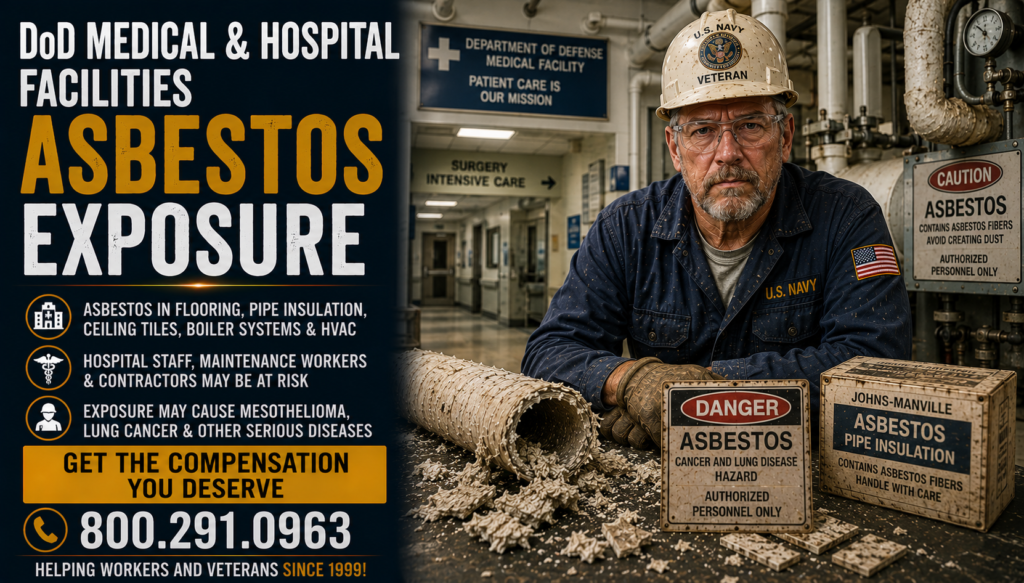
Department of Defense Medical and Hospital Facilities Asbestos Exposure
Exposure, Evidence and Claims
Older Department of Defense hospitals and clinics may contain historical insulation, floor materials and other building products requiring evaluation during repair or renovation. The medical function of a building does not establish asbestos content.
This article distinguishes facilities maintenance from clinical care and explains how building records, duty assignments and medical evidence can support a reliable exposure history.
How DoD Medical Facilities Used Older Building Systems
Department of Defense hospitals and clinics span many building generations, from large medical centers to small installation treatment facilities. Older facilities may have used asbestos-containing insulation, flooring, fireproofing or other construction products, but a military medical designation does not prove their presence. The relevant question is what was installed in a particular wing or mechanical system during the person’s service. Construction drawings, renovation records and material surveys can establish a more accurate picture than broad claims about military hospitals.
Military treatment facilities are frequently renamed, consolidated or transferred between commands. A modern hospital website may not identify the building occupied decades earlier. Track the installation, building number and clinic designation at the relevant time. Historical plans may distinguish a newly built patient wing from an older utility plant, preventing inaccurate statements about materials across an entire medical campus.
The broader workplace context is covered in Department of Defense exposure.
A related but distinct exposure setting is explained in Military veterans asbestos exposure.
Military hospitals are operationally complex facilities with patient care, engineering, logistics and contractor functions. A building’s clinical name may conceal several structures with different construction dates. Research should begin with the physical facility and service period rather than a generalized claim about all military hospitals. When a wing was demolished and rebuilt, historical records should distinguish the original construction from later materials. This improves both accuracy and the usefulness of the page to former employees seeking records.
Pipe Chases, Steam Distribution and Heating Plants
Hospital campuses may distribute steam and hot water through central plants, tunnels and pipe chases. Older insulation around pipes, fittings and boilers is a plausible material to investigate, especially where maintenance involved stripping or replacing coverings. Distinguish an intact insulated line from a repair that physically removed suspect insulation. Steamfitters, boiler operators and maintenance technicians may have had direct tasks; medical staff passing through a corridor may not. Work orders and plant diagrams can show which sections were opened and when.
Access to utility tunnels was often limited to facilities personnel, which matters when comparing occupational histories. An engineer servicing steam valves might have direct contact with insulation, while a laboratory technician in a distant building may have none. The mere existence of a tunnel network does not prove fibers traveled through the hospital. Work orders should be paired with personnel assignments and the physical location of repairs.
For a comparison involving different equipment or personnel, consult DoD shipyard civilian workers.
The surrounding site category is discussed in National Guard facilities.
Operating Rooms, Sterile Processing and Ventilation
Medical facilities rely on carefully controlled air movement, especially in operating rooms and sterile processing areas. Historical HVAC renovations could involve duct insulation, mechanical equipment gaskets, ceiling assemblies or adjacent utility spaces. That does not mean hospital ventilation routinely distributed asbestos fibers. Any claim about airborne migration should be grounded in an identified disturbance and credible evidence of airflow or failed containment. Distinguish staff working in treatment rooms from technicians replacing equipment above ceilings or inside service spaces.
In surgical suites, ventilation pressure and infection-control practices are designed for clinical safety, not as evidence that asbestos was present. If a renovation involved overhead utility spaces, the relevant records would describe containment and the material being removed. Do not conflate ordinary filter replacement with asbestos abatement. A factual account specifies the maintenance operation and whether suspect insulation or fireproofing was actually disturbed.
The linked topic addresses a different setting: National Guard medical personnel.
For related historical context, review Buildings exposure overview.
Renovation in Occupied Patient-Care Buildings
An occupied hospital renovation creates practical questions about patient protection and construction separation. Contractors may remove flooring, open walls or replace plumbing while clinical operations continue in adjacent rooms. Exposure evaluation should examine sealed barriers, work schedules, debris routes and documented incidents rather than infer exposure from simultaneous occupancy. Facility infection-control records may describe construction precautions, but they are not substitutes for asbestos-specific surveys or abatement records. The exact wing, floor and renovation phase are critical.
Construction work in a hospital may be restricted to particular shifts to protect patient services. A nurse assigned to a wing during daytime operations may have had a different exposure opportunity from a contractor working overnight. Shift rosters and project logs can resolve these distinctions. Reports of dust or temporary room closures are useful leads but do not independently identify asbestos-containing materials.
A separate maintenance scenario appears in Job-site asbestos exposure.
The parent subject is developed in Equipment exposure overview.
A worker’s recollection that insulation was white, gray or powdery may be sincere but is not a laboratory identification. Many non-asbestos materials can look similar. Likewise, a hospital’s asbestos-management program may list materials in areas the worker never entered. Connect the records to actual work assignments, such as a boiler repair, a floor replacement or a renovation in an occupied wing. Avoid implying that ordinary clinical care, by itself, creates occupational asbestos exposure.
Maintenance, Custodial and Contractor Work
Potential exposure tasks differ among trades. Plumbers might remove insulated fittings; electricians may open old service chases; maintenance staff may repair boilers; custodians could encounter residue after an improperly controlled project. Nurses, physicians and technicians generally have different task histories and should not be assigned the same exposure profile. Federal civilian employees, uniformed personnel and outside contractors also have different employment records and potential legal pathways. A careful history preserves these distinctions.
Civilian personnel files may show a maintenance trade and duty station, while contractor records may list the particular renovation package. These sources should be combined carefully rather than assuming a trade title proves contact with asbestos. A custodial worker who cleaned after a documented uncontrolled disturbance may have a different pathway from a plumber removing old insulation. Each task warrants its own evidence.
To compare different material systems, see Machinery exposure overview.
A complementary work-area discussion is available in Marine Corps asbestos exposure.
Distinguishing Clinical Duties From Building Exposure
Clinical contact with patients who have mesothelioma is not an asbestos-exposure pathway. The relevant issue is whether a healthcare worker encountered disturbed asbestos-containing building materials or equipment components. Similarly, wearing a military uniform does not establish service-connected exposure. Identify the building system, location and actual work performed. This prevents confusing medical care with environmental or occupational exposure and helps avoid overstating risk for staff whose duties were confined to unaffected treatment areas.
Occupational and clinical exposure questions should remain separate in patient-facing content. A medical corpsman or civilian nurse may have treated patients with asbestos-related disease without ever encountering asbestos in the facility. Conversely, a boiler mechanic may have worked in a hospital but never provided medical care. These distinctions help readers identify the correct evidence and avoid misleading claims about hospital staff as a single exposed group.
Different occupational duties are examined in Merchant Marine asbestos exposure.
Another relevant exposure category is covered in Fire station renovation exposure.
Facility Records That Help Identify Materials
Useful records include installation real-property inventories, historical floor plans, asbestos surveys, facility maintenance requests, construction contracts, demolition permits, contractor abatement reports and staffing assignments. Hospital names and functions may change over decades; track building numbers and wings rather than relying solely on the current facility name. If a person recalls a specific ceiling collapse or pipe replacement, look for dated incident or maintenance logs. Do not infer material composition from a witness’s description of white dust alone.
Where old records are incomplete, a renovation contract may still identify an abatement subcontractor or a material survey. Facility engineering offices, archives and procurement records may hold different portions of the history. Requesting a single generic personnel file may therefore be insufficient. The aim is to establish a verifiable timeline, not to fill every documentary gap with assumptions about the building’s age.
For background on adjacent evidence questions, review Military aircraft exposure.
The corresponding silo overview is available in Mesothelioma lawsuit overview.
When reviewing benefits, distinguish the period of uniformed service from later civilian work even if both occurred on the same installation. The VA assesses qualifying service and medical nexus under its rules; civilian employment may raise different administrative or legal questions. Retain both personnel and clinical records, but do not assume one program’s eligibility establishes another’s. An accurate article should help readers ask better questions rather than promise benefits or identify a defendant without adequate evidence.
Health Evaluation and Military or Civilian Claims
Asbestos exposure can be relevant to mesothelioma, lung cancer and asbestosis, but diagnosis requires appropriate medical evaluation. People with symptoms or a known history should discuss it with their clinician rather than rely on an online checklist. For claims, the person’s employment and duty status matter: military VA disability benefits, federal civilian employment processes and third-party product litigation have different requirements. Preserve medical diagnoses, service or personnel records and product evidence without assuming eligibility or a particular outcome.
Eligibility for federal civilian benefits and veterans disability benefits depends on different statutory and administrative frameworks. A former service member who later worked as a civilian may have records relevant to both periods, but they should not be merged into one undifferentiated exposure narrative. Medical evidence establishes diagnosis; service or employment evidence establishes the circumstances under review. Seek advice tailored to the applicable program.
For further information on separate claim considerations, consult Asbestos trust funds.
The related evidence framework is discussed in Veterans mesothelioma claims.
Facilities management records may distinguish an asbestos survey performed for routine building management from a survey conducted immediately before demolition. The former may not cover hidden spaces later opened by contractors. A work order for replacement of an old steam valve can identify a precise location and date, but does not itself prove the removed gasket contained asbestos. A strong history therefore links personnel, material identification and task details without treating any single record as conclusive. Where a hospital was renamed or reorganized, archived plans may be filed under an earlier installation designation. Patients and clinicians should not be described as exposed simply because they occupied the same large campus as a maintenance project.
❓ Frequently Asked Questions
Were all DoD hospitals built with asbestos?
No. Materials varied by construction date, building and renovation history; a facility-specific survey or reliable records are necessary.
Could a hospital boiler technician have encountered asbestos?
Possibly, particularly during work on historical thermal insulation or gaskets, if the materials were asbestos-containing.
Does treating a mesothelioma patient expose staff to asbestos?
No. Mesothelioma is not contagious, and routine patient care is not an asbestos exposure pathway.
Are nurses automatically at risk during renovation?
No. Risk depends on the material disturbed, containment, location, work period and actual exposure conditions.
What identifies a specific hospital building?
Building numbers, installation plans, historical maps, work orders and construction contracts can distinguish similarly named facilities.
Can civilian DoD hospital workers apply for VA disability?
Civilian employment alone does not create veteran status. Eligibility depends on qualifying military service and applicable VA rules.
How can old pipe insulation be identified?
Qualified inspection, laboratory analysis where appropriate, and historical procurement or abatement records may help.
What should a former employee do after a mesothelioma diagnosis?
Seek specialist medical care, preserve occupational and medical records, and obtain individualized advice about potentially applicable benefits or claims.
📞 Get the Mesothelioma Help & Compensation You Deserve — Contact Us Today!
Our team has more than 25 years of experience helping families explore asbestos exposure questions and possible legal options. Eligibility and outcomes depend on individual circumstances.
📲 Contact Us Today — Three Easy Ways!
CALL 800.291.0963 · LIVE CHAT 24/7/365 · CONTACT FORM
Disclaimer: This information is not be considered as legal or medical advice. Mesothelioma Help Center is not a law firm or medical provider and does not determine legal or VA eligibility.