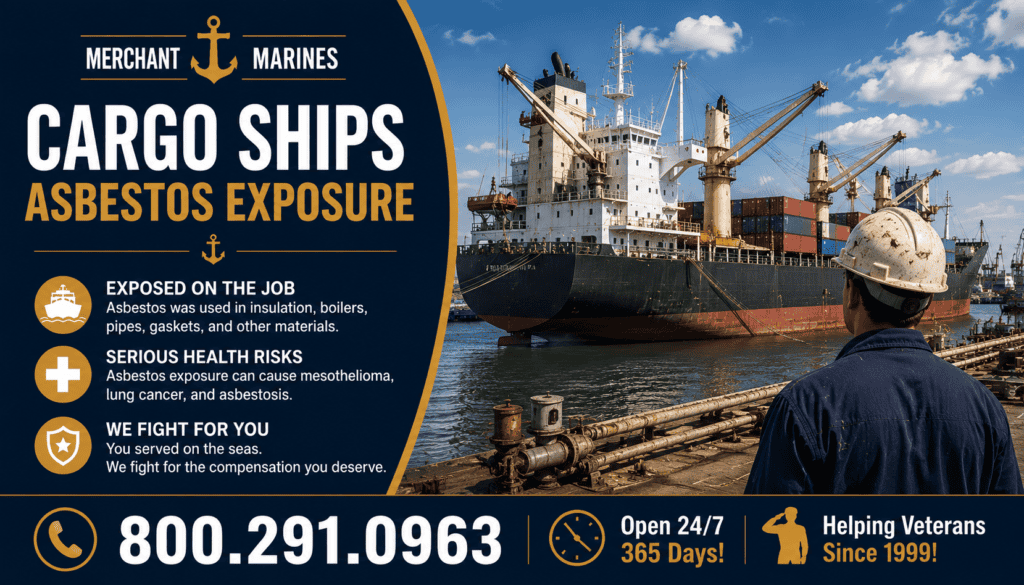
🚢 Merchant Marine Cargo Ships Asbestos Exposure
Merchant Marine cargo ships carried everything from military equipment and industrial machinery to food, fuel, automobiles, and raw materials across the world’s oceans. While these vessels played a vital role in global commerce and national defense, they also exposed thousands of Merchant Mariners to asbestos used throughout nearly every mechanical and structural system aboard the ship.
From the 1930s through the early 1980s, asbestos insulation was installed around boilers, steam pipes, turbines, pumps, generators, valves, cargo hold bulkheads, electrical equipment, and living quarters. Routine maintenance, cargo operations, and shipyard overhauls frequently disturbed these materials, releasing microscopic asbestos fibers into enclosed shipboard environments where crews lived and worked for weeks or months at a time.
Many former Merchant Mariners who served aboard cargo ships were later diagnosed with mesothelioma, asbestos-related lung cancer, or asbestosis decades after their exposure.
To learn more about asbestos exposure across commercial vessels, visit our Merchant Marine Ships Asbestos Exposure guide.
📞 Immediate help is available: 800-291-0963
🚨 Confidential Merchant Marine Case Evaluation
If you developed mesothelioma or another asbestos-related illness after serving aboard a Merchant Marine cargo ship, you may qualify to pursue compensation.
📞 Call 800-291-0963
✔ Confidential case evaluation
✔ No upfront costs
✔ Nationwide representation
✔ Help identifying ships and asbestos products
✔ No legal fee unless compensation is recovered
⚠️ Why Asbestos Was Common on Merchant Marine Cargo Ships
Cargo ships operated around the clock while transporting heavy freight across long ocean voyages. Their engines, boilers, and steam systems generated tremendous heat, making fire prevention one of the highest priorities for shipbuilders. For decades, asbestos was considered the industry standard because it was durable, inexpensive, and highly resistant to heat.
Shipyards installed asbestos throughout cargo vessels because it:
🔥 Protected engine rooms from extreme temperatures
⚙️ Insulated boilers, steam pipes, turbines, and propulsion systems
🧱 Fireproofed cargo holds, bulkheads, and machinery spaces
🛠️ Reduced maintenance caused by heat and vibration
🚢 Met maritime safety requirements used throughout much of the twentieth century
Most U.S.-built cargo ships constructed or extensively refurbished before the early 1980s contained substantial amounts of asbestos insulation and asbestos-containing components.
🛠️ Where Asbestos Was Found on Cargo Ships
Asbestos-containing materials were present throughout nearly every major section of older cargo vessels, exposing both engineering personnel and deck crews.
Common locations included:
⚙️ Engine rooms
🔥 Boiler rooms
🛢️ Steam pipes and exhaust systems
⚙️ Pumps, turbines, generators, and compressors
🔧 Valves, gaskets, and packing materials
🧱 Cargo hold bulkheads and fireproof insulation
⚡ Electrical switchboards and control panels
🌬️ Ventilation and HVAC systems
🏠 Crew quarters, passageways, and mess halls
As cargo ships aged, insulation became brittle and could crumble during repairs, vibration, or routine maintenance. Air circulation systems often carried asbestos fibers well beyond the engine room, increasing exposure throughout the vessel.
Learn more about asbestos-containing equipment used aboard commercial vessels:
- Merchant Marine Boiler Equipment Asbestos Exposure
- Merchant Marine Engine Room Equipment Asbestos Exposure
- Merchant Marine Pump Equipment Asbestos Exposure
- Merchant Marine Valve Equipment Asbestos Exposure
⚓ Types of Merchant Marine Cargo Ships
Cargo ships came in many designs depending on the freight they transported, but nearly all relied on asbestos insulation in machinery spaces, propulsion systems, and structural fireproofing.
⚓ General Cargo Ships
General cargo ships carried manufactured goods, machinery, packaged freight, and industrial materials. Engineers and maintenance crews frequently encountered asbestos while servicing propulsion systems, boilers, pumps, and steam lines below deck.
⚓ C1, C2, and C3 Cargo Ships
These standardized Maritime Commission vessels were extensively used before, during, and after World War II. Asbestos insulation surrounded boilers, turbines, piping, electrical systems, and engine-room equipment, exposing engineering crews during routine maintenance.
⚓ Liberty Ships
Liberty Ships transported military supplies and commercial cargo around the world during World War II. They contained extensive asbestos insulation around boilers, turbines, steam piping, and machinery spaces.
Learn more about Merchant Marines Liberty Ships Asbestos Exposure.
⚓ Victory Ships
Victory Ships continued many of the same construction practices as Liberty Ships, including widespread use of asbestos insulation throughout propulsion systems, exhaust ducts, electrical equipment, and engine rooms.
Read our Merchant Marines Victory Ships Asbestos Exposure guide.
⚓ Refrigerated Cargo Ships (Reefers)
Refrigerated cargo vessels used asbestos around refrigeration equipment, compressors, steam piping, and boiler systems. Maintenance of cooling systems frequently disturbed deteriorating insulation.
⚓ Roll-On/Roll-Off (Ro-Ro) Cargo Ships
Ro-Ro vessels incorporated asbestos into propulsion systems, braking mechanisms, cargo ramps, and machinery spaces. Mechanical repairs and modernization projects often released asbestos fibers into enclosed work areas below deck.
👷 How Merchant Mariners Were Exposed on Cargo Ships
Cargo ships required constant operation and maintenance while transporting freight around the world. As boilers, engines, pumps, steam systems, and cargo equipment aged, insulation and other asbestos-containing materials deteriorated. Routine repairs often released invisible asbestos fibers into confined work areas where Merchant Mariners spent long hours.
Common exposure activities included:
📦 Loading and unloading cargo near insulated bulkheads
🔧 Performing engine and boiler maintenance
🪚 Cutting or replacing insulated steam pipes
⚙️ Repairing pumps, valves, turbines, and generators
🧹 Cleaning machinery spaces and cargo holds
🚧 Shipyard repairs and dry dock overhauls
🌬️ Breathing airborne fibers circulated through ship ventilation systems
Workers serving as Merchant Marine Oilers Asbestos Exposure, Merchant Marine Engineers Asbestos Exposure, Merchant Marine Wipers Asbestos Exposure, Merchant Marine Firemen Asbestos Exposure, and Merchant Marine Electricians Asbestos Exposure often experienced the highest levels of exposure because they worked directly around engine-room equipment every day.
Even deckhands, cargo handlers, cooks, and other crew members could inhale asbestos fibers carried throughout the vessel by ventilation systems or released during maintenance projects below deck.
🧬 Health Risks Linked to Cargo Ship Asbestos Exposure
Medical research has linked asbestos exposure aboard Merchant Marine cargo ships to several serious diseases, including:
🫁 Mesothelioma
🫁 Asbestos-related lung cancer
🫁 Asbestosis
🫁 Pleural plaques
🫁 Pleural thickening
One of the greatest dangers of asbestos exposure is its long latency period. Symptoms often do not appear until 20 to 50 years after exposure, meaning many Merchant Mariners are diagnosed long after retiring from maritime service.
Learn more on our Merchant Marine Asbestos Exposure Health Risks page.
⚖️ Legal Rights of Merchant Mariners Exposed on Cargo Ships
Former Merchant Mariners diagnosed with mesothelioma or another asbestos-related disease may be eligible to pursue compensation through:
⚖️ Mesothelioma lawsuits against asbestos manufacturers
🏦 Asbestos trust fund claims
⚖️ Wrongful death lawsuits filed by eligible family members
Rather than focusing solely on shipping companies, many claims involve the manufacturers of asbestos insulation, boilers, pumps, turbines, valves, gaskets, packing materials, electrical equipment, and fireproofing products installed aboard cargo ships.
Additional legal resources include:
- Merchant Marines Mesothelioma Lawsuit
- Merchant Marine Asbestos Trust Fund Claims
- Merchant Marine Wrongful Death Lawsuits
- Merchant Marine Statute of Limitations
💰 Compensation That May Be Available
Depending on the circumstances of your diagnosis and exposure history, compensation may help cover:
💵 Medical treatment and future healthcare expenses
💼 Lost wages and diminished earning capacity
💔 Pain and suffering
🚗 Travel expenses for specialized treatment
👨👩👧 Caregiving and household assistance
⚖️ Wrongful death compensation for surviving family members
Because many cargo ships incorporated asbestos products manufactured by numerous companies, some Merchant Mariners may qualify to pursue claims against multiple asbestos trust funds in addition to filing civil lawsuits.
🛡️ How a Mesothelioma Attorney Helps Cargo Ship Mariners
A maritime asbestos attorney can investigate your service history and identify where asbestos exposure likely occurred.
An experienced attorney may help:
🧭 Identify the cargo ships you served aboard
🚢 Research ship construction, maintenance, and overhaul records
🏭 Identify asbestos-containing products used aboard your vessels
📂 Prepare lawsuits and asbestos trust fund claims
⏰ Ensure all legal deadlines are met
⚖️ Pursue every available source of compensation
📞 Call 800-291-0963 to discuss your Merchant Marine cargo ship exposure.
❓ Frequently Asked Questions
Did Merchant Marine cargo ships really contain asbestos in their cargo holds?
Yes. Many cargo ships incorporated asbestos insulation and fireproofing in cargo hold bulkheads, ceilings, machinery spaces, and adjacent structural components.
Can deckhands qualify even if they never worked in the engine room?
Potentially, yes. Asbestos fibers often circulated throughout cargo ships by ventilation systems, maintenance activities, and repairs, exposing crew members in multiple areas of the vessel.
Can I still file a claim if my exposure occurred in the 1960s or 1970s?
Many people diagnosed today were exposed decades ago. Because asbestos diseases usually develop many years after exposure, claims are commonly filed long after maritime service has ended.
Do I need ship blueprints or records showing asbestos products?
No. Experienced attorneys often reconstruct asbestos exposure using employment records, vessel histories, shipyard records, maintenance documents, and other historical evidence.
Can surviving family members pursue compensation?
Yes. Eligible family members may be able to pursue wrongful death lawsuits or asbestos trust fund claims after the loss of a loved one.
🚢 Get Help After Merchant Marine Cargo Ship Asbestos Exposure
Serving aboard a Merchant Marine cargo ship should never have resulted in exposure to a dangerous mineral that can cause disease decades later. If you or someone you love has been diagnosed with mesothelioma, asbestos-related lung cancer, or another asbestos disease after working aboard a cargo vessel, legal options may be available.
Our legal team can help investigate your maritime work history, identify asbestos-containing products used aboard your ships, and determine whether compensation may be available through lawsuits or asbestos trust funds.
📞 Call 800-291-0963
✔ Confidential case evaluation
✔ No upfront costs
✔ Nationwide representation
✔ Maritime asbestos litigation experience
✔ No legal fee unless compensation is recovered