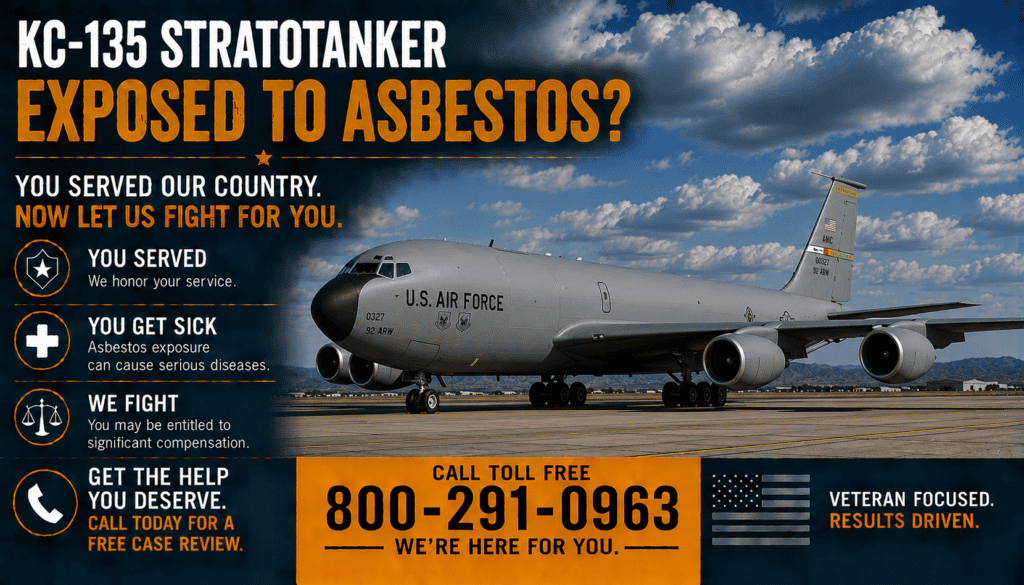
KC-135 Stratotanker Asbestos Exposure
KC-135 Stratotanker asbestos exposure research should focus on the veteran’s Air Force wing or squadron, base or deployment, service dates, Air Force specialty, aircraft model, work area, components, and maintenance duties. Official Air Force history confirms that the KC-135 first flew in August 1956, the initial production Stratotanker was delivered to Castle Air Force Base in June 1957, and the tanker became a central aerial-refueling platform for Strategic Air Command and later Air Mobility Command.
Veterans can strengthen a KC-135 exposure history with personnel and unit records, technical manuals, illustrated parts catalogs, aircraft maintenance and modification files, specifications, procurement records, manufacturer information, part numbers, facility records, and specific witness statements. Assignment to a Stratotanker unit does not establish asbestos exposure by itself, so aircraft-, model-, component-, facility-, product-, task-, proximity-, and date-specific evidence is important when investigating a possible military exposure.
KC-135 Stratotanker Asbestos Exposure
The KC-135 Stratotanker is a four-engine U.S. Air Force aerial-refueling aircraft developed from Boeing’s 367-80 design. Air Force records state that the first KC-135 flew in August 1956, the initial production aircraft was delivered to Castle Air Force Base in June 1957, and the last KC-135 was delivered in 1965.
Service on or around a KC-135 does not by itself prove asbestos exposure. Veterans researching possible exposure should identify their unit, base or deployment, service dates, Air Force specialty, aircraft model, work area, component, maintenance task, and records documenting material composition. Technical manuals, parts catalogs, maintenance files, specifications, procurement records, manufacturer information, and specific witness statements can help reconstruct the work performed.
KC-135 Stratotanker Air Force Service History
The Air Force purchased the first 29 aircraft of what became a 732-plane KC-135 fleet in 1954. The first aircraft flew on August 31, 1956, and the first production Stratotanker arrived at Castle Air Force Base, California, in June 1957.
The KC-135 initially supported Strategic Air Command bomber operations and became a central Air Force aerial-refueling platform. Air Force records state that the final KC-135 was delivered in 1965, while later modernization programs extended the aircraft’s service for decades.
KC-135 Models and Modernization
Many original KC-135A aircraft were later modified with new engines and other upgrades. Air Force sources describe the CFM-56-powered KC-135R modernization as providing greater fuel offload, improved fuel efficiency, and lower operating costs.
Model and configuration matter when researching historical materials because engines, systems, modifications, replacement components, and maintenance procedures changed over the aircraft’s long service life. Records should match the veteran’s aircraft and service period.
Aircraft Systems and Components to Investigate
The KC-135 includes propulsion, braking, hydraulic, electrical, environmental, landing-gear, fuel-transfer, and other aircraft systems. Possible asbestos research should be component-specific rather than assuming that a broad aircraft system contained asbestos.
- Brake and friction components where documented
- Engine and exhaust-area heat-resistant materials
- Gaskets, seals, and packing where documented
- Electrical or wiring materials where documented
- Thermal and fire-resistant materials
- Ground-support and maintenance equipment associated with tanker operations
KC-135 Maintenance and Repair Duties
KC-135 maintenance personnel have worked around engines, landing gear, brakes, hydraulics, electrical systems, fuel systems, environmental equipment, flight controls, and airframe components. Historical exposure research should identify the veteran’s actual duties and whether those duties disturbed a component documented as containing asbestos.
Useful details include the component, tools used, removal or cleaning procedures, visible dust or debris, ventilation, frequency, duration, and whether the veteran performed the work directly or worked nearby while other personnel completed maintenance.
Brakes, Gaskets and Heat-Resistant Materials
VA identifies historical military asbestos use in friction products and heat-resistant materials, including brakes, gaskets, valves, cements, adhesives, heat-resistant fabrics, and floor and pipe coverings. VA explains that asbestos-containing material is most hazardous when disturbed or damaged and fibers become airborne.
These general military product categories do not establish asbestos content in a specific KC-135 component. Part numbers, technical manuals, specifications, procurement records, manufacturer documents, and other product-specific evidence should be used to investigate the correct aircraft component and service period.
Air Bases, Flight Lines and Maintenance Facilities
KC-135 units have operated from Air Force installations in the United States and deployed locations worldwide. Castle Air Force Base received the initial production Stratotanker in 1957, and other tanker bases subsequently supported Strategic Air Command and later Air Mobility Command operations.
Research should identify the wing or squadron, installation or deployment, aircraft model, maintenance organization, shop or work center, and dates. If suspected exposure involved an older hangar, shop, boiler system, or renovation project rather than the aircraft itself, facility records should be researched separately.
Documenting KC-135 Work and Exposure
- DD214 and Official Military Personnel File records
- AFSC, wing, squadron, and duty-station records
- Deployment and aircraft-assignment histories
- KC-135 operator and maintenance technical manuals
- Illustrated parts catalogs and part-number records
- Aircraft maintenance, inspection, modification, and overhaul files
- Procurement, manufacturer, specification, and product records
- Specific firsthand coworker or witness statements
The strongest evidence connects the veteran to a particular KC-135 model and work location, identifies a documented asbestos-containing component, and describes the activity that could have disturbed that material.
VA Benefits and Exposure Evidence
VA states that veterans may be eligible for disability compensation when they have a health condition caused by asbestos exposure and had contact with asbestos while serving in the military. Relevant evidence includes medical records, service records listing the veteran’s job or specialty, and medical evidence connecting military asbestos exposure with the claimed condition.
KC-135 assignment alone should not be treated as proof of asbestos exposure, disease causation, liability, or VA eligibility. Aircraft-, facility-, and product-specific evidence can supplement personnel and medical records when reconstructing an alleged exposure.
Frequently Asked Questions
When did the KC-135 Stratotanker first fly?
Air Force sources state that the first KC-135 flew on August 31, 1956.
When was the first KC-135 delivered to the Air Force?
The initial production Stratotanker was delivered to Castle Air Force Base, California, in June 1957. The last KC-135 was delivered in 1965.
Does working on a KC-135 prove asbestos exposure?
No. Exposure research should connect the veteran’s duties to a specific component, product, facility material, or other source documented as containing asbestos during the relevant period.
Which KC-135 components should be researched?
Research may focus on friction components, gaskets, heat-resistant materials, electrical materials, insulation, and other parts only when aircraft-specific documentation supports asbestos content.
What records can help document KC-135 maintenance duties?
Personnel files, unit histories, technical manuals, parts catalogs, maintenance and modification records, specifications, procurement files, manufacturer information, and specific witness statements can help reconstruct the veteran’s work.
Confirmed Sources
Review Your KC-135 Stratotanker Service History
Write down your Air Force wing or squadron, base or deployment, service dates, AFSC, aircraft model, maintenance organization, work area, components, repair tasks, tools, nearby maintenance or facility work, and coworkers you remember. Preserve personnel, unit, facility, technical, maintenance, parts, procurement, manufacturer, product, and medical records and clearly distinguish documented facts from recollection.
Call 800.291.0963 for a no-obligation case evaluation and to speak with a real person 24/7, 365 days a year. Mesothelioma Help Center is not a law firm or medical provider and does not determine VA eligibility.
Disclaimer: General information only—not legal or medical advice. This website is not a law firm. Exposure, VA eligibility, liability and deadlines vary by case and jurisdiction. Do not disturb suspected asbestos. Past results do not guarantee future outcomes.