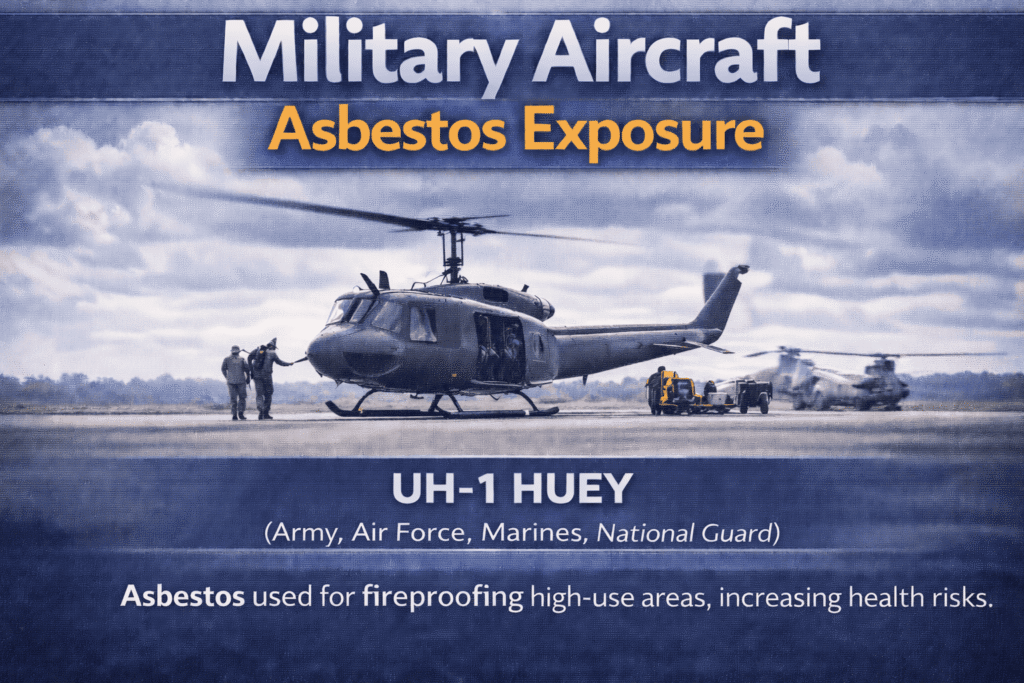
🚁 UH-1 Huey Asbestos Exposure Lawsuits
The UH-1 Huey was one of the most widely used helicopters in U.S. military history, serving the Army, Air Force, Marines, and National Guard from the Vietnam War through the 2000s. Designed for utility, medevac, troop transport, and combat missions, the Huey was built for rugged use in extreme environments. To protect its systems and crew from heat and fire, asbestos-containing materials were installed throughout key components.
Thousands of aviation mechanics, flight crews, and depot personnel who maintained or flew in Huey helicopters were unknowingly exposed to asbestos. Many later developed illnesses such as mesothelioma, asbestosis, and asbestos-related lung cancer. Our legal team helps Huey veterans and their families file lawsuits, asbestos trust fund claims, and VA benefits—with no upfront costs and no impact on VA disability ratings.
Why Asbestos Was Used in the UH-1 Huey
As a rotary-wing aircraft operating in hot, enclosed engine compartments and exposed environments, the Huey used asbestos in:
-
Rotor brake pads and linings that required heat resistance
-
Engine exhaust insulation wraps to prevent fire and thermal spread
-
Firewall gaskets and heat barriers between cockpit and engine housing
-
Electrical system insulation in avionics and cockpit panels
-
Soundproofing and floor adhesives in crew compartments
These materials frequently broke down during operation or required removal during routine servicing—exposing crews to dangerous asbestos fibers.
UH-1 Huey Deployment Across Military Branches
The Huey served across active-duty and reserve units in every major U.S. military conflict from Vietnam onward.
| Branch | Deployment Highlights | Primary Roles |
|---|---|---|
| U.S. Army | Vietnam, Gulf War, Iraq, Afghanistan | Troop lift, gunship, command and control |
| U.S. Marine Corps | Southeast Asia, Pacific, Middle East | Assault transport, MEDEVAC, reconnaissance |
| U.S. Air Force | Rescue and recovery, training, base patrol | Search and rescue, support operations |
| Army National Guard | Domestic missions, disaster relief, global support | Logistics, medevac, civil response |
Widespread use of the Huey made asbestos exposure a routine hazard during operations and maintenance.
Number of U.S. Service Members Exposed to Asbestos on UH-1 Huey Helicopters
Decades of Huey service resulted in frequent maintenance and part replacement, exposing tens of thousands of personnel.
| Category | Estimated Number of Service Members Exposed |
|---|---|
| Helicopter Mechanics (Army, USMC) | Over 80,000 worked on brakes, engines, and insulated systems |
| National Guard & Reserve Technicians | Around 24,000 performed maintenance at armories and depots |
| Flight Crews (Pilots, Medics, Gunners) | Nearly 30,000 exposed during extended missions and pre-flight |
| Air Force Rescue & Maintenance Teams | About 18,000 handled insulation and tail boom systems |
Total Estimated Exposure: More than 150,000 service members were potentially exposed to asbestos through Huey operations and upkeep.
Asbestos Exposure Areas on the UH-1 Huey
Rotor Brake Systems
-
Brake pads and housing lined with asbestos
-
Mechanics exposed during replacement and dust cleanup
Engine & Exhaust Insulation
-
Heat shields, blankets, and pipe wraps used asbestos
-
Fibers released during removal or damaged components
Firewall & Cabin Barriers
-
Asbestos gaskets and seals used for cockpit safety
-
Replaced during retrofits and heat damage repair
Tail Boom Assemblies
-
Housed insulated hydraulic and electrical lines
-
Mechanics disturbed asbestos while accessing internal parts
Electrical Systems
-
Wire insulation and panel boards included asbestos
-
Dust released during rewiring and maintenance
UH-1 Huey Personnel at High Risk of Asbestos Exposure
| Occupation | Exposure Level | Exposure Description |
|---|---|---|
| Helicopter Mechanics | Extremely High | Worked on engine systems, brakes, and insulation in confined areas |
| Airframe & Rotor Technicians | High | Handled brake systems and rotating components lined with asbestos |
| Avionics & Electrical Techs | High | Maintained wires, switches, and cockpit panels with asbestos insulation |
| Crew Chiefs & Flight Engineers | Moderate | Supervised routine maintenance, pre-flight checks, and in-flight systems |
| Medics & Door Gunners | Moderate | Exposed in rear compartments lined with floor insulation and adhesives |
| Guard/Reserve Mechanics | Moderate | Handled long-term depot repairs with asbestos exposure risks |
Common Asbestos Products Used on the UH-1 Huey
Rotor Brake Pads & Linings
-
Contained asbestos to absorb high-heat friction
-
Released dust during replacements
Exhaust Wraps & Heat Shields
-
Wrapped around exhaust manifolds and pipes
-
Shed fibers when cracked or during removal
Firewall Gaskets & Seals
-
Insulated between engine and crew areas
-
Disturbed during repairs or inspections
Electrical Wire Insulation
-
Wrapped cockpit and avionics cables
-
Flaked over time, releasing fibers
Soundproofing & Floor Adhesives
-
Lined crew compartment floors and panels
-
Wore down during missions or panel removal
Adhesives & Sealants
-
Bonded insulation and parts
-
Released particles during scraping or heat exposure
Long-Term Health Risks from UH-1 Huey Asbestos Exposure
-
Mesothelioma – Fatal cancer caused only by asbestos exposure
-
Asbestosis – Irreversible lung scarring caused by fiber inhalation
-
Lung Cancer – Often appears decades after military service
-
Pleural Thickening – Limits breathing due to lung lining damage
The Military’s Knowledge of Asbestos Dangers
-
Military and contractor reports confirmed asbestos hazards by 1940s
-
Despite this, helicopters like the Huey still used asbestos into the 1980s
-
Mechanics and aircrews were rarely warned or given protective gear
Lawsuits Filed by UH-1 Huey Veterans
Many veterans who maintained or flew in Huey helicopters have filed legal claims after asbestos diagnoses:
-
Mechanics inhaled fibers during rotor brake or engine work
-
Crews exposed in enclosed compartments and engine startups
-
National Guard maintainers faced risk during depot overhauls
-
Families filed wrongful death claims after veteran mesothelioma cases
UH-1 Huey Asbestos Settlements & Verdicts
| Settlement | Case Summary |
|---|---|
| $7.2 million | Army mechanic exposed during rotor brake pad replacements |
| $6.4 million | Marine Corps electrician exposed while rewiring cockpit systems |
| $5.7 million | Flight engineer inhaled fibers during pre-flight and engine checks |
| $4.9 million | National Guard tech exposed while replacing heat insulation wraps |
| $3.8 million | Avionics tech exposed while upgrading electrical switchboards |
Asbestos Manufacturers & Contractors Involved
-
Bell Helicopter (Huey manufacturer)
-
Owens Corning
-
Johns-Manville
-
Raybestos
-
Bendix
-
Uniroyal
-
Eagle-Picher
-
General Electric
-
Westinghouse
These companies supplied asbestos components for the Huey and were later named in lawsuits and trust fund payouts.
Veterans & Asbestos Trust Funds
-
Over $30 billion remains available for asbestos exposure victims
-
Most UH-1 Huey veterans qualify for multiple trust claims
-
Claims can be filed without going to court
-
Trust fund filings do not affect VA benefits
VA Benefits for UH-1 Huey Veterans with Mesothelioma
-
100% VA disability rating available
-
Over $3,800/month in tax-free compensation
-
Access to top VA mesothelioma treatment centers
-
Survivor benefits (DIC) available for families
-
Legal claims and VA benefits can be filed together
UH-1 Huey Asbestos Lawsuit Process
1. Free Case Review
We confirm your Huey service history and medical diagnosis.
2. Investigation
We obtain unit logs, maintenance records, and product evidence.
3. Filing Claims
We pursue asbestos lawsuits and trust fund claims on your behalf.
4. Resolution
Most cases settle in 6–18 months. No legal fees unless you win.
Statute of Limitations
-
Lawsuits: 2–3 years from diagnosis (varies by state)
-
Wrongful death: 2–3 years from the veteran’s passing
-
Trust fund deadlines may be longer—don’t delay
Frequently Asked Questions (UH-1 Huey Asbestos Exposure)
Q. Did Hueys actually contain asbestos?
Yes. It was common in brakes, insulation, gaskets, and electrical components.
Q. Can National Guard members file claims?
Yes. Guard and Reserve service is fully eligible for claims and benefits.
Q. Can families file on behalf of deceased veterans?
Yes. Surviving spouses and children may file for compensation.
Q. Will I have to go to court?
No. Most claims resolve privately through settlements or trust funds.
Why Work with Mesothelioma Help Center
-
25+ years of experience with Army and Marine Corps aviation claims
-
Access to UH-1 Huey maintenance records and base deployment data
-
Tens of millions recovered for helicopter mechanics and crews
-
No legal fees unless we win your case
Free Case Evaluation for UH-1 Huey Veterans
If you or a loved one served aboard or maintained UH-1 Huey helicopters and later developed an asbestos-related disease:
📞 Call 800.291.0963 today for a free, no-obligation case review.
Let us help you recover the compensation and justice you deserve.