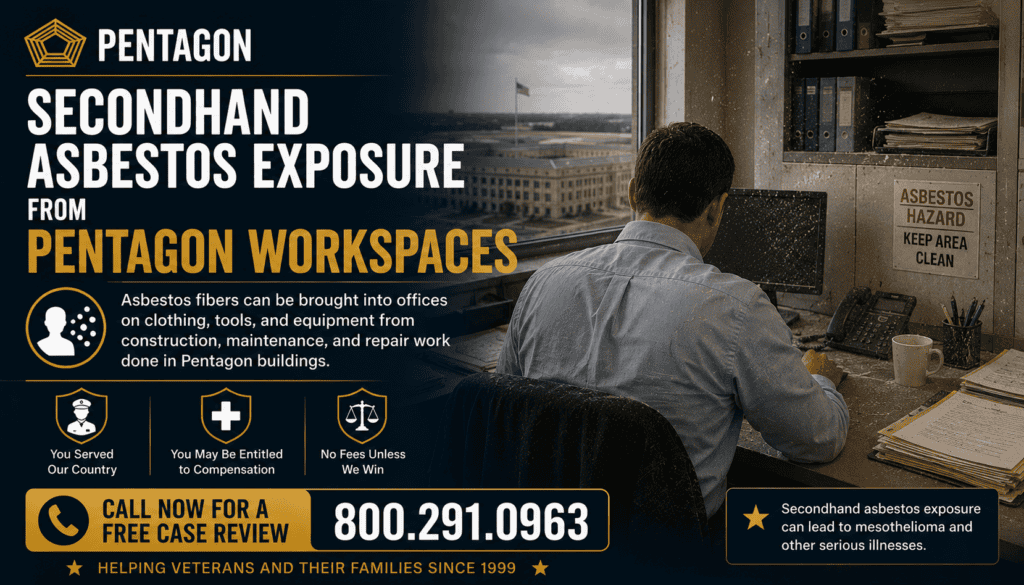
Secondhand Asbestos Exposure From Pentagon Workspaces
Exposure, Evidence and Claims
Secondhand Asbestos Exposure From Pentagon Workspaces concerns specific assignments and building conditions, not an assumption that every person at the Pentagon encountered asbestos. A meaningful review begins with duties, dates, work areas and documented material disturbance.
This article examines the particular evidence and exposure questions associated with secondhand asbestos exposure from pentagon workspaces. It distinguishes plausible historical scenarios from confirmed individual contact and explains why records, medical findings and legal eligibility must be evaluated separately.
What Secondhand Asbestos Exposure Means
Secondhand, or take-home, asbestos exposure refers to fibers transported from a workplace on clothing, shoes, hair, tools or belongings and subsequently released in another environment. It is not the same as direct work on asbestos-containing material. A household member may never have entered the Pentagon yet could have encountered fibers if a worker brought contaminated dust home.
This pathway requires careful evaluation. The Pentagon is not proof of contamination by itself, and ordinary household dust cannot be assumed to contain asbestos. Identify a specific workplace source, a plausible transfer route and repeated or significant household contact.
For background on the Pentagon work environment, read Pentagon asbestos exposure overview. This companion page addresses a separate workplace, material or claim question; the connection is useful only where its facts match the person’s actual assignment and dates.
For military service history that may identify the worker, see Military veterans asbestos exposure. This companion page addresses a separate workplace, material or claim question; the connection is useful only where its facts match the person’s actual assignment and dates.
Workplace Conditions That Could Transfer Dust
Potential transfer scenarios include a worker leaving a disturbed insulation area without changing clothes, carrying dusty tools after maintenance or storing contaminated workwear in a personal vehicle. Actual risk depends on whether asbestos was present, whether fibers were released and how contamination was managed.
Modern containment, protective clothing and decontamination practices can reduce transfer. Historical practices varied by job and period. Do not imply that office employees routinely carried asbestos home merely because they worked in an older federal building.
For maintenance work that could produce transferable dust, examine Pentagon facilities maintenance workers. This companion page addresses a separate workplace, material or claim question; the connection is useful only where its facts match the person’s actual assignment and dates.
For civilian employee roles that differ from household exposure, consult Pentagon civilian employees. This companion page addresses a separate workplace, material or claim question; the connection is useful only where its facts match the person’s actual assignment and dates.
Laundry and Clothing Handling at Home
A family member who shook out, brushed or laundered contaminated work clothes could have encountered fibers. The frequency of handling, visible dust, clothing storage and whether the worker changed before returning home may help reconstruct the pathway.
A detailed account should distinguish everyday laundry from repeated cleaning of dusty work garments. Ask who handled the clothes, where they were stored and whether the worker described a specific repair or demolition job. Such testimony can support chronology but does not chemically identify the dust.
For contractor dust sources, review Pentagon construction contractors. This companion page addresses a separate workplace, material or claim question; the connection is useful only where its facts match the person’s actual assignment and dates.
For engineering inspection activities, compare Pentagon engineering staff. This companion page addresses a separate workplace, material or claim question; the connection is useful only where its facts match the person’s actual assignment and dates.
The strongest take-home history usually contains two separate stories that can be connected: what happened at work and what happened at home. A worker may recall a dusty maintenance assignment, while a spouse remembers shaking out the same clothes before washing them. The dates must overlap, and the workplace dust must have a plausible asbestos source. Neither story alone proves the complete pathway.
Vehicles, Tools and Shared Household Spaces
Work boots, tool bags and vehicle interiors can potentially carry workplace dust. If a worker transported materials or tools after intrusive maintenance, consider whether household members cleaned the car or handled the equipment.
Do not assume every vehicle or tool carried asbestos. Evidence might include job descriptions, coworker accounts, photographs and workplace records. An industrial hygienist may be able to evaluate whether a proposed transfer mechanism is plausible, while acknowledging historical uncertainty.
For on-site cleanup rather than laundry at home, read Pentagon custodial workers. This companion page addresses a separate workplace, material or claim question; the connection is useful only where its facts match the person’s actual assignment and dates.
For urgent repairs that might generate dust, see Pentagon emergency repairs. This companion page addresses a separate workplace, material or claim question; the connection is useful only where its facts match the person’s actual assignment and dates.
Distinguishing Household and Independent Exposures
Household members may have had their own occupational or environmental asbestos exposures. Construction, automotive work and older building renovations can complicate attribution. A complete history should consider all sources rather than presuming that the Pentagon worker was the only pathway.
Build separate timelines for the worker and the household member, then identify periods of co-residence. Note changes in work duties, laundry routines and residences. This helps avoid conflating household exposure with direct exposure elsewhere.
For renovation phases and containment practices, consult Pentagon renovation projects. This companion page addresses a separate workplace, material or claim question; the connection is useful only where its facts match the person’s actual assignment and dates.
For building material identification, review Pentagon structural materials. This companion page addresses a separate workplace, material or claim question; the connection is useful only where its facts match the person’s actual assignment and dates.
Household exposure should not be confused with a claim that asbestos fibers routinely traveled through Pentagon air into private residences. The concern is contamination transferred on belongings after a particular disturbance. If the worker used a changing facility, disposable coveralls or effective decontamination, those facts matter too. A balanced history includes practices that could have reduced transfer as well as those that may have increased it.
Health Effects and Medical Evaluation
Secondhand asbestos exposure has been associated with mesothelioma in some settings. Disease risk cannot be calculated for an individual from a job title or a remembered dusty uniform. Mesothelioma, lung cancer and asbestosis require medical evaluation and have different diagnostic criteria.
People with persistent concerning symptoms should speak with a clinician and explain any credible exposure history. A history of possible take-home contact does not itself establish a diagnosis. Medical records, pathology and specialist opinions are separate from evidence of workplace dust.
For older mechanical insulation, see Pentagon mechanical plants. This companion page addresses a separate workplace, material or claim question; the connection is useful only where its facts match the person’s actual assignment and dates.
For electrical repair materials, consult Pentagon electrical panels. This companion page addresses a separate workplace, material or claim question; the connection is useful only where its facts match the person’s actual assignment and dates.
Take-home exposure investigations depend on a chain of events: a workplace source, material disturbance, transfer on belongings, and contact in the home. Missing links should be described as unknown rather than filled with assumptions. A family recollection that clothes were dusty is relevant context, but cannot establish asbestos content by itself. Household histories are strongest when they identify the worker’s duties and the family member’s actual contact during the same period.
Evidence of Workplace-to-Home Transfer
Potentially useful records include the worker’s employment or service history, maintenance work orders, asbestos surveys, protective-equipment policies and testimony about changing or laundry practices. Documents from a relevant time period are preferable to broad statements about building age.
Keep evidence in chronological order and distinguish confirmed facts from family recollections. If an asbestos survey covers a different wing or decade, it should not be represented as proof about the household member’s claimed exposure period.
For ventilation routes and mechanical dust, compare Pentagon HVAC systems. This companion page addresses a separate workplace, material or claim question; the connection is useful only where its facts match the person’s actual assignment and dates.
For floor adhesive removal, read Pentagon flooring and mastic. This companion page addresses a separate workplace, material or claim question; the connection is useful only where its facts match the person’s actual assignment and dates.
Family members may remember where clothes were washed, whether work boots were stored inside, who cleaned the vehicle and whether children handled dusty equipment. Record these details without assuming every recalled substance was asbestos. Medical assessment should consider the household member’s independent jobs, renovations and environmental history, because multiple potential sources may exist.
Legal Questions for Household Members
A household member’s potential legal options depend on the exposure source, responsible parties, state law and filing deadlines. Secondhand-exposure cases can raise distinct issues from claims by direct workers. A military veteran’s VA benefits are not automatically available to relatives simply because they lived together.
Consult a qualified attorney promptly about jurisdiction-specific rules and evidence. The factual questions are who carried the material, what it was, when transfer occurred and whether the illness is medically established. Avoid promises of compensation.
For overhead material disturbance, see Pentagon roofing and fireproofing. This companion page addresses a separate workplace, material or claim question; the connection is useful only where its facts match the person’s actual assignment and dates.
For demolition sources of dust, consult Pentagon demolition repairs. This companion page addresses a separate workplace, material or claim question; the connection is useful only where its facts match the person’s actual assignment and dates.
A family investigating possible take-home exposure should record whether work clothes were washed separately, whether the worker changed before leaving and whether any dust-producing tasks were actually performed. These observations cannot replace product identification or medical diagnosis, but they can help evaluate a proposed transfer pathway and guide requests for historical workplace records.
A household member’s medical history should be documented independently from the worker’s occupational history. The worker may have changed duties, used protective clothing or stopped bringing workwear home during the period the family lived together. Such changes could affect the proposed transfer pathway. Family recollections are useful, but investigators should distinguish a direct memory from a conclusion formed after a diagnosis. Keep the chronology transparent, including uncertain dates and other possible asbestos sources. A careful account can guide further review without overstating what historical evidence proves.
❓ Frequently Asked Questions
Can someone develop mesothelioma without working at the Pentagon?
Yes, a household member may have a relevant history without entering the workplace, but a credible transfer pathway is necessary.
Is all dust on a worker’s clothing asbestos?
No. Dust on clothes or tools is not automatically asbestos; the original material must be evaluated.
Could household laundry cause take-home exposure?
Handling contaminated garments can be a pathway in some circumstances, especially with repeated contact.
Do work boots and vehicles matter?
They can if a worker carried contaminated dust home, but neither boots nor vehicles establish the source by themselves.
How can a family document a historical exposure pathway?
Document both workplace disturbance and household handling, with dates and firsthand accounts where possible.
Can a household member receive the worker’s VA disability benefits?
VA disability compensation is not automatically available to relatives; survivor programs have separate rules.
What if the family member had another asbestos exposure?
Investigate all other jobs, household renovations and environmental sources rather than assuming one pathway.
Are secondhand asbestos claims subject to deadlines?
Yes. Applicable deadlines and claim requirements vary, so prompt individualized legal review is important.
📞 Get the Mesothelioma Help & Compensation You Deserve — Contact Us Today!
Our team has more than 25 years of experience helping families explore asbestos exposure questions and possible compensation options. Eligibility depends on the individual facts.
📲 Contact Us Today — Three Easy Ways!
CALL 800.291.0963 · LIVE CHAT 24/7/365 · CONTACT FORM
Disclaimer: This information is not be considered as legal or medical advice. Mesothelioma Help Center is not a law firm or medical provider and does not determine legal or VA eligibility.