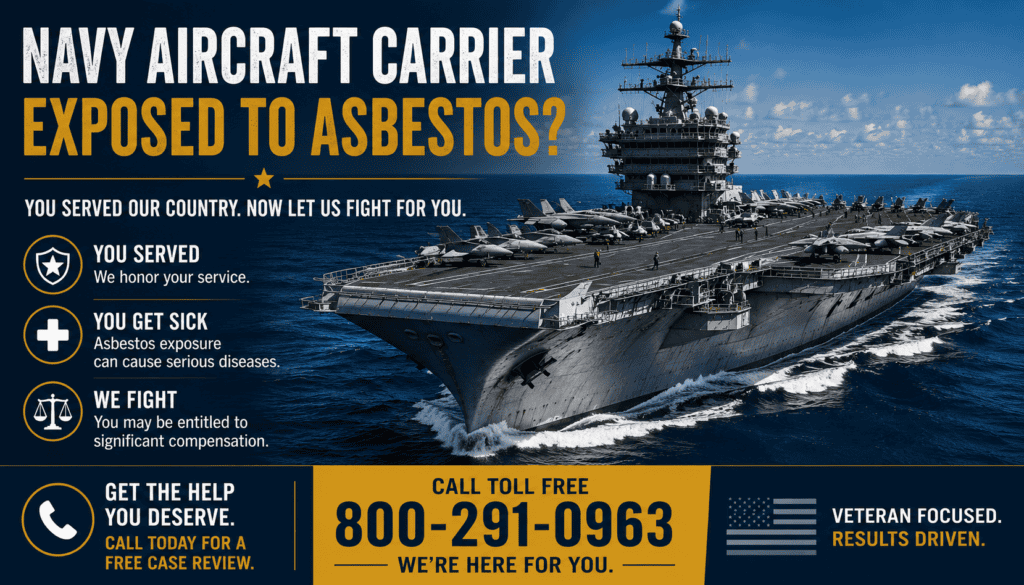
Navy Aircraft Carriers (CV) Asbestos Exposure Lawsuit
U.S. Navy Aircraft Carriers (CV-class) served as the cornerstone of American naval power—but these floating airbases were also filled with asbestos-containing materials in virtually every compartment. Designed to withstand intense heat, jet propulsion, and onboard combat operations, aircraft carriers used asbestos for insulation, fireproofing, and soundproofing. Thousands of sailors, aviation personnel, and shipyard workers who served on CV-class carriers were unknowingly exposed to toxic asbestos fibers, leading to serious illnesses such as mesothelioma, asbestosis, and lung cancer.
Our legal team helps Navy carrier veterans and their families pursue compensation through asbestos lawsuits, trust fund claims, and VA benefits—with no upfront legal costs and no interference with VA rights.
Why Asbestos Was Used Heavily Aboard Aircraft Carriers (CV)
Because aircraft carriers are high-risk environments involving jet engines, aviation fuel, ammunition, and nuclear propulsion, the Navy used asbestos for:
-
Insulating high-pressure steam systems, turbines, and exhaust systems
-
Fireproofing flight decks, hangar bays, and weapons magazines
-
Protecting electrical panels, cables, and radar rooms
-
Soundproofing sensitive areas like CICs, radio rooms, and berthing
Asbestos was used extensively in engine rooms, berthing spaces, ventilation systems, and even aircraft maintenance areas.
Aircraft Carrier Classes Where Asbestos Was Heavily Used
| Carrier Class | Example Ships |
|---|---|
| Essex-Class (WWII) | USS Yorktown (CV-10), USS Intrepid (CV-11), USS Ticonderoga (CV-14) |
| Midway-Class | USS Midway (CV-41), USS Coral Sea (CV-43), USS Franklin D. Roosevelt (CV-42) |
| Forrestal-Class | USS Forrestal (CV-59), USS Saratoga (CV-60), USS Ranger (CV-61) |
| Kitty Hawk-Class | USS Kitty Hawk (CV-63), USS America (CV-66) |
| Enterprise-Class | USS Enterprise (CVN-65) |
| Nimitz-Class (CVN) | USS Nimitz (CVN-68), USS Dwight D. Eisenhower (CVN-69) |
Every class of carrier constructed before the late 1970s included massive amounts of asbestos in both structural and mechanical systems.
Number of U.S. Service Members Exposed to Asbestos on Aircraft Carriers
U.S. Navy aircraft carriers have historically employed asbestos extensively due to its heat resistance and durability, especially in engine rooms, boilers, insulation, and fireproofing materials. Over the decades, millions of service members served aboard these vessels, placing a significant population at risk of asbestos exposure.
| Carrier Class | Estimated Number of Service Members Exposed |
|---|---|
| Essex-Class (WWII) | Approximately 250,000 sailors served on Essex-class carriers during and after WWII, many exposed to asbestos. |
| Midway-Class | Around 150,000 personnel served on Midway-class carriers, with prolonged asbestos exposure during maintenance and deployment. |
| Forrestal-Class | Nearly 120,000 service members served on Forrestal-class carriers during the Cold War era, facing high asbestos exposure risks. |
| Kitty Hawk-Class | An estimated 100,000 sailors served aboard Kitty Hawk-class carriers throughout their operational lives. |
| Enterprise-Class | Over 30,000 service members served aboard USS Enterprise (CVN-65), the first nuclear-powered carrier with extensive asbestos use in early years. |
| Nimitz-Class (CVN) | More than 200,000 personnel have served aboard Nimitz-class carriers since their commissioning, many encountering asbestos during construction and repairs. |
Total Estimated Exposure: Over 850,000 U.S. Navy personnel served on asbestos-containing aircraft carriers across these classes, making them one of the largest groups at risk for asbestos-related diseases.
Asbestos Exposure Areas on Navy Aircraft Carriers
Engine Rooms & Boiler Spaces
-
High-temperature components covered in asbestos for heat control
-
Sailors inhaled fibers during maintenance and routine operation
Flight Decks & Hangar Bays
-
Fireproof insulation in catapult systems, arresting gear, and aviation fueling stations
-
Jet mechanics and aviation personnel exposed during equipment servicing
Weapons & Ammunition Storage
-
Magazines lined with asbestos fire barriers
-
Ordnance handlers and gunners exposed while loading and cleaning compartments
Berthing & Mess Halls
-
Pipe insulation, floor tiles, ceiling panels, and adhesives contained asbestos
-
Fibers circulated through ventilation into sleeping and dining areas
CICs, Radio Rooms & Radar Control
-
Soundproofing and electrical insulation made with asbestos
-
Electricians and technicians exposed during installation or repair
Shipyard Maintenance & Overhauls
-
Asbestos disturbed during dry dock refits, welding, sanding, or panel removal
-
Exposure affected both ship crews and civilian workers
Navy Carrier Personnel at High Risk of Asbestos Exposure
| Occupation | Exposure Level | Duties with Asbestos Exposure | Job Description |
|---|---|---|---|
| Boiler Technicians (BT) | Extremely High | Operated boilers and steam systems | Worked daily in insulated machinery spaces |
| Machinist’s Mates (MM) | Extremely High | Maintained turbines, pumps, and generators | Exposed during repairs in asbestos-lined areas |
| Aviation Boatswain’s Mates | Very High | Handled aircraft fueling and arresting systems | Worked near asbestos-laden catapults and valves |
| Electrician’s Mates (EM) | High | Installed and serviced electrical systems | Cut into asbestos-insulated wires and panels |
| Damage Controlmen (DC) | High | Fire suppression and shipboard damage repair | Used asbestos fire blankets and gear |
| Airframe & Engine Technicians | High | Maintained jets and onboard aircraft systems | Exposed during exhaust, brake, and heat shield work |
| Weapons Techs & Gunners | Moderate | Loaded and maintained munitions and turrets | Exposed in insulated storage compartments |
| Cooks & Stewards | Moderate | Prepared food in asbestos-lined galley areas | Inhaled fibers through ventilation and flooring |
Common Asbestos Products Used on Navy Aircraft Carriers
🔥 Boiler & Turbine Insulation
Use: Controlled heat in propulsion systems and exhaust lines
Exposure: Routine inspection and repairs disturbed fragile insulation
🔧 Pipe Lagging & Valve Wraps
Use: Wrapped around steam, water, and fuel lines
Exposure: Maintenance work released airborne fibers into cramped spaces
🧱 Fireproof Panels & Bulkheads
Use: Lined high-risk areas like engine rooms and weapons bays
Exposure: Drilling or damage sent asbestos fibers into nearby compartments
⚙️ Gaskets & Seals
Use: Found in engines, pumps, aircraft arresting gear, and valves
Exposure: Replacement work produced asbestos dust
🪵 Floor Tiles & Tile Adhesives
Use: Installed throughout berthing, galleys, and passageways
Exposure: Broken tiles and worn adhesives released fibers
🧯 Protective Gear
Use: Firefighting blankets, gloves, and suits woven with asbestos
Exposure: Shed fibers during drills and emergencies
📦 Electrical Insulation
Use: Wrapped around wiring, panels, and radar systems
Exposure: Electricians and maintenance crews inhaled fibers while working
🎨 Paints, Adhesives & Sealants
Use: Contained asbestos to resist heat, corrosion, and fire
Exposure: Sanding, scraping, and wear produced airborne dust
🌬️ HVAC & Ventilation Insulation
Use: Ductwork and air systems insulated with asbestos
Exposure: Fibers circulated through shared air systems shipwide
Long-Term Health Risks from Aircraft Carrier Asbestos Exposure
-
Mesothelioma – Fatal cancer caused solely by asbestos exposure
-
Asbestosis – Irreversible scarring of lung tissue
-
Lung Cancer – Often appears decades after exposure
-
Pleural Thickening – Restrictive lung condition caused by asbestos damage
The Navy’s Knowledge of Asbestos Dangers
-
Manufacturers and government sources knew of the dangers by the 1930s
-
The Navy continued using asbestos materials without informing sailors
-
Crews aboard aircraft carriers were never warned or provided protection
Lawsuits Filed by Navy Aircraft Carrier Veterans
Thousands of lawsuits have been filed by CV veterans and families because:
-
Sailors were exposed daily while maintaining asbestos-filled systems
-
Contractors failed to warn or protect crew members
-
Veterans developed deadly illnesses decades after honorable service
-
Family members have filed wrongful death and survivor claims
Aircraft Carrier Asbestos Settlements & Verdicts
| Settlement | Case Summary |
|---|---|
| $9.2 million | Boiler tech exposed aboard USS Ranger (CV-61) |
| $8.0 million | Machinist’s mate exposed in USS Enterprise (CVN-65) |
| $7.1 million | Aviation tech exposed in hangar bay and catapult systems |
| $5.8 million | Electrician exposed while rewiring flight deck compartments |
| $4.6 million | Damage controlman exposed during fire suppression drills |
Asbestos Manufacturers & Contractors Involved
-
Johns-Manville
-
Raybestos-Manhattan
-
Owens Corning
-
Babcock & Wilcox
-
Armstrong World Industries
-
Foster Wheeler
-
Westinghouse Electric
-
General Dynamics
-
Eagle-Picher Industries
These companies supplied asbestos-containing products used in CV-class carriers and were later held accountable through lawsuits and trust fund settlements.
Navy Veterans & Asbestos Trust Funds
-
More than $30 billion remains available for asbestos exposure victims
-
Most Navy aircraft carrier veterans qualify for multiple trust payouts
-
Claims can be filed without attending court
-
Trust fund claims do not impact VA benefits
VA Benefits for Navy Aircraft Carrier Veterans with Mesothelioma
-
100% VA disability rating for mesothelioma
-
Tax-free monthly compensation (over $3,800/month)
-
Access to leading VA cancer specialists and treatment centers
-
Dependency & Indemnity Compensation (DIC) for surviving spouses
-
May be filed alongside lawsuits or trust fund claims
Navy Carrier Asbestos Lawsuit Process
1. Free Consultation
We review your diagnosis and aircraft carrier service records
2. Investigation
We collect ship logs, product exposure evidence, and duty documentation
3. File Claims
We file legal claims and/or trust fund submissions on your behalf
4. Settle or Go to Trial
Most cases resolve privately—no fees unless we win
Statute of Limitations
-
Most states allow 2–3 years from diagnosis to file
-
Wrongful death claims: 2–3 years from date of passing
-
Trust fund deadlines may extend longer—consult early to preserve rights
Frequently Asked Questions (CV Asbestos Exposure)
Q. Were aircraft carrier crews warned about asbestos?
No. Most were never informed, despite daily exposure.
Q. Can I file both a legal claim and VA claim?
Yes. Legal and VA claims are separate and may be filed together.
Q. Can family members file on behalf of deceased sailors?
Yes. Surviving spouses and children are eligible to file claims.
Q. How long do these cases take?
Most resolve within 6–18 months, depending on the case.
Why Work with Mesothelioma Help Center
-
Over 25 years of experience in Navy asbestos claims
-
Full access to CV-class ship records, crew rosters, and schematics
-
Millions recovered for Navy veterans and their families
-
No legal fees unless we win
-
We handle lawsuits and trust fund claims together for maximum results
Free Case Evaluation for Navy Aircraft Carrier Veterans
If you or a loved one served aboard a U.S. Navy aircraft carrier and developed mesothelioma or another asbestos-related disease:
📞 Call 800.291.0963 today for a free, no-obligation case review.
Let us help you recover the compensation and justice you deserve for your service—before time runs out.