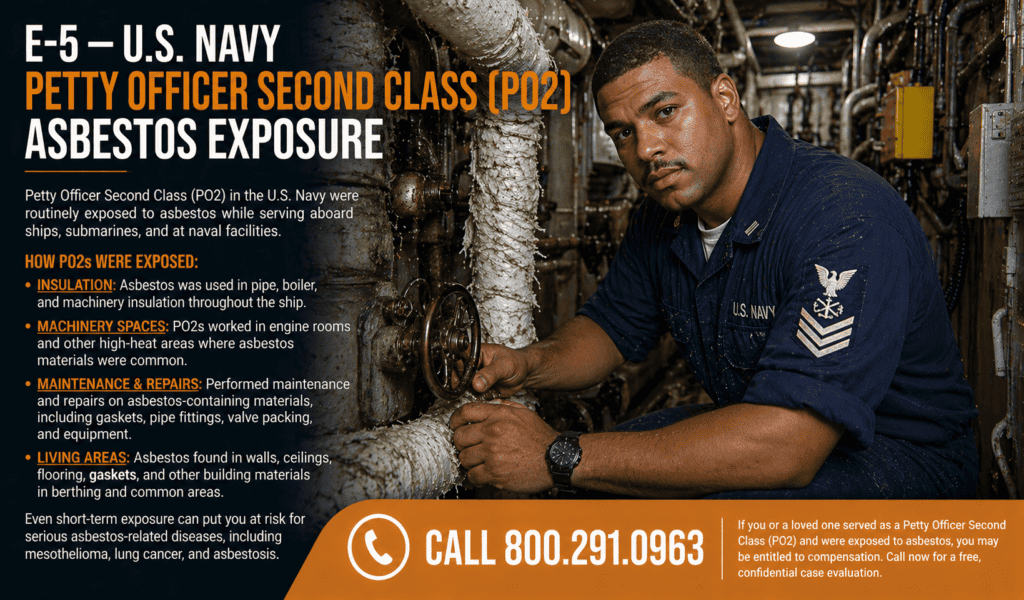
E-5 — Navy Petty Officer Second Class (PO2) Asbestos Exposure
⚠️ Asbestos Risks for U.S. Navy Petty Officer Second Class (PO2) Personnel
Petty Officer Second Class (PO2) sailors (E-5) served in some of the most asbestos-intensive environments of any enlisted rank in the U.S. Navy. As fully trained technicians and mid-level leaders, PO2 personnel supervised junior sailors while performing complex repairs across engineering spaces, propulsion plants, electrical rooms, and hull shops—areas where asbestos was widespread aboard pre-1980 naval vessels.
PO2s worked directly with high-heat components such as steam lines, boilers, turbines, pumps, generators, electrical panels, and machinery systems insulated with asbestos blankets, gaskets, packing, friction materials, and thermal insulation. They also participated in or supervised shipyard overhauls, drydock periods, and major maintenance evolutions—operations known to produce extremely high concentrations of airborne asbestos fibers.
Because of these duties, Petty Officer Second Class veterans often have clear, well-documented exposure pathways, making them strong candidates for VA disability compensation, asbestos trust funds, and legal claims.
🛠️ Typical Duties of an E-5 Navy Petty Officer Second Class (PO2)
PO2s perform specialized technical work while supervising E-1 to E-4 sailors. Their rating-specific assignments place them directly in engineering, propulsion, electrical, mechanical, and hull maintenance areas.
🔧 Advanced Mechanical, Electrical, or Hull Maintenance
PO2s often served in key technical ratings such as:
-
Machinist’s Mate (MM) – turbines, pumps, valves, steam systems
-
Electrician’s Mate (EM) – switchboards, wiring, transformers, electrical boards
-
Hull Technician (HT) – welding, pipefitting, structural repair, firefighting systems
-
Boiler Technician (BT) – boilers, burners, refractory materials
-
Engineman (EN) – auxiliary engines, generators, compressors
-
Damage Controlman (DC) – emergency repairs, fireproof materials
-
Electronics Technician (ET) – equipment insulated with ACM boards
These duties required extensive hands-on interaction with machinery and insulation systems historically filled with asbestos.
🧱 Asbestos Exposure Risks for Navy PO2 Personnel
🔥 1. High-Heat Pipes, Turbines & Engineering Spaces
Engineering spaces contained the highest levels of ACM aboard Navy ships. PO2s frequently worked around:
-
Thermal pipe insulation
-
Turbine blankets
-
Boiler insulation
-
Evaporator lagging
-
Pump and valve packing
-
Heat-resistant gaskets
-
Asbestos cloth and tape
-
Bulkhead panels made with ACM
PO2 machinists and engineering technicians inhaled asbestos dust during:
-
Pump overhauls
-
Valve rebuilds
-
Boiler inspections
-
Steam system repairs
-
Turbine maintenance
-
Chipping damaged insulation
-
Cleaning debris after repairs
Heat and constant ship vibration caused insulation to deteriorate rapidly, increasing airborne fibers.
🔩 2. Brake Linings & Friction Materials
Many mechanical systems required asbestos-based friction components, especially older vessels. Exposure sources included:
-
Winch brake pads
-
Capstan and anchor line brakes
-
Motor controller brakes
-
Aircraft carrier arresting-gear brakes
-
Berthing equipment brakes
-
Engine clutch systems
When PO2 technicians removed or replaced friction components, fibers were released into the air.
⚓ 3. Shipyard Overhauls & Drydock Repairs
Shipyard periods were among the highest exposure events for Navy PO2 personnel. During overhauls:
-
Insulation was stripped
-
Boilers were opened
-
Pipes were cut or resurfaced
-
Turbine blankets were removed
-
Bulkhead panels were replaced
-
ACM debris covered decks and work areas
PO2s supervised or assisted in:
-
Valve inspections
-
System testing
-
Pump and generator alignment
-
Welding and pipefitting preparation
-
Repair locker operations
Shipyards from the 1940s–1980s were heavily contaminated with asbestos, making these periods extremely hazardous.
🚢 Additional ACM Exposure Sources for PO2 Sailors
📡 Electrical Work
PO2 Electrician’s Mates encountered asbestos in:
-
Arc chutes
-
Fuse panels
-
Switchboards
-
Cable insulation
-
Heat-resistant electrical backing boards
Many electrical components were made from asbestos-reinforced materials to prevent thermal failure.
🛠 Hull & Structural Work
PO2 Hull Technicians disturbed ACM during:
-
Grinding and cutting metal
-
Preparing surfaces for welding
-
Removing insulation or gasket remnants
-
Repairing pipes with asbestos lagging
-
Damage control operations using ACM patching cloth
Even routine HT tasks released asbestos dust.
🛏 Living Quarters & Daily Workspaces
PO2 personnel lived and worked near deteriorating ACM in:
-
Deck tiles
-
Overhead pipe lagging
-
Bulkhead panels
-
Adhesive mastics
-
Ventilation ducts that circulated fibers
Cleaning, sweeping, or ship movement caused fibers to become airborne again.
📈 Why Navy PO2 Personnel Have Strong Asbestos Claims
Clear, Documented Exposure
PO2 sailors operated in:
-
Steam plants
-
Machinery spaces
-
Boiler rooms
-
Electrical spaces
-
Hull and repair shops
These locations are known ACM hotspots.
Supervisory Duties
PO2s often supervised younger sailors performing:
-
Insulation removal
-
Compartment cleaning
-
Gasket scraping
-
Pipefitting work
-
Ventilation repairs
Which further strengthens exposure evidence.
Ship and rating records support claims
VA and legal teams rely on:
-
Ship asbestos inventories
-
Overhaul logs
-
Rating-specific exposure charts
-
Navy manuals documenting ACM use
Even without precise memory, exposure is easy to prove.
📂 How Navy PO2 Veterans Prove Asbestos Exposure
Common evidence includes:
-
Ship assignment history
-
Rating (MM, EM, HT, BT, EN, ET, DC)
-
Service records confirming engineering or mechanical duties
-
Shipyard overhaul documentation
-
Naval technical manuals
-
Witness statements
-
VA asbestos ship lists
PO2 personnel rarely need to identify individual parts—documentation does it for them.
💼 Real-World PO2 Compensation Examples
📌 Case 1 — PO2 Machinist’s Mate
Turbines, valves, pumps, steam lines.
Compensation: $4.6M
📌 Case 2 — PO2 Hull Technician
Grinding, welding prep, pipe insulation removal.
Compensation: $4.1M
📌 Case 3 — PO2 Electrician’s Mate
Electrical panel insulation and cable ACM.
Compensation: $3.7M
📌 Case 4 — PO2 Boiler Technician
High-heat boiler room exposures.
Compensation: $4.9M
💙 Benefits Available to Navy PO2 Sailors
🎖 VA Disability Benefits
-
Mesothelioma → 100% rating
-
Many lung cancer claims are also accepted
💵 Asbestos Trust Funds
Over $30 billion available.
⚖ Legal Compensation
Filed against asbestos manufacturers—not the U.S. Navy.
❤️ VA DIC for Surviving Families
Tax-free benefits available for spouses and dependents.
❓ Frequently Asked Questions
🟦 Were PO2 sailors heavily exposed to asbestos?
Yes—engineering and mechanical duties placed them in the highest-risk shipboard environments.
🟦 Is exposure easy to prove without remembering details?
Yes. Rating + ship = documented ACM exposure.
🟦 Can families file after a veteran has died?
Yes—VA DIC + trust funds + legal claims remain open.
🟦 Did shipyard overhauls increase exposure?
Dramatically. Overhauls were among the most hazardous events.
📞 Get Help Identifying Your Asbestos Exposure as a Navy PO2
Petty Officer Second Class sailors spent their careers in the core asbestos environments of the fleet. If you or a loved one later developed an asbestos-related illness, specialists can identify exact exposure sources using Navy records, rating histories, and ship documentation.
📞 Call 800.291.0963 for a free Navy exposure review.