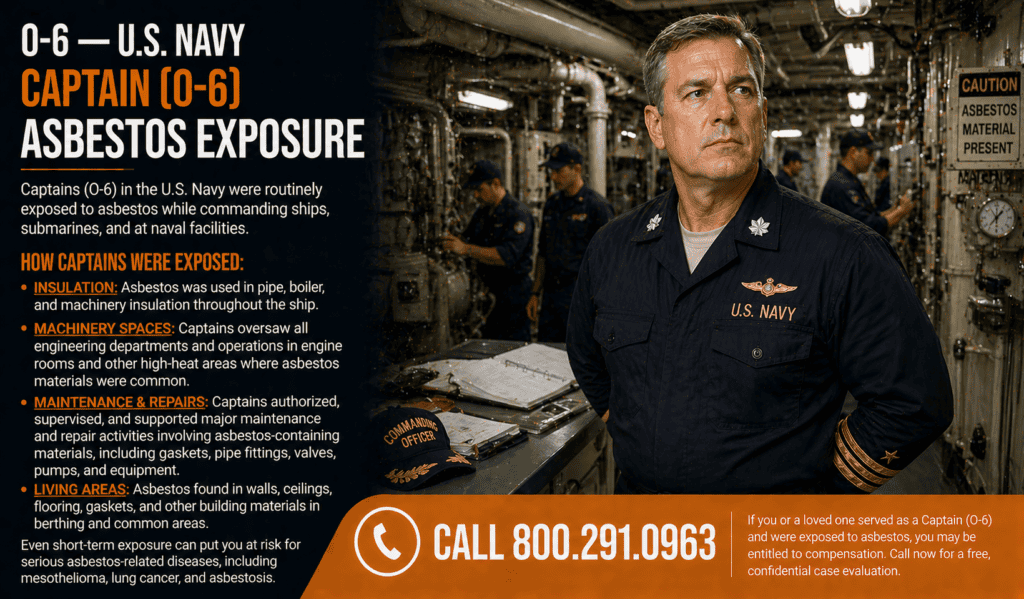
O-6 — U.S. Navy Captain (CAPT) Asbestos Exposure
⚠️ Asbestos Risks for U.S. Navy Captains (CAPT)
Navy Captains (O-6) hold some of the highest levels of operational responsibility in the U.S. Navy. They command major warships, large shore installations, aviation wings, surface combatants, amphibious ships, submarine squadrons, or logistical commands. During the decades when asbestos was widely used throughout the Navy (1930s–late 1980s), Captains routinely worked in command centers, administrative offices, bridge structures, engineering spaces, and crew living areas that were built with asbestos-containing materials (ACM).
Although Captains rarely performed hands-on repairs, their executive responsibilities required constant physical presence in every major compartment of the ship or facility they commanded. They oversaw readiness inspections, engineering assessments, shipyard modernization cycles, training evolutions, and material condition checks—each requiring extended time in compartments that historically contained high concentrations of airborne asbestos fibers.
Captains often served decades-long careers, frequently stationed on multiple ships or bases built before asbestos restrictions. This created cumulative exposure over many years, resulting in a significantly elevated risk for mesothelioma, asbestos-related lung cancer, and asbestosis later in life.
🛠️ Typical Duties of a Navy Captain (CAPT)
🔧 Command of Major Warships or Installations
Navy Captains serve as:
-
Commanding Officers of cruisers, destroyers, and amphibious ships
-
Commanding Officers of aviation squadrons or wings
-
Commanders of submarine squadrons
-
Base Commanders of large installations
-
Commanding Officers of logistic hubs
These roles required daily movement throughout high-risk ACM areas.
⚓ Oversight of Ship Readiness and Engineering Operations
Captains are responsible for:
-
engineering department performance
-
propulsion and power plant operations
-
damage control readiness
-
electrical and auxiliary systems
-
communications and navigation integrity
-
flight deck and hangar operations (for aviation commands)
All of these spaces historically included thermal insulation, pipe lagging, gaskets, millboard, and fireproof materials containing asbestos.
🛠 Supervision of Maintenance, Repairs & Inspections
Captains did not conduct repairs themselves but routinely supervised or inspected:
-
steam lines
-
turbines and boilers
-
pump rooms
-
engine rooms
-
electrical switchboards
-
ventilation ducts
-
compartment material conditions
These tasks brought Captains into the same asbestos-heavy environments that junior engineering personnel worked in daily.
📋 Administrative & Strategic Leadership
Even office spaces were often built with asbestos, including:
-
vinyl asbestos floor tiles
-
asbestos-backed adhesives
-
ACM ceiling panels
-
pipe insulation above the ceiling
-
fireproof paneling
Thus, both operational and administrative aspects of the job carried exposure risk.
🧱 Asbestos Exposure Risks for Navy Captains (CAPT)
🔥 1. Pre-Ban Construction Materials in Command Offices
Asbestos was used extensively in commanding officer spaces aboard ships and shore commands, including:
-
overhead insulation
-
tiled flooring
-
adhesive mastics
-
pipe insulation in office ceilings
-
soundproofing panels
Millions of microscopic asbestos fibers circulated whenever these aging materials deteriorated.
⚓ 2. Shipboard Command Centers Built with ACM
The “nerve centers” of Navy ships—combat information centers, pilot houses, navigation consoles, and radio rooms—contained asbestos in:
-
heat-resistant panels
-
insulated wiring chases
-
deck tiles
-
fireproof wallboard
Captains spent long hours in these compartments directing ship operations.
🚢 3. Presence During Shipyard Overhauls
During maintenance cycles, Captains reviewed:
-
boiler tear-outs
-
insulation removal
-
replacement of pipe lagging
-
pump and valve gasket work
-
hull and bulkhead refurbishment
Shipyards were among the most contaminated asbestos environments in the military. Supervisory presence in these spaces significantly increased exposure.
🛠 4. Engineering & Mechanical Space Inspections
Captains routinely accessed:
-
boiler rooms
-
turbine spaces
-
pump rooms
-
auxiliary machinery compartments
-
electrical distribution rooms
These spaces had some of the highest concentrations of asbestos dust aboard Navy vessels.
🌀 5. Ventilation Systems That Distributed Fibers
Aging ships circulated asbestos fibers through:
-
ventilation ducts
-
air treatment systems
-
fan rooms
-
contaminated filters
Even captains working exclusively in administrative or command spaces inhaled asbestos from systemwide airflow.
⚙️ 6. High-Risk Areas on Older Bases
Shore commands housed Captains in buildings that contained asbestos in:
-
heating and boiler plants
-
wallboard
-
roofing materials
-
floor tiles
-
pipe insulation
-
electrical rooms
-
basements and crawlspaces
Many Navy bases continued using ACM long after ships transitioned away from it.
📈 Why Navy Captains Have Strong Asbestos Claims
1. Long Naval Careers
Many Captains served 20–30 years, compounding exposure.
2. Repeated tours on pre-1980 ships
Most of the Navy’s fleet during those decades contained asbestos in nearly every system.
3. Command responsibility requiring presence in every compartment
Captains frequently moved between engineering, administrative, and operational spaces.
4. Involvement in shipyard availability and modernization
These periods resulted in highly concentrated airborne asbestos exposure.
5. Documented ACM in officer spaces
Technical manuals show asbestos in bridge structures, control rooms, and commander quarters.
📂 How Navy Captains Prove Asbestos Exposure
📄 Service Records & Sea Duty Assignments
Documenting:
-
ships commanded
-
years of service
-
ship classes (destroyers, cruisers, amphibious ships, etc.)
-
base commands
All carry known asbestos histories.
📘 Navy Asbestos Ship Lists
Confirm exposure for nearly every pre-1985 vessel.
🧰 Maintenance & Shipyard Records
Show extensive asbestos removal and replacement projects.
📚 Navy Technical Manuals
Identify asbestos use in:
-
command center panels
-
bulkhead insulation
-
floor adhesives
-
wiring channels
-
steam system insulation
👥 XO/CO Witness Statements
Support claims that Captains were physically present during ACM maintenance work.
💼 Real Compensation Examples for Navy Captains
📌 Case 1 — CAPT Commanding Cruiser
Years spent in ACM-lined command centers.
Compensation: $5.2M
📌 Case 2 — CAPT at Shore Installation
Exposure from aging administrative buildings.
Compensation: $4.6M
📌 Case 3 — CAPT During Shipyard Overhaul
Heavy dust exposure during boiler and steam system teardown.
Compensation: $5.1M
📌 Case 4 — CAPT in Aviation Command
Hangar insulation + base contamination.
Compensation: $4.3M
💙 Benefits Available to Navy Captain Veterans
🎖 VA Disability Benefits
Mesothelioma = 100% disability rating
💵 Asbestos Trust Fund Compensation
More than $30 billion available.
⚖ Legal Claims
Claims are filed against product manufacturers—not the Navy.
❤️ VA DIC Survivor Benefits
Available to families of deceased Navy Captains.
❓ Frequently Asked Questions
🟦 Did Captains face asbestos exposure even in office spaces?
Yes—offices, staterooms, and command centers all contained ACM.
🟦 Does leadership service qualify as asbestos exposure?
Yes—supervisory presence in contaminated areas is recognized.
🟦 Can a family file after the Captain passes away?
Yes—VA DIC and legal claims remain available.
📞 Get Help Identifying Your Asbestos Exposure as a Navy Captain (CAPT)
If you served as a Navy Captain aboard older vessels or commanded bases built before 1980, you were likely exposed to asbestos. A specialist can help confirm exposure locations and navigate VA and legal claims.
📞 Call 800.291.0963 for a free Navy exposure review.