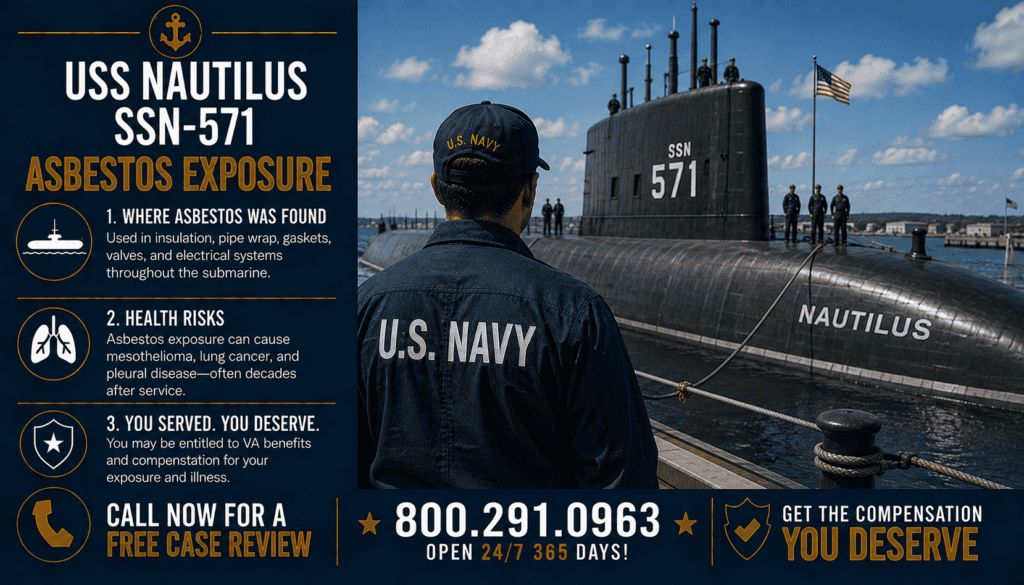
⚓ USS Nautilus (SSN-571)
Early Nuclear Submarine Asbestos Exposure
The USS Nautilus (SSN-571)—the world’s first operational nuclear-powered submarine—made naval history when launched in 1954. Yet her groundbreaking design came with hidden dangers: asbestos insulation, heavily used throughout the propulsion system, turbines, and living compartments. Because nuclear propulsion demanded extreme heat resistance, asbestos was applied liberally to nearly every component near the reactor and steam systems. Sailors, engineers, and shipyard crews working aboard or refitting the Nautilus were unknowingly exposed to toxic fibers for decades.
This guide outlines where asbestos existed aboard the Nautilus, who was most at risk, and how veterans and workers can pursue VA disability, trust-fund, and civil compensation today.
📞 Need help proving exposure aboard the USS Nautilus? Call 800.291.0963 for free assistance now.
🧭 Step 1: Asbestos Use in Early Nuclear Submarine Design
Because engineers were experimenting with new propulsion temperatures, asbestos was considered essential for insulation and safety.
Common asbestos applications aboard:
-
⚙️ Reactor-compartment heat shielding and pipe lagging.
-
🧱 Boiler, turbine, and valve gaskets throughout propulsion spaces.
-
💨 Ductwork and ventilation insulation to control reactor heat.
-
🔩 Electrical panels and wiring insulation near power systems.
-
🧰 Deck tiles and wall panels containing asbestos for fireproofing.
Goal: Understand how every major system aboard the Nautilus used asbestos to manage heat and pressure.
📁 Step 2: Construction & Maintenance Sites
The USS Nautilus was constructed and refitted in facilities that extensively handled asbestos materials.
Key shipyards:
-
⚓ Electric Boat Division (Groton, CT): Original construction and early maintenance.
-
⚙️ Portsmouth Naval Shipyard: Reactor and turbine system upgrades.
-
🧱 Puget Sound Naval Shipyard: Deactivation and final preservation.
Goal: Identify your service or civilian worksite to trace asbestos exposure history.
🏗️ Step 3: Who Was Exposed
Because of tight quarters and continuous propulsion maintenance, nearly all crewmen risked exposure.
Highest-risk personnel:
-
🧰 Machinist’s Mates (MM) and Boiler Technicians (BT) handling turbines.
-
⚙️ Nuclear Reactor Operators and Engine Room Crew.
-
💡 Electrician’s Mates (EM) and Electronics Technicians (ET) near insulated cables.
-
🧾 Civilian shipyard engineers and welders during retrofits or decommissioning.
Goal: Match your job specialty to likely asbestos contact zones.
💼 Step 4: How Exposure Occurred
Microscopic asbestos fibers circulated throughout sealed compartments for months during operations.
Common exposure activities:
-
🔧 Replacing or resealing turbine and valve gaskets.
-
💨 Grinding, sanding, or cutting asbestos lagging to fit new systems.
-
🧱 Cleaning reactor and bilge areas contaminated with fiber dust.
-
⚙️ Overhaul work during refueling or modernization projects.
Goal: Record maintenance tasks and duty logs proving confined-space exposure.
🩺 Step 5: Health Risks for Nautilus Personnel
Asbestos-related diseases can appear decades after exposure.
Common conditions include:
-
💀 Mesothelioma (pleural or peritoneal).
-
🫁 Asbestosis and restrictive lung scarring.
-
💬 Pleural plaques and effusions.
-
🩺 Lung, laryngeal, and gastrointestinal cancers.
Goal: Seek prompt screening and maintain lifelong health monitoring.
⚖️ Step 6: VA Disability Benefits for Nautilus Veterans
Veterans diagnosed with asbestos-related illnesses qualify for 100% VA disability.
Benefits include:
-
💰 Tax-free monthly compensation.
-
🏥 Access to VA mesothelioma specialists and travel reimbursement.
-
🕊️ DIC survivor benefits for family members.
-
⚖️ Eligibility for separate asbestos trust-fund recovery.
Goal: File both VA and trust-fund claims simultaneously for full compensation.
🧱 Step 7: Civilian & Shipyard Worker Compensation
Workers who helped build, overhaul, or decommission the Nautilus may also file claims.
Options:
-
⚖️ Asbestos trust-fund claims (over $32 billion available).
-
💵 Civil lawsuits against asbestos-product manufacturers.
-
🧾 SSDI and state workers’-comp programs.
-
🕊️ Wrongful-death claims for surviving families.
Goal: Collect employment records, pay stubs, and yard-assignment documentation.
🧠 Step 8: Supporting Evidence for Nautilus Claims
Key documentation:
-
🧾 Service or employment records listing the USS Nautilus (SSN-571).
-
⚙️ Maintenance or refueling logs mentioning insulation or lagging.
-
💬 Statements from shipmates or supervisors.
-
🧱 Decommissioning and abatement reports from the Navy and EPA.
Goal: Link your service period with official asbestos documentation.
🌈 Step 9: Decommissioning & Museum Preservation
The Nautilus was decommissioned in 1980 and now serves as a museum in Groton, CT.
Cleanup history:
-
🏗️ Asbestos abatement completed during 1980s deactivation.
-
⚙️ EPA and Navy records confirm extensive removal operations.
-
🧾 Preservation logs document prior asbestos contamination areas.
Goal: Use museum and abatement data to verify historical exposure.
💬 Step 10: Filing Your Claim
Next steps:
-
🧭 Confirm service dates or employment records tied to SSN-571.
-
⚙️ Collect medical and pathology reports.
-
🧾 File coordinated VA, trust-fund, and civil claims.
-
📞 Call 800.291.0963 for free case support.
Goal: Secure compensation and healthcare benefits before deadlines expire.
🤝 Where to Get Help
Our advocates assist USS Nautilus veterans and shipyard employees exposed during construction, operation, or decommissioning.
📞 Call 800.291.0963 to begin your claim today.
🧭 Summary
The USS Nautilus (SSN-571) marked the dawn of nuclear naval power—and widespread asbestos exposure for her pioneering crew. Every patrol and refit disturbed heat-resistant materials now known to cause mesothelioma and other deadly diseases. Veterans and workers can recover VA disability, asbestos trust-fund, and legal compensation for service-connected exposure.
Your service made history—now let justice honor it.
800.291.0963