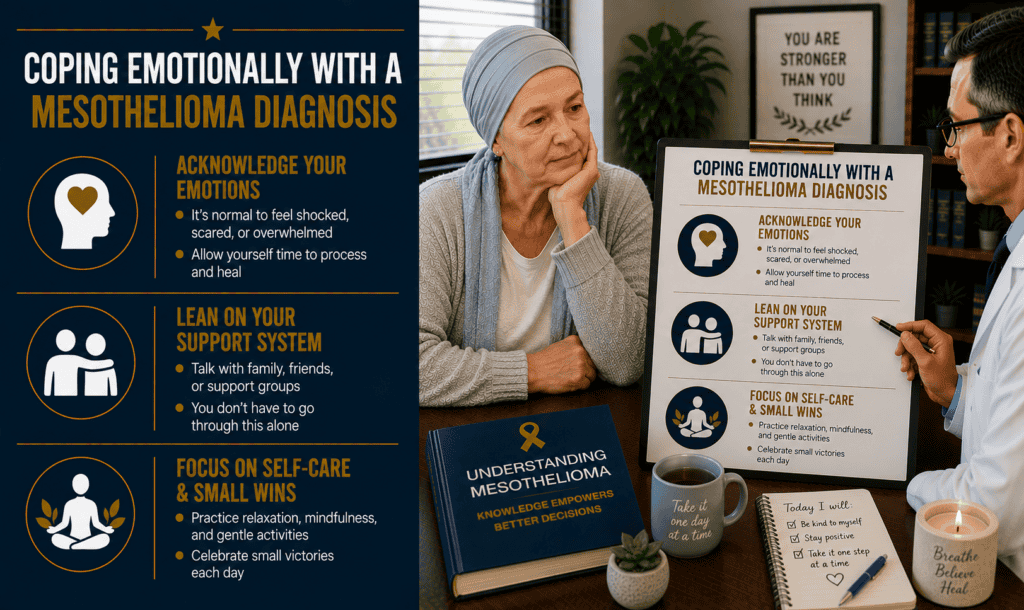
Coping Emotionally With a Mesothelioma Diagnosis
Practical ways to manage fear, uncertainty, relationships and day-to-day stress while finding support that fits your needs.
Receiving a mesothelioma diagnosis can change how you think about the future, your family and ordinary routines. Some people feel frightened or angry; others feel numb, focused on logistics or unsure what they feel. There is no required emotional response and no deadline for feeling better. Emotional care is part of cancer care, not a substitute for medical treatment.
Start here: Ask your oncology team who can help with emotional distress, write down your most immediate questions, and choose one person who can help you organize appointments. You do not have to make every decision at once.
Understanding the Emotional Impact
A cancer diagnosis may bring fear about treatment, sadness about changing plans, anger about asbestos exposure, uncertainty about work, or concern for people who depend on you. Reactions can change from day to day. The National Cancer Institute (NCI) describes distress as a spectrum: some people adjust with their usual supports, while others benefit from counseling, social work or additional mental-health treatment.
Physical symptoms can amplify emotional distress. Pain, breathlessness, poor sleep and exhaustion can make concentration and coping harder. Tell the care team about both physical and emotional symptoms; neither needs to be endured silently.
| Experience | What it may feel like | A useful first response |
|---|---|---|
| Shock or numbness | Difficulty taking in information | Ask for written notes and a follow-up conversation |
| Fear or uncertainty | Repeated worst-case thoughts | List questions that only your care team can answer |
| Anger | Frustration about illness or exposure | Talk with a trusted person or counselor without judging the emotion |
| Sadness or isolation | Pulling away from familiar activities | Ask someone to spend time with you without requiring conversation |
| Overwhelm | Too many decisions at once | Identify the next one or two decisions, not every future decision |
Emotional reactions alone do not tell you how the disease will progress. If you are looking at survival statistics, read our guide to what staging and prognosis numbers mean and ask your specialist how published figures relate—or do not relate—to your individual circumstances.
What to Do in the First Days
The first days can be especially difficult because medical language, appointments and decisions arrive quickly. A short written plan may reduce the number of details you need to remember.
| Priority | Action | Why it helps |
|---|---|---|
| Understand the diagnosis | Request a copy of the pathology report and ask what remains uncertain | Separates confirmed findings from questions still being evaluated |
| Find the right team | Ask about a mesothelioma specialist or second opinion | Provides another opportunity to understand options |
| Choose a point person | Ask a trusted person to coordinate updates if you wish | Reduces repeated conversations |
| Keep one notebook | Record questions, symptoms, medication changes and contacts | Makes appointments easier to navigate |
| Protect recovery time | Limit visitors or calls when you need rest | Preserves energy for what matters to you |
Our second-opinion guide explains how to request records and compare recommendations. You can also review the mesothelioma stages overview after your team confirms which staging system applies to your disease.
You may decide how much information to receive at a time. Ask your clinician for a plain-language explanation, a written summary, or a separate appointment to discuss complex decisions. A family member can attend with your permission.
Practical Coping Strategies
Coping strategies are tools, not obligations. Choose approaches that suit your values, physical abilities and current energy. If one method does not help, that does not mean you are coping incorrectly.
| Strategy | A realistic way to try it | Adjustment for difficult days |
|---|---|---|
| Grounding | Notice your feet on the floor and name a few things you can see | Use a short exercise rather than a long session |
| Brief planning | Choose one task for the morning and one for later | Ask someone else to handle the second task |
| Connection | Arrange a short call with a trusted person | Send a text when talking is tiring |
| Meaningful activity | Listen to music, spend time outdoors or enjoy a hobby | Adapt the activity to your symptoms |
| Information boundaries | Choose a reliable source and a limited reading period | Ask your clinician to explain what you find |
Sleep disruption and exhaustion can make distress more difficult to manage. See difficulty sleeping with mesothelioma and severe fatigue in mesothelioma for practical discussions to bring to your medical team. Ask before beginning exercise or breathing techniques if you have significant symptoms.
Try replacing an impossible goal—“I must stay positive”—with a workable one: “I can ask for help with the next decision.” You can experience hope, fear, grief and gratitude at different times or all at once.
When and How to Get Professional Support
Tell your oncology team if anxiety, low mood, panic, sleeplessness or distress interferes with eating, attending appointments, relationships or daily activities. Your team can screen for distress and refer you to an oncology social worker, psychologist, psychiatrist, palliative-care clinician or spiritual-care provider according to your preferences.
| Who may help | Typical role | What to ask |
|---|---|---|
| Oncology social worker | Emotional support, practical resources and referrals | Can you help with counseling and transportation or benefit resources? |
| Psychologist or counselor | Talk therapy and coping skills | Do you have experience with people living with cancer? |
| Psychiatrist or prescribing clinician | Assessment and medication when appropriate | How might treatment interact with my cancer medications? |
| Palliative-care team | Relief of symptoms and support at any disease stage | Can you help with pain, sleep and distress alongside cancer treatment? |
| Spiritual-care provider | Meaning, faith or existential concerns if desired | Can I speak with someone who respects my beliefs? |
Seek prompt professional help for persistent hopelessness, severe anxiety, inability to function or major changes in sleep or behavior. If someone may harm themselves, seek immediate emergency assistance. In the United States, call or text 988 for suicide and crisis support; call 911 for immediate danger.
New confusion, sudden behavior changes, severe breathlessness or other acute physical symptoms need urgent medical evaluation rather than being assumed to be anxiety. A clinician can check for medication effects or other medical causes.
Talking With Family and Your Care Team
You control whom you tell and how much you share. A short script can set expectations: “I have a mesothelioma diagnosis. I am still learning about my options. I appreciate your support, but I may not be ready to answer detailed questions.” You can ask a trusted person to provide updates with your permission.
| Conversation | Possible wording | Purpose |
|---|---|---|
| With a partner | I need you to listen before we solve anything. | Clarifies the kind of support needed |
| With children or relatives | Here is what the doctors know now; we will share updates when we have them. | Avoids speculation |
| With friends | A meal or ride would help more than advice right now. | Makes practical help specific |
| With the care team | Please explain the options in everyday language and write them down. | Supports informed decisions |
The NCI emphasizes that clear communication can improve understanding and help patients receive care aligned with their preferences. Our treatment overview can help you prepare topics to discuss, but your clinicians should explain what is appropriate for your diagnosis.
Managing Treatment and Financial Stress
Emotional distress may reflect concrete problems: missed work, travel to appointments, treatment costs, insurance questions or uncertainty about caregiving. Addressing a practical problem may relieve some of the pressure even when it does not remove the underlying worry.
| Stress point | First step | Potential helper |
|---|---|---|
| Appointment logistics | Create a shared calendar and transportation plan | Patient navigator or trusted relative |
| Insurance questions | Ask for an explanation of coverage and authorization | Hospital financial counselor or insurer |
| Income and leave | Gather employment and benefit documents | Social worker or employer benefits office |
| Symptoms affecting plans | Report changes and ask about symptom relief | Oncology or palliative-care team |
| Too many online claims | Use official medical sources and verify specifics | Treating specialist |
Financial and legal eligibility depends on individual circumstances; no settlement, benefit or result is guaranteed. Keep medical decisions separate from any legal consultation. Do not delay recommended care while investigating potential claims.
Support for Family and Caregivers
Family members and friends may also feel frightened, tired or uncertain. They may need their own emotional support. A caregiver can help with transport, medication lists or communication without taking over decisions the patient wants to make.
| Caregiver need | Practical response |
|---|---|
| Clear responsibilities | Divide appointments, meals and paperwork among willing helpers |
| Rest | Schedule breaks and arrange backup help when possible |
| Emotional outlet | Seek a counselor, peer group or trusted friend |
| Accurate information | Ask permission to attend appointments and take notes |
| Respect for autonomy | Ask the patient which decisions and updates they want to manage |
Caregiver strain is a legitimate reason to request assistance. Ask the cancer center about caregiver services, social work and support groups; support can be useful before a crisis develops.
Questions, Resources and Next Steps
Questions to bring to your next appointment
- Who on this team screens for emotional distress, and how can I reach them?
- Can I speak with an oncology social worker or counselor?
- Which symptoms should I report urgently?
- What information is confirmed, and what still needs testing?
- Can a patient navigator help coordinate visits and records?
- What support is available for family members or caregivers?
| Resource | What it offers | Link |
|---|---|---|
| NCI: Coping with Cancer | Patient information on feelings, daily life and support | https://www.cancer.gov/about-cancer/coping |
| NCI: Adjustment to Cancer | Detailed patient guidance on distress and professional support | https://www.cancer.gov/about-cancer/coping/feelings/anxiety-distress-pdq |
| NCI: Communication in Cancer Care | How to discuss diagnosis and preferences with clinicians | https://www.cancer.gov/about-cancer/coping/adjusting-to-cancer/communication-pdq |
| NCI: Family Caregivers | Caregiver roles and support needs | https://www.cancer.gov/about-cancer/coping/family-friends/family-caregivers-pdq |
Confirmed primary medical references: NCI Coping with Cancer; NCI Adjustment to Cancer; NCI Communication in Cancer Care; NCI Family Caregivers.
Frequently Asked Questions
Is it normal to feel numb after a mesothelioma diagnosis?
Some people initially feel numb or focused on practical tasks; others experience strong emotions. Reactions vary. Ask for help if distress persists or disrupts everyday functioning.
Do I have to stay positive to cope well?
No. You do not need to suppress fear or sadness. Coping can include honest conversations, symptom relief, counseling and asking for practical help.
Can anxiety make physical symptoms feel worse?
Distress and physical symptoms can interact, but new or worsening symptoms should be evaluated medically rather than attributed to anxiety without assessment.
When should I ask for counseling?
You can ask at any point. It is especially important when worry, sadness, panic or sleep problems interfere with care, relationships or daily activities.
Can palliative care help with emotional distress?
Yes. Palliative care can address symptoms and emotional concerns alongside disease-directed treatment; it is not limited to end-of-life care.
How should I tell my family?
Share what is confirmed, choose the amount of detail you are comfortable with, and ask for specific kinds of help. A social worker can assist with difficult conversations.
What if I am overwhelmed by survival statistics?
Ask your specialist to explain the source, patient population and limits of the numbers. Population averages cannot predict an individual outcome.
What should caregivers do if they feel overwhelmed?
They can ask the cancer team about social work, respite, counseling and caregiver groups. Sharing responsibilities and taking breaks are reasonable parts of caregiving.
Get Help and Explore Your Options
Call 800.291.0963 to discuss mesothelioma-related information and possible legal options. Live chat is available 24/7, 365 days a year. Submit Your Case using the form below.
Every case is different. Contacting us does not guarantee compensation or establish an attorney-client relationship. For emotional-health concerns, contact your oncology team or a qualified mental-health professional; this phone line is not an emergency or crisis service.
⚕️ Legal & Medical Information Disclaimer
This article provides general educational information, not individualized medical, mental-health or legal advice. Consult qualified clinicians and legal professionals about your circumstances. Seek emergency help for immediate safety concerns.