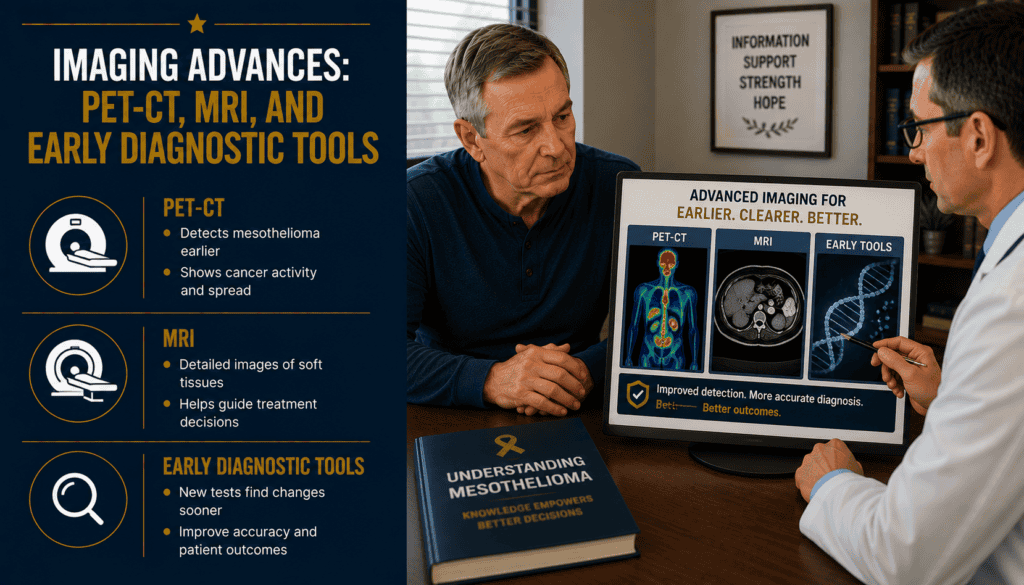
Imaging Advances: PET/CT, MRI and Early Diagnostic Tools for Mesothelioma
How modern scans support evaluation, staging, biopsy planning and follow-up—and why images alone cannot establish a diagnosis.
A suspicious chest X-ray or CT scan can raise concern about mesothelioma, but an image is only one part of a careful evaluation. CT shows anatomy, PET shows patterns of metabolic activity, and MRI can clarify relationships between a tumor and nearby soft tissues. These tools answer different questions. The appropriate sequence depends on symptoms, where disease is suspected, prior imaging, and whether a tissue sample has been obtained.
Key point: Imaging cannot confirm or exclude mesothelioma on its own. A specialist typically needs an adequate tissue sample examined by a pathologist. A normal or inconclusive scan does not override persistent symptoms or a concerning clinical history. See the mesothelioma diagnosis overview for the full process.
What Imaging Advances Can—and Cannot—Do
Imaging has several distinct roles: detecting an abnormality that needs investigation, locating an appropriate biopsy target, assessing possible spread, informing treatment discussions, and comparing findings over time. A scan may also show fluid around the lung or in the abdomen. Such findings are not specific to mesothelioma; infection, other cancers and noncancerous conditions can produce overlapping appearances.
| Clinical question | What imaging contributes | What remains uncertain |
|---|---|---|
| Is something abnormal? | Shows fluid, thickening, a mass or other change. | The underlying cause. |
| Where should tissue be sampled? | Helps identify a potentially accessible target. | Whether a sample will be adequate. |
| Has disease spread? | Maps suspicious sites for staging workup. | Some findings need tissue confirmation. |
| Is treatment working? | Compares current images with a baseline. | Changes can reflect treatment effects or inflammation. |
The imaging tests guide explains standard scans in more detail. For patients with symptoms or a suspicious finding, clinicians use imaging as part of a diagnostic evaluation—not as a stand-alone screening guarantee.
PET/CT, CT, MRI and Ultrasound Compared
The word “advanced” does not automatically mean “better.” Each scan has a particular strength, and more tests are not always necessary. A radiologist and mesothelioma team select studies that address a specific unanswered question.
| Test | Main contribution | Important limitation |
|---|---|---|
| Chest X-ray | Fast initial view of the chest and possible fluid. | May miss or poorly characterize subtle pleural disease. |
| Contrast-enhanced CT | Detailed cross-sectional anatomy and distribution. | Cannot determine cancer type by appearance alone. |
| FDG PET/CT | Combines metabolic activity with CT localization. | Inflammation may also be FDG-avid; some tumors may show limited uptake. |
| MRI | Detailed soft-tissue assessment, including selected chest-wall or diaphragm questions. | Longer exam; not necessary for every patient. |
| Ultrasound | Real-time fluid assessment and guidance for selected procedures. | Cannot survey the entire chest or abdomen like CT. |
A chest X-ray may be an entry point; CT is often central to subsequent evaluation. MRI or PET/CT may be added when they are likely to change staging or treatment decisions.
PET/CT: Metabolic Activity and Anatomy
PET usually uses a small injected amount of fluorodeoxyglucose (FDG), a radioactive glucose analogue. Areas with greater tracer uptake can appear brighter. Combining PET with CT places those findings in anatomical context. In a person already diagnosed with mesothelioma, PET/CT may help investigate lymph nodes or possible disease outside the original area. It may also help clinicians decide which suspicious site merits additional testing.
| PET/CT finding | Possible interpretation | Reason to discuss it |
|---|---|---|
| FDG-avid pleural thickening | Can raise concern for active disease. | Inflammation can also cause uptake. |
| Suspicious distant focus | May prompt evaluation for spread. | A separate condition or second cancer is possible. |
| Low uptake despite abnormal CT | Does not necessarily exclude disease. | Some lesions are small or less metabolically active. |
| Uptake after a recent procedure | May represent healing or inflammation. | Timing matters when interpreting results. |
PET/CT is not a replacement for pathology. Ask whether any PET finding would alter the biopsy plan, stage assignment or treatment approach. Your team should also know about recent surgery, infection or other procedures before interpreting uptake.
MRI: Evaluating Soft-Tissue Involvement
MRI uses magnetic fields and radio waves rather than ionizing radiation. Its soft-tissue contrast may help clarify suspected involvement of the diaphragm, chest wall or other nearby structures in selected patients with pleural mesothelioma. A surgeon may request MRI when CT leaves an important question unresolved. MRI does not independently identify mesothelioma cells or prove that an abnormality is cancer.
| MRI question | Potential benefit | Practical consideration |
|---|---|---|
| Does a lesion involve adjacent soft tissue? | More detailed assessment in selected anatomical areas. | Protocol should match the clinical question. |
| Is there concern about diaphragm involvement? | Can help clarify suspected local extension. | Interpretation still has uncertainty. |
| Is MRI safe for this patient? | Screening identifies incompatible devices or metal. | Tell the imaging team about implants and prior procedures. |
| Is contrast needed? | May improve characterization for some protocols. | Kidney history and previous contrast reactions matter. |
Patients with claustrophobia, implanted devices or difficulty lying flat should alert the imaging center in advance. A tailored plan may make the exam safer and more tolerable.
Early Detection and Emerging Imaging Tools
Researchers are exploring approaches such as PET/MRI combinations, advanced image analysis and radiomics, and new molecular tracers. These methods aim to extract more information from scans or visualize biological features beyond standard anatomy. However, a promising research technique is not the same as a validated, routinely available early-detection test for mesothelioma.
| Approach | What is being explored | Current caution |
|---|---|---|
| PET/MRI | Combining metabolic and detailed soft-tissue information. | Availability and clinical role vary. |
| Radiomics / AI image analysis | Quantitative patterns extracted from images. | Needs external validation and reliable clinical performance. |
| New PET tracers | Imaging biological targets beyond FDG. | Many applications remain investigational. |
| Serial imaging in exposed people | Whether changes can be identified earlier. | No major medical organization currently recommends routine mesothelioma screening solely for asbestos exposure. |
The American Cancer Society notes that there is no recommended routine mesothelioma screening program even for people with known asbestos exposure. Someone with symptoms should seek clinical assessment rather than waiting for a future screening technology. Read what to expect at a screening or evaluation appointment and why blood biomarkers are not stand-alone detection tests.
How Imaging Guides Biopsy and Diagnosis
When imaging raises suspicion, clinicians select a way to obtain tissue. CT or ultrasound may help guide a needle to an accessible abnormality; thoracoscopy or laparoscopy may be appropriate when a larger or more representative sample is needed. A pathologist then examines tissue and may perform additional stains or molecular tests to distinguish mesothelioma from other conditions.
| Step | Why it matters | Question to ask |
|---|---|---|
| Identify a target | Chooses an area likely to yield useful tissue. | Which image showed the best target? |
| Select biopsy method | Balances diagnostic yield and procedural risks. | Will this provide enough tissue for subtype testing? |
| Pathology review | Establishes diagnosis and histologic subtype. | Should a mesothelioma-experienced pathologist review it? |
| Review inconclusive findings | Reconciles scans, symptoms and pathology. | Is repeat sampling or a second opinion needed? |
Fluid testing may be helpful but a negative fluid sample does not exclude mesothelioma. Learn more about tests, biopsies and imaging in the diagnostic pathway and obtaining a mesothelioma second opinion.
Preparing for Scans and Understanding Reports
Preparation depends on the scan. The imaging center may give instructions about fasting, medicines, hydration, contrast material, diabetes management or removing metal objects. Follow its individualized instructions rather than a generic online checklist. Bring the order, medication list, relevant implant details, and copies or access information for prior images when possible.
| Before or after the scan | Practical action |
|---|---|
| Before CT contrast | Report prior contrast reactions and relevant kidney problems. |
| Before PET/CT | Ask about fasting, blood glucose and activity instructions. |
| Before MRI | Report implants, metal fragments, claustrophobia and pregnancy concerns. |
| After the scan | Ask when the radiology report will be available and who will explain it. |
| Comparing scans | Provide previous images, not just written reports, when requested. |
Radiology terms such as “pleural thickening,” “effusion,” “FDG uptake,” and “indeterminate” describe observations, not a definitive diagnosis. Ask your clinician to explain the specific finding and the next decision it informs. Organize reports and image files using this medical-record collection guide.
Choosing Tests and Planning Follow-Up
A useful next step is determined by the unresolved clinical question. A patient with suspicious pleural thickening may need tissue sampling; a patient with confirmed disease may need staging studies; someone receiving treatment may need comparison with a baseline scan. These are different situations, and a single universal imaging schedule would be misleading.
| Situation | Potential next discussion |
|---|---|
| Abnormal scan without diagnosis | Which biopsy approach can establish the cause? |
| Confirmed pleural mesothelioma | What imaging is needed to define extent and plan treatment? |
| Inconclusive result | Should images or pathology receive specialist review? |
| During or after treatment | What comparison scan and interval fit the treatment plan? |
| New or worsening symptoms | Does the change require urgent assessment or earlier imaging? |
Explore mesothelioma staging, pulmonary function testing when surgery is considered, and long-term follow-up scans and testing. Seek prompt medical attention for worsening breathlessness, severe chest pain or other rapidly progressing symptoms; do not wait for a routine scan appointment.
Primary medical references: National Cancer Institute: Mesothelioma Diagnosis and Prognosis; NCI: Stages of Mesothelioma; American Cancer Society: Detection, Diagnosis and Staging; ACS: Imaging Tests for Cancer.
Frequently Asked Questions
Can a PET/CT scan diagnose mesothelioma?
No. PET/CT can identify suspicious areas and help assess extent, but inflammation and other conditions can also show uptake. Diagnosis generally requires appropriate tissue and pathology.
Is PET/CT better than a CT scan?
They answer different questions. CT provides detailed anatomy; PET adds metabolic information. The team chooses tests based on whether the result will affect care.
Why would a doctor order MRI after CT?
MRI may help answer a specific soft-tissue question, such as suspected involvement of the diaphragm or chest wall, particularly when treatment planning requires greater detail.
Can an early mesothelioma be missed on imaging?
Yes. Small or subtle disease may not be clearly visible, and imaging findings can be nonspecific. Persistent symptoms warrant clinical evaluation even after an inconclusive study.
Can a scan tell mesothelioma from lung cancer?
Imaging may suggest where disease began or how it has spread, but it cannot reliably establish the cancer type. Pathology is used to distinguish mesothelioma from other cancers.
Does a negative PET scan rule out mesothelioma?
No. PET can miss small or less metabolically active lesions. Clinicians interpret it alongside CT, symptoms, biopsy and other findings.
Are new AI scans approved as routine mesothelioma screening?
Research is ongoing, but there is no established routine screening program recommended by major medical organizations for asymptomatic people solely because of asbestos exposure.
What should I bring to a mesothelioma imaging appointment?
Bring the scan order, medication list, prior imaging information and details about implants or contrast reactions. Follow the center’s test-specific preparation instructions.
Get Help After a Mesothelioma Diagnosis
Call 800.291.0963. Live chat is available 24/7, 365 days a year. Submit Your Case to ask about available assistance. Eligibility and compensation depend on individual facts; no outcome is guaranteed.
⚕️ Legal & Medical Information Disclaimer
This article provides general educational information, not a diagnosis, treatment recommendation or legal advice. Consult qualified medical and legal professionals about your circumstances.