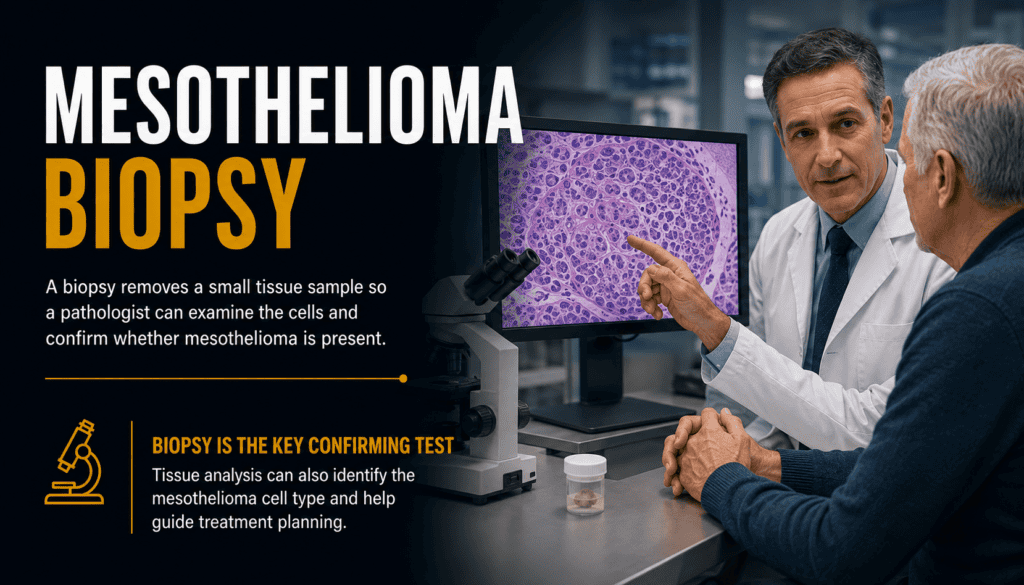
Mesothelioma Biopsy: Types, Procedure, Results and Next Steps
A practical guide to tissue sampling, pathology findings and the questions to ask your care team.
A mesothelioma biopsy removes a sample of tissue so a pathologist can examine cells and determine whether cancer is present. Imaging can identify a suspicious area, but a tissue diagnosis is usually needed to confirm mesothelioma and distinguish it from other conditions. The safest, most informative approach depends on where the suspected tumor is located, your health and whether enough tissue can be obtained for specialized testing.
Start with our mesothelioma diagnosis overview and guide to imaging tests for context. A biopsy result should be discussed with your treating team rather than interpreted from a single line in a report.
What Is a Mesothelioma Biopsy?
A biopsy is the removal of tissue or cells for laboratory examination. For suspected mesothelioma, doctors generally prefer a tissue sample large enough to assess how cells grow and to perform immunohistochemistry, a set of stains that helps distinguish mesothelioma from cancers that spread from other organs and from benign changes. A fluid sample may reveal suspicious cells, but fluid cytology alone does not always provide enough information for a definitive diagnosis or classification.
Mesothelioma most often arises in the lining around the lungs (pleura) or abdomen (peritoneum). Sampling plans differ by site. A specialist may also review earlier biopsy slides before recommending another procedure.
| What the team needs to know | Why it matters |
|---|---|
| Is cancer present? | Separates malignant disease from inflammation and other benign processes. |
| Is it mesothelioma? | Requires morphology and a suitable panel of laboratory markers. |
| What is the cell type? | Epithelioid, sarcomatoid or biphasic patterns may affect treatment discussions. |
| Is the sample adequate? | Insufficient tissue may require additional testing or a repeat biopsy. |
For a deeper explanation, see why pathology reviews matter.
Types of Biopsies Used for Mesothelioma
There is no single biopsy procedure for everyone. The team selects a method based on the location and accessibility of abnormal tissue, the likely diagnostic yield and procedural risks. An image-guided core biopsy can obtain tissue through a needle; thoracoscopy or laparoscopy lets a clinician look inside the chest or abdomen and collect targeted samples. The names below describe common approaches, not a recommendation for a particular patient.
| Method | Typical use | Key consideration |
|---|---|---|
| Image-guided core needle biopsy | CT or ultrasound helps direct a needle into an accessible mass or thickened lining. | May be less invasive; tissue quantity can be limited. |
| Thoracoscopy / VATS | A camera and instruments enter the chest to sample pleural abnormalities. | Can obtain multiple targeted samples; often involves anesthesia. |
| Laparoscopy | A camera enters the abdomen to sample suspicious peritoneal tissue. | Can inspect several areas and obtain tissue. |
| Open surgical biopsy | Used selectively when less invasive methods are unsuitable or inconclusive. | More invasive; recovery varies. |
| Fluid aspiration / cytology | Pleural or abdominal fluid is examined for abnormal cells. | Can help evaluation but may not replace tissue biopsy. |
Some patients also undergo bronchoscopy or sampling of lymph nodes to investigate alternative diagnoses or assess disease extent. Those procedures are not interchangeable with a biopsy of the suspected mesothelioma itself.
How to Prepare for a Mesothelioma Biopsy
Ask which procedure is planned, whether it uses local anesthesia, sedation or general anesthesia, and whether you will go home the same day. Tell the team about blood thinners, aspirin, other medications, supplements, allergies, prior anesthesia problems, heart or lung disease and any recent infection. Do not stop prescribed medicines unless your clinician instructs you to do so.
| Before the appointment | What to confirm |
|---|---|
| Medications | Which drugs to take, hold or adjust, and who authorizes changes. |
| Food and drink | Whether fasting is required and the exact cutoff time. |
| Transportation | Whether sedation or anesthesia requires someone to drive you home. |
| Existing tests | Whether prior scans, pathology slides and reports have been received. |
| Aftercare | Whom to call for symptoms or results after the procedure. |
Bring a current medication list and copies of relevant records when requested. Our medical-record collection guide can help organize the paperwork.
What Happens During the Biopsy?
The team verifies your identity, the planned sampling site and consent. For a needle biopsy, imaging helps locate the target; the skin is cleaned and numbed, and a needle removes one or more tissue cores. For thoracoscopy or laparoscopy, the team uses small incisions and a camera to inspect the area and take samples. The exact anesthesia, monitoring and recovery time depend on the procedure.
The clinician may take more than one sample to improve the chance of obtaining representative tissue. The tissue is labeled and sent to pathology. If the procedure involves the chest, the team may check for a pneumothorax (air around the lung) and determine whether additional observation or a chest tube is needed.
| Stage | What you can ask |
|---|---|
| Before sampling | What is the target, and what happens if it cannot be reached safely? |
| During sampling | How many samples are expected, and will tissue be saved for additional tests? |
| Recovery | How long will observation last, and what symptoms require urgent care? |
| Follow-up | Who will communicate results and arrange any additional tests? |
Do not assume a particular recovery schedule: instructions vary substantially between a needle biopsy and an operation.
Need help now? Call 800.291.0963 / Live chat available 24/7, 365 days a year / Submit Your Case.
How Pathologists Test the Tissue
Pathologists first examine tissue structure and cell appearance under a microscope. They then use a panel of immunohistochemical stains rather than relying on one marker. The panel is selected to support a mesothelial origin, exclude likely competing cancers and assess whether malignant behavior is established. Tests such as BAP1 loss, MTAP loss or CDKN2A/p16 deletion may help in certain diagnostic situations; their meaning depends on the specimen and clinical context. No single stain proves every case of mesothelioma.
When enough tissue is present, the report may describe epithelioid, sarcomatoid or biphasic histology. Small samples may not capture all components of a mixed tumor. Expert review is particularly valuable when findings are borderline, the sample is limited or the proposed treatment depends on an exact diagnosis.
| Pathology element | Plain-language meaning |
|---|---|
| Morphology | How the cells look and grow in the tissue. |
| Immunohistochemistry | A panel of stains used to support mesothelioma and exclude look-alike tumors. |
| Additional molecular tests | Selected tests that can help resolve difficult benign-versus-malignant questions. |
| Histologic subtype | Cell pattern identified in the available tissue; may be limited by sample size. |
| Adequacy statement | Whether there is enough material to answer the diagnostic question. |
Read our pathology review guide to learn when an expert second review may change the interpretation.
Understanding Your Mesothelioma Biopsy Results
Results may be reported as malignant mesothelioma, another diagnosis, suspicious or atypical findings, or nondiagnostic because too little representative tissue was obtained. A negative or inconclusive biopsy does not automatically rule out disease when scans and symptoms remain concerning. Ask the clinician to reconcile the pathology with imaging and the full clinical picture.
| Report wording | Useful follow-up question |
|---|---|
| Mesothelioma confirmed | Which subtype and site were identified, and is expert review recommended? |
| Another cancer or benign condition | Does this explain the imaging and symptoms? |
| Suspicious / atypical | Which findings are unresolved, and what additional test could clarify them? |
| Insufficient / nondiagnostic | Would another target or biopsy method provide a better sample? |
Pathology establishes diagnosis; scans and other evaluations help assess extent of disease. Learn more in our mesothelioma staging guide and discuss any result with your care team before making treatment decisions.
Biopsy Risks, Recovery and Warning Signs
Possible complications include pain, bleeding, infection and reactions to sedation or anesthesia. Chest procedures may cause a pneumothorax; abdominal procedures can carry risks involving nearby organs. Your individual risk depends on the biopsy method, location, medications and underlying health. The procedural team should explain risks specific to you.
| After biopsy | What to do |
|---|---|
| Mild expected soreness | Follow the written pain-control and wound-care instructions. |
| New or worsening shortness of breath, severe chest pain or fainting | Seek emergency medical attention. |
| Heavy bleeding, rapidly increasing swelling or severe abdominal pain | Seek urgent medical assessment. |
| Fever, spreading redness or drainage | Contact the procedural team promptly. |
| Unclear activity or medication instructions | Call the team rather than guessing. |
These examples are not a complete emergency checklist. Follow your discharge instructions, especially for chest tubes, dressing changes, activity limits and medication restart times.
Questions to Ask and What Happens Next
Arrange a specific follow-up plan before leaving the biopsy facility. Ask who will call, how you can access the full pathology report and whether slides or tissue blocks can be transferred to a mesothelioma-experienced pathologist. If mesothelioma is confirmed, the team may recommend additional staging, pulmonary assessment and a multidisciplinary discussion of treatment options. If results are inconclusive, ask why and whether repeat sampling is appropriate.
| Question | Why ask it? |
|---|---|
| Did the sample answer the original question? | Clarifies whether diagnosis is established. |
| Was the tissue reviewed by a mesothelioma-experienced pathologist? | Identifies whether another review may be useful. |
| What is the histologic subtype, if known? | Helps frame treatment discussions. |
| Do we need more imaging or another biopsy? | Separates diagnosis from staging and resolves uncertainty. |
| When will we meet to discuss the plan? | Avoids leaving results without a follow-up appointment. |
Related resources: getting a second opinion, finding mesothelioma doctors, questions for every doctor appointment and mesothelioma treatments.
Frequently Asked Questions About Mesothelioma Biopsies
Can mesothelioma be diagnosed without a biopsy?
Imaging and symptoms can raise suspicion, but tissue examination is generally needed to confirm mesothelioma and distinguish it from other diseases. A clinician can explain rare circumstances when tissue sampling is not feasible.
Is a needle biopsy enough?
Sometimes. A well-targeted core needle biopsy may provide adequate tissue, but a small or nondiagnostic sample may require thoracoscopy, laparoscopy or another approach.
Is fluid testing the same as a tissue biopsy?
No. Fluid cytology examines cells in fluid and can provide useful information, but it may not show tissue architecture or supply enough material for a definitive diagnosis.
Does a negative biopsy rule out mesothelioma?
Not always. If the sampled area missed the abnormal tissue or the sample was inadequate, the team may need to reassess imaging or obtain more tissue.
How long do biopsy results take?
Timing varies by laboratory, specimen complexity and the need for additional stains or expert consultation. Ask your team for its expected timeline and a firm follow-up plan.
Why might I need a pathology second opinion?
Mesothelioma can resemble other tumors and benign conditions. A specialist can review morphology, stains and adequacy, especially when the diagnosis is uncertain.
Will the biopsy tell me the stage?
A biopsy primarily establishes the diagnosis. Imaging and other clinical or surgical information are generally needed to determine disease extent; staging systems differ by mesothelioma site.
What should I do if I feel worse after the procedure?
Follow your discharge instructions. Seek emergency care for severe breathing difficulty, major bleeding, fainting or severe chest pain, and contact your care team promptly about fever or worsening symptoms.
Medical Sources and Further Reading
These resources explain diagnostic testing and pathology. Specific procedures and recommendations must be individualized by the treating team.
Get Help After a Mesothelioma Diagnosis
Call 800.291.0963 to discuss questions about asbestos exposure and available support. Live chat is available 24/7, 365 days a year. Submit Your Case to request assistance. No compensation or outcome is guaranteed.
⚕️ Legal & Medical Information Disclaimer
This page provides general educational information, not medical or legal advice. A qualified medical professional must evaluate diagnosis, testing and treatment; a licensed attorney can advise about individual legal rights and deadlines.