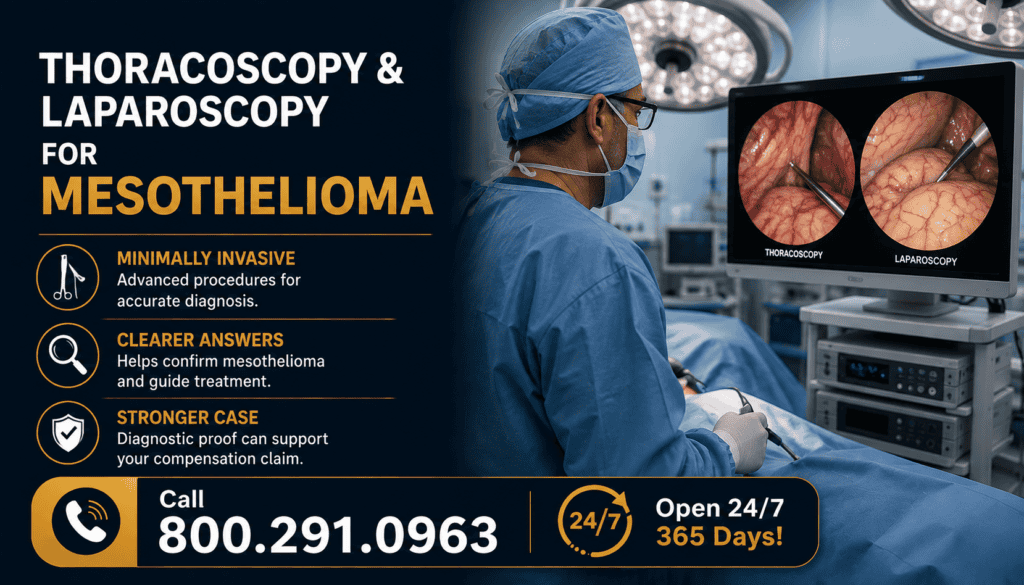
Thoracoscopy and Laparoscopy for Mesothelioma
How camera-guided procedures help doctors obtain tissue, clarify a diagnosis and plan next steps
Thoracoscopy and laparoscopy are minimally invasive procedures that let clinicians examine different body cavities and collect tissue samples. For someone being evaluated for mesothelioma, the choice depends largely on whether the suspicious area is in the chest or abdomen. These procedures are part of a broader mesothelioma diagnosis process; neither is automatically necessary for every patient.
Important: A biopsy examined by a pathologist is generally needed to establish a mesothelioma diagnosis. Imaging and fluid tests may suggest a problem, but they do not always provide enough information to identify the cancer or its subtype.
What These Procedures Do
A thoracoscope is a slender instrument with a camera and light used to look inside the chest. A laparoscope performs a similar function in the abdomen. Clinicians can inspect suspicious tissue and use instruments to obtain samples. The National Cancer Institute describes thoracoscopy among procedures for diagnosis and laparoscopy among procedures used to assess disease in the abdomen.
Mesothelioma most often involves the pleura, the lining around the lungs, or the peritoneum, the lining of the abdomen. The location matters: a person with suspected pleural mesothelioma may be evaluated differently from someone with suspected peritoneal mesothelioma.
| Term | Plain-language meaning |
|---|---|
| Thoracoscopy | Camera-assisted examination inside the chest through a small incision between ribs. |
| Video-assisted thoracoscopic surgery (VATS) | A surgical approach using a camera and instruments through small chest incisions. |
| Laparoscopy | Camera-assisted examination inside the abdomen through small incisions. |
| Biopsy | A tissue sample examined under a microscope by a pathologist. |
Thoracoscopy vs. Laparoscopy
The procedures share the goal of direct visualization and tissue collection, but they are not interchangeable. A thoracoscope enters the chest; a laparoscope enters the abdomen. Your clinician selects an approach according to the suspected disease location, imaging findings, health status and the amount of tissue required.
| Feature | Thoracoscopy | Laparoscopy |
|---|---|---|
| Body area | Chest / pleural space | Abdomen / peritoneal cavity |
| Typical concern | Pleural thickening, nodules or unexplained pleural fluid | Peritoneal nodules, thickening or unexplained abdominal findings |
| Sample | Pleural tissue | Peritoneal or abdominal tissue |
| Other potential role | May permit drainage or other pleural procedures when appropriate | May help inspect abdominal surfaces and assess disease extent |
| Anesthesia | Depends on technique and clinical plan | Usually general anesthesia; confirm with your team |
Read more about imaging tests for mesothelioma and how they help identify an area to sample.
When Doctors Recommend Each Test
Doctors consider the least invasive approach likely to obtain adequate diagnostic tissue. Some people can have an image-guided core needle biopsy instead. For suspected pleural mesothelioma when cancer-directed treatment is planned, an American Society of Clinical Oncology guideline recommends thoracoscopic biopsy because it can provide tissue for confirmation, subtype determination and additional testing. The choice still requires individual assessment.
| Clinical situation | Potential next step | Why it matters |
|---|---|---|
| Suspicious pleural thickening | Thoracoscopic or image-guided pleural biopsy | Obtain tissue for pathology |
| Pleural effusion with symptoms | Fluid drainage may be an initial assessment | May relieve symptoms; fluid cytology may be nondiagnostic |
| Suspicious peritoneal lesions | Image-guided biopsy or laparoscopy | Obtain abdominal tissue |
| Prior inconclusive sample | Specialist review and a larger or differently targeted sample | Reduce uncertainty before treatment |
| High procedural risk | Discuss alternative biopsy approaches | Balance diagnostic value and safety |
For fluid-related symptoms, see mesothelioma symptom fluid management. A negative fluid sample alone does not reliably exclude mesothelioma.
Preparing for the Procedure
Preparation is individualized. The team may review scans, prior biopsy results, medications, allergies, lung and heart health, and anesthesia risks. Ask for specific instructions about eating, drinking and whether to adjust blood thinners or diabetes medications; do not stop prescribed drugs on your own.
| Before the appointment | What to clarify |
|---|---|
| Medication list | Bring prescriptions, over-the-counter medicines and supplements. |
| Prior records | Arrange imaging discs, reports and earlier pathology for review. |
| Transportation | Ask whether you need an adult to take you home and stay with you. |
| Fasting | Follow the exact instructions from your procedure team. |
| Consent | Discuss purpose, alternatives, risks and what happens if the sample is insufficient. |
Tell your team about worsening breathing, fever or other new symptoms before the scheduled procedure.
What Happens During the Procedure
For thoracoscopy, a clinician makes one or more small incisions in the chest wall and inserts a camera to examine the pleura. Tissue is removed from suspicious sites. Some patients require a chest tube afterward to drain air or fluid while the lung re-expands. The exact technique varies, including whether the procedure is performed under local anesthesia with sedation or general anesthesia.
During laparoscopy, the surgeon makes small abdominal incisions and inserts a camera and instruments. The abdomen may be inflated with gas to improve visibility, and tissue is sampled from selected areas. The team decides whether additional inspection or procedures are appropriate.
| Step | Thoracoscopy | Laparoscopy |
|---|---|---|
| Access | Small chest incision(s) | Small abdominal incision(s) |
| Visualization | Pleural surfaces and chest cavity | Peritoneal surfaces and abdominal cavity |
| Sampling | Pleural tissue | Abdominal/peritoneal tissue |
| Afterward | Observation; chest drain may be needed | Observation; discharge timing varies |
These are descriptions of common approaches, not a prediction of the exact steps or anesthesia you will receive. Request a procedure-specific explanation from your surgeon.
Biopsy Results and Next Steps
A pathologist examines the tissue under a microscope and may use immunohistochemistry to distinguish mesothelioma from other cancers. The report may identify a histologic subtype such as epithelioid, sarcomatoid or biphasic when adequate tissue is available. Sometimes additional stains, specialist review or more tissue are necessary.
| Report item | What to ask |
|---|---|
| Diagnosis | Does the sample confirm mesothelioma, another condition or remain inconclusive? |
| Subtype | Is the histologic subtype established with sufficient confidence? |
| Immunohistochemistry | Which markers support the interpretation? |
| Sample adequacy | Is there enough tissue for additional tests if needed? |
| Next tests | What imaging or staging assessments are still needed? |
After diagnosis, the care team may discuss mesothelioma staging and treatment planning. Consider a mesothelioma second opinion from a team experienced in this rare cancer if the findings are uncertain or treatment choices are complex.
Recovery, Risks and Warning Signs
Recovery depends on the procedure, anesthesia, extent of biopsy and the person’s overall health. Temporary incision soreness and fatigue can occur. Thoracoscopy may involve a chest tube and a longer stay than a simple outpatient biopsy. Laparoscopy can cause abdominal soreness or temporary shoulder discomfort from gas used during the procedure.
| Possible complication | Why clinicians monitor for it |
|---|---|
| Bleeding | A biopsy can injure blood vessels. |
| Infection | Any incision or internal procedure carries infection risk. |
| Air leak or pneumothorax | A chest procedure can leave air around the lung. |
| Injury to nearby structures | Instruments operate close to organs and vessels. |
| Anesthesia-related problems | Risks depend on medical history and procedure. |
Seek emergency care for severe breathing difficulty, chest pain with fainting, uncontrolled bleeding or rapidly worsening symptoms. Contact the procedure team promptly for fever, increasing redness or drainage at an incision, worsening pain, persistent vomiting, or other symptoms specified in discharge instructions. Follow your personalized instructions about wound care, lifting, activity and follow-up.
Questions to Ask Your Care Team
Use the questions below to make an informed decision. A good explanation should cover why this approach is being chosen and what alternatives are available.
| Question | Why it is useful |
|---|---|
| Why this procedure rather than a needle biopsy? | Clarifies the need for direct visualization or larger samples. |
| Which areas will you biopsy? | Explains how imaging guides sampling. |
| What anesthesia will I receive? | Helps plan for risks and recovery. |
| Could I need a chest tube or overnight stay? | Helps arrange transportation and home support. |
| When and how will results be delivered? | Establishes a follow-up plan. |
| Who reviews the pathology? | Clarifies whether a mesothelioma-experienced pathologist is involved. |
| What if the sample is inconclusive? | Identifies a backup diagnostic plan. |
If symptoms are changing while you wait, revisit the mesothelioma symptoms overview and contact your clinician rather than waiting for the scheduled follow-up.
Confirmed primary medical sources
- National Cancer Institute: Diagnosis and Prognosis — diagnostic procedures, biopsy and pathology.
- National Cancer Institute: Stages of Mesothelioma — laparoscopy and staging assessments.
- National Cancer Institute: Mesothelioma Treatment (Health Professional) — diagnostic tissue and histologic subtypes.
- ASCO: Pleural Mesothelioma Guideline Update — thoracoscopic biopsy recommendations.
Frequently Asked Questions
Is thoracoscopy the same as a lung biopsy?
Not exactly. Thoracoscopy is an approach for looking inside the chest and obtaining tissue, often from the pleura. A lung biopsy describes tissue sampled from lung tissue; the location and approach may differ.
Is laparoscopy used for pleural mesothelioma?
Laparoscopy examines the abdomen, not the pleural space. It may be considered for abdominal findings or selected staging questions, but it is not a substitute for pleural tissue sampling.
Can fluid testing replace a tissue biopsy?
Fluid cytology can contribute information, but it may be inconclusive. A clinician may recommend tissue biopsy to confirm diagnosis and identify subtype.
Are these procedures always performed under general anesthesia?
No single anesthesia plan applies to every thoracoscopy. Laparoscopy is commonly performed under general anesthesia. Ask your team which technique and anesthesia are planned for you.
How long do results take?
Timing varies with laboratory workload, stains and whether a specialist review is needed. Ask the team for its expected timeline and who will contact you.
Can a biopsy spread mesothelioma?
Procedure-tract tumor implantation has been described in mesothelioma, and specialists plan incision sites with later treatment in mind. Discuss the relevance of this risk and the overall benefits of obtaining a diagnosis with your team.
What if the biopsy does not give a clear answer?
The team may request additional pathology review, more stains or another sample from a different area. An inconclusive result should be discussed directly with the treating specialist.
Will thoracoscopy or laparoscopy tell me my cancer stage?
These procedures may contribute staging information, but stage is determined from the full clinical picture, including imaging, pathology and other tests. Pleural and peritoneal mesothelioma are not staged identically.
Get Help Understanding Your Options
Call 800.291.0963 to discuss potential asbestos-exposure and legal questions. Live chat is available 24/7, 365 days a year. Submit Your Case using the form below.
Eligibility, deadlines and compensation depend on individual circumstances. No recovery or outcome is guaranteed.
⚕️ Legal & Medical Information Disclaimer
This page provides general information, not personalized medical or legal advice. Ask qualified medical professionals about diagnosis and procedures and a licensed attorney about legal rights and deadlines.