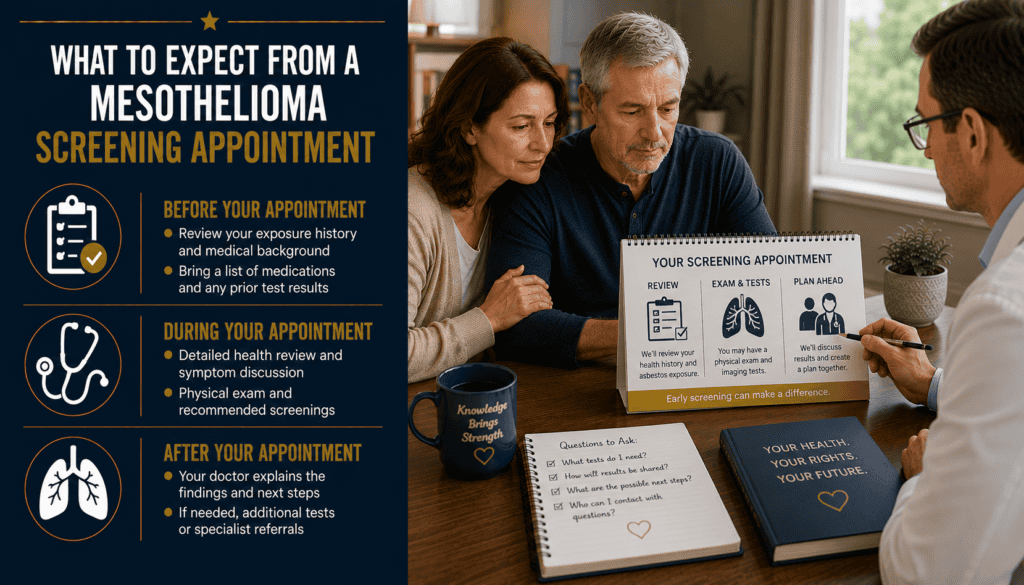
What to Expect From a Mesothelioma Screening Appointment
How to prepare, discuss asbestos exposure, understand possible tests, and plan your next steps.
If you have a history of asbestos exposure, an upcoming appointment may feel like a test you have to pass. It is not. The visit is an opportunity to explain your exposure and symptoms, review your health history, decide whether testing is appropriate, and leave with a clear plan. The exact steps depend on whether you feel well or have symptoms that need diagnostic evaluation.
Important distinction: No major medical organization currently recommends routine mesothelioma screening for people exposed to asbestos who have no symptoms. A clinician may still recommend an individualized health assessment or tests based on your history and symptoms. A scan or blood test cannot by itself establish a mesothelioma diagnosis; tissue testing is often needed when cancer is suspected.
Seek urgent medical attention for sudden or severe breathing difficulty, new crushing chest pain, fainting, or other rapidly worsening symptoms. Do not wait for a routine screening visit.
Screening Versus a Diagnostic Appointment
Screening means looking for disease before symptoms appear. Diagnostic evaluation means investigating symptoms or an abnormal finding. The word “screening” is often used loosely when scheduling an asbestos-related visit, so ask what kind of appointment you actually have. The American Cancer Society states that no major medical organization recommends routine mesothelioma screening even for people with known asbestos exposure; some doctors nevertheless consider periodic imaging in selected patients, and its benefit for early mesothelioma detection is uncertain.
| Visit type | Typical reason | What to expect |
|---|---|---|
| Exposure-related consultation | Past asbestos exposure without symptoms | Exposure review, symptom discussion, individualized follow-up plan |
| Diagnostic evaluation | New cough, chest pain, abdominal swelling, or other symptoms | Focused exam and testing guided by symptoms |
| Follow-up of abnormal imaging | A prior scan showed a concerning change | Comparison with prior images and possible additional testing |
| Post-treatment surveillance | Mesothelioma already diagnosed and treated | A separate follow-up schedule set by the oncology team |
People who have been exposed should tell their clinician about that exposure, even if it occurred decades ago. A normal visit today cannot guarantee that a disease will never develop. See our Diagnosis overview and Symptoms pages for related information.
Before Your Appointment
Bring a concise timeline rather than trying to remember every detail in the exam room. Include previous asbestos-related evaluations, any old imaging reports, and the names of doctors who can send records. If you have symptoms, write down when they began, what makes them better or worse, and whether they are changing.
| Bring or prepare | Useful details |
|---|---|
| Medication list | Prescription drugs, supplements, inhalers, and allergies |
| Exposure timeline | Employers, job duties, military service, materials handled, and approximate years |
| Symptoms | Start date, frequency, severity, and functional impact |
| Previous studies | Imaging reports and image files, biopsy or pathology reports, lung tests |
| Family history | Relevant cancer diagnoses or known inherited variants, if any |
| Practical support | Insurance information, questions, and a companion if desired |
Request copies through your providers or patient portals in advance when possible. Our Collecting medical records guide offers a practical way to organize them. You can ask the clinic whether you should avoid eating before any scheduled procedure; do not fast or stop medications unless instructed.
Exposure and Symptom History
The clinician will usually ask about both exposure and health. Asbestos-related disease can emerge decades after exposure, so older work or household history remains relevant. Explain tasks and environments, not just an employer name: insulation installation or removal, ship repair, construction demolition, maintenance around boilers and pipes, or laundering contaminated work clothes may help the clinician understand the circumstances. You do not need to prove exposure or know a product brand to discuss a concern.
| Question you may hear | Why it matters |
|---|---|
| When and where were you exposed? | Establishes an approximate exposure timeline |
| What work or activities were involved? | Adds context about potential dust-generating tasks |
| Have you had chest or abdominal symptoms? | Helps select appropriate evaluation |
| Have symptoms changed? | Identifies whether timely diagnostic testing is needed |
| Do you smoke or have other lung disease? | Helps assess other causes and separate lung cancer risks |
| Any prior imaging or biopsies? | Allows comparison and avoids unnecessary duplication |
Common symptoms that deserve discussion include persistent cough, shortness of breath, chest pain, abdominal swelling, loss of appetite, and unintended weight loss. These symptoms can have many causes and are not a diagnosis. See the National Cancer Institute’s asbestos exposure fact sheet for symptom and exposure guidance.
Exam and Possible Tests
After reviewing your history, the clinician may examine your breathing, chest, abdomen, and general health. Tests are not automatic for every patient. Your clinician should explain what each proposed test is meant to answer, its limitations, and what happens if the result is unclear.
| Possible step | What it can help show | Key limitation |
|---|---|---|
| Physical examination | Breathing findings, swelling, or other signs | Cannot confirm or exclude mesothelioma |
| Chest X-ray | Fluid or other visible chest changes | May miss disease and cannot confirm cancer |
| CT scan | More detailed chest or abdominal anatomy | Suspicious findings require further evaluation |
| Ultrasound | Fluid or selected abdominal findings | Not a stand-alone mesothelioma diagnosis |
| Pulmonary function tests | How well lungs work | Measures function rather than identifying cancer |
| Blood tests | General health or selected clinical questions | No validated stand-alone mesothelioma screening blood test |
| Biopsy, if indicated | Tissue for expert pathology review | Invasive; selection depends on clinical findings |
Imaging may help identify an area for sampling, but the National Cancer Institute describes biopsy and pathology as key parts of confirming mesothelioma. Fluid cytology can be useful, yet an inconclusive or negative fluid sample may require further assessment when suspicion remains. Read about Imaging tests, Blood tests and biomarkers, Pulmonary function tests, and Mesothelioma biopsy.
Need help now? Call 800.291.0963 / Live chat available 24/7, 365 days a year / Submit Your Case.
Understanding Results and Next Steps
Ask how results will be delivered and who is responsible for contacting you. A normal result may be reassuring for the question tested, but it does not rule out all future asbestos-related illness. An abnormal result does not automatically mean mesothelioma: infection, benign pleural disease, and other cancers can produce overlapping findings.
| Possible outcome | Reasonable next question |
|---|---|
| No concerning findings | What symptoms should prompt a call, and is any follow-up appropriate? |
| Unclear or incidental finding | Do we need prior images, repeat imaging, or specialist review? |
| Pleural fluid or thickening | What are the possible causes, and is sampling needed? |
| Suspicious lesion | Which biopsy approach and pathology team are appropriate? |
| Confirmed diagnosis | What type is it, what further staging is needed, and who will coordinate care? |
Confirm whether the clinic will contact you even if results are normal. If further testing is recommended, ask for the referral and expected scheduling process before leaving. A specialist Second opinion may be useful when pathology is complex or treatment decisions are significant. If a diagnosis is established, staging and treatment planning are subsequent steps; see Stages and Treatments.
Questions to Ask Your Clinician
These questions can turn a vague appointment into a specific plan. Choose the ones relevant to your circumstances and ask the clinician to write down unfamiliar terms.
| Ask this | Why ask |
|---|---|
| Is this screening or diagnostic testing? | Clarifies the purpose of the visit |
| What does my exposure history change about the plan? | Connects risk history with individualized care |
| What could explain my symptoms besides mesothelioma? | Avoids premature conclusions |
| What will each test tell us, and what can it miss? | Makes limitations explicit |
| Will I need a biopsy if imaging is abnormal? | Clarifies confirmation pathway |
| When and how will I receive results? | Prevents follow-up gaps |
| Who should I contact if symptoms worsen? | Creates a safety plan |
| Would a mesothelioma specialist be appropriate? | Identifies referral options |
It is appropriate to request a plain-language explanation, interpreter, printed after-visit summary, or time to discuss decisions with family. If the clinician recommends a procedure, ask about preparation, recovery, and potential risks rather than assuming every test is routine.
Records, Costs, and Follow-Up
Before leaving, confirm the next appointment, referrals, and whether the clinic needs records from another provider. Insurance coverage depends on your plan, clinical indication, network, and the specific test; ask the clinic and insurer about referrals or prior authorization. A visit for symptoms may be billed differently from preventive screening.
| Follow-up item | Action |
|---|---|
| Test order | Check where and when it will be performed |
| Results contact | Record the phone number or portal used |
| Specialist referral | Confirm whether an authorization is needed |
| Records transfer | Ask whether images, not just reports, should be sent |
| Symptoms between visits | Keep a dated log and report new or worsening problems |
| Financial questions | Request an estimate or speak with a patient navigator |
If the experience is emotionally difficult, ask about counseling, social work, and caregiver resources. Our Support page offers related reading. Do not delay evaluation of new symptoms while gathering employment documents or exploring compensation options.
Frequently Asked Questions
Is there a standard screening test for mesothelioma?
No. Major medical organizations do not currently recommend routine mesothelioma screening for asymptomatic people with known asbestos exposure. A clinician may tailor evaluation to your health history and symptoms.
Will I get a CT scan at my first appointment?
Not necessarily. The clinician may recommend imaging depending on symptoms, examination, prior results, and other factors. Ask why a particular scan is proposed.
Can a blood test tell me whether I have mesothelioma?
No blood test can independently confirm or rule out mesothelioma. Biomarkers remain limited for early detection, and diagnosis generally requires appropriate tissue evaluation.
Should I attend if my asbestos exposure was decades ago?
Yes, it is reasonable to discuss past exposure with your clinician. Asbestos-related diseases may develop many years later, and new symptoms should be evaluated.
What if my X-ray is normal but symptoms persist?
Tell your clinician that symptoms continue. An X-ray has limitations; further assessment depends on the symptoms and clinical findings.
Will a biopsy happen during the appointment?
Usually not at an initial consultation unless specifically scheduled. A biopsy is considered when findings warrant tissue sampling, and the team should explain preparation and risks.
What if an abnormal scan turns out not to be cancer?
Many abnormalities have noncancer causes. Your clinician may compare earlier studies, order additional tests, or recommend specialist review to determine the cause.
How soon should I call about new symptoms?
Contact your clinician promptly for new or worsening symptoms, especially after asbestos exposure. Sudden severe breathing problems, severe chest pain, or fainting warrant emergency care.
Get Help and Related Resources
Reliable Medical Sources
- American Cancer Society: Early Detection, Diagnosis, and Staging of Mesothelioma — screening limitations and diagnostic pathway.
- National Cancer Institute: Asbestos Exposure and Cancer Risk — exposure history and symptoms.
- National Cancer Institute: Mesothelioma Diagnosis and Prognosis — imaging, biopsy, and pathology.
- National Cancer Institute: Cancer Screening Overview — screening versus diagnostic testing.
Help With Questions After a Diagnosis
Call 800.291.0963. Live chat is available 24/7, 365 days a year. Submit Your Case. Our team can discuss general information and possible next steps. Eligibility and compensation depend on individual facts; no outcome is guaranteed.
⚕️ Legal & Medical Information Disclaimer
This article provides general information, not medical diagnosis, treatment advice, or legal advice. Consult qualified medical and legal professionals about your circumstances. Do not delay urgent medical care.