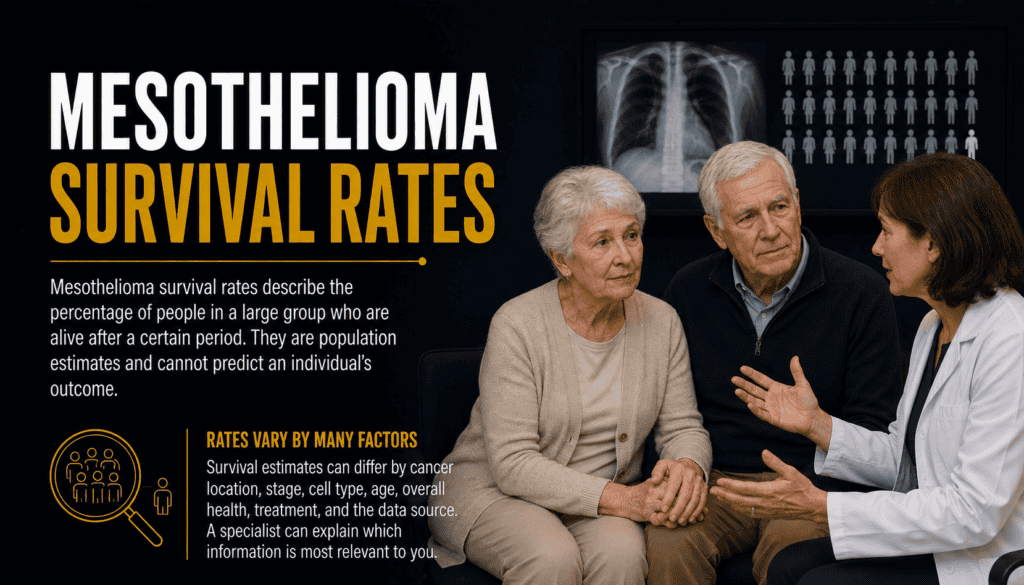
Mesothelioma Survival Rates
Updated interpretation of U.S. pleural survival data, diagnosis years 2015–2021; ACS revision February 2026.
What Mesothelioma Survival Rates Mean
A mesothelioma survival rate describes outcomes in a group of people diagnosed in the past. It is useful for understanding patterns, but it cannot tell any individual patient how long they will live. The most relevant published figures differ by where the cancer began, its extent at diagnosis, and the population and years studied. A mesothelioma specialist can put these numbers in context alongside your scans, pathology, health, and treatment goals.
This page concentrates on verifiable U.S. pleural mesothelioma five-year relative survival data, then explains why those numbers should not be transferred automatically to peritoneal mesothelioma or used as a personal countdown. For a broader discussion, see our mesothelioma prognosis overview.
| Term | What it means | Important limitation |
|---|---|---|
| Five-year survival | Percentage alive five years after diagnosis in a defined group. | May refer to overall, observed, or relative survival; check the definition. |
| Relative survival | Compares survival in a cancer group with expected survival in a similar general population. | Not the same as the percentage of patients literally alive. |
| Median survival | Time by which half of a study group have died and half have not. | Not a deadline for an individual. |
| Prognosis | A clinician’s assessment using the person’s specific situation. | Changes as new information becomes available. |
2026 Pleural Mesothelioma Survival Statistics
The American Cancer Society (ACS) revised its pleural mesothelioma survival page on February 3, 2026. Its figures use the National Cancer Institute’s SEER registry and cover U.S. patients diagnosed in 2015–2021. These are five-year relative survival rates, not predictions for patients diagnosed in 2026.
| SEER extent at initial diagnosis | Five-year relative survival | Population and period |
|---|---|---|
| Localized | 23% | U.S. pleural mesothelioma, diagnosed 2015–2021 |
| Regional | 15% | U.S. pleural mesothelioma, diagnosed 2015–2021 |
| Distant | 11% | U.S. pleural mesothelioma, diagnosed 2015–2021 |
| All SEER stages combined | 15% | U.S. pleural mesothelioma, diagnosed 2015–2021 |
Source: American Cancer Society, Survival Rates for Pleural Mesothelioma (revised February 3, 2026). These rates describe historical groups; they do not account fully for newer treatment availability, individual health, or treatment response.
How Stage Changes the Numbers
SEER groups cancers by extent of spread at diagnosis. These groups do not map one-to-one onto the clinical TNM stage I–IV system. A person should not convert a TNM stage into a SEER survival percentage without asking the oncology team.
| SEER category | Definition | What to ask |
|---|---|---|
| Localized | Cancer remains limited to the pleura. | Is my disease confined to the pleura on imaging and staging? |
| Regional | Cancer involves nearby structures or regional lymph nodes. | Which nearby structures or nodes are involved? |
| Distant | Cancer has reached distant parts of the body. | Where has spread been confirmed, and how does it change treatment? |
| Unknown or incomplete stage | Extent cannot yet be assigned confidently. | Are further imaging or tissue tests needed? |
The ACS cautions that survival figures are based on the extent when cancer was first diagnosed; they are not designed to estimate survival after recurrence or progression. Read our recurrent mesothelioma guide for that distinct situation.
Pleural Versus Peritoneal Survival
Pleural mesothelioma develops in the lining around the lungs; peritoneal mesothelioma develops in the abdominal lining. Their treatment pathways, staging methods, and patient populations differ. The ACS pleural table above does not provide peritoneal survival rates, so it would be misleading to apply its 23%, 15%, or 11% figures to someone with peritoneal disease.
| Disease site | What can be stated reliably | Why direct comparison is difficult |
|---|---|---|
| Pleural mesothelioma | ACS publishes SEER five-year relative survival by extent of disease for 2015–2021. | Treatment and patient characteristics differ from peritoneal cohorts. |
| Peritoneal mesothelioma | NCI describes favorable outcomes in selected patients treated with cytoreductive surgery and HIPEC at experienced centers. | Selected surgical patients are not representative of everyone diagnosed. |
| Pericardial or other rare sites | Individual specialist evaluation is essential. | Small populations limit reliable generalized estimates. |
The National Cancer Institute notes that among appropriately selected patients receiving cytoreductive surgery and HIPEC at experienced centers, reported median survival approaches three to four years. That figure comes from selected treatment cohorts and must not be presented as the average life expectancy for all peritoneal mesothelioma patients. See our CRS explanation and HIPEC guide.
Factors That Influence Survival
A survival table usually cannot incorporate all the features of one patient’s cancer. Clinicians consider tumor biology, disease extent, functional health, treatment options, and changes over time. Some factors are associated with better outcomes in certain studies, but an association is not a guarantee.
| Factor | Why clinicians consider it | Question to ask |
|---|---|---|
| Histology | Epithelioid, biphasic, and sarcomatoid tumors may behave differently. | What subtype did my pathology confirm? |
| Extent and lymph nodes | Spread can affect treatment choices and prognosis. | What does my staging show? |
| Performance status | Ability to perform everyday activities affects treatment tolerance. | How does my functional status affect options? |
| Resectability | Whether a specialist can safely remove visible disease matters for surgical planning. | Is surgery appropriate for my case? |
| Treatment response | Follow-up scans and symptoms can change the clinical picture. | How and when will response be assessed? |
The NCI identifies epithelioid histology, negative lymph nodes, and negative surgical margins as factors associated with longer survival in selected surgical series. Such series are vulnerable to selection differences: healthier patients and people with more favorable disease are often the ones offered aggressive surgery.
How Treatment Fits Into Survival
Treatment can affect outcomes, but no single population survival percentage can tell whether a particular regimen will help a specific patient. Depending on cancer site and clinical findings, options may include systemic therapy, carefully selected surgery, symptom-directed procedures, or clinical trials. Palliative care can be provided alongside anticancer treatment to address pain, breathlessness, and emotional distress.
| Treatment discussion | What it may involve | Avoid this misconception |
|---|---|---|
| Systemic therapy | Chemotherapy, immunotherapy, or other clinician-selected regimens. | A historical survival rate is not the expected benefit of a specific drug. |
| Pleural surgery | Specialist assessment of potential benefit, risks, and alternatives. | Surgery is not appropriate for every patient. |
| Peritoneal CRS and HIPEC | Evaluation at a center experienced in peritoneal surface malignancies. | Outcomes in selected surgical cohorts do not apply to all patients. |
| Supportive and palliative care | Relief of symptoms and help with practical decisions. | Palliative care does not automatically mean stopping cancer treatment. |
For detailed options, see mesothelioma drugs, surgery for mesothelioma, and palliative care. A specialist can explain whether a clinical trial is appropriate.
How to Interpret Statistics for Yourself
Statistics are best treated as background information rather than a forecast. Ask what population was studied, whether the measure is relative or overall survival, how old the data are, and whether the figure describes patients with your specific disease site and treatment history.
| If you see this claim | Check before relying on it |
|---|---|
| “Five-year survival is X%.” | Is this relative, observed, or overall survival? Which country and diagnosis years? |
| “Stage 4 survival is X months.” | Which staging system, disease site, and study population? |
| “A treatment doubles survival.” | Was it a randomized trial or a selected observational group? What was the comparison? |
| “Your life expectancy is X.” | Has your treating specialist reviewed your pathology, imaging, health, and treatment response? |
For a separate explanation of median survival and individual planning, see mesothelioma life expectancy. For counts and incidence trends rather than outcomes, see mesothelioma cancer statistics.
Questions and a Practical Planning Worksheet
Bring a short list of questions to the next visit. Ask the team to describe both the uncertainty in the evidence and the decisions you can make now. You can choose how much numerical detail you want to hear; a caregiver may help record answers if you wish.
| Question for the oncology team | Notes to bring or record |
|---|---|
| What type and subtype of mesothelioma do I have? | Pathology report and any second-opinion findings. |
| What is the current extent of my cancer? | Imaging date, staging system, and uncertainties. |
| Which survival statistics, if any, fit my situation? | Disease site, population, diagnosis years, and measure used. |
| What treatment options are available, and what are the trade-offs? | Benefits, risks, quality-of-life goals, and trial options. |
| When will we reassess the plan? | Next scan, symptoms to report, and contact number. |
Consider requesting a written care summary and asking about a mesothelioma second opinion. A second opinion can clarify pathology and treatment options without promising a different outcome.
Frequently Asked Questions
What is the five-year survival rate for pleural mesothelioma?
The ACS reports 15% five-year relative survival for all SEER stages combined among U.S. pleural mesothelioma patients diagnosed in 2015–2021. This is a historical group measure, not an individual prediction.
What are the survival rates for localized, regional, and distant disease?
For the same U.S. pleural cohort, ACS reports 23% localized, 15% regional, and 11% distant five-year relative survival. These SEER categories are not identical to TNM stages I–IV.
Does a 15% five-year relative survival rate mean I have a 15% chance of living five years?
No. Relative survival compares survival in a cancer group with expected survival in a comparable general population. Your outlook also depends on individual clinical factors that a table cannot capture.
Are these survival rates current for people diagnosed in 2026?
The ACS page was updated in February 2026, but its underlying patient diagnoses occurred in 2015–2021. Newer therapies and individual differences may change outcomes.
Do pleural survival rates apply to peritoneal mesothelioma?
No. The published ACS figures on this page apply specifically to pleural mesothelioma. Peritoneal disease has different patient populations and treatment pathways.
Is median survival the same as five-year survival?
No. Median survival is a time point in a studied group; five-year survival measures outcomes at a fixed five-year point. Definitions and populations must be checked before comparing them.
Can surgery or immunotherapy guarantee longer survival?
No treatment guarantees a particular lifespan. Benefits and risks depend on eligibility, cancer characteristics, treatment response, and evidence from relevant studies.
What should I ask my doctor about my own prognosis?
Ask about pathology subtype, extent of disease, treatment options, likely benefits and risks, and how follow-up findings may change the assessment. You can also ask not to receive numerical estimates if you prefer.
Confirmed Medical and Statistical Sources
- American Cancer Society — Survival Rates for Pleural Mesothelioma (revised February 3, 2026; U.S. diagnoses 2015–2021). Source for all four pleural five-year relative survival percentages.
- National Cancer Institute — Malignant Mesothelioma Treatment (PDQ), Health Professional Version. Source for prognostic factors, selection limitations, and the selected peritoneal CRS-HIPEC cohort discussion.
- National Cancer Institute — SEER*Explorer. Underlying U.S. cancer registry statistics; choose disease site, measure, and period carefully.
Data note: Percentages above are historical U.S. pleural mesothelioma relative survival rates, not current individual forecasts. No unverified peritoneal or stage IV survival percentage is presented.
Questions About Mesothelioma and Asbestos Exposure?
Call 800.291.0963. Live chat is available 24/7, 365 days a year. Submit Your Case to explore available assistance. Contacting us does not guarantee eligibility or compensation.
⚕️ Legal & Medical Information Disclaimer
This information is educational and is not individualized medical or legal advice. Discuss survival estimates and treatment decisions with your oncology team; consult a qualified attorney for legal questions. Never delay urgent medical care because of website information.