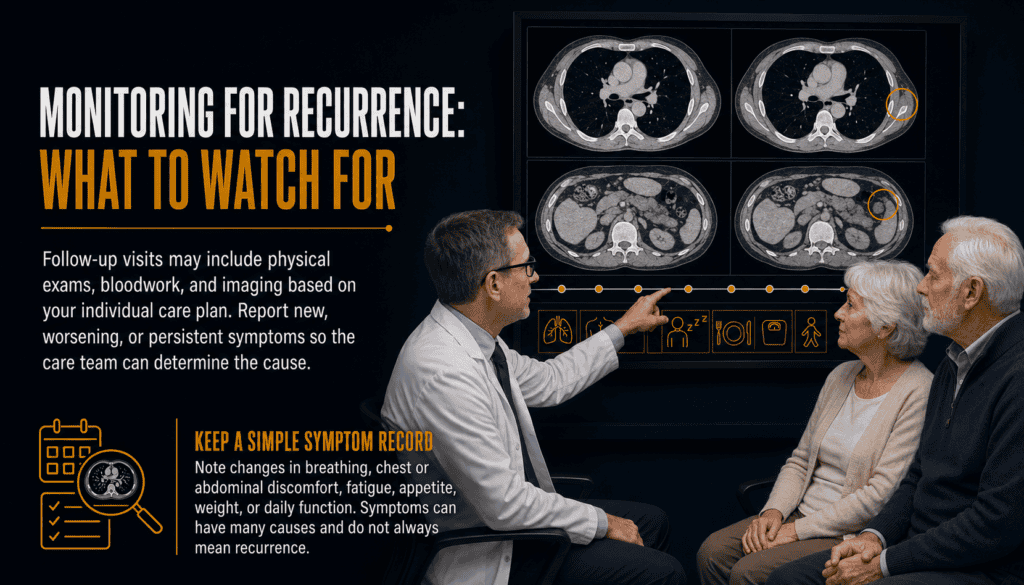
Monitoring for Mesothelioma Recurrence: What to Watch For
A practical follow-up guide for patients and families after mesothelioma treatment.
Finishing a treatment course or receiving a stable scan does not necessarily end follow-up. Monitoring helps the oncology team identify changes, manage ongoing effects, and decide when additional testing is needed. This guide explains what to watch for without assuming that every new symptom means cancer has returned.
What recurrence means
Recurrence means mesothelioma is detected again after a period when it could not be found or was controlled. Progression means known cancer grows or spreads despite or after treatment. A new symptom does not establish either diagnosis: postoperative scarring, inflammation, infections, treatment effects, and other conditions may produce similar symptoms. Your oncology team must interpret symptoms alongside examination, scans, and sometimes tissue testing.
| Term | Meaning |
|---|---|
| Recurrence | Cancer detected again following a period without detectable disease or after a response. |
| Progression | Known cancer grows or spreads. |
| Stable disease | Imaging does not show meaningful growth under the team’s assessment criteria. |
| Treatment effect | Changes caused by surgery, radiation, or other therapy that may need evaluation. |
For a broader overview, read recurrent mesothelioma and mesothelioma prognosis.
Build an individualized follow-up plan
There is no single surveillance schedule appropriate for every patient. Follow-up depends on the original disease site, treatment received, current symptoms, prior scan findings, and the care team’s goals. Ask your oncologist to put the schedule and contact instructions in writing; do not rely on a generic online interval.
| Ask the team | Record the answer |
|---|---|
| When is my next visit? | Date, clinician, and location |
| Which scan is planned? | CT or another test, body region, contrast instructions |
| Who reviews the result? | Name, expected communication method |
| What if symptoms change before then? | Daytime and after-hours telephone numbers |
Keep copies of scan reports and note where images were obtained. If you move or seek another opinion, access to prior images helps radiologists compare changes over time. Your team may recommend a second opinion if findings are unclear or decisions are complex.
Symptoms to report promptly
Tell your oncology team about new, persistent, or worsening symptoms rather than waiting for a routine appointment. Pleural mesothelioma may be associated with breathing changes or chest symptoms; peritoneal disease may be associated with abdominal symptoms. These signs have many possible causes and are not proof of recurrence.
| Possible change | What to document |
|---|---|
| Increasing breathlessness or cough | When it began, whether it occurs at rest, and effect on activities |
| New chest, shoulder, back, or abdominal pain | Location, severity, pattern, and response to prescribed treatment |
| Abdominal swelling, early fullness, or bowel changes | Duration, appetite, and associated symptoms |
| Unexplained weight change or increasing fatigue | Trend and impact on daily functioning |
Also report new lumps, unexplained fever, or other changes your team has asked you to watch. For strategies to manage symptoms while the cause is evaluated, see palliative care for mesothelioma.
When to seek urgent medical help
Call emergency services immediately for severe or sudden difficulty breathing, new severe chest pain, fainting, new confusion, or other life-threatening symptoms. These can signal emergencies unrelated to recurrence, including blood clots, infection, or heart and lung problems. Do not wait for a surveillance scan.
| Situation | Action |
|---|---|
| Sudden severe breathlessness, severe chest pain, fainting | Call emergency services. |
| Rapidly worsening symptoms, fever during active cancer treatment, inability to keep fluids down | Contact the oncology team urgently using its instructions; use urgent care or emergency care if directed or unreachable and symptoms are serious. |
| Mild but persistent new symptoms | Contact the oncology team promptly rather than waiting for the next scheduled visit. |
Ask the team for individualized fever thresholds, particularly during chemotherapy. Never change medication doses or start leftover antibiotics without clinical direction.
How scans and tests are interpreted
CT imaging is commonly used to monitor mesothelioma, but the appropriate test varies by disease location and clinical question. A clinician may consider other imaging or biopsy when findings are uncertain. Imaging after surgery or radiation can be difficult to interpret because scar tissue and inflammation may resemble disease.
| Assessment | Role and limitation |
|---|---|
| Symptoms and examination | Identify changes that warrant investigation; cannot diagnose recurrence alone. |
| CT or other imaging | Shows changes and allows comparison with earlier images; findings may be indeterminate. |
| Biopsy, when appropriate | May clarify a suspicious finding; not always safe or necessary. |
| Blood tests | May evaluate general health or other causes; no routine blood test alone confirms mesothelioma recurrence. |
Ask whether the finding is clearly new, unchanged, or uncertain and what next step will resolve uncertainty. A scan result should be explained in the context of your treatment history.
A practical symptom and appointment worksheet
A short, consistent record can help you describe changes accurately. Record information once a day or when a meaningful change occurs; constant checking may increase anxiety without improving care. Use the monitoring frequency your clinician recommends.
| Date/time | Symptom and severity | Duration or trigger | Action and response |
|---|---|---|---|
| ________ | ________ | ________ | ________ |
| ________ | ________ | ________ | ________ |
| ________ | ________ | ________ | ________ |
Bring the log, current medication list, recent test reports, and questions to appointments. Note who to call after hours. A family member can help with recordkeeping if you want that support, but the patient should remain involved in decisions whenever possible.
What happens if recurrence is suspected
A suspicious scan or symptom usually prompts a discussion of how certain the finding is and whether more testing is needed. If recurrence is confirmed, treatment choices depend on where disease is present, what treatments have already been used, time since previous therapy, overall health, and personal goals. Options may include systemic therapy, selected procedures, a clinical trial, or symptom-focused care; none is appropriate for everyone.
| Question | Why it matters |
|---|---|
| Is this confirmed recurrence or an uncertain finding? | Clarifies whether more tests or observation are needed. |
| How does it compare with my last scan? | Establishes whether and how the finding has changed. |
| What are the reasonable next options? | Connects choices to previous treatment and current health. |
| Would a specialist review or clinical trial be appropriate? | May broaden the discussion of available care. |
Read more about mesothelioma medicines and treatment approaches. Never interpret a single scan or change treatment without your clinician.
Managing scan anxiety and family support
Waiting for imaging or results can trigger intense worry, sometimes called scanxiety. Ask the clinic when results will be available, how they will be delivered, and who can answer questions. Consider scheduling support from a trusted person, using a brief relaxation practice, and limiting repeated online symptom searches if they heighten distress.
| Need | Possible step |
|---|---|
| Uncertainty about timing | Ask for the expected result date and a contact if delayed. |
| Help remembering information | Invite a support person or request a written visit summary. |
| Persistent anxiety or low mood | Ask for oncology social work, counseling, or mental health care. |
| New symptoms while waiting | Use the clinical team’s contact plan; do not wait for the result. |
See managing fear of recurrence and scanxiety and emotional support resources. Supportive care can accompany active cancer treatment.
Frequently Asked Questions
Can symptoms alone tell me mesothelioma has returned?
No. Symptoms can have many causes, including treatment effects and other illnesses. Your team will decide whether imaging or additional tests are needed.
What symptoms should I tell my doctor about?
Report new, persistent, or worsening breathlessness, pain, cough, abdominal swelling, appetite or weight changes, fatigue, or other changes your team identified.
How often will I need scans?
The schedule is individualized based on disease location, previous treatment, scan findings, symptoms, and your care plan. Ask your oncologist for a written schedule.
Can scar tissue look like recurrence?
Yes. Postsurgical and post-radiation changes can complicate imaging interpretation. Comparing prior scans and sometimes additional evaluation may help.
Does a concerning scan always mean recurrence?
No. An imaging finding may be uncertain or have another explanation. Ask what the report actually shows and whether further evaluation is needed.
What should I do if breathing suddenly becomes much worse?
Seek emergency care for sudden severe breathlessness, severe chest pain, fainting, or other life-threatening symptoms. Do not wait for a scheduled appointment.
What happens if recurrence is confirmed?
Your oncology team reviews the disease location, previous treatments, current health, goals, and possible treatments or trials before recommending a plan.
How can I handle anxiety before scans?
Agree on a result-communication plan, involve trusted support, and ask for counseling if worry affects sleep or daily life. Contact your team for new symptoms rather than relying on reassurance alone.
Medical reference resources
Use these authoritative starting points alongside your own oncology team’s advice. The precise surveillance plan and treatment options should be confirmed with your clinician.
Need help understanding your options?
Call 800.291.0963 or use our live chat 24/7, 365 days a year. Submit Your Case to request information about possible legal options. Contacting us does not guarantee eligibility or compensation.
⚕️ Legal & Medical Information Disclaimer
This article provides general information, not a diagnosis or personalized medical or legal advice. Consult your oncology team for symptoms, testing, and treatment decisions, and a qualified attorney for legal questions. For emergencies, call emergency services.