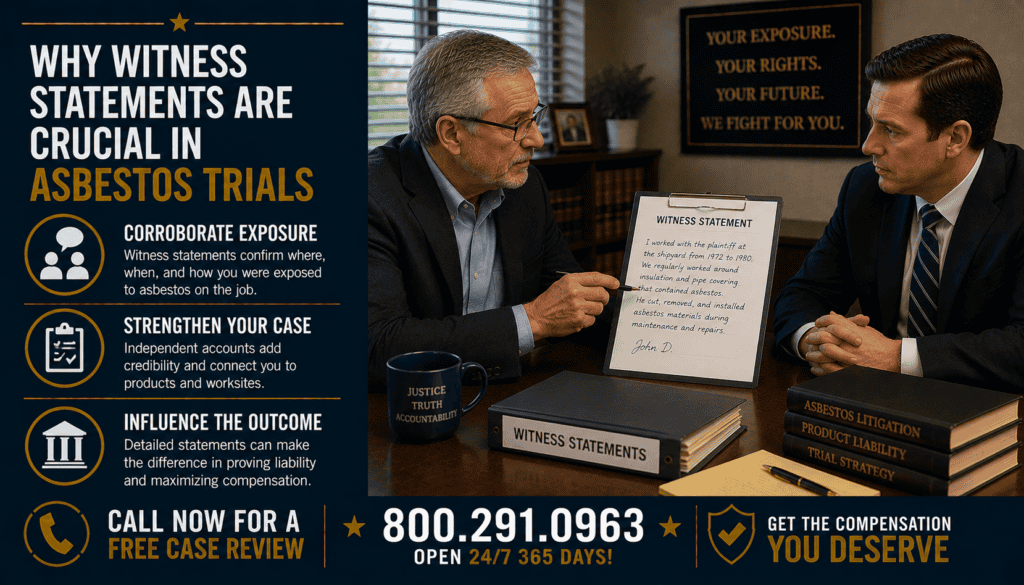
🗣️ Why Witness Statements Are Crucial in Asbestos Trials
Understand how co-workers, supervisors, and family members validate your exposure story for powerful courtroom evidence.
When someone files a mesothelioma or asbestos-related lawsuit, the case often reaches back 20,40, or even 60 years into the victim’s past. Most asbestos exposure occurred decades before symptoms ever appeared. During that time, buildings were demolished, companies closed, job records disappeared, and many responsible manufacturers went bankrupt.
Because documentation is often incomplete or long gone, witness statements become one of the most powerful forms of evidence in mesothelioma trials. These statements—given by co-workers, supervisors, maintenance workers, union members, or even family—help reconstruct exposure history and prove how and when asbestos exposure occurred.
Strong witness testimony can confirm the use of specific asbestos products, identify negligent workplace practices, and link the victim’s diagnosis directly to a company or job site. These details can dramatically increase the strength and value of a case.
If you or a loved one were diagnosed with mesothelioma and need help gathering witness statements, call 800.291.0963 to speak with an advocate today.
👥 What Is a Witness Statement in an Asbestos Case?
A witness statement is a written or recorded account from someone who:
-
Worked alongside you
-
Supervised your job duties
-
Performed similar tasks
-
Handled asbestos-containing materials
-
Shared a worksite, ship, refinery, plant, or construction zone
-
Lived with you and observed asbestos coming home on your clothing
-
Knew the environment or products involved in exposure
These statements help verify the details of your exposure, especially when documentation is missing or incomplete.
Witness statements are used by attorneys to:
-
Confirm asbestos-containing products
-
Identify manufacturers and suppliers
-
Establish job-site conditions
-
Outline safety practices (or the lack thereof)
-
Show how frequently exposure occurred
-
Build timelines that match medical findings
In many cases, a single credible witness can validate what no paper record can.
🔍 Why Witness Testimony Is So Important in Asbestos Litigation
1. Exposure Often Happened Decades Ago
Because mesothelioma has a latency period of 20–60 years, most victims cannot rely on old work records alone. Many companies:
-
No longer exist
-
Destroyed historical files
-
Changed ownership
-
Lost employee logs
-
Closed plants or facilities
Witnesses help fill in those missing pieces.
2. They Verify the Use of Asbestos-Containing Products
Co-workers and supervisors can often recall:
-
Brand names
-
Product packaging
-
Asbestos insulation types
-
Boiler and turbine labels
-
Construction materials
-
Tools and equipment used
These details help attorneys identify responsible manufacturers.
3. They Recreate Job-Site Conditions
Witness statements often include first-hand descriptions such as:
-
Dust clouds during insulation work
-
Removal of asbestos pipe wrap
-
Sawing, sanding, grinding, or cutting ACM (asbestos-containing materials)
-
Lack of protective gear
-
Poor ventilation
-
Warning labels that were covered or missing
These descriptions help prove negligence.
4. They Support the Victim’s Testimony
In trials, consistency matters. When multiple witnesses repeat similar details, it dramatically strengthens the victim’s credibility.
5. Witnesses Help Identify Additional Defendants
One statement can reveal:
-
Multiple asbestos products
-
Additional contractors
-
Secondary suppliers
-
Negligent supervisors
-
Other job sites where exposure occurred
These additional defendants may significantly increase the total compensation available.
🏗️ Types of Witnesses Used in Mesothelioma Trials
🛠️ 1. Co-Workers
People who performed the same job are often the strongest witnesses. They can describe:
-
Daily tasks
-
Asbestos materials used
-
Job-site safety culture
-
Frequency of exposure
-
Tools and equipment handled
👷♂️ 2. Supervisors and Foremen
They can testify about:
-
Company policies
-
Work assignments
-
Safety procedures
-
Training practices
-
Whether asbestos warnings were ignored
📦 3. Product Co-Users
Many workers used the same tools, insulation, or cement. These witnesses help connect exposure to the correct manufacturer.
👨👩👧👦 4. Family Members
Family testimony is powerful in cases involving:
-
Secondary exposure (fibers brought home on clothing)
-
Observing dust on work clothes
-
Laundering contaminated uniforms
-
Declining health over the years
-
How mesothelioma has affected daily life
🏛️ 5. Union Members
Unions often retain:
-
Job logs
-
Worksite details
-
Safety grievances
-
Equipment records
Union stewards may also serve as witnesses.
👴 6. Retired Workers and Industry Veterans
They often have long memories of:
-
Building materials
-
Manufacturers
-
Task procedures
-
Old facility layouts
In older cases, these witnesses may be crucial.
📄 What Makes a Strong Witness Statement?
A high-quality witness statement includes:
-
Full name and contact information
-
Job title and duties
-
Dates and locations worked
-
Specific asbestos products remembered
-
Brands, logos, or packaging details
-
Names of co-workers and supervisors
-
How asbestos materials were handled
-
Whether dust exposure was visible
-
Whether safety warnings were provided
-
Frequency and duration of exposure
-
Personal observations about the victim
The more detail, the stronger the evidence.
🧩 How Attorneys Find Witnesses for Your Case
Because exposure happened decades ago, victims often say:
“I don’t remember anyone’s name.”
That’s normal. Attorneys use several methods to locate witnesses:
📚 1. Union Records
Unions keep archived lists of workers and contractors.
🏭 2. Job-Site Databases
Top mesothelioma law firms maintain internal databases with thousands of known asbestos job sites.
📇 3. Co-Worker Testimony From Previous Cases
Many workers testify in multiple cases involving the same plant or company.
📢 4. Public Records and Directories
These include:
-
Employment records
-
Worksite rosters
-
Old phone books
-
Local newspaper archives
👥 5. Social Media and Alumni Groups
Retiree groups, shipyard associations, and trade forums often reconnect former workers.
📞 6. Direct Outreach
Attorneys may call:
-
Former supervisors
-
Contractors
-
Subcontracting companies
Even one solid witness can transform a case.
🧾 How Witness Statements Are Used in Court
Witness statements can appear in many parts of the trial process:
Under Oath Depositions
Witnesses answer questions before trial.
Affidavits
Signed written statements serve as sworn testimony.
Live Testimony
Witnesses appear in court to support your exposure story.
Supporting Expert Reports
Experts rely on witness accounts to recreate exposure levels.
Settlement Negotiations
Strong statements pressure companies to settle rather than risk trial.
⚖️ How Witness Testimony Improves Compensation
Witness statements can increase the value of a case by:
-
Proving long-term exposure
-
Linking exposure to specific products
-
Demonstrating negligence
-
Showing corporate knowledge of asbestos dangers
-
Establishing multiple defendants
-
Supporting emotional distress claims
The stronger the witness evidence, the higher the compensation tends to be.
⏳ Why You Should Gather Witnesses Early
Time is critical in asbestos cases.
Witnesses may:
-
Move
-
Retire
-
Become unreachable
-
Lose memory clarity over time
-
Pass away
Early interviews preserve key testimony before memories fade.
Calling 800.291.0963 ensures your legal team begins witness outreach immediately.
📞 Get Help Finding and Securing Witness Statements
If your exposure occurred decades ago, witnesses are vital. Our team works quickly to identify co-workers, supervisors, union members, and others who can strengthen your case.
Call 800.291.0963 now to speak with an advocate who can help you begin gathering critical witness evidence today.