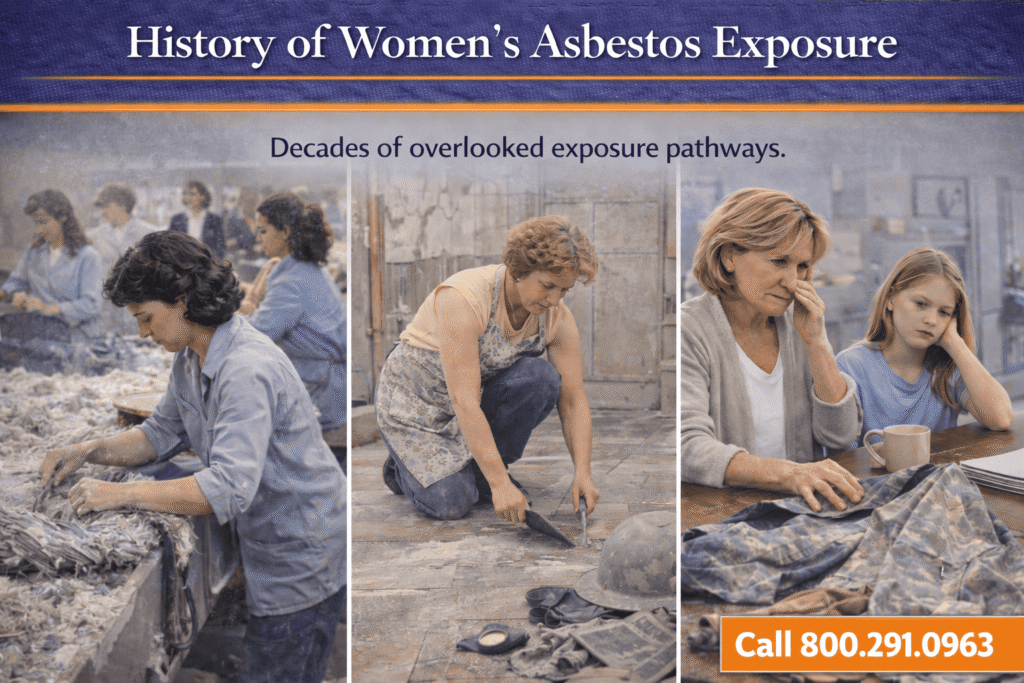
📜 History of Women’s Asbestos Exposure
Decades of overlooked exposure pathways left millions of women at risk without warning or protection.
For most of the 20th century, asbestos exposure was framed as a “men’s industrial problem.” This narrow view ignored how deeply asbestos was embedded in homes, schools, hospitals, consumer products, offices, military bases, and everyday life—places where women lived and worked.
As a result, women’s asbestos exposure went largely unrecognized, undocumented, and unprotected for decades. Today, growing numbers of women are being diagnosed with mesothelioma, lung cancer, ovarian cancer, and pleural disease, often shocked to learn their exposure occurred through ordinary daily activities.
🧱 Early Industrial Use (1900s–1930s): Exposure Begins at Home
Asbestos use expanded rapidly in the early 1900s, prized for heat resistance and durability.
While men handled asbestos directly in factories and shipyards, women were exposed through:
-
👕 Secondhand (take-home) exposure from laundering work clothes
-
🏠 Asbestos-containing homes built with insulation, cement, and tiles
-
🧺 Household products incorporating asbestos for heat resistance
No warnings were given—exposure was considered harmless.
🏫 Mid-Century Expansion (1940s–1960s): Women Enter Asbestos Buildings
World War II and postwar construction led to massive asbestos use across civilian infrastructure.
Women increasingly worked and lived in asbestos-containing environments:
🏢 Workplaces
-
Schools and universities
-
Hospitals and clinics
-
Offices and government buildings
🏠 Homes
-
Public housing
-
Base housing
-
Renovated older residences
🎖️ Military Environments
Women serving or working around facilities operated by the U.S. military were exposed through:
-
Barracks and housing
-
Medical facilities
-
Administrative buildings
Asbestos was everywhere—but exposure was still ignored.
💄 Consumer Product Era (1950s–1970s): Direct Exposure to Women
During this period, asbestos moved directly into products marketed to women.
Common sources included:
-
💄 Talc-based body powders and cosmetics
-
🧴 Feminine hygiene products
-
🧺 Appliances, textiles, and ironing boards
-
🎨 Craft and hobby materials
Manufacturers marketed these products as safe—even for babies—despite internal knowledge of contamination risks.
🚺 Women in the Workforce (1960s–1980s): Environmental Exposure Grows
As more women entered the workforce, they encountered asbestos in non-industrial jobs:
-
👩🏫 Teachers in older schools
-
👩⚕️ Nurses and healthcare workers
-
👩💼 Office and clerical staff
-
👩🔬 Laboratory and research workers
Exposure occurred environmentally, not through direct handling—making it harder to identify and prove.
⚠️ Missed Warnings and Delayed Recognition (1970s–1990s)
By the 1970s, the dangers of asbestos were known—but women were still excluded from the conversation.
Failures included:
-
❌ Lack of warnings for secondhand exposure
-
❌ No regulation of consumer talc products
-
❌ Dismissal of women’s symptoms
-
❌ No tracking of environmental exposure
Even as regulations increased, existing asbestos remained in buildings and products.
⏳ The Long Latency Effect on Women
Asbestos diseases take decades to develop.
For women, this meant:
-
⏱️ Exposure in youth, diagnosis after retirement
-
❌ No memory of exposure source
-
❌ Doctors unaware of exposure history
-
❌ Legal rights nearly missed due to delay
The result: systemic underdiagnosis and under-compensation.
🩺 Modern Recognition (2000s–Today): The Truth Emerges
Today, medicine and courts increasingly recognize:
-
👕 Secondhand exposure as a major cause
-
💄 Talc and consumer products as exposure sources
-
🏢 Building exposure as legally valid
-
🎖️ Military-related exposure in women
Women’s asbestos exposure is no longer invisible—but justice is still catching up.
⚖️ Why History Matters for Women’s Legal Rights
Understanding this history is critical because:
-
📂 It explains why exposure records are missing
-
⚖️ It supports lawsuits without industrial jobs
-
🏦 It validates trust fund claims
-
👨👩👧 It protects families’ wrongful death rights
Courts now recognize that women were exposed differently—not less.
🧑⚖️ How a Lawyer Uses History to Build Women’s Cases
Asbestos lawyers rely on historical research to prove women’s claims. A lawyer can:
-
🔍 Match life history to asbestos-use timelines
-
📂 Identify hidden exposure pathways
-
🏭 Link products and buildings to manufacturers
-
🏦 Access trust funds created decades ago
-
⚖️ File lawsuits based on historic exposure
You do not need perfect records—history fills the gaps.
❓ Frequently Asked Questions (FAQs)
❓ Why wasn’t women’s exposure recognized earlier?
Because asbestos risk was wrongly framed as industrial only.
❓ Can exposure from decades ago still qualify?
Yes. That’s why trust funds and discovery rules exist.
❓ Do courts accept secondhand and product exposure?
Yes. These are now well-established.
❓ Can families file claims based on historic exposure?
Yes. Wrongful death claims rely heavily on exposure history.
❓ Is proof required from the time of exposure?
No. Lawyers reconstruct exposure using historical data.
📞 Help for Women Affected by Decades of Asbestos Exposure
If you or a loved one was diagnosed with an asbestos-related disease after a lifetime of unrecognized exposure, history may now work in your favor.
📌 You May Be Eligible For:
-
Lawsuit compensation
-
Asbestos trust fund payments
-
VA benefits (if applicable)
-
Wrongful death compensation
📞 Call 800-291-0963 for a free, confidential exposure-history review
⏱️ No upfront costs • Women-focused claims • Nationwide representation
What was overlooked for decades can still be addressed today.