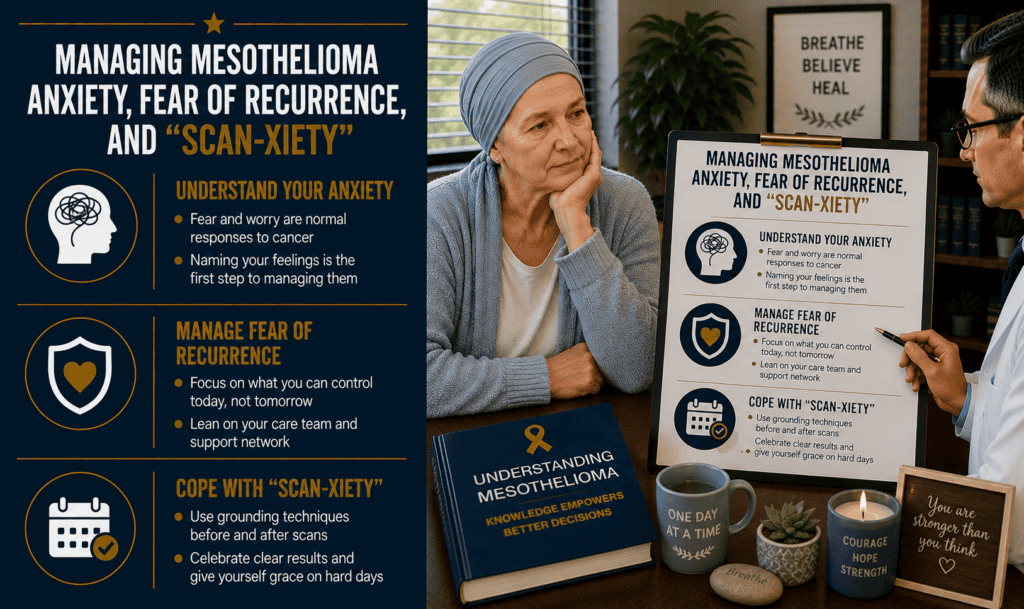
Managing Anxiety, Fear of Recurrence and Scanxiety During Mesothelioma Care
Practical support for uncertainty before scans, during treatment and after results.
Mesothelioma care can involve repeated scans, appointments and periods of uncertainty. Feeling worried does not mean a person is coping poorly, and it does not predict what a scan will show. The goal is not to force positive thoughts; it is to make difficult days more manageable while staying connected to medical care.
What anxiety, fear of recurrence and scanxiety mean
Scanxiety describes worry surrounding imaging tests and the wait for results. It can start when an appointment is scheduled, intensify on scan day, and continue until a clinician explains the findings. Fear of recurrence refers to concern that cancer may return after treatment. People with ongoing mesothelioma may instead fear progression, a change in treatment or an uncertain future. These experiences overlap but are not identical.
Anxiety can coexist with hope, sadness, anger or relief. It may fluctuate rather than improve in a straight line. A normal scan cannot promise that cancer will never return; an unfamiliar phrase in a report also does not, by itself, establish progression.
| Term | What it can mean | Helpful next step |
|---|---|---|
| Scanxiety | Distress before imaging or results | Agree on a result-delivery plan |
| Fear of recurrence | Concern cancer could return after treatment | Discuss individualized follow-up and symptoms |
| Fear of progression | Concern existing cancer may grow or change | Ask what the scan is intended to assess |
| General distress | Worry affects sleep, relationships or daily tasks | Tell the oncology team and request support |
Common triggers and signs that anxiety needs attention
Scan appointments, anniversaries, new aches, changing treatment plans, financial pressure and seeing test results in a patient portal before speaking with a clinician can all increase worry. Some people feel restless or irritable; others experience racing thoughts, trouble concentrating, disrupted sleep or a desire to repeatedly search online.
Physical symptoms should not automatically be attributed to anxiety. Mesothelioma, treatment complications and other illnesses can also cause breathlessness, chest discomfort or dizziness. Seek urgent medical assessment for new or severe breathing difficulty, chest pain, fainting or other rapidly worsening symptoms.
| Experience | Possible response |
|---|---|
| Difficulty sleeping before a scan | Tell your care team; make a short evening routine and avoid repeated portal checks |
| Repeatedly interpreting every symptom | Ask for a written list of symptoms to report and when |
| Missing appointments because of fear | Request a social worker, navigator or counselor to plan support |
| Worry interfering with daily life | Ask for a distress assessment and mental-health referral |
Before a scan: make the uncertainty more manageable
Ask why the test is needed, what it can and cannot answer, whether contrast is planned, how to prepare and when the results should be available. Decide whether you prefer to view results in the portal immediately or wait for a clinician to explain them. If a portal automatically releases reports, ask your clinic how and when someone can discuss unfamiliar wording.
Arrange transportation and a support person if useful. Bring a short question list rather than trying to remember everything. If enclosed spaces or previous scan experiences trigger panic, tell the imaging team before the appointment; they may be able to explain the procedure, discuss comfort measures or coordinate clinician-approved medication. Do not take someone else’s sedative or drive after a sedating medicine.
| Question to ask before imaging | Why it matters |
|---|---|
| What question is this scan trying to answer? | Defines the purpose of testing |
| When and how will I receive results? | Reduces uncertainty about the timeline |
| Who should I contact if results appear first in my portal? | Creates a clear interpretation pathway |
| What symptoms require a call before the appointment? | Prevents anxiety from delaying necessary care |
Need help now? Call 800.291.0963 / Live chat available 24/7, 365 days a year / Submit Your Case.
How to cope while waiting for scan results
Waiting is often the hardest part because there may be no action that can speed up interpretation. Set a realistic plan for checking messages, ask a trusted person to accompany you when results arrive and choose one or two manageable activities for each day. Brief breathing or grounding exercises, gentle activity when medically appropriate, music, conversation or a familiar routine may reduce distress for some people.
Consider writing two lists: “What I know now” and “What I need to ask.” This separates confirmed facts from imagined outcomes. Avoid using online stories to predict your own results: people have different disease types, treatment histories and circumstances. If anxiety becomes overwhelming, contact your care team rather than waiting for the next appointment.
| When | Small practical step |
|---|---|
| Immediately after the scan | Confirm expected result date and contact number |
| During the waiting period | Limit portal checks to a chosen schedule |
| If worry escalates | Call a support person or oncology social worker |
| If results are delayed | Contact the clinic to ask when review is expected |
Understanding scan results without jumping to conclusions
Imaging reports may contain technical descriptions, comparisons with earlier scans and findings unrelated to cancer. The ordering clinician must interpret them in the context of symptoms, examination, prior imaging and treatment. A report mentioning a change does not automatically establish recurrence or progression; some findings require comparison, repeat imaging or additional tests.
Ask your clinician to explain what is known, what remains uncertain, whether the plan changes and when the next review will occur. If findings are unclear, request the exact next step and who will contact you. Follow-up schedules are individualized: more imaging is not always better, and anxiety alone should not determine scan frequency.
| Result conversation | Useful question |
|---|---|
| Stable or unchanged | What does stable mean for my treatment plan? |
| Improvement | How will we monitor this response? |
| Indeterminate finding | What else could explain it and when will we reassess? |
| Possible progression | What additional evaluation or treatment discussion is needed? |
Professional support and evidence-informed treatment
Tell your oncology team if fear disrupts sleep, eating, relationships, decision-making or attendance at care. An oncology social worker, psycho-oncology clinician, counselor or psychiatrist can assess distress and suggest tailored support. Cognitive behavioral therapy, other structured counseling and mindfulness-based approaches may help some patients. Medication may be appropriate when a clinician determines that symptoms warrant it; potential interactions with cancer drugs and other medicines should be reviewed.
Supportive and palliative care can address emotional distress alongside pain, breathlessness and other symptoms, including while a person receives cancer-directed treatment. Asking for help is not a sign that treatment has failed. If you feel unsafe or might harm yourself, seek immediate emergency assistance; in the United States call or text 988 for crisis support.
| Support option | What it may offer |
|---|---|
| Oncology social worker | Practical barriers, counseling referrals, family support |
| Psycho-oncology or therapist | Assessment and structured coping strategies |
| Palliative care | Symptom relief and emotional support alongside cancer care |
| Peer or caregiver group | Connection with others, without substituting for medical advice |
How family and caregivers can help
Ask the patient whether they want company, distraction, help organizing questions or quiet time. Avoid insisting they “stay positive” or promising a particular result. Offer concrete assistance: driving to imaging, recording questions with permission, taking notes during the results appointment or handling a meal. Respect the patient’s preferences about sharing information with others.
Caregivers may experience their own scanxiety. They can seek counseling, respite or support groups without shifting the burden of reassurance onto the patient. When family members disagree about when to view results, prioritize the patient’s wishes and involve the care team if needed.
| Helpful phrase | Why it helps |
|---|---|
| Would you like me to listen or help plan? | Lets the patient choose the type of support |
| I can take notes if you want. | Reduces memory burden |
| We can ask the doctor what that wording means. | Avoids unsupported interpretation |
| I can help with transportation or meals. | Offers specific practical support |
A practical scanxiety and follow-up checklist
Use this checklist before the next scan. It is a planning aid, not a substitute for instructions from your care team.
- Write down the scan date, location and preparation instructions.
- Confirm when and how the clinician will explain results.
- Choose whether and when to open portal reports.
- Identify one support person and one calming activity.
- List new symptoms to report; do not dismiss them as anxiety.
- Prepare three priority questions for the results visit.
- Ask for mental-health support if worry disrupts daily life.
- Record the next step and the person responsible for contacting you.
Related reading: Long-term follow-up care, scans and testing; PET, CT and MRI scans; Your mesothelioma care team; Managing sleep problems during treatment.
| Before | During | After |
|---|---|---|
| Confirm logistics and results plan | Use agreed coping and support strategies | Review findings with clinician |
| Write questions and symptoms | Contact team for new concerning symptoms | Document next step and follow-up |
| Ask for help if anxiety is severe | Limit unhelpful repeated searches | Seek counseling if distress persists |
Frequently Asked Questions
What is scanxiety?
Scanxiety is worry connected to medical scans and waiting for their results. It can occur before, during or after imaging.
Is fear of recurrence the same as fear of progression?
No. Recurrence generally refers to cancer returning after treatment; progression refers to existing cancer growing or changing. People may experience either or both fears.
Does worrying make mesothelioma worse?
Worry is not evidence that a scan will be abnormal. Do not blame yourself for anxiety; ask your team for support if it affects your well-being.
Should I read my scan report in the patient portal?
That is a personal preference. Ask when a clinician can explain results, especially if reports may appear before your appointment.
Can I request extra scans to feel reassured?
Discuss symptoms and the appropriate imaging schedule with your oncologist. Extra scans may not resolve anxiety and are not automatically medically useful.
What can help while waiting for results?
A clear results timeline, limited portal checking, support from trusted people and brief relaxation practices may help. Professional counseling is available if distress persists.
When should I seek professional mental-health support?
Ask for help when worry affects sleep, eating, relationships, daily tasks or medical appointments, or whenever you want additional support.
Can palliative care help with anxiety?
Yes. Palliative care can address emotional distress and physical symptoms alongside cancer-directed treatment; it is not limited to end-of-life care.
Primary Medical and Patient-Education Sources
- National Cancer Institute: Adjustment to Cancer—Anxiety and Distress
- National Cancer Institute: Coping After Cancer Treatment
- American Cancer Society: How to Cope With Scanxiety
- American Cancer Society: Cancer Recurrence
These general cancer-care resources inform coping recommendations; an individual mesothelioma care plan must come from the treating team.
Get Help With Mesothelioma Questions and Next Steps
Call 800.291.0963 for help exploring available resources. Live chat is available 24/7, 365 days a year. Submit Your Case to discuss potential legal options. Compensation is not guaranteed and depends on individual facts and applicable law.
⚕️ Legal & Medical Information Disclaimer
This page provides general information, not medical, mental-health or legal advice. Discuss symptoms, treatment and emotional distress with qualified clinicians, and legal questions with an attorney.