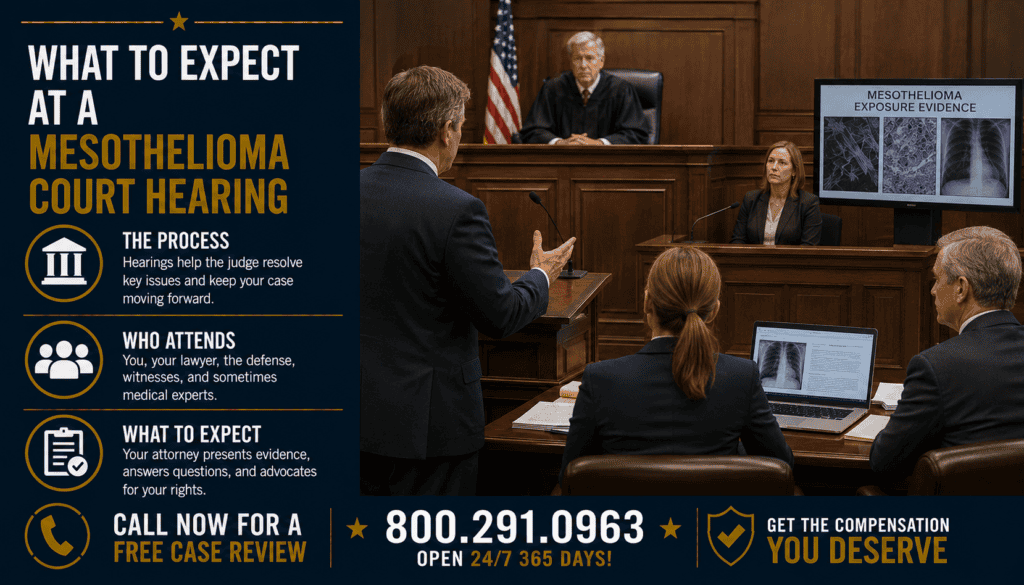
What to Expect at a Mesothelioma Court Hearing
A mesothelioma court hearing is a proceeding before a judge that can address scheduling, discovery disputes, motions, evidence, expert testimony, settlement-related case management or other issues before trial. A hearing is not necessarily a trial, and many hearings focus primarily on legal or procedural questions rather than live witness testimony.
The exact procedure depends on the court, jurisdiction, judge and purpose of the hearing. In federal civil cases, Rule 16 of the Federal Rules of Civil Procedure gives courts broad authority to manage scheduling and pretrial conferences, while other rules govern motions, discovery and testimony. State courts apply their own procedural rules.
⚖️ What a Mesothelioma Court Hearing Is
A hearing gives the judge an opportunity to address a particular issue in the lawsuit. Some hearings are brief and procedural; others involve extensive legal argument, evidence or testimony.
A Hearing Is Different From a Trial
A trial generally resolves disputed claims through the presentation of evidence to the designated factfinder. A pretrial hearing usually addresses narrower legal, evidentiary, discovery or case-management questions.
The Judge Controls the Proceeding
The court determines the issues to be heard, the order of argument and whether evidence or testimony is necessary.
Not Every Mesothelioma Case Has the Same Hearings
The number and type of hearings depend on the claims, defendants, discovery disputes, motions, expert issues and court schedule.
🏛️ Common Types of Court Hearings
| Hearing type | Possible purpose |
|---|---|
| Scheduling/status conference | Deadlines, discovery progress and case management |
| Discovery hearing | Disputes over documents, depositions or other discovery |
| Motion hearing | Legal arguments concerning a pending motion |
| Summary-judgment hearing | Whether a claim or defense can be resolved without trial |
| Expert/evidence hearing | Admissibility or limits on technical or other evidence |
| Pretrial conference | Witnesses, exhibits, disputed issues and trial planning |
Pretrial Conferences
Federal Rule 16 permits courts to use pretrial conferences to manage the case, simplify issues, control discovery, address evidence, consider summary adjudication, facilitate settlement and prepare for trial.
Summary Judgment
Under federal Rule 56, a party may seek judgment on a claim or defense when there is no genuine dispute of material fact and the movant is entitled to judgment as a matter of law. A ruling may resolve all or only part of a case.
📋 What Happens Before the Hearing
Before a hearing, the parties usually file or receive papers identifying the issues the court will consider. Court orders and local rules establish deadlines and procedural requirements.
Review the Hearing Notice
The notice or court order may identify the date, time, location, remote-access instructions and subject of the hearing.
Motion Papers
When the hearing concerns a motion, lawyers may submit briefs, declarations, deposition excerpts, documents or other materials permitted by the applicable rules.
Know Whether Personal Attendance Is Required
A represented plaintiff should confirm with retained counsel whether personal attendance is required. Some hearings are handled primarily by attorneys, while a court may require a party or representative to appear or be available for specified purposes.
Health and Scheduling Concerns
Mesothelioma treatment and health limitations can affect travel or attendance. Counsel can address appropriate scheduling or accommodation requests with the court under applicable procedures.
👥 Who Attends & Whether You Must Appear
Participants depend on the purpose of the hearing. The judge and attorneys are commonly involved, while parties, witnesses or experts may participate when their presence is required.
Attorneys
Lawyers generally present legal arguments, respond to the judge’s questions and address procedural issues for represented parties.
The Plaintiff
A plaintiff is not automatically required to testify at every hearing. Whether personal attendance is necessary depends on the court order, local practice and purpose of the proceeding.
Witnesses and Experts
Some evidentiary hearings may involve testimony. Federal Rule 43 provides that when a motion relies on facts outside the record, a court may consider affidavits, oral testimony or depositions as permitted by the rule.
Remote Participation
Courts may conduct certain conferences or proceedings remotely under applicable rules and orders. The availability of remote participation should be confirmed for the specific hearing rather than assumed.
🎙️ What Happens During the Hearing
The judge typically identifies the matter being considered and allows the parties to present their positions. The format can vary substantially.
Legal Argument
Attorneys may explain how statutes, procedural rules, evidence and precedent apply to the disputed issue.
Questions From the Judge
The judge may ask counsel about the factual record, legal authorities, discovery history or practical effect of a requested ruling.
Evidence or Testimony
Some hearings rely primarily on written submissions. Others may include exhibits, deposition excerpts or live testimony when permitted and necessary.
Courtroom Conduct
Participants should follow the judge’s instructions and applicable courtroom rules. A represented party should generally allow counsel to address the court unless the judge asks the party a question or counsel advises otherwise.
📂 Evidence, Motions & Expert Issues
Mesothelioma litigation can generate hearings involving historical asbestos evidence, discovery disputes and expert testimony.
Discovery Disputes
A court may decide whether requested documents, electronically stored information, deposition testimony or other materials must be produced and under what conditions.
Summary-Judgment Evidence
Federal Rule 56 allows parties to support factual positions with materials including depositions, documents, electronically stored information, affidavits or declarations, stipulations, admissions and interrogatory answers.
Expert Testimony
Pretrial proceedings may address whether proposed expert testimony satisfies the governing admissibility standard and whether particular opinions should be limited or excluded.
Claimant-Specific Evidence Still Matters
Historical proof that asbestos was used at a facility does not automatically establish a particular claimant’s exposure or a particular defendant’s liability. The court may examine whether the record contains evidence relevant to the specific claim or defense.
🧭 Possible Court Rulings
A judge may rule during the hearing, issue a written order later or take the matter under consideration.
| Possible result | What it may mean |
|---|---|
| Motion granted | The requested relief is granted in whole or part |
| Motion denied | The requested relief is not granted |
| Partial ruling | Only certain claims, defenses or issues are resolved |
| Additional briefing | The court requests further written argument or evidence |
| Discovery order | The court directs production, limits discovery or sets conditions |
| Scheduling order | Deadlines or trial-preparation requirements are established |
A Hearing Does Not Always End the Case
Many rulings address only one issue. Even a partial summary-judgment ruling can leave other claims or issues for trial.
The Court May Explain Its Reasons
For federal summary judgment, Rule 56 states that the court should state on the record the reasons for granting or denying the motion.
📝 What Happens After the Hearing
The next step depends on the court’s ruling and the stage of litigation.
Written Orders
The court may issue an order memorializing decisions made at a scheduling or pretrial conference. Under Rule 16, such orders can control the subsequent course of the action unless modified.
Additional Discovery
If discovery remains open, the parties may continue document production, depositions or expert work according to the court’s schedule.
Further Motions
A ruling may lead to additional briefing, evidentiary motions or other pretrial proceedings.
Trial Preparation
As trial approaches, the court may address witnesses, exhibits, evidentiary issues and a final pretrial plan.
Discuss the Ruling With Counsel
A represented party can ask retained counsel what the ruling means for the remaining claims, deadlines, evidence and next procedural step.
❓ Frequently Asked Questions
Is a mesothelioma court hearing the same as a trial?
No. Many hearings address procedural, legal, discovery or evidentiary issues before trial.
Do I have to attend every hearing?
Not necessarily. Attendance depends on the court order, jurisdiction, type of hearing and advice of retained counsel.
Will I have to testify?
Not at every hearing. Some hearings consist primarily of legal argument, while others may involve testimony or other evidence.
Can a hearing be remote?
Potentially. Courts may permit remote participation for certain proceedings, but the specific court’s order controls.
What is a status conference?
It is generally a case-management proceeding in which the court may address progress, deadlines, discovery and upcoming procedural steps.
What is a summary-judgment hearing?
It concerns a request to resolve a claim, defense or part of one without trial under the applicable legal standard.
Can the judge dismiss a claim at a hearing?
Potentially, when a properly presented motion and governing law support that result.
Can expert testimony be discussed before trial?
Yes. Courts may address the admissibility or scope of expert testimony during pretrial proceedings.
Will the judge always rule immediately?
No. A judge may rule from the bench, request additional briefing or issue a written decision later.
What should I bring to a hearing?
A represented party should follow counsel’s and the court’s instructions. Do not assume documents or exhibits should be independently presented without coordinating with counsel.
📞 Request a Case Evaluation
Court hearings are easier to understand when the underlying evidence is organized. Preserve medical records, employment histories, product information, witness names, deposition materials and court documents relevant to the asbestos claim.
Call 800.291.0963 for a no-obligation case evaluation and to talk to a real person 24/7, 365 days a year. Many mesothelioma law firms handle qualifying cases on a contingency-fee basis; confirm the terms with the firm you retain. Submit your case here.
📝 Summary
A mesothelioma court hearing can address scheduling, discovery, motions, expert testimony, evidence or other pretrial issues. Some hearings are brief and lawyer-focused; others involve testimony or extensive argument. The judge may rule immediately or later, and many hearing decisions resolve only part of the lawsuit. The specific court order, local rules and advice of retained counsel should guide preparation and attendance.
🔗 Confirmed Sources
- Cornell Legal Information Institute — Federal Rule of Civil Procedure 16
- Cornell Legal Information Institute — Federal Rule of Civil Procedure 56
- Cornell Legal Information Institute — Federal Rule of Civil Procedure 43
Disclaimer: General information only—not legal advice. This website is not a law firm. Hearing procedures vary by court and jurisdiction. Past results do not guarantee future outcomes.