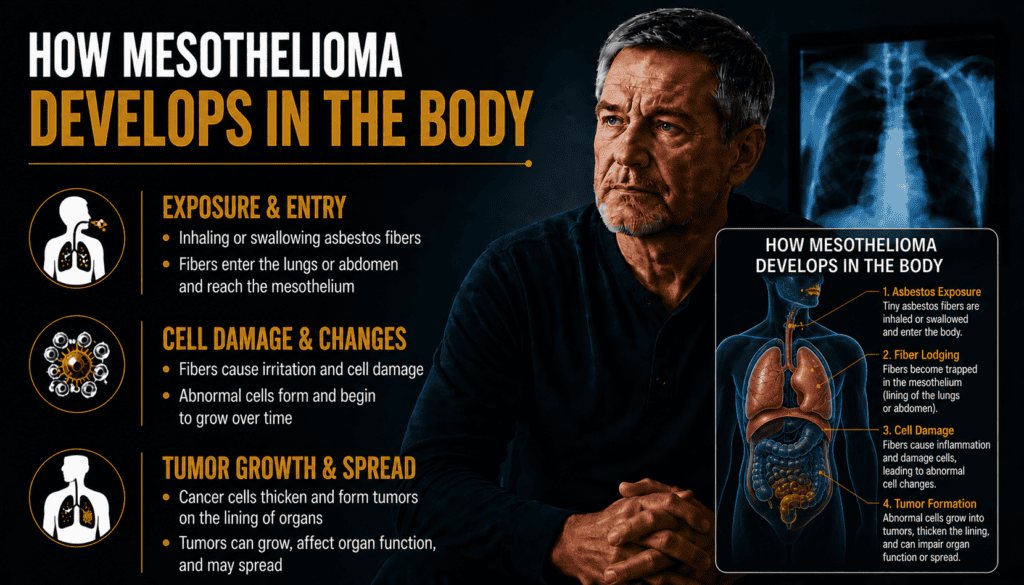
How Mesothelioma Develops in the Body
From asbestos exposure and cellular changes to tumor growth, symptoms, and diagnosis
Mesothelioma begins in the mesothelium, the thin tissue that lines certain internal organs. Most cases are associated with asbestos exposure, but the biological process is gradual and individual cases cannot be explained by one simple timeline. Understanding how the disease develops can help patients interpret their diagnosis without mistaking an exposure history, scan, or blood test for proof of cancer. Start with our mesothelioma overview and diagnosis guide for the broader context.
Important: A history of asbestos exposure does not mean a person will develop mesothelioma. Conversely, some patients have no known exposure history. Persistent or worsening symptoms require medical assessment rather than self-diagnosis.
1. Where Mesothelioma Begins
The mesothelium is a specialized lining that helps organs move against surrounding structures. Its cells are found in the pleura around the lungs, the peritoneum inside the abdomen, the pericardium around the heart, and the tunica vaginalis around the testicle. Mesothelioma arises from cells of these linings; it is not the same disease as a lung cancer that starts inside lung tissue.
| Lining | Location | Why it matters |
|---|---|---|
| Pleura | Chest cavity and lung surfaces | Most common site; may affect breathing and chest comfort |
| Peritoneum | Abdominal cavity and organ surfaces | May cause abdominal swelling or pain |
| Pericardium | Sac around the heart | Rare site requiring specialist assessment |
| Tunica vaginalis | Tissue around the testicle | Rare site that may present as a scrotal mass |
Explore the differences between pleural mesothelioma and peritoneal mesothelioma. The starting location matters because symptoms, staging methods, and treatment planning differ.
2. How Asbestos Exposure Can Contribute
Asbestos is a group of naturally occurring fibrous minerals. When asbestos-containing material is disturbed, airborne fibers can be inhaled; fibers may also be swallowed. Exposure can occur at work, in certain environments, or through fibers carried home from contaminated workplaces. Inhaled fibers may persist in the respiratory system, and some can reach or affect pleural tissue. Researchers associate fiber-related injury, chronic inflammation, and resulting cellular changes with mesothelioma development; the exact sequence cannot be reconstructed for every patient.
| Step | What is understood | What is not established for an individual |
|---|---|---|
| Exposure | Fibers enter the body when inhaled or swallowed | A precise personal dose may be impossible to reconstruct |
| Persistence | Some fibers remain in tissue for long periods | Persistence alone does not prove cancer will occur |
| Tissue response | Inflammation and injury may follow | Not every inflammatory response becomes cancer |
| Cancer formation | Accumulated changes can allow abnormal cell growth | No exposure-to-diagnosis timetable is exact |
Asbestos exposure is a major risk factor, not a diagnosis. NCI notes that risk varies and some patients have no recognized risk factor. Smoking and asbestos together strongly increase lung cancer risk, but that interaction should not be presented as a proven multiplier of mesothelioma risk.
3. How Healthy Cells Become Cancerous
Healthy cells normally follow instructions that regulate growth, repair, and programmed cell death. Cancer develops when changes disrupt these controls, allowing abnormal cells to survive and multiply. In mesothelioma, researchers have identified changes involving tumor-suppressor pathways, including BAP1 and other genes. A change found in tumor tissue is not automatically inherited; genetic counseling may be appropriate when personal or family history raises concern.
| Biological concept | Plain-language meaning | Clinical significance |
|---|---|---|
| DNA or gene changes | Instructions controlling cell behavior become altered | Some changes help characterize a tumor |
| Growth-control failure | Abnormal cells divide despite normal limits | A mass or diffuse tumor may develop |
| Local invasion | Cancer grows into neighboring structures | Can affect pain, breathing, and treatment options |
| Tumor heterogeneity | Cancer cells may differ within one tumor | Explains why detailed pathology is important |
Testing discussed in our genetic testing and biomarkers article may help clarify inherited risk or tumor features in selected situations. It does not replace a tissue diagnosis.
4. Why Mesothelioma Can Take Decades to Develop
Mesothelioma often becomes apparent many years after asbestos exposure. During that interval, an exposed person may feel entirely well. A long delay does not establish exactly when cancer first formed; it describes the time between an exposure and the eventual clinical recognition of disease. NCI states that asbestos-related diseases can become apparent 10 to 40 years or more after exposure, while individual mesothelioma timelines vary.
| Time period | Possible situation | Important limitation |
|---|---|---|
| Exposure period | A person works or lives around asbestos | Exposure is not equivalent to cancer |
| Long symptom-free interval | No obvious illness may be present | Absence of symptoms cannot date cell changes |
| Symptoms emerge | Chest or abdominal symptoms prompt evaluation | Many noncancer conditions cause similar symptoms |
| Diagnosis | Imaging and pathology establish what is present | Diagnosis date is not the date cancer began |
People with a suspected exposure history should share the type of work, approximate years, products or locations, and any household exposure with their clinician. Do not assume that a recent symptom proves a recent exposure caused it.
5. Where Tumors Develop and Spread
Mesothelioma can grow as multiple nodules or a more diffuse sheet along a lining rather than forming one neatly separated lump. Pleural disease may involve surfaces around the lung and adjacent chest structures. Peritoneal disease can involve abdominal surfaces. With progression, cancer may invade nearby tissue, involve lymph nodes, or spread farther away. Patterns differ by primary site and patient.
| Pattern | Potential consequence | How assessed |
|---|---|---|
| Growth along pleura | Reduced lung expansion or chest discomfort | CT and other imaging plus pathology |
| Pleural fluid buildup | Shortness of breath or cough | Imaging and clinical examination |
| Peritoneal surface involvement | Abdominal swelling, discomfort, or altered appetite | Abdominal imaging and tissue sampling |
| Invasion or distant spread | Additional symptoms or treatment considerations | Site-specific staging workup |
Read our mesothelioma stages overview for the distinction between tumor extent and prognosis. Formal stage I–IV descriptions are established for diffuse pleural mesothelioma; clinicians do not simply apply the same chart to every peritoneal case.
6. How Tumor Growth Can Cause Symptoms
Symptoms depend on the location of disease, inflammation, fluid accumulation, and which structures are affected. Pleural mesothelioma may cause shortness of breath, cough, chest pain, fatigue, or unexplained weight loss. Peritoneal disease may cause abdominal swelling, pain, nausea, fatigue, or weight loss. These symptoms are not specific to mesothelioma.
| Symptom | Possible mechanism | Appropriate response |
|---|---|---|
| Breathlessness | Pleural fluid or restricted lung expansion | Prompt clinical evaluation; emergency care if sudden or severe |
| Chest pain | Pleural or chest-wall irritation | Medical assessment, especially with new symptoms |
| Abdominal distention | Fluid or disease involving abdominal lining | Contact treating team for evaluation |
| Weight loss or fatigue | Cancer effects, reduced intake, or other causes | Report changes and request supportive assessment |
See our mesothelioma symptoms guide for more detail. Sudden severe breathlessness, fainting, or severe chest pain warrants emergency medical care.
7. How Doctors Identify Mesothelioma
Doctors begin with symptoms, examination, medical history, and possible asbestos exposure. Imaging can show abnormalities such as thickening, masses, or fluid but cannot independently establish a mesothelioma diagnosis. Tissue obtained by biopsy is examined by a pathologist, often using immunohistochemistry to distinguish mesothelioma from other cancers. Fluid cytology can provide useful information but a negative sample does not reliably exclude disease.
| Diagnostic step | Purpose | Key limitation |
|---|---|---|
| Clinical history and examination | Identify symptoms and possible exposures | Cannot confirm cancer |
| X-ray, CT, PET/CT, or MRI | Locate abnormalities and assess extent | Imaging alone cannot establish cell type |
| Fluid sampling | Evaluate an effusion | Negative cytology may require tissue biopsy |
| Biopsy and pathology | Examine tissue and diagnostic markers | Adequate sampling and expert interpretation matter |
| Additional staging tests | Help plan care after diagnosis | Tests depend on primary site and clinical circumstances |
Our guides to imaging tests, mesothelioma biopsy, and pathology reviews explain these steps. A second opinion may be useful when the pathology is difficult to interpret or treatment decisions are complex.
8. What Patients Can Do Next
If you have symptoms or a suspected asbestos exposure history, schedule an evaluation and provide a clear timeline. If mesothelioma has been diagnosed, ask which lining is involved, what the pathology report says, whether further staging is needed, and which specialists should review treatment options. Supportive care for pain, breathlessness, nutrition, and emotional concerns can begin alongside diagnostic or cancer-directed care.
| Action | Why it helps |
|---|---|
| Write down symptoms and when they began | Supports a focused appointment |
| Record exposure locations and approximate years | Gives clinicians relevant background |
| Request copies of imaging and pathology reports | Makes specialist review easier |
| Ask whether a tissue diagnosis is definitive | Clarifies remaining uncertainty |
| Discuss treatment and symptom-control goals | Aligns care with medical needs and preferences |
Review mesothelioma treatments and the diagnosis overview for next steps. No article can determine whether a specific person has mesothelioma or predict their course.
Confirmed medical sources
9. Frequently Asked Questions
Does asbestos exposure always lead to mesothelioma?
No. Exposure increases risk, but most exposed people do not develop mesothelioma. Risk depends on multiple factors, and some patients have no known exposure.
How does mesothelioma start?
It starts when cells in a mesothelial lining acquire changes that disrupt normal growth controls. Asbestos-related tissue injury and inflammation can contribute, but the precise pathway varies.
Can mesothelioma develop without asbestos exposure?
Yes. Some patients have no recognized asbestos exposure. Clinicians consider other possibilities and personal or family history when appropriate.
How long does it take to develop?
It often takes decades after exposure to become clinically apparent. No single latency period predicts an individual diagnosis.
Is mesothelioma the same as lung cancer?
No. Mesothelioma begins in mesothelial linings, commonly the pleura; lung cancer originates in lung tissue. They require different pathology and treatment assessments.
Does a pleural effusion mean mesothelioma is present?
No. Fluid around a lung has many possible causes. Imaging and sometimes fluid sampling or biopsy help determine the cause.
Can a CT scan show when the cancer began?
No. CT can show current abnormalities and extent, but it cannot date the original cellular changes or independently confirm the diagnosis.
What confirms a mesothelioma diagnosis?
A specialist generally relies on adequate tissue and pathology, including appropriate markers, interpreted alongside clinical and imaging findings. Ask your team what evidence establishes your diagnosis.
Get Help After a Mesothelioma Diagnosis
Call 800.291.0963 for help discussing possible next steps. Live chat is available 24/7, 365 days a year. Submit Your Case using the form below.
Eligibility and compensation depend on individual facts and applicable law. No recovery or outcome is guaranteed.
⚕️ Legal & Medical Information Disclaimer
This page provides general information, not medical diagnosis, treatment, or legal advice. Consult qualified medical and legal professionals about your circumstances.