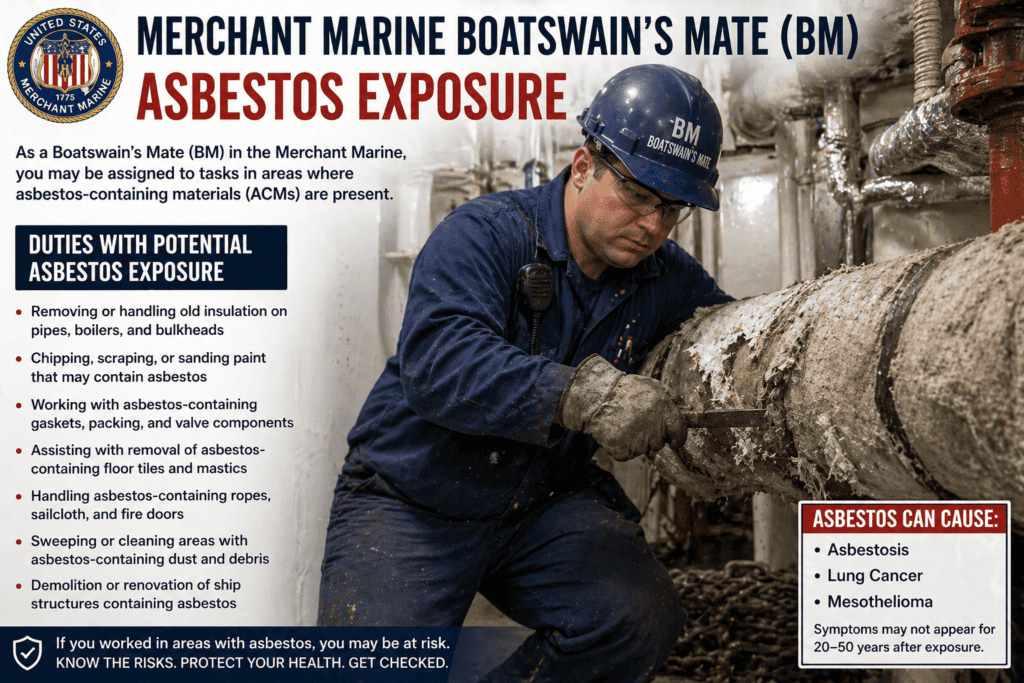
Merchant Marine Boatswain’s Mate (BM) Asbestos Exposure
A Merchant Marine Boatswain’s Mate (BM) traditionally served as an experienced deck-department worker with responsibility for supervising deck crews, line handling, cargo gear, deck machinery, maintenance, and other vessel operations. Depending on the ship, era, employer, and crew structure, a Boatswain’s Mate could spend substantial time around winches, capstans, hatch equipment, deck piping, machinery, cargo spaces, and repair work.
Potential asbestos exposure for a Boatswain’s Mate could arise if older deck systems, machinery, piping, gaskets, packing, insulation, fire-resistant materials, or nearby shipboard components contained asbestos and were disturbed during maintenance or overhaul. That does not mean every Boatswain’s Mate was exposed. Exposure must be reconstructed from the specific vessel, service dates, duties, materials, repair history, frequency, proximity, and supporting evidence.
This page is part of the Merchant Marines Ranks Asbestos Exposure hub within the broader Merchant Marines Asbestos Exposure silo. Related deck-worker pages include Merchant Marine Able Seaman (AB) Asbestos Exposure, Merchant Marine Ordinary Seaman (OS) Asbestos Exposure, and Merchant Marine Deckhands Asbestos Exposure.
⚓ Boatswain’s Mate Role and Deck Leadership
Boatswain’s Mates often helped direct and organize deck work. Depending on the vessel, they could supervise line handling, cargo operations, deck maintenance, painting preparation, equipment use, and work performed by other deck crew.
For asbestos exposure analysis, the supervisory role can matter because a Boatswain’s Mate may have worked close to maintenance activity and could also have performed hands-on tasks. The title alone does not prove exposure; actual duties and work locations must be identified.
| Deck Duty | Possible Exposure Pathway | Evidence to Review |
|---|---|---|
| Supervising deck crews | Presence near maintenance or repair work involving older ship materials | Deck logs, crew assignments, coworker testimony |
| Line handling and mooring | Work around winches, capstans, deck machinery, and nearby piping | Vessel plans, machinery records, maintenance logs |
| Cargo gear operations | Work near hatch equipment, winches, brakes, machinery, or cargo-area systems | Cargo records, equipment manuals, repair files |
| Deck maintenance | Potential contact with older gaskets, packing, insulation, panels, or debris during repairs | Work orders, product records, deck logs |
| Shipyard and overhaul support | Presence near concentrated removal and replacement work | Shipyard records, contractor files, overhaul specifications |
🛠️ Possible Asbestos Exposure Pathways
Asbestos was historically used in some maritime products because of its resistance to heat, fire, and wear. Depending on the vessel, manufacturer, component, and era, asbestos-containing materials could be associated with some gaskets, packing, pipe insulation, machinery components, electrical materials, fire-resistant products, and interior construction materials.
A Boatswain’s Mate could potentially experience direct exposure while performing maintenance that disturbed an asbestos-containing product, or bystander exposure while working near electricians, engineers, welders, pipefitters, machinists, or shipyard personnel disturbing such materials.
A credible exposure history should identify the particular deck area, task, equipment, material, frequency, duration, and evidence that the product actually contained asbestos.
⚙️ Deck Machinery, Winches, and Cargo Gear
Boatswain’s Mates could work around deck machinery used for mooring, cargo handling, and general vessel operations. Older machinery and adjacent systems sometimes used heat- or friction-resistant materials, but asbestos content varied significantly by equipment and era.
Winches and capstans
Investigators may examine brake or friction components, gaskets, seals, motors, electrical systems, and nearby insulated piping. No component should be assumed to contain asbestos without evidence.
Hatch and cargo equipment
Cargo-handling areas could include mechanical drives, electrical components, piping, ventilation, and fire-resistant materials. Maintenance and repair records can help identify what was installed and disturbed.
Deck piping and valves
Some deck systems included insulated piping, valves, pumps, or flange connections. Historical gaskets, packing, or insulation may be relevant if product-specific evidence shows asbestos content.
🔧 Deck Maintenance and Repair Work
Deck maintenance can be particularly important in a Boatswain’s Mate exposure investigation because the role can involve close supervision or direct participation in repair work. Depending on the vessel, tasks could include servicing deck machinery, assisting with piping repairs, cleaning work areas, removing damaged materials, or preparing equipment for repair.
Potential fiber release depends on whether the material involved actually contained asbestos and how it was handled. Cutting, scraping, removing, grinding, or cleaning up asbestos-containing products can be more relevant than simply working near intact materials.
Deck logs, maintenance records, work orders, manufacturer documents, shipyard files, and coworker testimony can help reconstruct what occurred.
🔩 Materials and Equipment to Investigate
The categories below are investigative starting points only. Material composition varied by manufacturer, model, installation date, repair history, and replacement part.
| Material or Equipment | Potential Historical Asbestos Use | Evidence to Investigate |
|---|---|---|
| Deck winches and capstans | Some historical friction, gasket, seal, or adjacent electrical materials | Equipment manuals, parts lists, repair records |
| Deck piping and valves | Some historical insulation, gaskets, or packing | Piping diagrams, maintenance files, manufacturer records |
| Pumps and cargo-system equipment | Some historical packing, gaskets, or insulated connections | Parts documentation, equipment records, work orders |
| Electrical components | Some historical heat-resistant insulating materials | Electrical plans, manufacturer data, repair files |
| Panels and fire-resistant materials | Some historical shipboard construction materials contained asbestos | Construction specifications, renovation files, shipyard records |
| Nearby insulated systems | Some historical pipe covering or thermal insulation | Ship plans, insulation specifications, maintenance records |
For broader system-specific research, use the Merchant Marine Equipment Asbestos Exposure hub.
🚢 Ships, Work Areas, and Overhaul Periods
Boatswain’s Mates served aboard many vessel types, including cargo ships, tankers, container ships, bulk carriers, passenger ships, Liberty ships, Victory ships, and other merchant vessels. Deck layouts, cargo systems, machinery, and maintenance practices varied by ship.
The Merchant Marine Ships Asbestos Exposure hub can help organize vessel-specific research. The Merchant Marine Facilities Asbestos Exposure hub may also be relevant when service included shipyards, ports, dry docks, or maintenance facilities.
Major overhaul periods can involve extensive deck, piping, electrical, machinery, and structural work. Review Merchant Marine Shipyards Asbestos Exposure and Merchant Marine Dry Docks Asbestos Exposure when those periods appear in the work history.
The Merchant Marine Asbestos Exposure Timeline can provide historical context for the service era.
📋 Evidence for a Boatswain’s Mate Exposure History
Because asbestos-related disease can appear decades after maritime employment, reconstructing a Boatswain’s Mate work history may require multiple sources.
| Evidence | What It May Help Establish |
|---|---|
| Employment and mariner records | Boatswain’s Mate title, employer, vessel, and dates of service |
| Vessel assignments | Specific ships and periods aboard each vessel |
| Deck logs | Deck operations, maintenance, cargo activity, and repair periods |
| Equipment manuals and parts lists | Components installed in deck machinery and cargo systems |
| Maintenance and work orders | Specific repairs and tasks performed |
| Shipyard and dry-dock records | Major overhaul, removal, and replacement work |
| Manufacturer and product records | Whether specific gaskets, packing, insulation, or other components contained asbestos |
| Coworker testimony | Actual duties, proximity, frequency, and work conditions |
| Medical records | Diagnosis and relevant medical history |
The strongest evidence connects the Boatswain’s Mate to a specific vessel, deck task, repair event, and asbestos-containing material rather than relying only on the job title.
🫁 Asbestos-Related Health Risks
Inhalation of asbestos fibers is associated with mesothelioma, lung cancer, and asbestosis. These diseases can have long latency periods, so historical deck work may remain medically relevant many years later.
A diagnosis alone does not establish asbestos causation. Medical evaluation may consider occupational exposure history, smoking history, other risk factors, imaging, pathology, and additional clinical evidence.
See Merchant Marine Asbestos Exposure Health Risks for the dedicated health-risk page.
Need help now? If a Merchant Marine Boatswain’s Mate or family member is trying to reconstruct possible asbestos exposure, Call 800.291.0963, use our 24/7 live chat, or Submit Your Case. Vessel names, service dates, deck assignments, machinery, cargo gear, repair periods, coworkers, and product information can be important starting points.
⚖️ Legal Options and Claim Investigation
A Merchant Marine Boatswain’s Mate diagnosed with an asbestos-related disease may be able to investigate legal options depending on the facts and evidence. Potential claims can depend on diagnosis, exposure history, product identification, responsible companies, jurisdiction, and filing deadlines.
The Merchant Marine Asbestos Exposure Legal Options hub covers Merchant Marine mesothelioma lawsuits, asbestos trust fund claims, wrongful death lawsuits, and statutes of limitations. Compensation is not automatic, and deck employment alone does not establish liability.
What a case investigation may examine
- Diagnosis and pathology records.
- Merchant Marine employment and rating history.
- Vessel names and dates of service.
- Deck supervision, line handling, and cargo-gear duties.
- Winches, capstans, pumps, valves, piping, and electrical systems.
- Shipyard, dry-dock, and overhaul periods.
- Product, manufacturer, contractor, and shipyard records.
- Coworker and witness statements.
- Jurisdiction and applicable filing deadlines.
❓ Frequently Asked Questions
What did a Merchant Marine Boatswain’s Mate do?
A Boatswain’s Mate traditionally supervised or supported deck crews, line handling, cargo gear, deck machinery, maintenance, and other deck operations depending on the vessel and era.
Were all Merchant Marine Boatswain’s Mates exposed to asbestos?
No. The job title does not prove exposure. Investigators must identify the vessel, equipment, work areas, repair history, and materials involved.
Could deck machinery contain asbestos-related components?
Some historical machinery or adjacent systems used asbestos-containing gaskets, packing, friction materials, insulation, or electrical components. Whether a specific part contained asbestos must be established from evidence.
Could a Boatswain’s Mate have bystander exposure?
Possibly. A Boatswain’s Mate could work near engineers, electricians, pipefitters, welders, machinists, or shipyard workers disturbing asbestos-containing materials. Frequency, distance, duration, ventilation, and work practices matter.
Why are overhaul periods important?
Major overhauls can involve simultaneous work on deck machinery, piping, insulation, electrical systems, and structural materials. These periods may generate detailed records that help reconstruct exposure.
What records help reconstruct a Boatswain’s Mate exposure history?
Useful evidence can include employment records, vessel assignments, deck logs, equipment manuals, parts lists, work orders, shipyard files, manufacturer records, coworker testimony, and medical records.
Can asbestos exposure be relevant to lung cancer?
Yes. Asbestos is a recognized cause of lung cancer, but a diagnosis alone does not establish asbestos causation. Medical and occupational evidence should be evaluated together.
Can a family investigate a claim after a Boatswain’s Mate dies?
Possibly. Depending on diagnosis, exposure evidence, responsible parties, jurisdiction, and filing deadlines, surviving family members may be able to investigate wrongful death or other asbestos-related claims.
☎️ Help for Merchant Marine Boatswain’s Mates and Families
If you or a family member worked as a Merchant Marine Boatswain’s Mate and later developed mesothelioma or lung cancer, an exposure investigation can examine vessel assignments, deck duties, cargo gear, machinery, maintenance work, overhaul periods, products, manufacturers, and available historical evidence.
Call 800.291.0963 to discuss a Merchant Marine asbestos exposure history. Live chat is available 24/7, 365 days a year. You can also Submit Your Case online.
There is no guarantee that a diagnosis or work history will qualify for compensation. Eligibility depends on the facts, evidence, responsible parties, jurisdiction, and filing deadlines.
⚕️ Legal & Medical Information Disclaimer
This page provides general educational information and is not medical or legal advice. It does not establish diagnosis, asbestos exposure, causation, liability, eligibility, or compensation. Consult qualified medical and legal professionals for guidance specific to your situation.