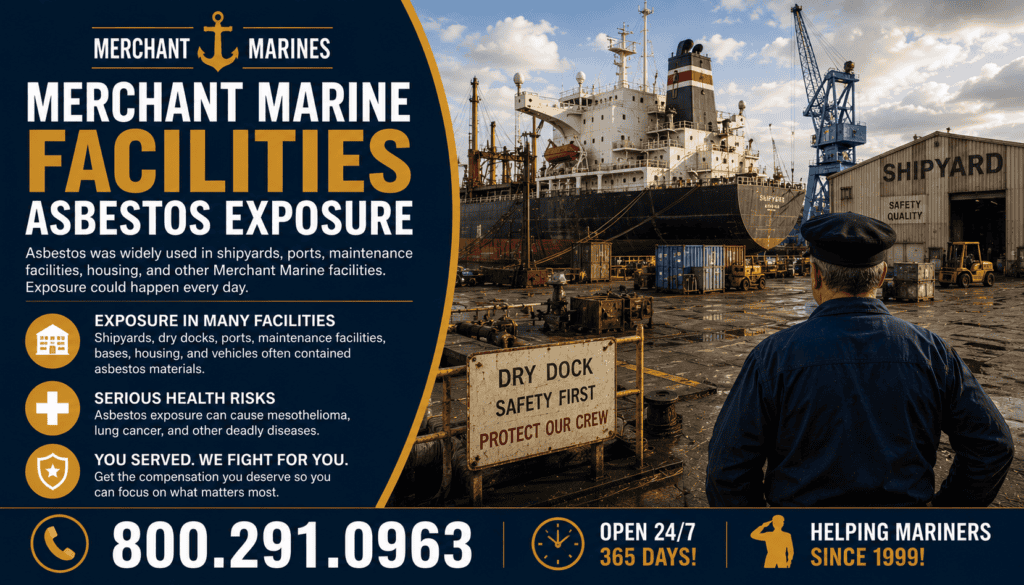
🏭 Merchant Marine Facilities Asbestos Exposure
Merchant Marine facilities played a vital role in supporting America’s commercial shipping industry and military logistics for much of the twentieth century. Shipyards, marine terminals, repair facilities, maintenance shops, warehouses, dry docks, cargo handling centers, fueling terminals, and port operations relied heavily on asbestos-containing products because of their durability, fire resistance, and ability to withstand extreme heat.
From the 1930s through the early 1980s, asbestos was installed throughout these facilities in insulation, boilers, steam systems, machinery, electrical equipment, roofing materials, flooring, fireproofing, and industrial construction products. Workers who built, repaired, maintained, or operated Merchant Marine facilities often encountered airborne asbestos fibers during routine maintenance, renovations, and ship overhauls.
Many former Merchant Mariners, civilian employees, shipyard workers, mechanics, electricians, pipefitters, and maintenance personnel were unknowingly exposed for years before the dangers of asbestos became widely recognized. Decades later, many developed mesothelioma, asbestos-related lung cancer, asbestosis, and other serious diseases.
If you were exposed aboard a vessel, visit our Merchant Marine Ships Asbestos Exposure guide. You can also explore our Merchant Marine Equipment Asbestos Exposure page to learn how machinery contributed to asbestos exposure.
📞 Call 800-291-0963 to discuss your potential legal options.
🚨 Confidential Merchant Marine Case Evaluation
If you were diagnosed with mesothelioma or another asbestos-related illness after working in or around Merchant Marine facilities, you may qualify to pursue compensation.
📞 Call 800-291-0963
✔ Confidential case evaluation
✔ Nationwide legal representation
✔ No upfront costs
✔ Help identifying asbestos exposure locations
✔ No legal fee unless compensation is recovered
⚠️ Why Asbestos Was Used in Merchant Marine Facilities
Merchant Marine facilities operated around the clock and contained high-temperature equipment, steam systems, fuel storage areas, and heavy industrial machinery. Asbestos was considered an ideal construction material because it resisted fire, insulated equipment, and reduced heat loss.
Common reasons asbestos was installed throughout Merchant Marine facilities included:
🔥 Fireproofing buildings and machinery
⚙️ Insulating boilers, turbines, and steam systems
🧱 Protecting structural steel from high temperatures
🌡️ Conserving energy by insulating pipes and equipment
🚢 Meeting maritime and industrial safety standards
Unfortunately, disturbing these materials during maintenance or demolition often released microscopic asbestos fibers into the air where workers could easily inhale them.
🏗️ Types of Merchant Marine Facilities Where Asbestos Was Common
Merchant Mariners and civilian workers could encounter asbestos in many different maritime facilities throughout the United States.
Common exposure locations included:
🚢 Commercial shipyards
⚓ Dry docks
🏭 Marine repair facilities
📦 Cargo terminals
🛢️ Fuel storage and transfer terminals
🔧 Maintenance shops
⚙️ Equipment repair buildings
🏢 Port administration buildings
🚚 Warehouses
⚡ Power generation buildings
🛠️ Machine shops
🏗️ Construction and fabrication facilities
Whether workers maintained ships, repaired equipment, handled cargo, or serviced mechanical systems, asbestos-containing materials were frequently present throughout these workplaces.
🔧 Common Sources of Asbestos Inside Merchant Marine Facilities
Asbestos was incorporated into thousands of products installed throughout Merchant Marine facilities. Over time, repairs, renovations, and normal wear caused many of these materials to deteriorate and release fibers.
Common asbestos-containing materials included:
🔥 Boilers and Steam Systems
Industrial boilers supplying steam for maintenance shops, dry docks, and repair operations contained extensive asbestos insulation, refractory materials, pipe covering, and boiler cement.
Learn more about Merchant Marine Boiler Equipment Asbestos Exposure.
⚙️ Pumps, Valves, and Mechanical Equipment
Maintenance buildings and repair facilities contained countless pumps, valves, compressors, turbines, generators, and hydraulic equipment that used asbestos gaskets, packing, insulation, and seals.
Additional information is available on our:
⚡ Electrical Systems
Switchgear, transformers, electrical panels, generators, cable insulation, and electrical control equipment frequently contained asbestos because of its excellent insulating and fire-resistant properties.
Electricians and maintenance personnel often encountered asbestos while repairing or replacing aging electrical systems.
🧱 Building Materials
Merchant Marine facilities themselves frequently contained asbestos in:
- Pipe insulation
- Spray-applied fireproofing
- Roofing materials
- Ceiling tiles
- Floor tiles
- Wallboard
- Joint compound
- Cement products
- HVAC duct insulation
- Fire doors
During renovations or demolition projects, these materials could become friable and release dangerous airborne fibers.
🚧 Ship Repair Areas
Dry docks and repair shops routinely removed worn insulation from boilers, piping, engines, turbines, pumps, and machinery aboard commercial vessels.
Asbestos dust generated during ship overhauls often spread throughout repair buildings, exposing mechanics, welders, laborers, supervisors, and nearby workers who never directly handled asbestos products themselves.
For more information about shipboard exposure, visit our pages covering Merchant Marine Cargo Ships Asbestos Exposure, Merchant Marines Liberty Ships Asbestos Exposure, Merchant Marines Victory Ships Asbestos Exposure, and Merchant Marines Oil Tankers Asbestos Exposure.
👷 How Workers Were Exposed to Asbestos in Merchant Marine Facilities
Merchant Marine facilities were busy industrial workplaces where maintenance, ship repairs, equipment overhauls, cargo operations, and construction projects occurred every day. Many of these activities disturbed asbestos-containing insulation, pipe coverings, gaskets, floor tiles, roofing materials, fireproofing, and machinery components, releasing microscopic fibers into the air.
Because asbestos fibers are invisible and can remain airborne for hours, workers often inhaled them without realizing they had been exposed.
Common exposure activities included:
🔧 Repairing boilers, pumps, valves, and generators
⚙️ Replacing worn gaskets and packing materials
🛠️ Removing pipe insulation during maintenance
🏗️ Renovating or demolishing older buildings
🚢 Overhauling commercial vessels in dry docks
🧹 Sweeping asbestos-contaminated dust from maintenance areas
⚡ Repairing electrical equipment and switchgear
🌬️ Working near ventilation systems that circulated asbestos fibers
Workers were often exposed even if they never handled asbestos products directly. Maintenance crews, supervisors, warehouse personnel, inspectors, crane operators, laborers, and office employees working near renovation projects could also inhale airborne fibers.
Occupations frequently associated with higher exposure included Merchant Marine Engineers Asbestos Exposure, Merchant Marine Firemen Asbestos Exposure, Merchant Marine Oilers Asbestos Exposure, Merchant Marine Electricians Asbestos Exposure, and Merchant Marine Wipers Asbestos Exposure.
🧬 Diseases Linked to Merchant Marine Facility Asbestos Exposure
Medical researchers have long recognized asbestos exposure as the primary cause of several serious occupational diseases. One of the most challenging aspects of these illnesses is their long latency period. Symptoms often do not appear until 20 to 50 years after exposure.
Common asbestos-related diseases include:
🫁 Mesothelioma
🫁 Asbestos-related lung cancer
🫁 Asbestosis
🫁 Pleural plaques
🫁 Pleural thickening
Early symptoms may include:
- Persistent cough
- Shortness of breath
- Chest pain
- Fatigue
- Unexplained weight loss
- Fluid around the lungs
If you previously worked in Merchant Marine facilities and have developed one of these conditions, your illness may be connected to occupational asbestos exposure.
Visit our Merchant Marine Asbestos Exposure Health Risks page for additional information.
⚖️ Legal Rights After Merchant Marine Facility Asbestos Exposure
Many individuals diagnosed with mesothelioma or another asbestos disease may have legal options available.
Potential claims may include:
⚖️ Personal injury lawsuits
🏦 Asbestos trust fund claims
⚖️ Wrongful death lawsuits filed by surviving family members
Claims often involve manufacturers of asbestos-containing insulation, construction materials, boilers, pumps, valves, electrical equipment, and other industrial products installed throughout Merchant Marine facilities.
Helpful legal resources include:
- Merchant Marine Mesothelioma Lawsuit
- Merchant Marine Asbestos Exposure Legal Options
- Merchant Marine Asbestos Trust Fund Claims
- Merchant Marine Wrongful Death Lawsuits
- Merchant Marine Statute of Limitations
💰 Compensation That May Be Available
Every asbestos case is unique, but compensation may help cover financial losses caused by an asbestos-related diagnosis.
Potential compensation may include:
💵 Medical expenses
💼 Lost wages and reduced earning capacity
🏥 Future treatment costs
🚗 Travel expenses for specialized care
💔 Pain and suffering
👨👩👧 Wrongful death compensation for surviving family members
Because many Merchant Marine facilities contained asbestos products supplied by numerous manufacturers, individuals may qualify to pursue compensation from more than one source.
🛡️ How a Mesothelioma Attorney Can Help
Investigating asbestos exposure that occurred decades ago often requires specialized experience and historical research.
A mesothelioma attorney may help:
📂 Review employment and work history
🏭 Identify Merchant Marine facilities where exposure occurred
⚙️ Determine asbestos-containing products used at those facilities
📑 Prepare lawsuits and asbestos trust fund claims
⏰ Ensure filing deadlines are met
⚖️ Pursue every available source of compensation
Even if you no longer remember the names of the facilities or products involved, experienced attorneys can often identify likely sources of exposure using employment records, shipyard documents, historical product information, and industry records.
❓ Frequently Asked Questions
Which Merchant Marine facilities commonly contained asbestos?
Shipyards, dry docks, cargo terminals, maintenance buildings, warehouses, machine shops, marine repair facilities, fueling terminals, and port maintenance areas frequently contained asbestos-containing materials.
Who had the greatest risk of exposure?
Engineers, mechanics, electricians, pipefitters, welders, maintenance personnel, laborers, shipyard workers, and repair crews generally experienced the highest exposure levels.
Can office workers or supervisors also be exposed?
Yes. Airborne asbestos fibers could travel throughout buildings, exposing employees who never directly handled asbestos products.
Can I still file a claim decades after working in a Merchant Marine facility?
Possibly. Many states measure filing deadlines from the date an asbestos-related disease is diagnosed rather than when exposure originally occurred.
Can surviving family members pursue compensation?
Yes. Eligible spouses, children, and other family members may qualify to pursue wrongful death claims and certain asbestos trust fund claims after the loss of a loved one.
📞 Confidential Merchant Marine Case Evaluation
If you worked in a Merchant Marine facility and later developed mesothelioma, asbestos-related lung cancer, or another asbestos disease, you may have legal options. Our legal team can investigate your work history, identify likely asbestos-containing products and facilities, and determine whether you may qualify for compensation through lawsuits or asbestos trust funds.
📞 Call 800-291-0963
✔ Confidential case evaluation
✔ Nationwide legal representation
✔ No upfront costs
✔ Help identifying asbestos exposure sources
✔ No legal fee unless compensation is recovered