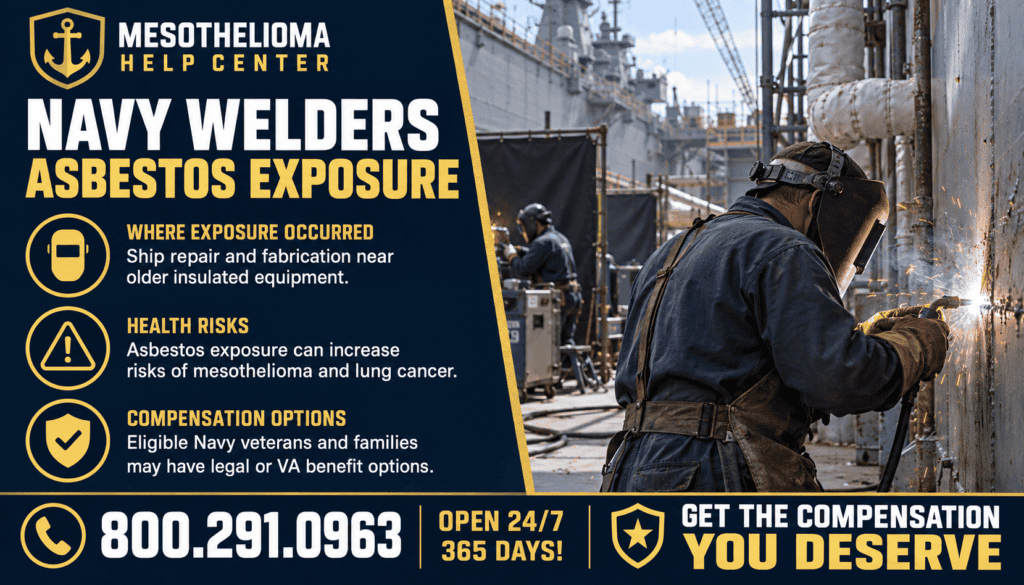
Navy Welders Asbestos Exposure
Some Navy welding jobs took place near historical asbestos-containing insulation or other materials. Whether a veteran encountered asbestos depends on the actual repair, location, products, and dates.
Distinguish welding duties from nearby asbestos material disturbance and gather dated records. Work locations and products varied among ships and repair facilities.
Navy Welders and Historical Asbestos Exposure
Some historical hot-work settings also involved asbestos-containing insulation or heat-resistant materials. Welding itself does not establish asbestos exposure: the relevant question is what documented material was disturbed or used during a specific job. The guide to How To Obtain Navy Bureau Of Ships Technical Manuals can help identify which dated technical or service records to request.
Navy descriptions of hull maintenance technicians include welding and piping repairs. A veteran’s actual duties, vessel, location, and dates may differ from a modern occupation description.
VA identifies older ships and below-deck spaces as potential asbestos settings. For the wider occupational context, read Navy Occupations Asbestos Exposure.
The most useful exposure account follows the sequence of the job. First identify what was prepared or removed, then where the welder worked, and finally what happened during cleanup. This sequence helps separate a documented material-handling event from an ordinary metal fabrication task. Interview witnesses about what they personally saw and when they saw it; descriptions borrowed from other ships do not establish the conditions on this vessel.
For related Navy exposure research, review Navy Machinist Mates Asbestos Exposure.
Welding Assignments and Work Locations
Welding assignments may include hull repairs, machinery supports, pipe joints, tanks, and metal fittings, depending on the work center and ship. A welding qualification is evidence of training, not proof of any particular job or material.
Identify whether the veteran welded aboard a vessel, in a shipyard, at a shore shop, or during an overhaul. Record ship and hull number, compartment, work order, contractor participation, and time spent on the task.
Hot work often requires preparing the space and controlling nearby hazards. OSHA shipyard guidance describes preparation for hot work, but a modern safety procedure does not establish what a particular historic Navy crew did.
Separate direct handling of a confirmed asbestos-containing item from being near other trades removing insulation. Those are different events and may be supported by different witnesses or records.
A welding job may involve an engineering compartment, exterior plating, or a shop bench, and those places can have very different nearby materials. The work location should be as precise as the available evidence allows. Technical qualifications can confirm that a sailor was authorized to perform a process, while a maintenance order or work center log may show the specific project. Preserve that difference when summarizing the record.
For a related Navy duty profile, review Navy Boiler Technicians Asbestos Exposure.
Welding tasks vary by trade, vessel, and facility. A welder may cut or join metal near insulation, remove coverings to gain access, or work in a shop far from shipboard piping. Welding metal itself does not prove asbestos exposure. Identify the work location, equipment, materials removed before hot work, and which trade performed the removal. The same Navy job title can describe different assignments on a vessel, in a dry dock, or at a shore maintenance facility.
Nearby Insulation and Heat-Resistant Materials
A documented historic work area may have contained asbestos-containing pipe lagging, thermal insulation, insulation cement, gaskets, or heat-resistant fabric. Verify each material and its use at the actual repair date. Some hot-work shields or blankets were made of other substances; never assume they contained asbestos.
Heat or sparks do not turn ordinary welding fumes into asbestos. Asbestos concerns relate to separate materials that contained asbestos and were disturbed, handled, or present nearby.
A product’s supplier and installation date matter. A ship’s original insulation specification may not reflect subsequent replacement during an availability. Equipment makers and insulation contractors can also be different companies.
Use manuals, material specifications, purchase records, work packages, and credible firsthand testimony. Do not identify a dusty coating by appearance alone.
If a heat shield is mentioned, find a purchase order, product label, approved material list, or contemporary procedure that identifies its composition. The common name “welding blanket” does not identify asbestos. Similarly, nearby insulation may be different from the barrier used for the welding operation. List each possible product separately with its supplier, location, installation history, and the evidence supporting identification.
Heat-resistant blankets, nearby pipe insulation, joint materials, and protective products should be evaluated separately. A material selected for high temperatures does not necessarily contain asbestos; composition depends on the specific specification and production period. Keep the maker and product revision for each alleged item. A photograph can help identify a work site but cannot reliably reveal fiber composition. Where an older product was present, determine whether it remained intact or was cut or handled during the particular job.
Hot Work, Removal, and Cleanup Events
A repair may require removal of documented insulation to expose a pipe, bulkhead, or machinery support before welding. Another crew may perform that preparatory work. Identify who did it, when, where, and whether the veteran was present.
Scraping an old joint, cutting through a documented asbestos-containing adjacent component, moving a known heat barrier, or cleaning residue after material removal can be relevant to an exposure inquiry. The welding arc by itself is not asbestos evidence.
Document the work order, location, material, task sequence, ventilation, containment, protective measures, and time in the compartment. Account for whether the veteran returned after work by another trade.
Do not infer airborne fiber concentration from a description of visible dust. A qualified expert may evaluate material evidence and exposure circumstances if a case requires it.
A credible event description may specify that a contractor stripped covering on Monday, the welder worked in the space Tuesday, and cleanup occurred later. Those dates and people matter. A witness present for the first event may not establish the veteran’s presence at the second. Maintain a record of what each witness observed directly, and note any uncertainty about whether material was still present when the veteran entered.
An exposure narrative should follow the sequence of preparation, hot work, reinstatement, and cleanup. One team may strip a pipe before a welder begins, while another may reinstall covering after the welder leaves. A welder who was present during stripping has a different account from one who arrived after the area was cleared. Record dates, shifts, compartment, workers present, material description, and any completed repair file. Avoid assuming that every hot-work permit documents asbestos removal; check the specific supporting records.
Shipyards, Dry Docks, and Contractors
Major shipyard availabilities may combine structural welding, pipe work, and insulation removal in overlapping spaces. A yard work package can show a planned task while orders, time records, and witnesses may establish a particular veteran’s presence.
Record whether work was performed by ship’s force or civilian contractors. A welder employed later by a private yard should document that employment separately from military service.
Distinguish a shipboard repair at sea from shop work in a dry dock or base facility. They may involve different materials, dates, and legal pathways.
Read Navy Ships Asbestos Exposure and Navy Bases Asbestos Exposure for setting research.
A large availability often contains numerous projects across a vessel. The fact that insulation removal and welding appeared in the same overall contract does not place both activities in the same compartment or week. Look for job control numbers, compartment identifiers, zone schedules, and daily work assignments. Even partial records can narrow a project sufficiently to test a veteran’s recollection without exaggerating it.
A dry dock availability can involve several contractors and Navy divisions working on different systems at the same time. A broad yard schedule may show the vessel’s presence while offering no detail about a particular welder’s work station. Look for a task number, permit location, contractor assignment, and completion date. The person’s own recollection can then be compared with those records and with any material documentation. If a job was canceled or shifted to another compartment, record the change rather than assuming the originally planned work occurred.
Match the Job to the Ship and Material Era
Create a chronology of training, ships, shore assignments, welding qualifications, shipyard periods, and recalled repairs. Add material specifications and documented replacements to that timeline.
A source describing asbestos on a ship class cannot establish its presence at every location on a particular hull or throughout the vessel’s life. Compare construction and overhaul records to the veteran’s service dates.
National Archives ship histories and engineering drawings can guide this research. Deck logs help date movement or casualties, but they are not direct proof of asbestos material or a sailor’s individual contact.
Mark uncertain recollections honestly. A precise task and compartment provide a stronger research lead than a broad statement about welding aboard Navy ships.
| Stage | Document | Question |
|---|---|---|
| Assignment | Personnel record | Where and when? |
| Repair | Work order | What was welded? |
| Preparation | Yard package | Was material removed? |
| Product | Specification | What was installed? |
Records for VA and Other Claims
Gather DD-214, military occupational records, ship assignments, welding qualifications, evaluations, work orders, shop and shipyard records, drawings, material specifications, photos, and firsthand statements. Explain which records prove the assignment, the task, the material, or presence nearby. For related care and benefit questions, consult Navy VA Benefits For Mesothelioma using the veteran’s own medical and service history.
VA describes medical records, specialty or duty records, and a clinician’s statement relating disease to asbestos contact in service as evidence for a disability claim. Civil or trust filings may need product identification and information about responsible parties.
Provide clinicians a complete Navy and civilian work history. Mesothelioma and other possible asbestos-related diseases require diagnosis and individual medical advice.
For claim preparation, see Documents Needed for Navy Asbestos Claims.
Keep medical causation separate from occupational research. A clinician assesses diagnosis and the significance of exposure history; an archive can document a ship system; a legal review considers potential responsible parties and deadlines. Collecting this evidence early helps prevent a witness or a record from becoming unavailable. Veterans should also keep a record of civilian welding, construction, or other jobs for a complete history.
Preserve the vessel name and hull or shore installation, welding assignment, work package, hot-work permit, drawings, and witness recollections. Use a material specification to establish what a suspected covering or blanket contained during that period. A service record can place the veteran at the installation without proving presence at the individual repair. If there was later civilian shipyard employment, describe it separately so clinicians and claims advisers receive a complete chronology rather than a Navy-only account.
Frequently Asked Questions
Does welding itself release asbestos?
Welding fumes are not asbestos. Investigate separate documented asbestos-containing materials in or near the job.
Were all welding blankets made with asbestos?
No. Determine the actual product and era from reliable evidence.
What if insulation was removed before welding?
Record who removed it, material identity, timing, proximity, and the veteran’s presence.
Does a shipyard work package prove personal exposure?
No. Match it with individual assignments and work location.
Can a veteran rely on ship class alone?
No. A specific hull, date, material, and task provide a better history.
Should suspected material be sampled personally?
No. Do not disturb it; consult qualified professionals.
Review Your Navy Service History
Gather the veteran’s rating, ship and duty assignments, equipment serviced, dated work orders, witness accounts, and medical records. A job title alone does not establish contact.
Call 800.291.0963 for a no-obligation case review, or submit your case here. For medical decisions, speak with a qualified clinician; for VA claims, consider a VA-accredited representative.
Keep the original records and label uncertain details. A vessel, rating, or diagnosis alone cannot determine a specific claim outcome.
Summary and Welder Case Review
A Navy welder exposure inquiry should identify actual welding work and any separate confirmed asbestos-containing material that was disturbed or used nearby. Dated service, product, and repair evidence help distinguish a plausible setting from an established individual event.
Confirmed Sources
- VA Veterans Health Library — Asbestos
- VA — Veterans Asbestos Exposure
- National Archives — Navy Asbestos Research
- NCI — Asbestos Exposure and Cancer Risk
- U.S. Navy — Hull Maintenance Technician
- OSHA — Shipyard Hot Work Preparation
Disclaimer: General information only—not legal or medical advice. This website is not a law firm. Exposure, VA eligibility, liability and deadlines vary by case and jurisdiction. Do not disturb suspected asbestos. Past results do not guarantee future outcomes.