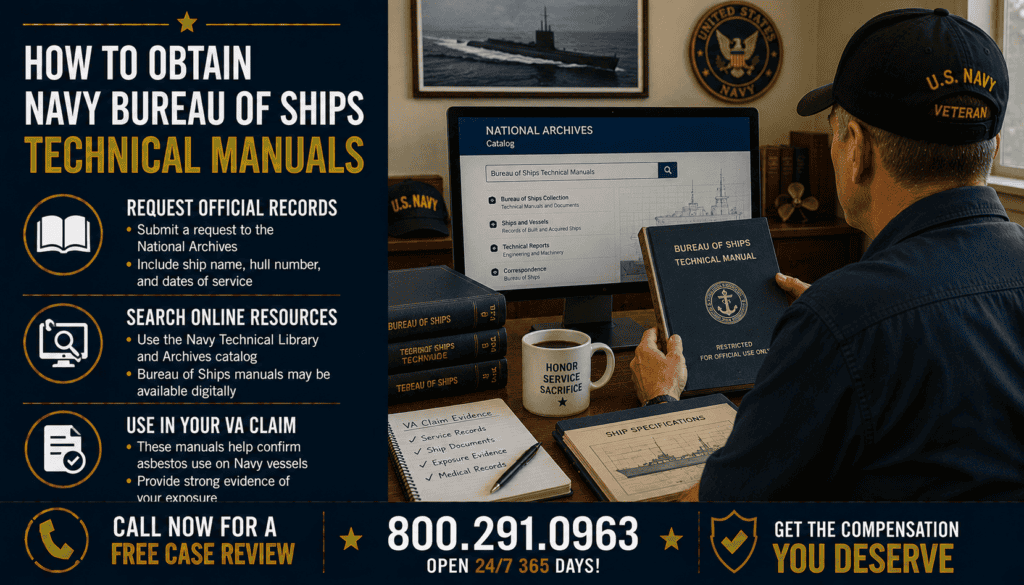
📚 How to Obtain Navy Bureau of Ships Technical Manuals
Historical Navy technical manuals can help identify how shipboard equipment was built, installed, operated, maintained, and repaired. For asbestos research, manuals are often most useful when combined with Navy specifications, Qualified Products Lists (QPLs), ship plans, manufacturer correspondence, overhaul records, and a veteran’s personnel records.
The National Archives preserves extensive Record Group 19: Records of the Bureau of Ships. The Bureau of Ships supervised Navy ship design, construction, conversion, procurement, maintenance, and repair and developed specifications for ship components and supplies. Many records are not digitized, so obtaining the right document can require identifying the ship, equipment, manufacturer, date, specification number, or Bureau of Ships filing code before requesting archival material.
⚓ What the Bureau of Ships Was
The Bureau of Ships, commonly abbreviated BUSHIPS or BuShips, was established in the Department of the Navy in 1940 by consolidating functions of the Bureau of Engineering and the Bureau of Construction and Repair. According to the National Archives, it supervised the design, construction, conversion, procurement, maintenance, and repair of Navy ships and other craft.
The Bureau also managed shipyards, repair facilities, laboratories, and shore stations and developed technical specifications used in naval shipbuilding and maintenance. It was abolished in 1966, with the Naval Ship Systems Command succeeding it.
This history matters because records for World War II, Korean War, Cold War, and early Vietnam-era vessels can be filed under the Bureau of Ships rather than under today’s NAVSEA organization. Earlier engineering records may also be found under predecessor bureaus.
Record Group 19 spans records dating from 1794 through 1972 and contains general correspondence, maintenance records, electronics records, publications, shipbuilding records, technical records, plans, specifications, and other material.
Start with Navy Records & Documentation for Asbestos Exposure if the veteran’s overall service chronology has not yet been assembled.
🔎 Identify the Manual or Equipment First
A request for “all technical manuals for a Navy ship” is usually too broad. A more efficient search begins with as many identifiers as possible.
Collect:
- Ship name and hull number — for example, the exact vessel rather than only the ship class.
- Service and repair dates — especially overhaul, modernization, conversion, or shipyard periods.
- Equipment type — boiler, turbine, pump, valve, generator, switchboard, compressor, heat exchanger, or another system.
- Manufacturer — if known from equipment plates, manuals, parts lists, testimony, or repair records.
- Model or drawing number — useful for distinguishing similar equipment.
- Specification number — MIL-SPEC, Navy specification, QPL number, or other procurement identifier.
- Compartment or system — engine room, boiler room, auxiliary machinery space, steam system, electrical system, and similar locations.
The National Archives’ asbestos research guidance specifically recommends identifying specification numbers before searching specification collections because many series are arranged by specification or QPL number.
Equipment-specific research can be paired with Navy Equipment Asbestos Exposure.
🏛️ Search National Archives Record Group 19
The primary archival starting point is Record Group 19 — Records of the Bureau of Ships. NARA’s record-group guide identifies multiple categories of technical and ship-related records.
Relevant holdings can include:
- Bureau of Construction and Repair technical records.
- Bureau of Engineering technical records.
- Bureau of Ships general correspondence.
- Maintenance Division records.
- Electronics Division records.
- Publications Division records.
- Shipbuilding Division records.
- Ship plans and engineering drawings.
- Specifications and specification-development files.
NARA’s Record Group Explorer shows that only a small portion of the estimated textual pages in RG 19 are available as online scans. That means a catalog search that does not produce a downloadable manual should not be interpreted as proof that the record does not exist.
Researchers may need to use NARA catalog descriptions, finding aids, archival entry numbers, box information, and reference staff to locate undigitized records. The National Archives identifies Preliminary Inventory of the Records of the Bureau of Ships, PI 133 and a later supplement as finding aids for the record group.
When contacting an archive, provide precise identifiers rather than a general asbestos request. Ship, hull number, equipment, manufacturer, date range, specification, and known record-series information can substantially narrow the search.
🗃️ Use Navy Filing Codes and Manufacturer Files
The National Archives provides Navy Filing Manuals that explain historical filing systems used to organize Navy correspondence. These filing codes can be essential when searching Bureau of Ships correspondence.
NARA’s asbestos research guide explains that researchers trying to identify a specification number for a particular item or component may need to review Bureau of Ships manufacturer correspondence in RG 19. Companies can appear under the Navy filing code QM followed by the company’s name.
Those QM files can contain contract correspondence between manufacturers and the Bureau of Ships. According to NARA, specification numbers for specific items or components are often found in this correspondence.
A practical research sequence is:
- Identify the equipment or material and manufacturer.
- Use the appropriate Navy Filing Manual to understand the filing code.
- Locate the manufacturer correspondence in RG 19.
- Look for contract, drawing, equipment, or specification references.
- Record the exact specification or QPL number.
- Use that number to search specification-development and qualification records.
This method is stronger than assuming that a manufacturer always supplied an asbestos-containing product. The evidence should connect the manufacturer to the specific product, specification, shipboard application, and relevant time period.
📋 Find Specifications and Qualified Products Lists
Military specifications and QPLs can be critical asbestos evidence because they can document technical requirements and products qualified for Navy procurement.
NARA defines a Military Specification as an acquisition document describing essential technical requirements and criteria for determining whether purchased material meets those requirements. A Qualified Product is a product examined, tested, and approved for inclusion on the applicable Qualified Products List.
NARA recommends beginning specification research with the Specification and Standard Development Case Files, Entries P 45 through P 45-W, because those collections can be more accessible for beginning researchers. The archive also identifies other RG 19 series containing specification-development and detailed specification files.
Specification indexes can also exist outside RG 19. NARA identifies specification indexes within Record Group 143, Records of the Bureau of Supplies and Accounts, including Supply Management Publications and Documents, 1939–1964.
For asbestos research, a QPL can potentially establish which products were qualified under a specification during a particular period. It does not, by itself, prove that a specific product was installed on the veteran’s ship. Installation, repair, procurement, or ship-specific evidence is still needed.
📐 Ship Plans, Drawings, and Related Technical Records
Technical manuals are only one form of Navy engineering evidence. The National Archives Cartographic Branch holds ship engineering drawings for a majority of commissioned U.S. Navy vessels dating from the 1790s through the Korean War era.
NARA states that these drawings commonly include inboard and outboard profiles, deck plans, sections, and, for some ships, additional general-arrangement drawings. Its Ship Plan Index is arranged by ship name and identifies the record group and catalog series for each vessel.
Record Group 19 contains the majority of Navy ship plans held by the Cartographic Branch. Earlier Bureau of Construction and Repair and Bureau of Engineering records also contain extensive ship, boiler, engine, and machinery plans.
Plans can help establish where equipment and systems were located. For example, a plan may help identify the relationship between a veteran’s work area and an engine room, boiler room, steam line, pump room, or other machinery space. A drawing normally does not establish that a material contained asbestos unless it identifies the material or is combined with a specification or other supporting record.
See Navy Ships Asbestos Exposure and Navy Shipyards Asbestos Exposure.
🔗 Connect Technical Records to Veteran Exposure
The most important step is connecting technical evidence to the veteran rather than simply collecting old Navy documents.
A useful evidence chain can look like this:
- Personnel record: establishes the veteran’s rating and ship assignment.
- Ship record: establishes construction, overhaul, repair, or modernization dates.
- Occupational evidence: establishes likely duties and machinery or systems maintained by that rating.
- Technical manual or drawing: identifies equipment configuration, components, and maintenance procedures.
- Specification or QPL: helps determine whether a material or component was specified or qualified as asbestos-containing.
- Maintenance or shipyard record: connects the component to a repair or replacement event.
- Witness evidence: can describe firsthand work practices, material condition, dust, insulation removal, or shared work areas.
- Medical evidence: documents the diagnosis and medical assessment of exposure history.
VA states that asbestos-related disability claims generally require medical records showing the condition, service records listing the veteran’s job or specialty, and a doctor’s statement connecting military asbestos contact with the condition.
Technical records are therefore supporting evidence, not a substitute for service and medical documentation. See Navy Veterans Medical Exposure Profile, Documents Needed for Navy Asbestos Claims, and Navy VA Benefits for Mesothelioma.
❓ Navy Bureau of Ships Technical Manuals FAQ
Where are historical Bureau of Ships records kept?
The National Archives preserves Bureau of Ships records primarily in Record Group 19. Related records can also exist in predecessor and other Navy record groups.
Are all Bureau of Ships technical manuals online?
No. NARA’s Record Group Explorer indicates that only a small fraction of estimated RG 19 textual pages have online scans. Many records require archival research or assistance from reference staff.
What information should I have before requesting a manual?
Try to identify the ship and hull number, date range, equipment type, manufacturer, model, drawing number, specification number, and relevant compartment or system.
How can I identify a Navy specification number?
NARA recommends reviewing Bureau of Ships manufacturer correspondence. Specification numbers for components can often appear in contract correspondence, including files arranged under the QM manufacturer filing code.
What is a Navy Qualified Products List?
A QPL identifies products that were examined, tested, and approved for qualification under a particular specification. It can help identify historical products but does not by itself prove installation aboard a particular ship.
Does NAVSEA have asbestos records online?
Yes. NAVSEA maintains an asbestos electronic reading room containing historical specifications and Qualified Products Lists, including records for asbestos-fiber thermal insulation, metallic-asbestos gaskets, and asbestos packing.
Can ship plans prove asbestos exposure?
Usually not by themselves. Plans can identify equipment and work locations, but material content generally requires specifications, notes, manuals, QPLs, asbestos surveys, or other supporting evidence.
Can a technical manual alone prove a veteran was exposed?
No. A manual can document equipment or materials, but exposure should be connected to the veteran’s ship, service dates, rating, work area, maintenance activity, and medical evidence.
📚 Get Help Researching Navy Bureau of Ships Records
If you or a family member served aboard a Navy ship and has been diagnosed with mesothelioma, asbestos-related lung cancer, asbestosis, or another potentially asbestos-related disease, technical records can help reconstruct historical equipment and material use. Begin with the ship and hull number, service dates, rating, machinery or system, manufacturer, overhaul history, and any known specification or manual numbers.
Call 800.291.0963 to discuss the Navy service and available technical documentation. Live chat is available 24/7, 365 days a year. You can also Submit Your Case. No technical manual, specification, exposure determination, VA benefit, settlement, trust payment, or legal outcome is guaranteed.
⚕️ Legal & Medical Information Disclaimer
This page provides general educational information and is not legal or medical advice. Historical records do not by themselves establish asbestos exposure, diagnosis, causation, VA eligibility, liability, or entitlement to compensation. Consult qualified health care professionals about medical concerns and a licensed attorney or accredited veterans representative about legal or benefits questions.