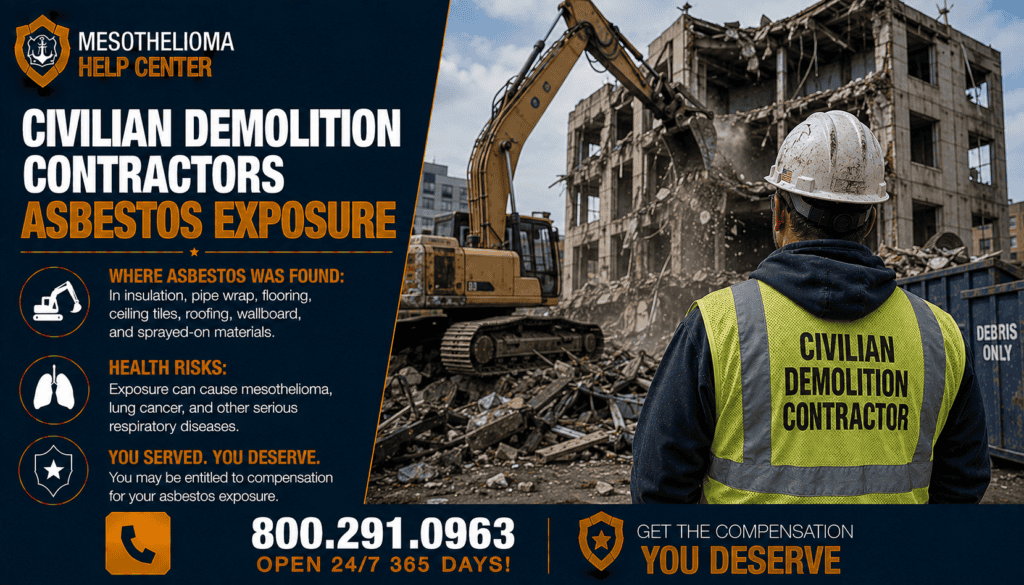
🏚️ Civilian Demolition Contractors Asbestos Exposure
Civilian demolition contractors may encounter asbestos when dismantling, gutting or clearing older homes, commercial buildings, factories, schools, hospitals, military facilities and industrial structures. Demolition can break previously intact materials, mix asbestos-containing products with debris and create airborne dust.
Working at an old building does not prove exposure. A reliable investigation examines pre-demolition surveys, project dates, work areas, materials, equipment, air monitoring, protective measures and witnesses.
🧭 On This Page
- Where demolition exposure may occur
- Demolition tasks that may release fibers
- Asbestos materials found in older structures
- Heavy equipment, debris and cleanup
- Inspection and safety requirements
- Health and household risks
- How to document demolition work
- Lawsuits, trusts and compensation
- Frequently asked questions
🏭 Where Demolition Exposure May Occur
Potential settings include mechanical rooms, boiler houses, utility tunnels, factories, power plants, refineries, warehouses, barracks, shipyard buildings, schools and hospitals. Selective interior demolition may disturb hidden systems before full structural demolition begins.
EPA states that asbestos NESHAP requirements address demolition and renovation at covered institutional, commercial and industrial buildings, including a thorough inspection requirement. Regulatory applicability and notification requirements depend on the structure and operation.
The Civilian Contractor Buildings and Construction Asbestos Exposure hub provides the broader construction context. The Civilian Contractors Asbestos Exposure main guide connects these sites to occupations, products and claims.
🔨 Demolition Tasks That May Release Fibers
Potentially dusty tasks include removing walls and ceilings, cutting pipe systems, stripping mechanical rooms, breaking floor assemblies, dismantling boilers, pulling insulated wiring, crushing concrete products, loading debris and cleaning the site.
Workers may also be exposed when another crew disturbs asbestos nearby. Relevant questions include whether material was wet, contained or removed before demolition; whether the area was isolated; and whether visible emissions or uncontrolled debris occurred.
The Civilian Disaster Cleanup Asbestos Exposure guide addresses emergency work after fires, storms or structural failures. The Civilian Environmental Remediation Asbestos Exposure guide focuses on planned cleanup projects.
🧱 Asbestos Materials Found in Older Structures
Depending on age and construction, materials may include pipe and boiler insulation, sprayed fireproofing, ceiling texture, floor tile and adhesive, cement panels, roofing, wall systems, gaskets, packing and electrical insulation.
Not every older material contains asbestos, and visual identification is unreliable. Surveys, laboratory analysis, specifications and abatement records provide better evidence. The Civilian Contractor Asbestos Products Exposure hub organizes relevant product categories.
📞 Need Help Reviewing Demolition-Site Asbestos Exposure?
If mesothelioma or asbestos-related lung cancer followed demolition work, a focused review can identify the buildings, contractors, materials, equipment and records that may matter.
Call 800.291.0963, use our live chat 24/7/365 or tell us about the demolition projects through the contact form for a free, confidential review.
🚜 Heavy Equipment, Debris and Cleanup
Excavators, loaders, bulldozers, skid steers, crushers and trucks can disturb or transport contaminated debris. Operators may work inside cabs, but cab condition, filtration, open windows, maintenance and decontamination practices affect the exposure analysis.
Laborers sorting debris or cleaning equipment can encounter residual dust after the main demolition. Waste packaging, labeling, transport and disposal records may help identify what material left the site and when.
The Contractor Equipment and Machinery Asbestos Exposure hub covers machinery-related pathways. A machine’s presence alone does not establish exposure; document the task and environment.
🦺 Inspection and Safety Requirements
EPA explains that covered demolitions require a thorough inspection before work begins. The asbestos NESHAP may also require notification and work practices designed to prevent visible emissions. State and local requirements can add obligations.
OSHA’s construction asbestos standard applies to demolition or salvage of structures where asbestos is present and addresses regulated areas, exposure assessment, engineering controls, respiratory protection, protective clothing, hygiene, training and recordkeeping.
Historical evidence may include surveys, notifications, abatement contracts, air-monitoring results, negative-exposure assessments, training logs, respirator records, daily reports and waste manifests. The absence of a remembered warning does not prove that required steps were or were not completed.
Current workers should follow the project’s competent-person directions and applicable regulations. Do not disturb suspected asbestos based on general website information.
🩺 Health and Household Risks
Inhaling airborne asbestos fibers can increase the risk of mesothelioma, lung cancer, asbestosis and other pleural disease. Symptoms may not appear until decades after exposure. Exposure does not mean disease is certain.
Former demolition workers should tell clinicians about dusty projects, materials, work zones and approximate years. The Civilian Contractor Asbestos Exposure Health Risks guide provides more detail.
Fibers may also have traveled home on clothing, boots, tools or vehicles. The Civilian Contractor Secondhand Asbestos Exposure guide explains how household routines can be documented.
📋 How to Document Demolition Work
Create one timeline entry for each project and record:
- Building, address, owner, prime contractor and subcontractor.
- Project dates, crew, trade and supervisor.
- Areas demolished and methods used.
- Survey findings and known abatement work.
- Materials handled and machinery operated.
- Respirators, protective clothing, wet methods and containment.
- Air monitoring, incident reports and waste manifests.
- Coworkers who can confirm duties and conditions.
- Medical symptoms, testing and diagnosis dates.
Preserve union records, W-2s, pay stubs, contracts, photographs, work orders and medical reports. Use the Civilian Contractor Asbestos Exposure Timeline to organize the chronology. Do not revisit a restricted site or collect suspected material.
⚖️ Lawsuits, Trusts and Compensation
An investigation may examine manufacturers, suppliers, contractors, premises owners and other entities. Liability depends on supported facts and applicable law—not merely participation in demolition.
The Civilian Contractor Mesothelioma Lawsuit guide explains civil claims. The Civilian Contractor Asbestos Trust Fund Claims guide covers bankruptcy trusts.
Workers’ compensation and governmental notice requirements may also apply. State filing deadlines can run after diagnosis or death, so review the Civilian Contractor Asbestos Statute of Limitations guide promptly.
❓ Frequently Asked Questions
Do all pre-1980 buildings contain asbestos?
No. Age can guide an investigation, but surveys and laboratory testing are needed to identify specific material.
Must asbestos be removed before every demolition?
Requirements depend on the structure, material and applicable federal, state and local rules. Covered operations require proper inspection and compliance planning.
Can equipment operators be exposed?
Potentially, when machinery disturbs contaminated debris. Cab condition, filtration, task duration and controls matter.
What if asbestos was discovered after demolition began?
Document when and where it was found, stop-work actions, notices, testing and witnesses. Current work must follow applicable regulatory requirements.
Can demolition dust be carried home?
Yes, particularly when clothing, tools or vehicles were not properly decontaminated. Household exposure requires individual evaluation.
Should workers save debris as proof?
No. Do not handle or collect suspected asbestos. Preserve records and photographs instead.
🚀 Reconstruct the Demolition Project Before Evidence Is Lost
Buildings disappear, contractors change and project records become harder to find. A prompt review can connect the diagnosis with the structure, crew, materials, equipment, surveys and responsible sources.
Call 800.291.0963 now, use our live chat any time—24/7/365—or submit the demolition work history through our contact form for a free, confidential case review.