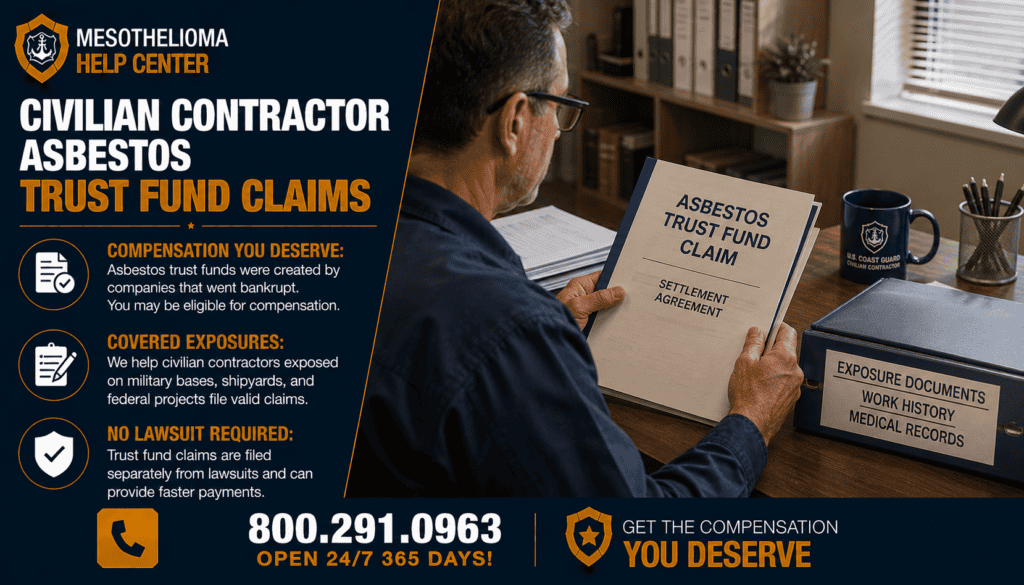
🏦 Civilian Contractor Asbestos Trust Fund Claims
Civilian contractors diagnosed with mesothelioma or another asbestos-related disease may qualify to file claims with one or more asbestos bankruptcy trusts. These trusts were established through bankruptcy proceedings to compensate eligible present and future claimants connected to particular companies, products or exposure sites.
A trust claim is not the same as a lawsuit, and working around asbestos does not automatically establish eligibility. Each trust uses its own trust distribution procedures, medical standards, exposure requirements, payment values and review options. A careful submission must be accurate and coordinated with any lawsuits or other compensation claims.
🧭 On This Page
- How asbestos bankruptcy trusts work
- Who may qualify for a trust claim
- Medical and exposure evidence
- Identifying companies, products and sites
- Expedited and individual review
- Scheduled values and payment percentages
- Coordinating trusts and lawsuits
- Deadlines and filing process
- Frequently asked questions
🏛️ How Asbestos Bankruptcy Trusts Work
Section 524(g) of the Bankruptcy Code provides a mechanism through which certain asbestos liabilities may be directed to a trust created under a reorganization plan. The trust then evaluates qualifying claims under court-approved documents and trust distribution procedures.
Trustees manage assets for current and future claimants. Because available funds must serve claims over time, a trust may pay only a stated percentage of a claim’s scheduled or determined value. That percentage can change according to trust finances and governing documents.
The How Asbestos Trust Funds Compensate Civilian Workers guide explains the broader civilian process. The U.S. Government Accountability Office also provides background in its report on the role and administration of asbestos trusts.
✅ Who May Qualify for a Trust Claim
A civilian contractor may qualify when the required medical diagnosis and exposure evidence connect the person to a company covered by an active trust. Eligibility is trust-specific and may depend on an approved occupation, product, site or period.
Common questions include:
- Does the diagnosis satisfy the trust’s disease level?
- Did exposure occur during a period recognized by the trust?
- Can the claimant connect work to a covered company, product or location?
- Does the evidence satisfy occupational and significant-exposure requirements?
- Is the claimant living, or must an authorized estate representative file?
- Have releases, prior payments or other claims affected the submission?
Contractor status alone is not enough. Each factual statement should be supported and consistent across all related claims.
📁 Medical and Exposure Evidence
Medical documentation may include pathology reports, imaging, physician statements and records confirming the diagnosis. Exposure evidence may include Social Security earnings histories, W-2s, union cards, personnel files, contracts, invoices, work orders, equipment manuals, photographs and coworker affidavits.
The Civilian Contractor Asbestos Exposure Timeline helps organize employers, sites, duties and dates. The Civilian Contractor Asbestos Exposure Health Risks guide explains major asbestos-related conditions.
Never invent a product, employer or date to fit trust criteria. Mark uncertain information as approximate and use records or independent witnesses to strengthen it.
📞 Need Help Identifying Possible Asbestos Trust Claims?
If mesothelioma or asbestos-related lung cancer followed civilian contract work, a focused review can compare the employers, sites, equipment and products with available trust requirements.
Call 800.291.0963, use our live chat 24/7/365 or submit the work history through the contact form for a free, confidential review.
🔎 Identifying Companies, Products and Sites
Civilian contractors may have worked for one employer while handling products made by other companies at a facility owned by another entity. Equipment may have included original components, replacement gaskets or packing, and separately supplied insulation.
Use the Contractor Equipment and Machinery Asbestos Exposure hub, Equipment Manufacturers and Asbestos Use guide and Civilian Contractor Asbestos Products Exposure hub to separate these sources.
Trust site lists can be useful, but appearing on a list does not automatically prove individual exposure. The claimant must satisfy the applicable trust procedures.
⚙️ Expedited and Individual Review
Many trusts offer more than one review path. Expedited review generally applies standardized criteria and a scheduled value for qualifying claims. Individual review may consider additional facts and can result in a different value, but it may require more evidence and time.
The best option depends on the trust documents and case facts. Individual review does not guarantee a larger payment, and expedited review does not mean evidence requirements disappear.
💵 Scheduled Values and Payment Percentages
A scheduled value is not necessarily the amount a claimant receives. Trusts may apply a payment percentage designed to preserve assets for future claimants. Both scheduled values and percentages can differ among trusts and may change.
Do not add scheduled values across trusts and describe the total as guaranteed compensation. Actual payments depend on eligibility, review choice, trust finances, prior claims, releases and other adjustments. No ethical evaluation can promise a particular trust payment.
⚖️ Coordinating Trusts and Lawsuits
Trust claims and civil lawsuits are separate but can interact. Courts or defendants may require disclosure of trust submissions, and state law may address setoffs or allocation. Statements about employers, dates, products and exposure must remain consistent.
The Civilian Contractor Mesothelioma Lawsuit guide explains claims against legally viable defendants. Filing trust claims without coordinating the litigation strategy can create avoidable inconsistencies or timing problems.
⏳ Deadlines and Filing Process
Each trust’s governing documents may contain filing, deferral and limitations provisions. State lawsuit deadlines can also affect trust-related planning. Families filing after a death may need estate authority and separate documentation.
A careful process generally includes:
- Confirm the diagnosis and authorized claimant.
- Build a complete occupational and household exposure history.
- Identify potentially relevant trusts without assuming eligibility.
- Collect trust-specific medical and exposure evidence.
- Select the appropriate review option.
- Coordinate disclosures with lawsuits and other claims.
- Review releases and certifications before submission.
- Track deficiencies, requests and payment status.
The Civilian Contractor Asbestos Statute of Limitations guide explains why no general website can calculate every deadline. The Wrongful Death Asbestos Lawsuits guide addresses claims after death.
❓ Frequently Asked Questions
Is an asbestos trust claim a lawsuit?
No. It is an administrative claim evaluated under a trust’s procedures. Lawsuits proceed through courts against legally viable defendants.
Can a civilian contractor file with more than one trust?
Possibly, when evidence independently satisfies each trust’s requirements. Eligibility for one trust does not prove eligibility for another.
Does a listed job site guarantee payment?
No. Site evidence may help, but the claimant must meet medical, exposure and timing requirements.
Are published trust values guaranteed?
No. Payment percentages, review outcomes and other adjustments affect the amount actually paid.
Can a family file after the worker dies?
Potentially. The proper estate representative, medical proof, exposure evidence and deadlines must be confirmed.
Should trust claims be coordinated with lawsuits?
Yes. Consistent disclosures, court requirements, setoffs and filing schedules may matter.
🚀 Find the Trusts That Match the Actual Contractor History
The strongest trust claim starts with documented work—not guesses or a generic company list. A prompt review can connect the diagnosis with qualifying employers, sites, equipment, products and exposure periods while coordinating every available claim.
Call 800.291.0963 now, use our live chat any time—24/7/365—or submit the civilian contractor history through our contact form for a free, confidential trust-claim review.