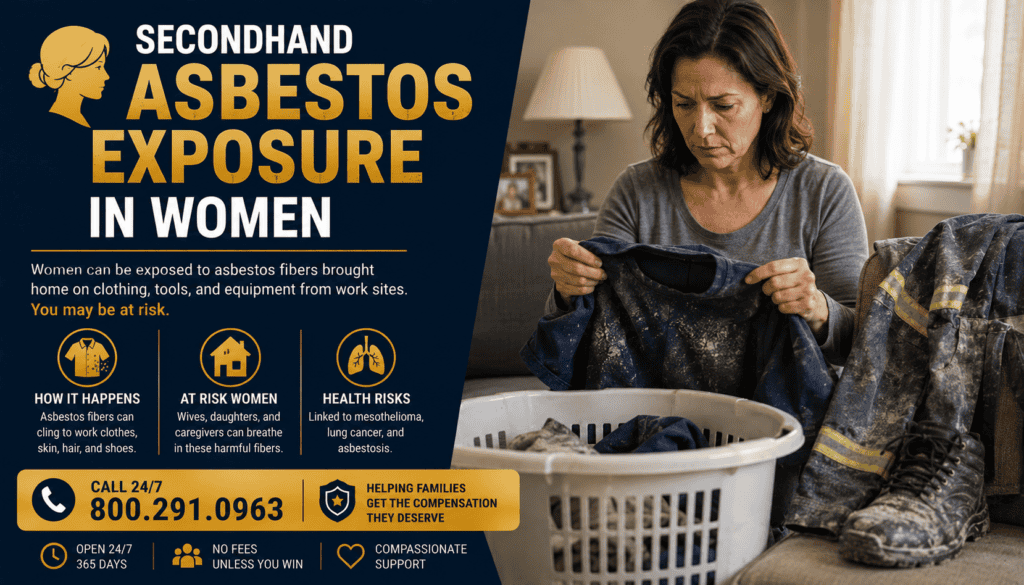
Secondhand Asbestos Exposure in Women
Women may have encountered asbestos without working directly with asbestos-containing materials. The National Cancer Institute reports evidence that family members of workers heavily exposed to asbestos have an increased risk of mesothelioma and identifies fibers brought home on workers’ shoes, clothing, skin and hair as the suspected pathway. This is often described as secondhand, household or take-home asbestos exposure.
CDC/NIOSH explains that workplace contaminants can travel into homes and vehicles on a worker’s body, clothing and shoes, and specifically lists asbestos as a take-home hazard. A family relationship or dusty occupation alone does not prove secondhand asbestos exposure. A reliable investigation connects the worker to a documented asbestos source and then reconstructs how fibers could have reached the woman through recurring household contact.
🏠 Secondhand Asbestos Exposure in Women
Secondhand asbestos exposure describes exposure that can occur away from the original workplace after asbestos fibers are transported from an occupational source. NIOSH’s take-home guidance explains that contaminants from work can reach homes and cars on skin, hair, clothing and shoes. NCI specifically discusses this pathway for asbestos and family members of heavily exposed workers.
Start with the Women’s Military & Secondary Asbestos Exposure hub and Take-Home Asbestos Exposure in Women. Separate what is known about the worker’s job from what is known about the woman’s household contact, then connect the two with records and witness evidence.
| Question | Details to document |
|---|---|
| Who was the worker? | Name, relationship, employer and occupation |
| Where was asbestos encountered? | Plant, shipyard, construction site, base, refinery or other workplace |
| What was the source? | Product, insulation, equipment, process or documented ACM |
| How could fibers reach home? | Clothing, shoes, skin, hair, tools, bags or vehicle |
👕 How Asbestos Could Be Carried Home
NCI identifies shoes, clothing, skin and hair as pathways by which asbestos fibers may be carried into the home. NIOSH adds that workplace contaminants can reach floors, furniture and vehicles. These pathways can create recurring contact for household members even though they never entered the original workplace.
Document whether the worker changed or showered before leaving work, wore work clothing home, stored work shoes in living areas, brought tools or bags home, or traveled in a family vehicle while still wearing dusty work clothing. These details establish possible transport pathways; they do not by themselves establish that the dust contained asbestos.
| Pathway | Evidence to seek |
|---|---|
| Work clothing | Uniform practices, photographs and witness recollections |
| Shoes | Storage location and whether work shoes entered the home |
| Skin/hair | Workplace shower and changing practices |
| Vehicle | Commuting routines and contaminated work clothing |
| Tools/items | Objects routinely transported between work and home |
🛠️ Connecting Exposure to a Worker’s Job
The strongest secondhand history begins by establishing the worker’s occupational asbestos exposure. Historical sources may involve shipyard and ship work, construction, insulation, asbestos-product manufacturing, power generation, refineries, railroads, automotive friction work, mechanical trades or other occupations, depending on the specific job and period.
An occupation title alone is not enough. Identify the employer, facility, department, job duties, products, equipment, coworkers and dates. Employment records, union files, military records, product documents, industrial-hygiene records and testimony may help establish whether asbestos was present in the worker’s actual job.
🧺 Household Contact, Laundry and Vehicles
Household contact can include handling work clothes, hugging or sitting near a worker who returned home in dusty clothing, cleaning areas where work items were stored, or riding in a vehicle contaminated by work clothing or shoes. NIOSH notes that take-home contaminants can reach floors, furniture and cars.
Laundry is a particularly useful pathway to document because the routine may have occurred repeatedly for years. Record who sorted the clothes, whether garments were shaken or brushed, where laundry was handled and how often it was done. See Laundry-Related Asbestos Exposure in Women.
| Contact | Details to document |
|---|---|
| Laundry | Sorting, shaking, brushing, washing and frequency |
| Arrival home | Whether work clothes and shoes remained on |
| Vehicle | Who used it and whether dusty work clothing was worn inside |
| Storage | Where work clothes, shoes, tools and bags were kept |
🎖️ Military and Shipyard Family Exposure
Military and shipyard families may have a secondhand exposure history if a service member or civilian worker had documented occupational contact with asbestos and returned home without effective decontamination. The worker’s own military or shipyard exposure and the woman’s household exposure are related but distinct evidence questions.
See Military Family Asbestos Exposure in Women. Preserve service records, ratings or occupational specialties, duty stations, ship assignments, civilian shipyard records, equipment records and evidence identifying asbestos-containing materials associated with the worker’s duties.
🗂️ Evidence for a Secondhand Exposure History
A secondhand exposure investigation generally requires two linked timelines: the worker’s occupational asbestos history and the woman’s household-contact history. Preserve employment, union or military records, product and facility evidence, photographs, shared addresses, laundry routines, vehicle practices and statements from coworkers or relatives.
The Mesothelioma Lawsuit Evidence & Documentation hub provides additional record-gathering guidance. Keep a memory such as “his clothes were covered in dust” separate from evidence identifying that dust as asbestos from a particular workplace source.
| Link | Possible evidence |
|---|---|
| Worker at job | Employment, payroll, union or military records |
| Asbestos at job | Product, facility, equipment or industrial-hygiene records |
| Transport from workplace | Changing practices, work rules and coworker testimony |
| Woman’s household contact | Shared residence, laundry, vehicle and family testimony |
| Medical diagnosis | Pathology, imaging and treating-clinician records |
🫁 Medical Documentation and Latency
NCI classifies asbestos as a known human carcinogen and identifies asbestos exposure as the major risk factor for mesothelioma. NCI notes that asbestos-related conditions may not become apparent until 10 to 40 years or more after exposure, which makes historical occupational and household timelines important.
Use the Women’s Asbestos Diseases hub for focused health information. Medical documentation establishes diagnosis and treatment, while occupational and household evidence addresses where and how a particular exposure may have occurred.
⚖️ Potential Claim Questions
A secondhand exposure claim may raise questions involving product manufacturers, suppliers, employers, contractors, premises owners or asbestos bankruptcy trusts depending on the documented occupational source and applicable law. Legal duties concerning take-home exposure vary by jurisdiction and by the facts of the relationship, workplace and time period.
Review the Women’s Asbestos Legal Options hub and Mesothelioma Lawsuits in All 50 States. Filing deadlines and available claim routes differ, and compensation is not guaranteed.
🛡️ Modern Take-Home Prevention
Modern workplace controls are designed to reduce take-home contamination. OSHA’s general-industry asbestos standard requires specified protective clothing and change-room practices for covered exposures, restricts employees from taking contaminated work clothing out of the change room except for authorized purposes, requires closed containers, and regulates laundering so airborne fibers are controlled.
NIOSH recommends changing clothes and shoes before leaving work, keeping dirty work clothing separate, washing before leaving when possible and cleaning potentially contaminated items. These modern requirements and recommendations should not be assumed to describe practices at historical workplaces decades ago.
❓ Frequently Asked Questions
What is secondhand asbestos exposure?
It is exposure that may occur when asbestos fibers from another person’s workplace are transported into a home, vehicle or other shared environment.
Can asbestos fibers be carried home on clothing?
Yes. NCI identifies clothing as one possible pathway for asbestos fibers brought home by heavily exposed workers.
Can asbestos also travel on shoes, skin and hair?
Yes. NCI specifically identifies shoes, clothing, skin and hair as potential pathways.
Does living with someone who had a dusty job prove exposure?
No. Evidence should connect that worker’s actual job to asbestos and then document a credible pathway into the household.
Why is laundry history important?
Repeated handling and washing of contaminated work clothing can help document the household-contact pathway when the worker’s occupational asbestos exposure is established.
Can a family vehicle be part of the history?
Yes. NIOSH explains that workplace contaminants can enter cars when transported on workers or their clothing and shoes.
What records can help prove secondhand exposure?
Employment, union, military, product, facility, work-practice, address, laundry, vehicle and witness records may help reconstruct the history.
Is compensation guaranteed?
No. Exposure evidence, legal duties, responsible parties, medical documentation, deadlines and applicable law affect whether a claim is available.
📞 Submit Your Case
If you or a loved one has a mesothelioma diagnosis and a possible secondhand asbestos history, gather the worker’s employers, occupations, job sites and dates along with information about work clothing, shoes, changing practices, laundry, vehicles and shared household addresses. Unknown details should remain research leads rather than guesses.
Call 800.291.0963 for a no-obligation case evaluation. Live chat is available 24/7, 365 days a year. Submit your case here.
📝 Summary
Secondhand asbestos exposure in women may involve fibers transported from a worker’s job into a home or vehicle on clothing, shoes, skin, hair or other items. NCI reports evidence of increased mesothelioma risk among family members of workers heavily exposed to asbestos. A reliable investigation connects a documented occupational asbestos source to the pathway into the household and to the woman’s recurring contact.
🔗 Confirmed Sources
- National Cancer Institute — Asbestos Exposure and Cancer Risk
- CDC/NIOSH — About Take-Home Exposures
- NIOSH — Protect Your Family: Reduce Contamination at Home
- OSHA — 29 CFR 1910.1001 Asbestos
This page provides general information, not legal or medical advice. This website is not a law firm. Exposure, eligibility, filing deadlines and compensation depend on individual facts and applicable law. No outcome is guaranteed.