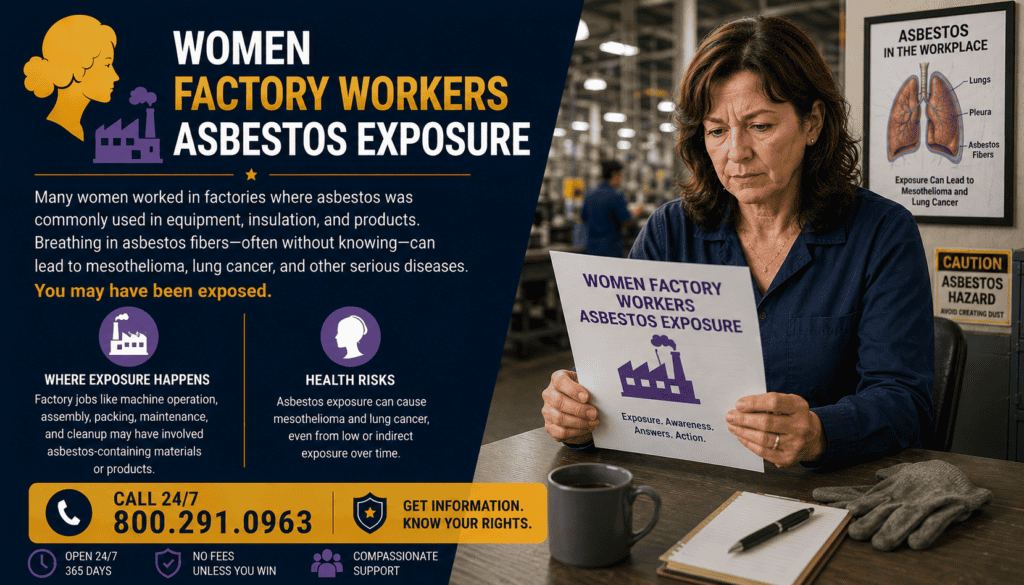
Women Factory Workers Asbestos Exposure
Women who worked in factories and manufacturing plants may have encountered asbestos through particular products, production processes, machinery, insulation, maintenance or cleanup activities. OSHA specifically recognizes asbestos exposure in general industry and notes that employees manufacturing asbestos-containing products may be exposed to fibers. Factory employment alone does not prove exposure; the plant, department, job, material and relevant time period should be documented.
Historical industrial exposure can involve direct handling of asbestos-containing material or indirect work near operations that generated dust. OSHA’s asbestos standard identifies manufacturing processes involving asbestos-cement products, friction products, textiles and plastics, while asbestos was also historically used in heat-resistant materials and building components. A reliable investigation reconstructs the woman’s actual duties and workplace rather than assuming all factories presented the same conditions.
🏭 Women Factory Workers: Exposure Overview
OSHA’s general-industry asbestos standard applies to occupational asbestos exposure in industries covered by the Occupational Safety and Health Act, except work covered by separate construction and shipyard standards. OSHA states that asbestos exposure in general industry occurs in a wide variety of industrial and commercial settings and specifically identifies employees who manufacture asbestos-containing products as potentially exposed.
Start with the Women’s Occupations & Workplace Asbestos Exposure hub. Record every factory, employer, department, production line, job title, shift and approximate date, along with materials handled and nearby operations.
| Question | Details to document |
|---|---|
| Where? | Factory, department, production line and work station |
| When? | Employment dates, shifts and product eras |
| What task? | Production, cutting, grinding, packing, cleanup or maintenance |
| What material? | Product, raw material, insulation, gasket, friction material or debris |
⚙️ Manufacturing Operations to Investigate
OSHA’s asbestos standard identifies particular historical manufacturing operations for which engineering controls and work practices are addressed, including asbestos-cement pipe and sheet manufacturing, friction-product manufacturing, dry textile carding and spinning, and plastics grinding or sanding. This does not mean every plant in those industries used asbestos during every period.
Identify the actual products made at the facility, the years they were produced and the worker’s proximity to relevant processes. Corporate records, product catalogs, industrial-hygiene files, union records and former coworkers can help establish what occurred at a specific plant.
| Operation | Evidence question |
|---|---|
| Cement products | Were asbestos-containing pipe or sheets manufactured? |
| Friction products | Were asbestos-containing brakes, clutches or similar products made? |
| Textiles | Were asbestos fibers carded, spun or woven? |
| Plastics | Were asbestos-containing formulations ground or sanded? |
📦 Asbestos-Containing Products and Materials
OSHA’s technical information identifies historical asbestos uses including heat-resistant clothing, automotive brake and clutch linings, floor and ceiling tiles, roofing felt, asbestos-cement pipe and sheet, fire-resistant drywall, pipe and boiler insulation and sprayed-on building materials. A factory exposure history should determine whether the plant manufactured, incorporated, repaired or handled any relevant asbestos-containing material.
A product name or category alone is not proof that the particular version used at a plant contained asbestos. Seek product specifications, safety data, invoices, catalogs, formulas, purchase records, deposition records or qualified material analysis when available.
🔧 Machinery, Boilers, Pipes and Insulation
Factories often relied on boilers, steam lines, ovens, furnaces, pumps and other equipment that required heat-resistant or sealing materials. OSHA defines thermal-system insulation as insulation applied to pipes, fittings, boilers, tanks, ducts and other components to prevent heat loss or gain. Installed materials in older facilities may also fall under OSHA’s presumed-asbestos rules.
See Women Working in Asbestos-Containing Buildings. Maintenance records, equipment manuals, insulation surveys and shutdown or overhaul files can help determine whether machinery or plant systems were a relevant source.
| Equipment/area | Records to seek |
|---|---|
| Boilers/steam lines | Insulation surveys and maintenance records |
| Pumps/valves | Gasket and packing specifications |
| Ovens/furnaces | Heat-resistant lining or insulation records |
| Production machinery | Manuals, parts lists and repair records |
👷 Production, Cleanup and Maintenance Tasks
Task details can be critical. Cutting, grinding, sanding, mixing, carding, spinning, sweeping or cleaning dusty production areas may present different circumstances from office or inspection work away from the process. OSHA requires exposure monitoring where employees may reasonably be expected to reach specified airborne asbestos levels and requires engineering controls and work practices for covered operations.
Document whether the woman directly handled raw materials or finished products, worked beside another process, cleaned production areas, changed machinery parts or was present during repairs. Dust should not automatically be characterized as asbestos without evidence identifying its source.
🗂️ Employment and Exposure Evidence
Build a chronological work history connecting the worker with a specific factory, department, line and task. Preserve personnel files, Social Security or payroll records, union records, job descriptions, production records, product catalogs, purchase records, industrial-hygiene monitoring, training records, maintenance files and coworker names.
OSHA requires covered employers to retain asbestos exposure-monitoring records for at least 30 years, making historical industrial-hygiene records particularly valuable when they remain available. The Mesothelioma Lawsuit Evidence & Documentation hub provides additional record-gathering guidance.
🫁 Medical Documentation and Exposure History
The National Cancer Institute identifies asbestos exposure as the major risk factor for mesothelioma and states that asbestos exposure can also cause cancers including lung, laryngeal and ovarian cancer. Asbestos-related disease can appear decades after exposure, which makes a detailed historical work timeline important.
Use the Women’s Asbestos Diseases hub for focused health information. Medical records establish diagnosis and treatment, while employment, product and industrial records address where and how asbestos exposure may have occurred.
⚖️ Potential Claim Questions
A factory-worker claim investigation may examine the employer, premises owner, equipment or product manufacturers, raw-material suppliers, contractors or asbestos bankruptcy trusts depending on the documented source and governing law. Multiple potential sources can exist within one long industrial career.
Review the Women’s Asbestos Legal Options hub and Mesothelioma Lawsuits in All 50 States. Workers’ compensation, civil claims and asbestos trust claims have different requirements and deadlines. Compensation is not guaranteed.
🛡️ Current Industrial Asbestos Controls
OSHA’s current general-industry asbestos standard sets an 8-hour time-weighted-average permissible exposure limit of 0.1 fiber per cubic centimeter and a 30-minute excursion limit of 1.0 fiber per cubic centimeter. The standard includes monitoring, regulated areas, engineering controls, respiratory protection, hygiene, training, medical surveillance and recordkeeping requirements for covered exposures.
Current requirements should not be used to assume what conditions existed at a factory decades earlier. Historical monitoring, work-practice and product records are more useful for reconstructing past conditions. Do not disturb suspect material today to investigate an old exposure.
❓ Frequently Asked Questions
Could women factory workers have encountered asbestos?
Yes, in particular manufacturing operations or plants where asbestos-containing products, materials or equipment were used. Individual evidence is required.
Does factory employment alone prove asbestos exposure?
No. The plant, department, job duties, materials and time period must be investigated.
What manufacturing processes does OSHA associate with asbestos?
OSHA’s standard addresses operations including asbestos-cement manufacturing, friction-product manufacturing, dry textile processes and certain plastics manufacturing.
Could factory machinery or utility systems be relevant?
Potentially. Historical boilers, pipes and other equipment could use asbestos-containing insulation, gaskets or related materials, but product-specific evidence matters.
Could cleanup work matter?
Yes. OSHA recognizes potential exposure from housekeeping in industrial facilities with asbestos-product manufacturing operations.
What records are especially useful?
Personnel files, union records, production documents, product catalogs, purchase records, exposure-monitoring data, maintenance files and coworker accounts can help.
What if the factory closed years ago?
Archived corporate records, union files, historical directories, property records, product documents and former coworkers may still help reconstruct conditions.
Is compensation guaranteed?
No. Exposure evidence, responsible parties, medical documentation, deadlines and applicable law affect whether a claim is available.
📞 Submit Your Case
If you or a loved one has a mesothelioma diagnosis and a history of factory or manufacturing work, gather employer names, plant locations, departments, work dates, job duties, products made, machinery used and any known industrial-hygiene or asbestos records. Unknown details should remain research leads rather than guesses.
Call 800.291.0963 for a no-obligation case evaluation. Live chat is available 24/7, 365 days a year. Submit your case here.
📝 Summary
Women factory workers may have encountered asbestos through documented manufacturing processes, asbestos-containing products, industrial equipment, insulation, maintenance or cleanup. OSHA specifically recognizes asbestos exposure in general industry and historical asbestos-product manufacturing. A reliable investigation connects the worker to a particular plant, department, task, material and time period using employment, product, industrial-hygiene, maintenance, witness and medical records.
🔗 Confirmed Sources
- OSHA — 29 CFR 1910.1001 Asbestos
- OSHA — Appendix G: Substance Technical Information for Asbestos
- National Cancer Institute — Asbestos Exposure and Cancer Risk
This page provides general information, not legal or medical advice. This website is not a law firm. Exposure, eligibility, filing deadlines and compensation depend on individual facts and applicable law. No outcome is guaranteed.