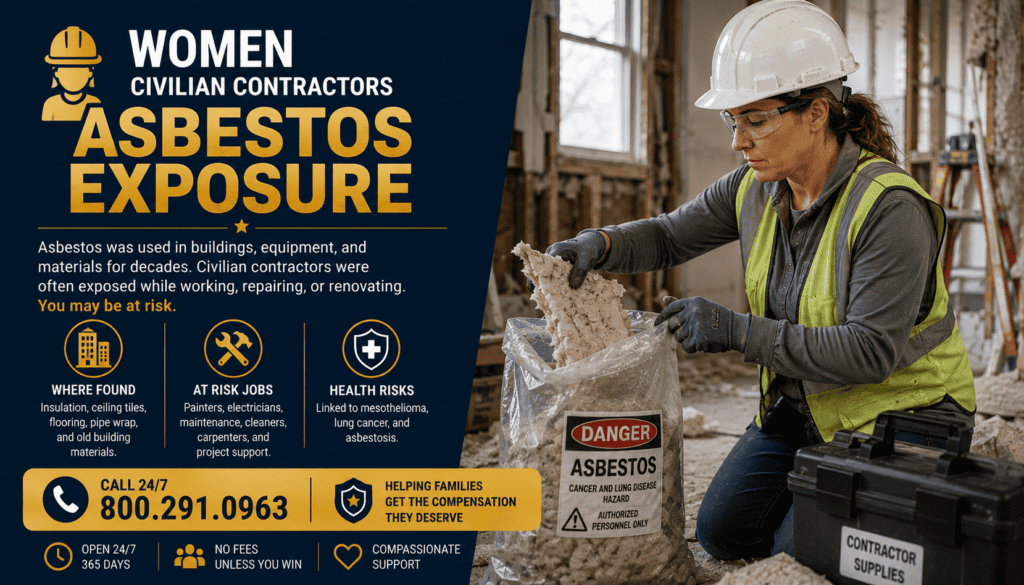
Women Civilian Contractors Asbestos Exposure
Women employed by civilian contractors may have worked at industrial plants, military installations, shipyards, power facilities, construction projects, hospitals, warehouses and other sites where asbestos-containing materials were historically installed or disturbed. Contractor status alone does not establish exposure. A useful investigation identifies the employer, contract, facility, work dates, actual duties, nearby trades and materials involved.
Contract work can make an old exposure history more complicated because the worker’s employer may differ from the company or government entity controlling the property. Subcontractors and multiple trades may also share a worksite. This guide explains how women can reconstruct contractor employment, identify possible asbestos-related work, preserve evidence and understand why potential legal responsibility requires a fact-specific review.
👷 Women Civilian Contractors: Exposure Overview
OSHA regulates occupational asbestos exposure under different standards for construction, general industry and shipyard employment. Construction rules cover activities such as demolition, asbestos removal, and repair, maintenance or renovation of structures containing asbestos. General-industry rules can apply in industrial and commercial settings. This makes the worker’s actual activity and worksite more informative than the broad label “civilian contractor.”
Start with the Women’s Occupations & Workplace Asbestos Exposure hub. Write down every contractor or subcontractor name, jobsite, department, supervisor, badge or project number and approximate date. Then separate confirmed facts from memories that still need corroboration.
| Question | Evidence to seek |
|---|---|
| Who employed the worker? | Payroll, W-2, personnel or union records |
| Where did she work? | Contract, badge, site log or project record |
| What did she do? | Job description, work order, coworker account |
| What material was involved? | Survey, specification, purchase or laboratory record |
🏗️ Jobsites and Facilities to Investigate
Civilian contractors can move among facilities, so exposure research should be site-specific. Older factories, utility plants, mechanical rooms, government facilities, warehouses and commercial buildings may have contained asbestos materials, but a building’s age alone does not prove that asbestos was present in the worker’s area or disturbed during her assignment.
EPA advises building owners and managers to use asbestos inspection and assessment records when renovation may disturb asbestos-containing material. For building-centered histories, see Women Working in Asbestos-Containing Buildings.
| Site issue | Potential record |
|---|---|
| Building materials | Asbestos survey or assessment |
| Renovation | Project specification and abatement file |
| Maintenance | Work orders and equipment records |
| Contractor presence | Access logs, contract and daily reports |
🔧 Contractor Tasks and Nearby-Trade Exposure
Potential exposure can involve direct work with a material or work performed close to another trade disturbing it. OSHA’s construction standard covers removal, repair, maintenance, renovation, demolition and related asbestos work. On multi-employer projects, documentation about regulated areas, contractor responsibilities and work sequencing may help reconstruct who was present during a particular operation.
Women performing inspection, cleanup, material handling, electrical, mechanical, administrative or support duties should document where those duties placed them in relation to active work. Do not assume that every worker on a large project shared the same exposure.
| Activity | What to document |
|---|---|
| Repair/maintenance | Equipment, component and material disturbed |
| Cleanup | Source of debris and preceding work |
| Inspection/support | Frequency and duration in active work areas |
| Material handling | Product, packaging, supplier and destination |
🎖️ Civilian Contract Work on Military Sites
Civilian contractors may have performed construction, maintenance, logistics, equipment or facility work on military installations without being service members. Their evidence can therefore differ from a veteran’s service record. Contracts, payroll, access badges, project files and facility records may be central to showing where and when the civilian employee worked.
See the Women’s Military & Secondary Asbestos Exposure hub for related military-setting information. Civilian contractor work should not automatically be characterized as military service, and VA benefit eligibility should be evaluated separately from civilian employment claims.
🗂️ Employment and Exposure Records
Contractor evidence is strongest when records connect the worker to a specific project, location and time period. Preserve pay stubs, W-2s, union records, contracts, badges, photographs, work orders, training records and names of coworkers. Product or site records can then be used to investigate whether asbestos-containing materials were present and disturbed.
The Mesothelioma Lawsuit Evidence & Documentation hub provides additional guidance. Do not collect or disturb suspected asbestos to create evidence. EPA recommends trained asbestos professionals when suspect material must be evaluated.
| Record | What it may establish |
|---|---|
| Pay or tax record | Employer and employment period |
| Contract/project file | Worksite and scope |
| Badge/site log | Presence at a facility |
| Survey/product record | Potential asbestos-containing material |
| Coworker statement | Firsthand tasks and conditions |
🫁 Medical Documentation and Exposure History
Medical evidence and exposure evidence serve different purposes. Pathology, imaging and treating-clinician records document diagnosis and care. Employment, site and product records help investigate where exposure may have occurred. A diagnosis should not be used by itself to assign responsibility to a contractor, property owner or manufacturer.
Use the Women’s Asbestos Diseases hub for health information. Individual medical questions should be addressed by qualified healthcare professionals with access to the patient’s complete history.
⚖️ Employers, Property Owners and Third Parties
A contractor’s employer is not necessarily the only entity relevant to an exposure investigation. Depending on the facts and applicable law, questions may involve a property owner, general contractor, another subcontractor, equipment or product manufacturer, supplier or a bankrupt company with an asbestos trust. The existence of multiple companies at a jobsite does not establish liability against each one.
The Mesothelioma Third-Party Lawsuit page explains why claims involving entities other than an employer require separate legal analysis. Workers’ compensation exclusivity and third-party rights vary by jurisdiction and circumstances.
| Entity | Evidence question |
|---|---|
| Employer | What work did it assign and control? |
| Property owner | What records exist about site materials and projects? |
| General/subcontractor | Which operation and work area did it control? |
| Manufacturer/supplier | Can a product be reliably identified? |
📄 Potential Claim Routes
Possible routes can include workers’ compensation, a personal-injury lawsuit, a third-party claim or an asbestos bankruptcy trust claim. These processes have different proof requirements and may interact differently under state law. No route should be assumed available merely because asbestos was historically used at a facility.
Review the Women’s Asbestos Legal Options hub. A case evaluation can compare the documented work history with the legal requirements that apply to the relevant employers, sites and products. Compensation is not guaranteed.
⏳ Filing Deadlines and Early Review
Filing deadlines depend on jurisdiction, claim type and individual facts. A workers’ compensation deadline, personal-injury limitation period and asbestos trust procedure are not necessarily the same. Historical employment dates should not be used alone to calculate a lawsuit deadline.
The Mesothelioma Lawsuits in All 50 States hub can help identify state-specific resources. Early review may also make it easier to locate old contractor records, project documents and witnesses.
❓ Frequently Asked Questions
Does being a civilian contractor prove asbestos exposure?
No. The worker’s site, dates, duties and materials need to be investigated.
Can a contractor be exposed without handling asbestos directly?
Potentially. Nearby work can matter when fibers migrate from asbestos operations, but proximity and conditions require evidence.
What if the contractor company closed?
Tax, union, project, property, government and coworker records may still help establish employment and site history.
Can women contractors on military bases qualify for VA disability benefits?
Civilian contractor employment alone is not the same as qualifying military service. VA eligibility should be evaluated separately.
Can an old photograph prove a material contained asbestos?
Usually not from appearance alone. It may help establish location or context that can be compared with other records.
Could a property owner or another contractor be relevant?
Possibly, depending on duties, control, exposure evidence and applicable law.
Can an asbestos trust claim be available?
Potentially, if a specific trust’s medical and exposure requirements are satisfied.
Is compensation guaranteed?
No. Eligibility, evidence, deadlines, responsible parties and outcomes vary.
📞 Submit Your Case
If you or a loved one has a mesothelioma diagnosis and a history of civilian contract work, gather employer names, work dates, jobsites, project names, duties and any known product or contractor information. Unknown facts can be listed as research leads rather than guessed.
Call 800.291.0963 for a no-obligation case evaluation. Live chat is available 24/7, 365 days a year. Submit your case here.
📝 Summary
Women civilian contractors may have encountered asbestos during construction, maintenance, renovation, industrial, maritime or government-facility work. A reliable claim investigation connects the individual worker to a specific employer, project, location, task and material through employment, site, product, medical and witness evidence rather than relying on contractor status alone.
🔗 Confirmed Sources
- OSHA — 29 CFR 1926.1101 Asbestos in Construction
- OSHA — 29 CFR 1910.1001 Asbestos in General Industry
- OSHA — 29 CFR 1915.1001 Asbestos in Shipyard Employment
- EPA — Buildings That Contain Asbestos
This page provides general information, not legal or medical advice. This website is not a law firm. Exposure, eligibility, filing deadlines and compensation depend on individual facts and applicable law. No outcome is guaranteed.