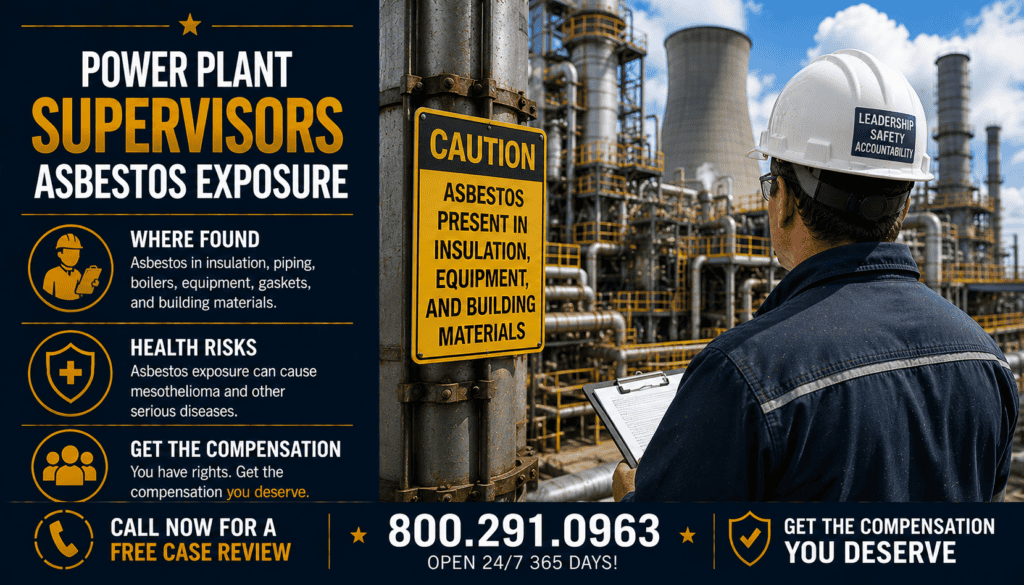
Power Plant Supervisors Asbestos Exposure
Power plant supervisors repaired boilers, piping, pressure vessels, supports, and other metal systems in facilities where older asbestos insulation and heat-resistant materials were sometimes installed. Supervisory itself does not establish asbestos exposure; risk depended on which materials were present and whether work disturbed them.
If you welded at a power station and later developed mesothelioma or asbestos-related lung cancer, this guide explains exposure pathways, useful employment records, medical considerations, and possible legal options for you and your family.
🏭 Where Asbestos Was Found
Supervisors could have encountered asbestos dust while inspecting boiler rooms, walking through turbine halls, overseeing contractors, and coordinating outages. Their exposures may differ sharply from those of hands-on tradespeople. Relevant evidence includes shift assignments, inspection routes, proximity to insulation removal, work permits, and whether supervisors remained in occupied areas during cleanup.
Older generating stations contained extensive hot piping, steam systems, turbines, boilers, and associated equipment. Historically, certain thermal insulation, lagging, gaskets, packing, and fire-resistant products contained asbestos. The presence of any one of these products at a particular plant must be established with dated records, surveys, or reliable witness evidence; a facility’s age alone is not proof. For a broader view of facility systems, see Power Plants Asbestos Exposure.
Boiler Rooms And Maintenance Oversight
Boiler rooms combined high-temperature components with crowded maintenance access. Supervisors repairing boiler casings, tube assemblies, headers, or adjacent steel might have worked near insulation crews removing old coverings to reach damaged metal. A supervisory repair could begin only after insulation was stripped back, and the resulting debris could remain near scaffolds or work platforms. Ask whether a particular outage included insulation removal, who performed it, and what cleanup followed.
Coal-fired, oil-fired, gas-fired, and other power stations used different equipment configurations. An asbestos exposure account should identify the unit, the repair year, the employer, and the precise area rather than treating every boiler room as identical. Historical installation specifications can show whether asbestos-containing insulation was present during a worker’s assignment.
Pipe Galleries And Contractor Work Areas
High-pressure steam piping, elbows, valves, and flanges were commonly insulated to control heat loss and protect personnel. Some historical coverings and joint materials contained asbestos. A supervisor replacing a section of pipe could encounter dust when a separate crew removed old lagging or when the work area was cleared for cutting. The occupational context overlaps with Power Plant Pipefitters Asbestos Exposure, although supervisory and pipefitting duties were not always performed by the same person.
The most useful evidence is a description of a specific line, location, and repair. A drawing showing insulated piping is not enough to identify the insulation composition; material specifications, purchasing records, or asbestos surveys can help make that distinction.
Turbine Overhauls And Shutdown Planning
Turbine areas included steam lines, pumps, valves, expansion joints, and heat-resistant components. Supervisors might repair supports, platforms, drain lines, or equipment housings near these systems. Some older gasket and packing products contained asbestos, but not every pump or turbine component did. Power Plant Mechanics Asbestos Exposure describes related maintenance activities that could occur alongside supervisory work.
A plant’s maintenance schedule may distinguish routine operation from major turbine overhauls. Overhauls sometimes brought multiple contractors into a confined area; a supervisor could be exposed as a nearby worker even without personally handling an asbestos product.
Control Rooms And Plant Walkthroughs
Supervisors also fabricated brackets, repaired handrails, installed supports, and modified steel around electrical and mechanical installations. Some older fire-resistant boards, coatings, or nearby insulation may have contained asbestos. The work of Power Plant Electricians Asbestos Exposure can provide context for overlapping work zones, but electrical equipment and supervisory steel should not be presumed to contain asbestos merely because they were inside a power station.
👷 Supervisors And Daily Jobs
Maintenance Supervisory During Scheduled Outages
A scheduled outage often involved draining equipment, opening access panels, removing insulation, cutting out damaged sections, supervisory replacements, testing, and reinstalling coverings. The sequence matters. The asbestos question is not whether a worker struck an arc; it is whether asbestos-containing material was disturbed before, during, or after the supervisory assignment. The Power Plant Workers And Occupations overview helps place supervisors among the other trades involved in these projects.
An outage log can identify work order numbers, subcontractors, plant units, and shift dates. Workers should describe whether insulation debris was visible on the deck, whether barriers separated trades, and whether cleaning used methods capable of dispersing settled dust. These details are more informative than a general recollection that an old plant was dusty.
Coordinating Emergency Maintenance
Steam leaks, pipe failures, and unexpected equipment shutdowns could require urgent repairs. In an emergency, crews might remove insulation to locate a leak, cut damaged pipe, prepare joints, and weld under tight scheduling pressure. If the removed material contained asbestos, disturbance could create exposure. The repair’s urgency does not prove that asbestos was present, and records should separate what the worker saw from what coworkers later reported.
Repair permits, safety briefings, incident reports, and unit operating logs may document the emergency. A coworker who removed insulation may be able to identify the product or contractor more accurately than the supervisor who arrived afterward.
Contract Supervisors And Traveling Crews
Some supervisors worked for plant owners, while others arrived through construction, boiler-service, or industrial-maintenance contractors. A traveling supervisor may have worked at multiple generating stations, refineries, factories, or shipyards. A useful history lists each employer and site separately because exposure sources and potentially responsible companies can differ by project.
Union dispatch records, apprenticeship records, pension histories, and payroll records can establish periods of employment even when the original contractor has closed. Avoid assigning a single product brand to every project without supporting evidence.
Supervisory Apprentices, Helpers, And Nearby Trades
Apprentices and helpers might position material, grind joints, erect shields, or clean work areas while other trades stripped insulation. Exposure can involve bystanders when airborne fibers travel outside the immediate disturbance area. Power Plant Insulators Asbestos Exposure explains the separate tasks performed by insulation crews, which may be relevant to a supervisor’s account of shared workspaces.
Other workers in the same unit may recall who cut back lagging, where waste was placed, and whether temporary containment was used. Their statements should describe firsthand observations, not assume asbestos based solely on insulation color or texture.
🧱 Products And Equipment
Asbestos historically served heat-resistant and sealing functions in some industrial products. The following categories are prompts for investigation, not a claim that every listed component at a specific power plant contained asbestos. Insulation Products Asbestos Exposure provides background on product types, while Asbestos Exposure In Equipment addresses the broader equipment context.
| Product Or Area | Potential Supervisory Connection | Evidence To Seek |
|---|---|---|
| Pipe and boiler insulation | Removal before cutting or joint repair | Insulation schedules, surveys, contractor invoices |
| Valve and flange gaskets | Disassembly near welded pipe sections | Part numbers, maintenance kits, purchasing records |
| Pump and valve packing | Nearby overhaul or repair work | Equipment manuals, packing specifications |
| Fireproofing and heat-resistant boards | Adjacent structural repairs or shielding | Material surveys, construction drawings |
| Protective supervisory blankets or cloth | Temporary hot-work protection | Product labels, procurement and safety records |
| Turbine and vessel coverings | Access preparation during outage | Outage plans, photographs, insulation work orders |
Thermal Insulation Versus Supervisory Fumes
Supervisory produces metal fumes and gases that are separate hazards from asbestos fibers. A worker may have encountered both in a poorly controlled work area, but they should not be conflated. Stainless steel supervisory, for example, raises different questions from disturbance of asbestos-containing thermal insulation. A physician should receive an accurate account of all relevant exposures rather than a single assumed cause.
OSHA distinguishes asbestos-related construction maintenance from other work based on the activity and materials involved. Historical safety conditions may differ from current requirements; present-day standards are useful for understanding recognized hazards but do not automatically establish what happened decades ago.
Product Identification Without Disturbing Material
An equipment manufacturer’s name is not necessarily the manufacturer of an installed gasket, packing, or insulation product. Replacement parts may have changed across decades. Try to locate purchase orders, installation dates, material safety records, or qualified inspection results. Never scrape or sample suspect material yourself. A qualified asbestos professional can evaluate current materials safely.
🌫️ How Exposure Occurred
Presence During Removal And Reinstallation
To make a weld safely, crews often needed access to bare metal. On an insulated line, that could require removing a portion of the covering and preparing the joint. If the covering contained asbestos and was cut, broken, or stripped without effective controls, airborne fibers could be released. The supervisor may have performed this step personally or entered after another trade had finished.
The difference between these scenarios matters for documentation. A worker who handled the covering can describe its removal directly; a bystander should describe proximity, timing, dust, and observations of the removal crew. Neither should guess at asbestos content without supporting evidence.
Inspection During Cutting And Demolition
Grinding and cutting are routine metalworking activities, but asbestos exposure depends on whether they disturb asbestos-containing products or contaminated residue. Grinding clean steel is not itself asbestos work. Abrading a metal surface next to deteriorated asbestos insulation or disturbing residue left from insulation removal is a different situation. Work orders, material assessments, and air monitoring records can help clarify the conditions.
Shared Scaffolds, Ventilation, And Housekeeping
During outages, trades may share scaffolds, narrow galleries, or enclosed machinery spaces. Dust can spread when material is disturbed and ventilation carries particles into adjacent areas. Historical dry sweeping, compressed-air cleaning, or handling dusty debris could redistribute fibers if asbestos-containing material was involved. OSHA’s construction asbestos standard addresses work practices intended to limit such releases.
Clothing and tools may also carry dust away from a work area. Secondhand Asbestos Exposure discusses potential take-home exposure pathways. The presence of dust on clothing alone does not identify its composition; a credible account should connect it to a known or reasonably documented asbestos source.
Why Dates And Controls Matter
A plant built in the 1950s may have undergone numerous insulation replacements, asbestos abatements, and equipment upgrades. The same supervisor could have encountered different materials in different years. Record whether the work took place before or after an identified abatement project, whether containment was erected, and whether the worker received asbestos training or respiratory protection.
OSHA describes maintenance that disturbs asbestos-containing material as a distinct class of asbestos work under the construction standard. This classification helps explain why the material and task matter, but does not retroactively prove an individual exposure or legal violation.
🩺 Mesothelioma After Workplace Exposure
Recognizing A Diagnosis And Seeking Specialist Care
Mesothelioma is a cancer of the mesothelial lining, most often the pleura around the lungs. Asbestos is a major established cause. Symptoms may appear decades after exposure, which means a retired supervisor’s earlier plant work can be medically relevant. A specialist may use imaging, biopsy, pathology, and other tests to distinguish mesothelioma from different cancers or benign conditions. See Mesothelioma Diagnosis for an overview of the diagnostic process.
Symptoms such as persistent shortness of breath, chest discomfort, or unexplained fluid around a lung require medical assessment; these symptoms are not specific to mesothelioma. If a diagnosis is confirmed, ask about multidisciplinary evaluation and options summarized in Mesothelioma Treatments. A medical team determines appropriate care; employment records serve a different role in exposure reconstruction.
Latency And Multiple Workplaces
A long latency period can make a work history difficult to reconstruct. Some supervisors spent decades across power plants and other industrial settings. Record each period of possible exposure rather than assuming that the most recent job caused the illness. Medical experts assess diagnosis and exposure history; attorneys and claims reviewers separately evaluate evidence connecting products and responsible entities.
A diagnosis does not automatically identify a particular asbestos product or employer. It is possible for several exposure periods to matter, and a careful timeline can preserve that distinction without overstating certainty.
🫁 Asbestos-Related Lung Cancer
Asbestos, Smoking, And Other Occupational Hazards
Asbestos is an established cause of lung cancer. Smoking independently increases lung cancer risk, and combined smoking and asbestos exposure can increase risk further. A smoking history does not automatically rule out asbestos as a contributing factor. Supervisory fumes and other plant hazards should also be disclosed to clinicians so they can consider the full occupational history.
Pathology, imaging, smoking history, and exposure documentation may all be relevant. A clinician determines the diagnosis and treatment plan; legal causation and compensation eligibility require separate assessment. For civil claim information, see Asbestos Lung Cancer Lawsuits.
Medical Documentation For A Former Supervisor
Keep pathology reports, imaging results, oncology notes, and a dated work history together. Include the names of plants, supervisory assignments, known insulation disturbances, and other occupational exposures. Ask the treating team whether referral to an occupational-medicine specialist would help clarify the exposure history. Do not delay clinical care while searching for decades-old records.
📋 Work History And Evidence
A detailed account should establish where the supervisor worked, what metal was repaired, which other trades were present, and whether documented asbestos-containing materials were disturbed. A broad job title or a photograph of a boiler is not enough by itself to identify asbestos exposure.
| Record | What It May Establish |
|---|---|
| Payroll, union dispatch, pension records | Employer, plant, job dates and contractor |
| Supervisory permits and repair orders | Equipment location, work scope and timing |
| Outage plans and insulation work orders | Whether covering removal coincided with supervisory |
| Plant asbestos surveys and abatement records | Identified materials and removal dates |
| Supplier invoices and product manuals | Possible manufacturer and product composition |
| Coworker and supervisor accounts | Firsthand observations of work practices |
| Medical and pathology records | Diagnosis, treatment and clinical timeline |
Building A Reliable Exposure Timeline
Start with the earliest known plant assignment and move chronologically. For each job, note the unit number, contractor, supervisor, dates, and supervisory task. Add a separate line for nearby insulation removal or equipment overhaul. Mark each fact as personal recollection, document-supported, or reported by another witness. This prevents later assumptions from being presented as firsthand knowledge.
A supervisor who worked on several units should avoid combining them into one generic description. Unit-specific records may reveal that insulation had already been replaced on one system while original materials remained elsewhere.
Finding Records After A Plant Closure
If a facility or contractor no longer exists, records may survive with a successor operator, labor union, pension administrator, former employees, engineering contractor, or archival repository. Preserve copies with their dates and sources. A legal professional may know how to request records without requiring a former worker to contact every supplier personally.
Questions To Ask Former Coworkers
- Which plant unit and outage do you remember working on together?
- Who removed insulation before the weld and where was debris placed?
- Do you recall a product label, contractor name, or equipment identifier?
- Were barriers, ventilation, or cleanup procedures used?
- Are your observations firsthand, or based on information learned later?
Do not encourage coworkers to guess at a brand or sign a statement that goes beyond what they personally remember. Specific, consistent accounts are more useful than exaggerated descriptions.
⚖️ Compensation And Legal Options
Personal-Injury And Wrongful-Death Lawsuits
People diagnosed with mesothelioma or asbestos-related lung cancer sometimes explore civil lawsuits against legally responsible parties. Whether a claim is available depends on the jurisdiction, diagnosis, exposure evidence, product identification, and applicable law. Mesothelioma Lawsuit explains the general process. A worker’s employer may be subject to different rules than a product manufacturer or contractor; the proper legal theory cannot be inferred from the job title alone.
Families may also ask about wrongful-death procedures when a loved one has died. Deadlines, eligible family members, and recoverable losses vary by state. Mesothelioma Filing Deadlines provides general context, but current jurisdiction-specific advice is essential because waiting can affect legal rights.
Asbestos Bankruptcy Trust Claims
Some companies that faced asbestos liabilities established bankruptcy trusts with specific medical and exposure criteria. Asbestos Trust Funds explains the general concept. A trust application may require evidence connecting a worker to qualifying products, sites, and dates; supervisory at a power plant does not automatically qualify a person for a particular trust.
Trust procedures, documentation rules, and interactions with litigation vary. Claims should be evaluated individually, and the existence of a trust does not guarantee a payment. A qualified adviser can explain whether multiple potential avenues apply and what disclosures are required.
Veterans, Military Power Systems, And Separate Benefits
Some supervisors also served in the military or maintained boilers and piping at military installations. Their civilian power plant employment and military service should be documented separately. U.S. Military Veterans Asbestos Exposure describes military-related exposure issues. Veterans may ask about VA benefits when a disease is connected to qualifying service, but neither military service nor a diagnosis alone establishes eligibility.
A VA claim, asbestos trust claim, and civil lawsuit are separate systems. The evidence and standards differ, and a legal or accredited veterans-benefits adviser can help identify the correct process. Avoid assuming that every power plant was operated by the military or that civilian work establishes service connection.
Preparing For A Legal Consultation
Bring a concise timeline, employment records, medical diagnosis, and any photographs or product documents. Explain uncertain details openly. Mesothelioma Claims discusses claims in general. Ask about applicable filing deadlines, potential responsible entities, trust disclosure requirements, fees, and how the lawyer distinguishes a documented product from a suspected one.
Compensation outcomes depend on individual facts. No particular settlement, trust payment, VA award, or lawsuit result is guaranteed. Seeking advice promptly can be important even when the worker does not yet have complete employment records.
📚 Confirmed Sources
The following authoritative references explain asbestos hazards, maintenance work, and cancer risk. They do not prove that any particular worker or power station had asbestos exposure.
- OSHA — Asbestos Standard For Construction (29 CFR 1926.1101)
- OSHA — Asbestos Standard For General Industry (29 CFR 1910.1001)
- OSHA — Inspection Procedures For Occupational Asbestos Exposure
- National Cancer Institute — Asbestos Exposure And Cancer Risk
❓ Frequently Asked Questions
Did Every Power Plant Supervisor Encounter Asbestos?
No. Exposure depended on the plant, period, materials, task, and nearby disturbances. Supervisory alone is not proof of asbestos contact.
Could A Supervisor Be Exposed Without Removing Insulation?
Yes, potentially. If asbestos-containing insulation was disturbed nearby, fibers could reach adjacent work areas depending on controls and ventilation. The specific circumstances need evidence.
Are Supervisory Fumes The Same As Asbestos Dust?
No. Supervisory fumes and asbestos fibers are different hazards. A complete occupational history should describe each without assuming that one proves the other.
What If The Plant Has Closed?
Union records, pension histories, contractor files, equipment manuals, archives, and coworkers may help reconstruct work assignments and products.
Can A Former Supervisor Seek Help Decades After Working At A Plant?
Yes. Asbestos-related illnesses can have long latency periods. Medical evaluation should not be delayed, and legal deadlines should be checked promptly.
Does A Mesothelioma Diagnosis Guarantee Compensation?
No. A claim requires individualized review of diagnosis, exposure evidence, applicable rules, responsible parties, and filing requirements.
Can Family Members Seek Information After A Worker Dies?
Yes. Families can ask about medical records, employment histories, and jurisdiction-specific wrongful-death or survivor-benefit options. Eligibility varies.
🧭 Summary
Power plant supervisors may have worked near asbestos-containing thermal insulation, gaskets, packing, or other historical materials during repairs and shutdowns. The strongest account connects a specific plant, unit, date, material, and disturbance rather than assuming exposure from a job title. Preserve employment and medical records, seek specialist care when needed, and obtain qualified advice about possible claims and deadlines.
Get The Compensation You Deserve
Find out if you may qualify for asbestos compensation today. Call 800.291.0963 or Submit Your Case Here.
25+ years of experience. Help is available 24/7/365.
Disclaimer: Mesothelioma Help Center is not a law firm or medical provider and does not determine legal or VA eligibility. This information is not individualized medical or legal advice.