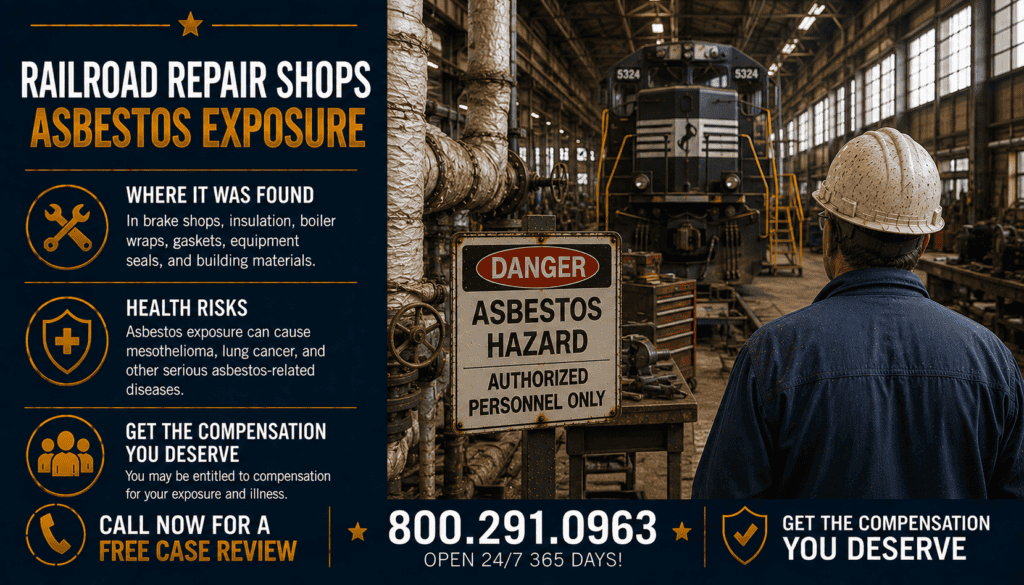
Railroad Repair Shops Asbestos Exposure
If you worked in locomotive and railcar repair shops and have been diagnosed with mesothelioma or asbestos-related lung cancer, you deserve clear information about what happened at work and where help may be available. Historical railroad equipment and facilities sometimes contained asbestos in insulation, gaskets and other heat-resistant products.
This page explains exposure situations relevant to railroad repair shops asbestos exposure, why particular work assignments matter, and the medical and compensation questions that workers and families often face. A diagnosis can be overwhelming; you do not need to know every product name before asking for assistance.
🏭 Where Exposure May Have Occurred
Historical locomotive and railcar repair shops could place employees near aging equipment and building systems. Some railroad operations used asbestos-containing materials because they resisted heat and wear. The presence of asbestos at one railroad property does not prove that it was present at another, and the materials changed over time.
A locomotive overhaul shop may have handled large insulated steam equipment, while a freight-car repair area may have concentrated on brakes, bearings and undercarriage work. The tasks and decades matter more than the shop name.
For workers such as shop mechanics, carmen, electricians, boilermakers, pipefitters, cleaners and apprentices, the most useful details are the decades of employment, the specific location, the equipment serviced and the type of repair occurring nearby. Workers often remember a building, a supervisor or a recurring assignment even when they cannot identify a manufacturer. Those details can still help explain a credible occupational history.
For a broader explanation of historic railroad workplaces, see Railroad Asbestos Exposure and the related discussion of Railroad Engine Houses . These settings sometimes overlapped, but their activities were not identical.
🧱 Historical Asbestos-Containing Materials
Materials worth distinguishing include steam lines, boiler insulation, valve packing, flange gaskets, brake assemblies and older building insulation. In older industrial settings, asbestos could be incorporated into insulation or friction products, but the actual composition depended on the component, supplier and time of installation.
Asbestos fibers are microscopic. A worker may remember dusty, brittle insulation or compressed sheet packing, yet appearance alone cannot establish that the material contained asbestos. Some later products used substitutes, and many ordinary workplace materials never contained asbestos at all.
Not every railroad shop or piece of equipment contained asbestos. The relevant question is which older components were present, when they were disturbed, and who was nearby.
For someone already diagnosed with a serious illness, this distinction matters because a clear account of the actual material is more useful than a sweeping statement that an entire railroad facility was contaminated. It also helps medical and legal professionals understand which work periods warrant attention.
Related occupations include Railroad Machinists and Railroad Pipefitters And Boilermakers , whose work could involve different components of the same machinery.
🔧 Work Activities And Airborne Dust
Tasks that could disturb older asbestos-containing products included stripping damaged lagging, opening insulated machinery, removing compressed gaskets, replacing brakes and cleaning repair bays. Cutting, scraping, removing or handling damaged material could release fibers when asbestos was actually present. Risk depended on the condition of the product, the activity, ventilation and protective measures.
A worker did not necessarily have to install the material personally. Repair work might occur while other employees remained at their benches, walked through a shared bay or worked in an adjacent pit. On the other hand, simply passing through a building does not establish a meaningful asbestos exposure without more detail.
One practical way to describe the setting is to distinguish routine duties from periodic overhaul work. An employee may have spent most days on inspection or operation and only occasionally been present for stripping damaged lagging. Those less frequent jobs can be important to a truthful history.
Housekeeping practices also changed. Dry sweeping or compressed-air cleaning of asbestos-contaminated dust could spread fibers, while appropriate containment and wet or HEPA-filtered methods reduce release. The exact practices used at a historical site should not be assumed from current safety standards.
Workers can compare adjacent duties in Railroad Repair Shops and Railroad Brake Workers .
👷 Workers And Shared Exposure
People who may have worked in or near these operations included shop mechanics, carmen, electricians, boilermakers, pipefitters, cleaners and apprentices. The specific employer and work assignment are important: two workers with the same title might have had very different daily duties.
Nearby exposure is a separate issue. Adjacent workers using the same service pits, benches and enclosed repair bays could have shared air with dust generated by maintenance. Whether that dust contained asbestos depends on the products and work being performed.
Some employees moved among shops, terminals, rail yards and trackside locations during their careers. Others worked for contractors rather than the railroad itself. These differences can affect both the account of exposure and the available legal route. A worker should not be ruled out solely because a job title sounds less hands-on.
Other relevant roles are discussed on the Railroad Electricians and Railroad Car Repairmen pages. Families can also read about Secondhand Asbestos Exposure when work clothing may have carried contaminated dust home.
🩺 Mesothelioma And Asbestos-Related Lung Cancer
Asbestos exposure can cause mesothelioma, a cancer of the lining of the lungs or other organs, and can also cause lung cancer. Symptoms may not appear until decades after exposure. A former railroad worker who has been retired for many years can still have a relevant occupational history.
Mesothelioma and lung cancer are different diagnoses and require different medical evaluation. A diagnosis depends on clinical findings, imaging and, when appropriate, tissue examination. Work history may be medically relevant but does not by itself establish that a particular cancer was caused by a particular job.
Asbestos exposure and smoking together increase lung-cancer risk more than either exposure alone. Smoking history should be discussed openly with a clinician; it does not erase the importance of an occupational asbestos history. Persistent breathlessness, chest pain, worsening cough or unexplained weight loss deserves prompt medical attention.
For explanations of diagnostic testing and care options, see Mesothelioma Diagnosis and Mesothelioma Treatments . These pages are informational and do not replace a treating specialist.
People already receiving treatment may need assistance with travel, household expenses, disability benefits or coordination of appointments. Asking for help early can ease pressure on a family while the medical team focuses on care.
📋 Understanding Your Work History
Helpful work-history details can include shop rosters, locomotive and car numbers, job cards, overhaul schedules, union records and retired coworker accounts. Even a partial list of employers, years, locations and coworkers can provide a starting point. Exact dates are valuable, but uncertainty about a month or product brand should not prevent someone from seeking advice.
A family member may know the name of a railroad division, terminal or hometown repair facility when the worker no longer has records. Old pay statements, pension correspondence, photographs, union cards and employment papers can sometimes help establish where a person worked. Documents should be kept in their original form whenever possible.
Medical records and employment records serve different purposes. Pathology and imaging address diagnosis; occupational details describe potential exposure. Neither should be treated as a substitute for the other. An experienced professional can explain how the information fits together without requiring the family to make technical judgments alone.
If the worker is deceased, relatives may still have access to employment history, benefit records or personal papers. Families should avoid discarding old work documents until they understand whether those records might matter for benefits or a potential claim.
For related workplace context, compare Railroad Track Infrastructure and Railroad Roundhouse Maintenance Shops .
⚖️ Railroad Claims And Compensation
Railroad employment may raise Federal Employers’ Liability Act (FELA) questions; the employer, status of employment, injury and timing must be assessed by a lawyer familiar with railroad claims.
Potential compensation may depend on the employer, the worker’s diagnosis, the applicable law, the dates involved and the companies responsible for specific products. Some cases involve a railroad employer; others may involve asbestos product manufacturers or bankruptcy trusts. The availability of one route does not automatically establish eligibility for another.
Railroad workers should not assume that a general state personal-injury deadline is the only time limit. Federal railroad law can involve different rules, and the discovery of a disease long after exposure raises questions that must be evaluated individually. Filing deadlines can be short, so a diagnosed worker or family should seek qualified legal guidance promptly.
Compensation, when available, may help address medical bills, lost income and other legally recognized losses. Outcomes vary and no settlement or verdict can be promised. Trust fund claims also have their own requirements, proof standards and deadlines.
Read more about Mesothelioma Claims , Asbestos Trust Funds and Mesothelioma Filing Deadlines .
👨👩👧 Help For Families And Veterans
A mesothelioma or asbestos-related lung-cancer diagnosis affects spouses, children and caregivers as well as the person who is ill. Families may need answers about treatment decisions, time away from work, transportation and how to keep household finances stable. These immediate needs are important regardless of whether a legal claim is ultimately available.
If a loved one has died from an asbestos-related disease, a surviving family member may be able to ask about wrongful-death or survival claims. Eligibility and deadlines vary by law and circumstances. Families should not assume that an old exposure date means there is no remaining option, nor that every diagnosis qualifies for a payment.
Veterans who later worked on railroads may have separate questions about military exposure and VA benefits. Civilian railroad employment does not itself establish VA eligibility, but a veteran’s full service and work history can be relevant to different benefit programs.
The most helpful first conversation is one that listens to the worker’s diagnosis, the places they worked and the family’s current concerns. It should clearly distinguish available information from legal or medical conclusions and avoid promising a result.
❓ Frequently Asked Questions
Did Every Railroad Worker Encounter Asbestos?
No. Historical asbestos use varied by equipment, facility and decade. The important issue is whether an identifiable asbestos-containing product was disturbed in the worker’s environment.
Can I Ask For Help If I Do Not Know Product Names?
Yes. Work dates, railroad locations, job duties and coworkers may provide a useful starting point. A professional can explain what additional information may matter.
What If The Exposure Happened Decades Ago?
Asbestos-related diseases can have long latency periods. A diagnosis many years after employment does not, by itself, rule out a possible claim, but applicable filing deadlines require prompt attention.
Does A Lung Cancer Diagnosis Count?
Asbestos can cause lung cancer as well as mesothelioma. The diagnosis, medical history and occupational evidence need individual review; not every lung cancer is asbestos-related.
Can My Family Ask About Compensation?
Family members may be able to seek information about a deceased worker’s potential claims or benefits. The rules depend on the type of claim and the governing law.
🧭 Summary
For workers from locomotive and railcar repair shops, the central questions are what materials were used, which activities could have released asbestos fibers, and how the work history relates to a diagnosed illness. The answer should be grounded in the individual’s experience, not assumptions about every railroad property.
Help may be available for medical questions, financial concerns and possible legal options. The most important next step after a diagnosis is to speak with appropriate professionals while relevant deadlines can still be considered.
📚 Confirmed Sources
- OSHA — Asbestos Overview
- National Cancer Institute — Asbestos Exposure And Cancer Risk
- OSHA — Brake And Clutch Repair Interpretation (scope of particular provisions; not a blanket railroad exposure finding)
Get The Compensation You Deserve
Find out if you may qualify for asbestos compensation today. 800.291.0963 — Help is available 24/7/365. 25+ years of experience.
Mesothelioma Help Center is not a law firm or medical provider and does not determine legal or VA eligibility. This information is not individualized medical or legal advice.