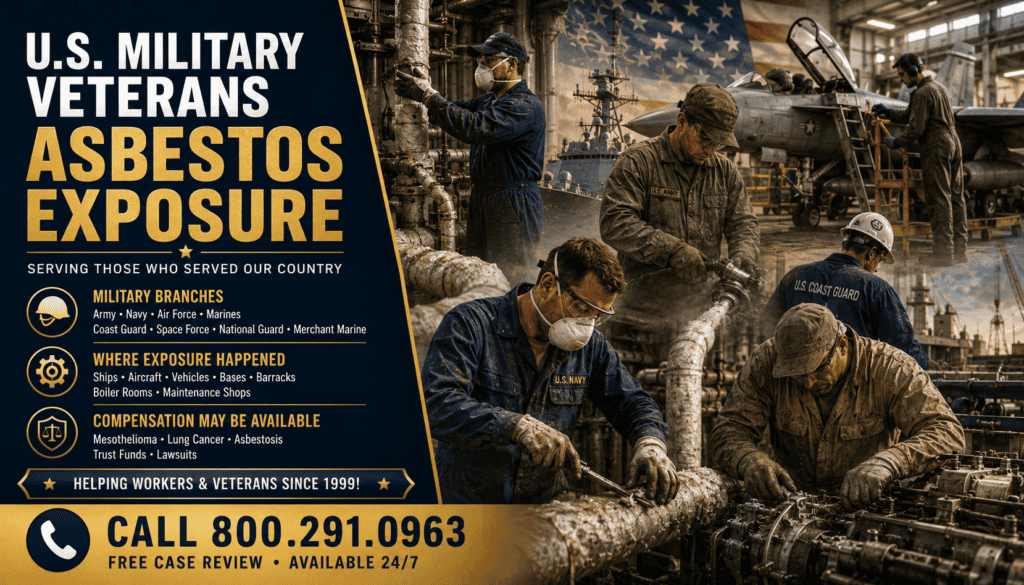
U.S. Military Veterans & Asbestos Exposure
Complete Guide to Military Asbestos Exposure, Mesothelioma, VA Benefits, Lawsuits & Financial Compensation
Every branch of the United States military relied heavily on asbestos throughout much of the twentieth century. From World War II through the Cold War, asbestos was incorporated into thousands of military products because it resisted heat, fire, corrosion, and electrical damage. It was used aboard Navy ships, military aircraft, combat vehicles, military housing, maintenance facilities, power plants, shipyards, and nearly every type of military installation across the world.
Unfortunately, the same material that helped protect military equipment has also left hundreds of thousands of veterans at risk for mesothelioma, asbestos lung cancer, asbestosis, and other asbestos-related diseases. Because these diseases often take 20 to 50 years to develop, many veterans are only now learning that their military service exposed them to dangerous asbestos fibers.
If you or someone you love served in the military and has been diagnosed with mesothelioma or another asbestos-related disease, you may qualify for compensation through VA disability benefits, asbestos trust fund claims, and mesothelioma lawsuits.
This guide explains where asbestos was used throughout the military, which veterans faced the greatest risk, the diseases asbestos causes, available compensation, and links to detailed information covering every major branch of military service and hundreds of military-specific exposure sources.
Why Did the U.S. Military Use Asbestos?
For decades, asbestos was considered one of the best construction and insulation materials available. Military engineers selected asbestos because it was:
- Highly resistant to fire
- Extremely durable
- Excellent thermal insulation
- Effective electrical insulation
- Resistant to chemicals
- Inexpensive
- Readily available
As a result, asbestos became standard in thousands of military products including:
- Steam pipes
- Boilers
- Turbines
- Pumps
- Valves
- Electrical systems
- Gaskets
- Packing materials
- Cement products
- Floor tile
- Roofing materials
- Aircraft brakes
- Vehicle clutches
- Fireproof wall systems
- Military housing insulation
While asbestos protected military equipment from heat and fire, disturbing these products during repairs, maintenance, construction, or demolition released microscopic asbestos fibers into the air. Once inhaled, these fibers could remain trapped in the lungs or abdomen for decades before eventually causing disease.
To learn more about asbestos-containing military materials, visit:
Military Products Asbestos Exposure
You can also explore thousands of additional exposure sources throughout our Asbestos Exposure in Products section:
Why Military Veterans Face a Higher Risk of Mesothelioma
Military veterans represent one of the largest groups diagnosed with mesothelioma in the United States.
Unlike many civilian occupations, military personnel often worked around asbestos every day. Service members not only maintained asbestos-containing equipment but frequently lived aboard ships, inside military housing, and worked in buildings insulated with asbestos materials.
Many veterans experienced repeated exposure while serving aboard ships, maintaining aircraft, repairing military vehicles, constructing buildings, or working inside mechanical rooms where asbestos insulation surrounded pipes, boilers, turbines, and electrical equipment.
Even veterans who never directly handled asbestos could inhale fibers released by nearby repair work or damaged insulation.
Because mesothelioma usually develops decades after exposure, veterans diagnosed today are often discovering that exposure occurred many years earlier during military service.
For a complete overview of military exposure sources, visit:
Military Buildings Asbestos Exposure
Military Branches with Significant Asbestos Exposure
Nearly every military branch used asbestos extensively throughout much of the twentieth century.
U.S. Navy
The U.S. Navy experienced some of the highest asbestos exposure rates of any military branch.
Virtually every Navy ship built before the early 1980s contained asbestos throughout engine rooms, boiler rooms, sleeping quarters, machine spaces, steam systems, electrical equipment, pumps, valves, turbines, insulation, flooring, and fireproof materials.
Sailors often spent months at sea working in enclosed compartments where asbestos dust accumulated during repairs and maintenance.
Explore our complete Navy section:
You can also learn about asbestos aboard individual vessels in our:
U.S. Army
Army veterans encountered asbestos in military housing, maintenance facilities, motor pools, construction projects, engineering operations, boiler plants, warehouses, and countless military buildings.
Mechanics, electricians, engineers, pipefitters, construction crews, and maintenance personnel frequently repaired asbestos-containing brakes, clutches, insulation, electrical systems, and heating equipment.
Army Corps of Engineers personnel also worked extensively around asbestos during military construction and infrastructure projects.
Army exposure information:
U.S. Air Force
The Air Force relied heavily on asbestos in aircraft, hangars, maintenance facilities, power plants, heating systems, and military installations.
Aircraft mechanics frequently worked with asbestos-containing brakes, engine insulation, electrical systems, fireproof materials, and cockpit components.
Additional exposure occurred inside maintenance buildings, utility tunnels, mechanical rooms, and aircraft overhaul facilities.
Air Force veterans can learn more here:
U.S. Air Force Asbestos Exposure
Military aircraft exposure information:
Military Aircraft Asbestos Exposure
U.S. Marine Corps
Marine Corps personnel experienced asbestos exposure both ashore and while serving aboard Navy vessels.
Marine mechanics, engineers, aircraft maintenance specialists, vehicle repair crews, and construction personnel often worked directly with asbestos-containing equipment.
Many Marines also encountered asbestos while deployed aboard Navy ships during overseas operations.
Marine Corps asbestos exposure:
U.S. Marine Corps Asbestos Exposure
U.S. Coast Guard
Although smaller than other branches, the Coast Guard relied on many of the same asbestos-containing ship designs used throughout the Navy.
Coast Guard cutters, patrol vessels, engine rooms, steam systems, pumps, electrical equipment, and mechanical spaces frequently contained asbestos insulation.
Maintenance personnel, machinists, electricians, and engineers often experienced repeated occupational exposure.
Learn more:
U.S. Coast Guard Asbestos Exposure
Merchant Marine
Merchant Mariners transported troops, supplies, fuel, and equipment aboard ships heavily insulated with asbestos.
Engine rooms, boiler systems, steam pipes, pumps, valves, turbines, and cargo vessels all relied extensively on asbestos-containing insulation.
Merchant Marine asbestos exposure:
U.S. Merchant Marines Asbestos Exposure
Military Occupations with the Highest Risk
Although every military occupation could involve asbestos exposure, some jobs consistently faced much greater risks.
These include:
- Boiler Technicians
- Machinist’s Mates
- Pipefitters
- Shipfitters
- Hull Maintenance Technicians
- Electricians
- Welders
- Damage Control Personnel
- Construction Engineers
- Heavy Equipment Mechanics
- Aircraft Mechanics
- Vehicle Mechanics
- Steamfitters
- Insulators
- Civilian Shipyard Workers
You can explore hundreds of occupations inside our High-Risk Jobs section:
Asbestos Exposure in High-Risk Jjobs
Military Equipment That Frequently Contained Asbestos
Asbestos appeared in thousands of military products and equipment because it provided excellent protection against fire and extreme heat.
Common examples included:
- Aircraft
- Tanks
- Jeeps
- Bulldozers
- Cranes
- Personnel carriers
- Generators
- Compressors
- Pumps
- Boilers
- Steam turbines
- Pipe insulation
- Electrical panels
- Fire doors
- Floor tile
- Roofing systems
- Cement products
- Gaskets
- Packing materials
- Brake linings
- Clutch facings
Many of these products released dangerous asbestos fibers whenever they were repaired, replaced, sanded, drilled, or removed.
Browse our complete equipment library:
Diseases Caused by Military Asbestos Exposure
Veterans exposed to asbestos during military service may develop several serious diseases. While mesothelioma is the disease most commonly associated with asbestos exposure, it is not the only illness linked to inhaling asbestos fibers.
The most common asbestos-related diseases include:
- Mesothelioma
- Asbestos Lung Cancer
- Asbestosis
- Pleural Plaques
- Pleural Thickening
- Pleural Effusions
- Other asbestos-related respiratory diseases
Many veterans remain healthy for decades before symptoms appear. Because asbestos diseases usually have a 20 to 50-year latency period, a veteran exposed in the 1960s or 1970s may not receive a diagnosis until retirement.
Mesothelioma and Military Veterans
Mesothelioma is a rare and aggressive cancer that develops in the protective lining surrounding the lungs, abdomen, heart, or testicles. Nearly every case is linked to asbestos exposure.
Military veterans account for approximately one-third of all mesothelioma diagnoses in the United States because asbestos was so widely used throughout every branch of military service.
Unlike many cancers, mesothelioma often produces only mild symptoms during its earliest stages. As the disease progresses, veterans may experience:
- Shortness of breath
- Chest pain
- Persistent cough
- Fatigue
- Weight loss
- Fluid around the lungs
- Difficulty swallowing
- Night sweats
Our complete medical guides include:
- Mesothelioma Symptoms
- Mesothelioma Diagnosis
- Mesothelioma Stages
- Mesothelioma Treatment Options
- Mesothelioma Life Expectancy
Military Veterans Diagnosed with Asbestos Lung Cancer
Not every veteran exposed to asbestos develops mesothelioma. Some instead develop asbestos-related lung cancer.
Unlike mesothelioma, asbestos lung cancer forms inside the lung tissue itself. Veterans who smoked cigarettes and were also exposed to asbestos generally face a much greater risk than veterans exposed to asbestos alone.
Learn more about:
Where Veterans Were Commonly Exposed
Military asbestos exposure occurred in thousands of locations around the world.
Veterans frequently encountered asbestos while serving in:
- Shipyards
- Naval bases
- Army installations
- Air Force bases
- Marine Corps bases
- Coast Guard stations
- Military hospitals
- Warehouses
- Ammunition depots
- Aircraft hangars
- Maintenance facilities
- Machine shops
- Boiler rooms
- Utility tunnels
- Barracks
- Government housing
- Power plants
- Dry docks
Our military exposure library includes detailed pages covering:
- Military bases
- Military buildings
- Military housing
- Military vehicles
- Military aircraft
- Military equipment
- Military products
Additional military exposure resources:
Military Buildings Asbestos Exposure
Military Products Asbestos Exposure
>Asbestos Exposure in Equipment
Military Veterans May Qualify for VA Benefits
Veterans diagnosed with mesothelioma or another asbestos-related illness may qualify for benefits through the U.S. Department of Veterans Affairs.
Depending on individual circumstances, benefits may include:
- VA disability compensation
- VA health care
- Specialized cancer treatment
- Travel reimbursement
- Dependency and Indemnity Compensation (DIC)
- Survivor benefits
- Burial benefits
Receiving VA benefits does not necessarily prevent a veteran from pursuing compensation from asbestos trust funds or filing a mesothelioma lawsuit against the manufacturers responsible for asbestos-containing products.
Many veterans receive compensation from multiple sources.
Mesothelioma Lawsuits for Military Veterans
Veterans generally cannot sue the U.S. military for asbestos exposure that occurred during active service.
However, they may be eligible to file lawsuits against the manufacturers that supplied asbestos-containing products to the military.
These manufacturers produced products including:
- Pipe insulation
- Boilers
- Pumps
- Valves
- Gaskets
- Packing
- Cement
- Fireproof materials
- Floor tile
- Roofing products
- Electrical insulation
- Brakes
- Clutches
- Aircraft components
Many of these companies later filed bankruptcy and established asbestos trust funds specifically to compensate future victims.
Learn more:
Military-specific legal information:
Military Veterans Mesothelioma Lawsuit
Asbestos Trust Funds
More than 60 asbestos bankruptcy trusts have been established to compensate individuals diagnosed with asbestos-related diseases.
These trusts collectively contain billions of dollars reserved for future claimants.
Compensation may help pay for:
- Medical treatment
- Lost income
- Travel expenses
- Home care
- Pain and suffering
- Family financial support
Veterans often qualify for compensation from more than one trust fund because they were exposed to products manufactured by multiple companies during military service.
Our complete trust fund guide:
What Are Asbestos Trust Funds?
You can also browse our complete library of individual asbestos trust funds to learn about eligibility requirements and available compensation.
How Military Exposure Is Proven
Successful claims usually rely upon documenting where and how asbestos exposure occurred.
Evidence may include:
- DD-214 military discharge papers
- Military occupational specialty (MOS)
- Ship assignments
- Base assignments
- Maintenance records
- Employment records
- Medical records
- Pathology reports
- Witness statements
- Product identification
- Military construction records
Experienced mesothelioma attorneys often maintain extensive databases identifying which asbestos products were present aboard specific ships, aircraft, military bases, and installations during particular years of service.
These records can significantly strengthen a veteran’s claim.
Military Veterans Wrongful Death Claims
Families who lose a loved one to mesothelioma or another asbestos-related disease may have legal options even after the veteran has passed away.
A wrongful death claim may help surviving family members recover compensation for:
- Medical expenses
- Hospice care
- Funeral and burial costs
- Lost financial support
- Loss of companionship
- Pain and suffering experienced before death
Depending on the circumstances, surviving spouses and family members may also qualify for VA survivor benefits and compensation from asbestos trust funds.
Learn more:
Wrongful Death Mesothelioma Lawsuits
Secondary (Take-Home) Asbestos Exposure
Military asbestos exposure was not limited to active-duty personnel.
For decades, veterans unknowingly carried asbestos dust home on their:
- Uniforms
- Boots
- Jackets
- Gloves
- Hair
- Skin
- Tool bags
- Vehicle interiors
Spouses often shook out dusty uniforms or washed contaminated clothing, while children hugged parents returning home from work or deployment. These secondary exposures have been linked to mesothelioma diagnoses in military family members many years later.
Learn more:
Military Manufacturers That Supplied Asbestos Products
Thousands of asbestos-containing products used by the U.S. military were manufactured by private companies.
Many of these manufacturers supplied insulation, boilers, pumps, valves, electrical equipment, brakes, clutches, cement products, roofing materials, and fireproof construction products for military ships, aircraft, vehicles, and installations.
Examples include manufacturers of:
- Pipe insulation
- Steam boilers
- Turbines
- Pumps
- Industrial valves
- Electrical switchgear
- Fireproof panels
- Brake linings
- Clutch facings
- Gaskets
- Packing materials
- Cement pipe
- Roofing systems
- Industrial adhesives
- Floor tile
- Thermal insulation
Many of these companies later established asbestos bankruptcy trust funds after facing thousands of lawsuits.
Browse our complete library of:
Military Job Sites and Facilities
Veterans encountered asbestos in nearly every type of military workplace.
Some of the highest-risk environments included:
- Shipyards
- Dry docks
- Naval repair facilities
- Aircraft maintenance depots
- Vehicle maintenance shops
- Machine shops
- Boiler rooms
- Utility tunnels
- Power plants
- Ammunition plants
- Barracks
- Base hospitals
- Warehouses
- Motor pools
- Engineering facilities
- Construction projects
- Missile sites
- Radar stations
Many civilian contractors working alongside military personnel also experienced significant asbestos exposure.
Explore hundreds of high-risk locations in our:
Military Equipment and Vehicles
Asbestos was incorporated into countless military vehicles because of its ability to withstand extreme temperatures and friction.
Examples include:
- Tanks
- Jeeps
- Personnel carriers
- Bulldozers
- Combat engineer tractors
- Trucks
- Fire trucks
- Forklifts
- Cranes
- Aircraft tow tractors
- Recovery vehicles
- Missile transporters
- Generators
- Compressors
Common asbestos-containing components included:
- Brakes
- Clutches
- Engine insulation
- Exhaust insulation
- Gaskets
- Packing
- Firewalls
- Heat shields
- Electrical insulation
Explore our complete military equipment guides:
Military Equipment Asbestos Exposure
Military Vehicles Asbestos Exposure
Frequently Asked Questions
Can military veterans file a mesothelioma lawsuit?
Yes. Although veterans generally cannot sue the U.S. government for asbestos exposure during military service, they may be able to file claims against the manufacturers that produced asbestos-containing products used by the military.
Can veterans receive both VA benefits and lawsuit compensation?
In many cases, yes. Veterans may qualify for VA disability compensation while also pursuing asbestos trust fund claims or lawsuits against private manufacturers.
How long after exposure does mesothelioma develop?
Mesothelioma usually develops 20 to 50 years after asbestos exposure. Many veterans diagnosed today were exposed while serving decades earlier.
Which military branch had the highest asbestos exposure?
The U.S. Navy is generally considered to have had the greatest asbestos exposure because asbestos was extensively used aboard ships, submarines, and naval shipyards. However, Army, Air Force, Marine Corps, Coast Guard, Merchant Marine, National Guard, and civilian military contractors also experienced significant exposure.
What if I don’t remember being exposed?
Many veterans never realized they worked around asbestos. Exposure often occurred while performing routine maintenance, repairing equipment, serving aboard ships, living in military housing, or simply working near damaged insulation.
Can family members develop mesothelioma from a veteran’s exposure?
Yes. Secondary exposure from asbestos fibers brought home on uniforms, boots, or work clothing has been linked to mesothelioma in spouses and other family members.
How much compensation may be available?
Every case is different. Compensation depends on factors such as the veteran’s diagnosis, exposure history, available asbestos trust funds, responsible manufacturers, medical expenses, lost income, and applicable state law.
How can I learn whether I may qualify?
Gathering military service records, medical records, pathology reports, and employment history is often the first step. These records can help determine where exposure occurred and which compensation options may be available.
Explore Our Military Asbestos Exposure Library
Our Military Asbestos Exposure Center contains hundreds of detailed pages covering virtually every aspect of military asbestos exposure, including:
- Individual branches of military service
- Military ships and naval vessels
- Military aircraft
- Military vehicles
- Military equipment
- Military bases
- Military buildings
- Military Depots
- Military housing
- Military products
- Military ranks
- Military Yards
- Manufacturers
- Asbestos-containing products
- Job sites
- Mesothelioma treatment
- VA benefits
- Asbestos trust funds
- Mesothelioma lawsuits
- Wrongful death claims
- Deep Underground Military Bases (DUMBs)
- Department of Defense
- Pentagon
- Civilian Contactors
- Space Program
- Women Military Veterans
- Retired Military Veterans
- Veteran Treatment Centers
Whether you served aboard a Navy destroyer, repaired Air Force aircraft, maintained Army vehicles, worked in a Coast Guard engine room, served as a Marine mechanic, or supported military operations as a civilian contractor, understanding where asbestos exposure occurred is an important step toward protecting your legal rights and obtaining the compensation you may deserve.
For additional information, explore our complete Military Veterans Asbestos Exposure resource center and the hundreds of military-specific pages linked throughout this guide.
U.S. Military Mesothelioma Settlements
Many veterans developed mesothelioma after asbestos exposure in ships, bases, and vehicles. Legal settlements now provide justice for those harmed while serving their country.
💰 $9.2 Million Settlement – Navy Veteran
Exposed in engine rooms and shipyards, a retired boiler tech handled asbestos-wrapped pipes and valves. He developed mesothelioma and settled for $9.2 million.
💰 $4.8 Million Settlement – Army Mechanic
Maintained armored vehicles with asbestos brakes, clutches, and gaskets. Diagnosed decades later with lung cancer. Received a $4.8 million asbestos-related settlement.
⚖️ $5.6 Million Verdict – Marine Corps Veteran
Performed construction on bases with asbestos in insulation, tiles, and cement. Developed mesothelioma. Family won a $5.6 million wrongful death verdict.
💰 $3.9 Million Settlement – Air Force Crew Chief
Exposed to asbestos in brake linings and panels while servicing jets. Diagnosed with mesothelioma. Case resolved with a $3.9 million settlement.
💰 $6.7 Million Settlement – Coast Guard Veteran
Worked in icebreaker ships with asbestos insulation and poor ventilation. Developed mesothelioma. Settled his asbestos exposure case for $6.7 million.
✅ Key Takeaways for Veterans and Their Families:
- Asbestos exposure was widespread across all branches of military service
- Settlements and verdicts have ranged from $3.9 million to over $9 million
- Veterans who served before 1990 in technical or mechanical roles are at especially high risk
- Surviving family members can file wrongful death claims
- Legal and VA benefits are available even if service was decades ago
📞 If you or a loved one served in the U.S. military and developed mesothelioma or asbestos-related cancer, you may be entitled to significant compensation. Legal help is available with no upfront costs and nationwide support.
How Do You Prove Asbestos Exposure in the Military?
Many veterans were unknowingly exposed to asbestos during active duty, especially between the 1930s and 1980s. Proving exposure involves connecting your military service with documented sources of asbestos and showing that it led to an asbestos-related illness.
✅ Steps to Prove Military Asbestos Exposure:
- Obtain your military service records (DD-214) to show job titles, branch, and years of service
- Identify likely exposure sources (ships, aircraft, barracks, vehicles, boiler rooms, etc.)
- Review your MOS (Military Occupational Specialty) for known high-risk roles (e.g., machinist’s mate, boiler tech, pipefitter)
- Collect medical documentation showing a diagnosis like mesothelioma or asbestos-related lung cancer
- Use historical asbestos usage data from specific ships, bases, or units
- Gather statements from fellow service members who witnessed asbestos conditions
- Include repair/maintenance logs or base renovation records if available
- File a VA disability claim or legal claim if linked to private asbestos-containing products used by the military
⚠️ Diseases Linked to Asbestos Exposure
Asbestos exposure puts U.S. Navy veterans and others at risk for serious illnesses:
-
Mesothelioma: A rare cancer in the lung, abdomen, or heart lining. Often develops 20–50 years after exposure.
-
Lung Cancer: Risk increases with asbestos exposure, especially in smokers. Symptoms include chest pain and persistent cough.
-
Asbestosis: A chronic lung condition caused by scarring, leading to shortness of breath and ongoing cough.
🩺 Early Diagnosis Matters
Symptoms may take decades to appear. If you’ve been exposed, seek medical care early—even without symptoms.
🏥 Treatment Options
-
Mesothelioma: Surgery, chemo, radiation, immunotherapy
-
Lung Cancer: Surgery, chemo, targeted therapy
-
Asbestosis: Oxygen, medications, pulmonary rehab
If diagnosed, veterans may qualify for VA benefits, legal settlements, or asbestos trust fund claims.
Filing a VA Claim for Asbestos Exposure
Who’s Eligible?
Veterans may qualify for VA benefits, asbestos trust funds, and legal settlements—not from the military, but from asbestos manufacturers.
You may be eligible if you:
-
Served before 1990 in the Navy, Army, Marines, Air Force, Coast Guard, or National Guard
-
Were exposed to asbestos in shipyards, aircraft, vehicles, or base housing
-
Have a diagnosis of mesothelioma, asbestos lung cancer, or asbestosis
-
Worked around pipes, insulation, brakes, or asbestos building materials
-
Lost a loved one to a military-related asbestos disease
💼 VA Claims Process (Quick Overview)
-
Check Eligibility
Must show service-related asbestos exposure and diagnosis. -
Gather Documentation
Include military records, job duties, and medical records. -
File the Claim
File online, by mail, or with help from a Veterans Service Organization (VSO). -
Receive Compensation
If approved, you may get monthly disability payments. Families may receive survivor benefits.
⚖️ Legal Help
Working with an asbestos attorney or VSO can:
-
Help maximize your payout
-
Make the process easier
-
Assist with trust fund and VA claims together
🧾 Key Points
-
VA recognizes mesothelioma and asbestos-related illnesses as service-connected.
-
Compensation may include medical costs, lost income, and survivor benefits.
-
Legal help can increase your chances of success.
📞 Support and Help
If you or a loved one worked with or around military vehicles or housing and were later diagnosed with an asbestos-related disease, free legal and medical support information is available. You may be entitled to significant compensation—even decades after exposure.
👨⚖️ How a Mesothelioma Lawyer Can Help
An asbestos attorney can help by:
• Identifying which asbestos products and equipment you worked with
• Researching job sites, service records, and exposure timeframes
• Filing trust fund claims or lawsuits
• Representing surviving families
• Meeting all legal deadlines
• Charging nothing unless you win compensation
⚡ Free Legal Help for Veterans Who Develop Mesothelioma
If you or a loved one served in the military and later developed mesothelioma, lung cancer, or asbestosis due to asbestos exposure—you may be eligible for substantial financial compensation.
📞 Call Now: 800.291.0963
• No upfront costs
• No fees unless we win
• We identify brands, job sites, and asbestos products
• Help for veterans and their families
📩 Or request help online 24/7