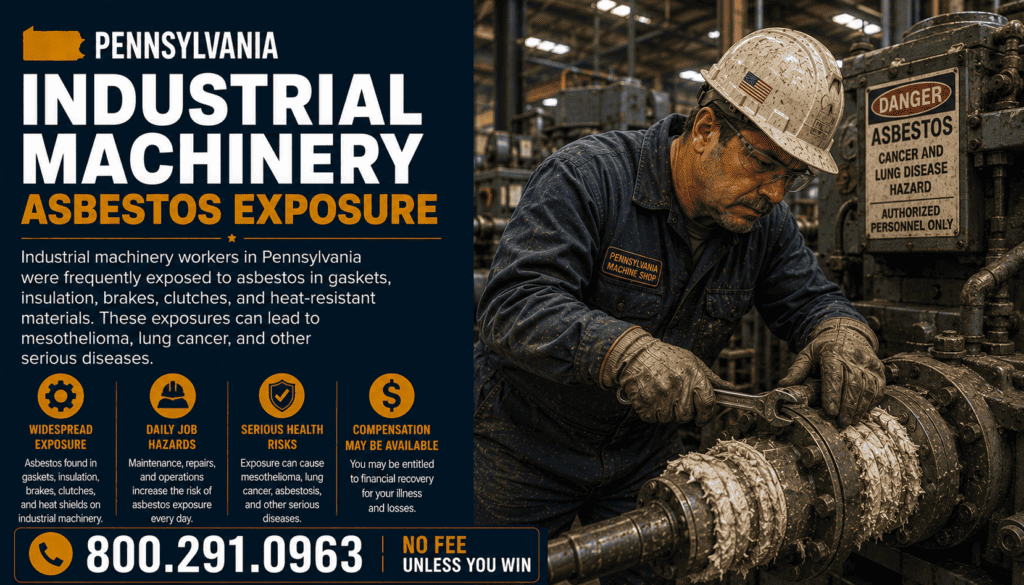
🏭 Pennsylvania Industrial Machinery Asbestos Exposure
Pennsylvania industrial machinery asbestos exposure occurred across factories, steel mills, power plants, foundries, refineries, chemical plants, manufacturing facilities, and processing centers throughout the state.
For much of the twentieth century, industrial machinery contained asbestos because the mineral resisted heat, fire, friction, pressure, and chemical damage. Manufacturers incorporated asbestos into gaskets, seals, packing, insulation, brake linings, clutch components, electrical panels, heat shields, refractory materials, and numerous replacement parts used on heavy equipment.
Workers were often exposed while machinery operated, vibrated, overheated, broke down, or required routine maintenance. Repairing, rebuilding, or replacing worn components frequently disturbed asbestos-containing materials and released microscopic fibers into the surrounding air. These fibers could remain airborne for hours before settling on machinery, workbenches, floors, tools, and workers’ clothing.
Machinists, millwrights, maintenance mechanics, electricians, pipefitters, welders, laborers, machine operators, and cleanup crews may have inhaled asbestos dust repeatedly over many years without knowing the serious health risks.
Individuals diagnosed with mesothelioma or another asbestos-related disease can learn more about their legal rights by visiting our guide to Pennsylvania Asbestos Exposure Lawsuits. Workers can also explore additional occupation-specific resources in our Pennsylvania Asbestos Exposure Articles library.
⚙️ Why Industrial Machinery Used Asbestos in Pennsylvania
Industrial equipment operated under some of the harshest conditions found in manufacturing and heavy industry. Machinery generated extreme heat, constant friction, vibration, pressure, and exposure to chemicals. Engineers needed materials that could withstand these demanding environments while protecting both equipment and workers.
Asbestos became the preferred material because it:
- 🏭 Withstood extremely high temperatures
- ⚙️ Reduced friction between moving parts
- 🔥 Resisted fire and combustion
- 🧱 Insulated machinery and piping
- 🛢️ Resisted many industrial chemicals
- 🧰 Increased equipment durability
- 💰 Reduced maintenance and replacement costs
These characteristics made asbestos a standard component in thousands of industrial machines used throughout Pennsylvania.
Many of these same products were also found throughout factories, mills, and processing facilities discussed in our Pennsylvania Industrial Asbestos Exposure guide.
🧱 Common Asbestos Components in Industrial Machinery
Industrial machinery often contained multiple asbestos-containing components. Workers could be exposed whenever these materials deteriorated or were disturbed during inspections, maintenance, repairs, or equipment overhauls.
⚙️ Gaskets, Packing and Seals
Asbestos gaskets and packing materials created heat-resistant seals around pumps, valves, compressors, turbines, boilers, steam systems, and industrial piping.
Maintenance workers frequently removed old gaskets by scraping, grinding, sanding, or wire-brushing hardened material from metal surfaces before installing replacements. These activities often released concentrated asbestos dust directly into the breathing zone.
Old packing material surrounding pumps and valves also became brittle after years of heat and pressure. Removing deteriorated packing frequently generated airborne fibers.
Workers can learn more about these products in our guide to Pennsylvania Industrial Asbestos Products.
🔥 Insulation and Heat Shields
Industrial machinery commonly required insulation to protect equipment and conserve heat.
Asbestos insulation surrounded:
- Boilers
- Furnaces
- Ovens
- Steam piping
- Turbines
- Compressors
- Heat exchangers
- Industrial engines
- Pumps
- Dryers
Years of vibration and thermal expansion caused insulation to crack, crumble, and separate from machinery. Maintenance work often disturbed this aging insulation, releasing asbestos fibers into enclosed work areas.
Additional information is available in our guide to Pennsylvania Asbestos Insulation Products.
🏭 Brakes, Clutches and Friction Materials
Heavy industrial machinery relied on asbestos-containing friction products to control movement and stop equipment safely.
These components were commonly found in:
- Cranes
- Conveyors
- Rolling mills
- Industrial presses
- Hoists
- Elevators
- Forklifts
- Material handling equipment
- Production machinery
- Heavy manufacturing equipment
Normal wear gradually released asbestos dust inside machinery housings and surrounding work areas. Grinding, replacing, or cleaning brake and clutch components significantly increased exposure.
Similar exposure hazards existed with Pennsylvania Automotive Asbestos Products and Pennsylvania Automotive Brake Equipment Asbestos Exposure.
🧰 Refractory Materials
Industrial furnaces and other high-temperature equipment frequently used asbestos-containing refractory products.
These materials lined:
- Furnaces
- Kilns
- Boilers
- Heat-treatment ovens
- Steelmaking equipment
- Foundry equipment
- Ladles
- High-temperature processing units
Repeated heating and cooling eventually caused refractory materials to crack and crumble. Removing worn linings often generated large amounts of airborne asbestos dust.
Many facilities containing this equipment are also included among documented Pennsylvania Asbestos Exposure Sites.
⚡ Electrical Components
Many industrial electrical systems incorporated asbestos because of its insulating and fire-resistant properties.
Common asbestos-containing electrical products included:
- Switchgear
- Electrical panels
- Motor insulation
- Arc shields
- Control panels
- Wiring insulation
- Electrical boards
- Fire barriers
- Heat-resistant electrical cloth
Electricians servicing older machinery could unknowingly disturb these materials while replacing motors, troubleshooting electrical failures, or upgrading equipment.
Additional information can be found in our guide to Pennsylvania Electricians Asbestos Exposure.
🛠️ How Industrial Machinery Asbestos Exposure Occurred
Industrial machinery asbestos exposure rarely resulted from one isolated incident. Instead, workers were repeatedly exposed during daily operations throughout their careers.
Common exposure activities included:
- Servicing industrial machinery
- Replacing worn gaskets
- Removing valve packing
- Repairing pumps and compressors
- Rebuilding turbines
- Servicing boilers
- Grinding brake components
- Replacing clutch materials
- Removing insulation
- Opening machinery housings
- Repairing electrical systems
- Emergency breakdown repairs
- Cleaning equipment
- Sweeping production floors
- Removing machinery during demolition
Many industrial buildings had limited ventilation. Asbestos fibers released during repairs could remain suspended in the air before settling throughout the facility. Later activities such as sweeping or using compressed air often reintroduced settled fibers into the breathing zone.
Workers performing boiler repairs or steam system maintenance often experienced similar exposure risks discussed in our Pennsylvania Boiler Equipment Asbestos Exposure guide.
👷 Pennsylvania Jobs With High Machinery Exposure Risk
Workers from many different trades encountered asbestos-containing industrial machinery throughout their careers. Even employees who never handled asbestos directly could inhale airborne fibers released during nearby maintenance, repairs, or equipment failures.
🏭 Machine Operators
Machine operators worked beside industrial equipment during entire shifts. They monitored production lines, presses, rolling mills, conveyors, and manufacturing machinery that frequently contained asbestos insulation, gaskets, seals, and friction materials.
Although operators often did not perform repairs themselves, they could inhale asbestos fibers released from deteriorating equipment or nearby maintenance work. Years of working around aging machinery increased the likelihood of repeated occupational exposure.
🔧 Maintenance Mechanics
Maintenance mechanics routinely repaired pumps, compressors, boilers, conveyors, presses, turbines, engines, and other heavy equipment.
Their work commonly included:
- Removing worn gaskets
- Replacing valve packing
- Repairing pumps and compressors
- Installing new seals
- Grinding replacement parts
- Removing damaged insulation
- Cleaning machinery before repairs
Because these tasks directly disturbed asbestos-containing materials, maintenance mechanics were among the occupations at greatest risk for asbestos exposure.
⚙️ Millwrights
Millwrights installed, aligned, dismantled, repaired, and rebuilt heavy industrial machinery used throughout Pennsylvania factories, steel mills, manufacturing facilities, chemical plants, refineries, and power stations.
Machine tear-downs frequently exposed millwrights to asbestos insulation, gaskets, packing materials, brake components, and refractory products.
Many millwrights also worked in facilities discussed throughout our Pennsylvania Manufacturing Asbestos Exposure guide.
⚡ Industrial Electricians
Industrial electricians serviced motors, generators, electrical panels, switchgear, control systems, transformers, and production equipment.
Many older electrical systems contained asbestos because of its excellent insulating and fire-resistant properties. Electricians often worked near boilers, pumps, turbines, compressors, and insulated steam piping where asbestos materials had deteriorated over time.
Workers can learn more by visiting Pennsylvania Electricians Asbestos Exposure.
🔩 Pipefitters and Steamfitters
Pipefitters installed, repaired, and maintained industrial piping connected to pumps, boilers, compressors, turbines, heat exchangers, and steam systems.
Common asbestos exposure occurred while replacing:
- Pipe insulation
- Flange gaskets
- Valve packing
- Mechanical seals
- Boiler components
- Steam line insulation
Additional information is available in our guide to Pennsylvania Pipefitters Mesothelioma.
🧰 Laborers and Cleanup Crews
Industrial laborers frequently swept contaminated floors, removed insulation debris, cleaned machinery, transported damaged equipment, and assisted skilled tradespeople during repairs.
Although they often did not remove asbestos themselves, cleanup crews commonly inhaled airborne fibers generated by maintenance activities throughout the facility.
🏗️ Construction and Demolition Workers
Construction crews installed heavy industrial equipment while demolition workers removed aging machinery from older manufacturing facilities.
Both occupations routinely disturbed asbestos insulation, electrical systems, machine components, roofing materials, flooring, fireproofing, and structural products.
Additional information is available in our guides to Pennsylvania Construction Asbestos Exposure and Pennsylvania Construction Workers Mesothelioma.
🏗️ Pennsylvania Facilities Linked to Industrial Machinery Asbestos Exposure
Industrial machinery containing asbestos was used throughout Pennsylvania’s manufacturing economy for much of the twentieth century. Workers across numerous industries encountered asbestos-containing equipment during production, maintenance, repairs, and facility renovations.
🏭 Steel Mills and Foundries
Pennsylvania’s steel industry relied on furnaces, rolling mills, boilers, cranes, turbines, compressors, pumps, and material handling systems operating under extreme temperatures.
Many of these machines incorporated asbestos insulation, refractory products, gaskets, packing, and friction materials.
Former employees of Bethlehem Steel Corporation and similar industrial employers may have encountered asbestos while working around heavy machinery.
🏭 Manufacturing and Assembly Plants
Manufacturing facilities used presses, conveyors, packaging equipment, production lines, ovens, drying systems, compressors, pumps, and heavy industrial machinery containing asbestos components.
Workers can also review our pages covering Pennsylvania Manufacturing Asbestos Exposure and Pennsylvania Factory Workers Asbestos Exposure.
⚗️ Chemical and Petroleum Facilities
Chemical plants and petroleum refineries depended upon pumps, valves, compressors, pressure vessels, tanks, boilers, heat exchangers, and extensive piping systems.
Routine maintenance often disturbed asbestos-containing gaskets, seals, insulation, and valve packing.
⚡ Power Generation Facilities
Pennsylvania power plants contained turbines, generators, boilers, pumps, compressors, and steam systems insulated with asbestos products.
Maintenance personnel frequently encountered deteriorating insulation while servicing equipment.
Additional information is available in Pennsylvania Power Generation Equipment Asbestos Exposure, Pennsylvania Power Plant Asbestos Exposure, and Pennsylvania Power Plant Workers Mesothelioma.
📄 Paper Mills and Processing Plants
Paper mills, textile facilities, food processing plants, and other industrial operations relied on boilers, heated rollers, dryers, conveyors, pumps, and manufacturing machinery that frequently incorporated asbestos-containing products.
Many of these facilities continued using asbestos-containing machinery for decades, increasing long-term exposure risks for multiple generations of workers.
🏠 Secondary Exposure Risks for Families
Workers frequently carried asbestos fibers home on:
- Work clothing
- Jackets
- Boots
- Gloves
- Hair
- Skin
- Tools
- Lunch containers
- Vehicle interiors
Family members could unknowingly inhale these microscopic fibers while washing contaminated clothing, cleaning work boots, or riding in contaminated vehicles.
This type of exposure is commonly called secondary, household, or take-home asbestos exposure. Medical studies have shown that spouses and children of industrial workers have developed mesothelioma and other asbestos-related diseases despite never working around asbestos themselves.
🩺 Health Risks From Industrial Machinery Asbestos Exposure
Microscopic asbestos fibers can remain lodged inside the lungs and surrounding tissues for decades after exposure. Over time they may cause chronic inflammation, scarring, genetic damage, and serious disease.
🧬 Mesothelioma
Mesothelioma is a rare but aggressive cancer affecting the lining surrounding the lungs, abdomen, heart, or testes. Occupational asbestos exposure remains its primary known cause.
🫁 Asbestos-Related Lung Cancer
Industrial asbestos exposure significantly increases lung cancer risk, particularly among workers who also smoked. However, nonsmokers may also develop asbestos-related lung cancer after prolonged occupational exposure.
Workers diagnosed with lung cancer may qualify for compensation through Pennsylvania Asbestos Lung Cancer Lawsuits.
🫀 Asbestosis
Asbestosis is a progressive scarring disease of the lungs that may cause:
- Persistent coughing
- Shortness of breath
- Chest tightness
- Fatigue
- Reduced lung capacity
📉 Pleural Disease
Industrial asbestos exposure may also lead to:
- Pleural plaques
- Pleural thickening
- Pleural effusions
- Diffuse pleural fibrosis
Symptoms frequently do not appear until 20 to 50 years after asbestos exposure occurred.
⚖️ Legal Responsibility for Industrial Machinery Asbestos Exposure
For decades, many manufacturers, suppliers, distributors, contractors, and facility owners knew or should have known that asbestos could cause serious disease. Despite growing medical evidence, asbestos continued to be used in industrial machinery because it was inexpensive, durable, and highly resistant to heat and friction.
Today, workers diagnosed with mesothelioma, asbestos-related lung cancer, asbestosis, or other asbestos diseases may have legal claims against one or multiple responsible companies.
Potentially liable parties may include:
- Machinery manufacturers
- Pump manufacturers
- Compressor manufacturers
- Boiler manufacturers
- Gasket manufacturers
- Packing suppliers
- Valve manufacturers
- Seal manufacturers
- Brake and clutch manufacturers
- Electrical equipment manufacturers
- Insulation manufacturers
- Facility owners
- Maintenance contractors
- Product distributors
Because industrial workers often spent decades around many different machines, a single case may involve numerous asbestos-containing products and multiple manufacturers.
Evidence commonly used to support industrial machinery exposure claims includes:
- Employment records
- Union records
- Social Security work history
- Maintenance records
- Equipment manuals
- Purchase orders
- Facility blueprints
- Product catalogs
- Coworker testimony
- Historical job site documentation
Workers who were employed at facilities identified on our Pennsylvania Asbestos Exposure Sites page may have additional evidence documenting asbestos-containing equipment used at those locations.
🏦 Asbestos Trust Funds for Industrial Machinery Workers
Many manufacturers of asbestos-containing industrial equipment later filed for bankruptcy protection after thousands of asbestos lawsuits were filed against them.
As part of the bankruptcy process, many companies established asbestos bankruptcy trust funds to compensate future victims diagnosed with asbestos-related diseases.
Industrial machinery workers may qualify for one or several trust fund claims depending upon:
- The machinery they serviced
- Products they worked around
- The manufacturers involved
- Their employment history
- Their medical diagnosis
- Available exposure documentation
Common documentation may include:
- Medical records
- Pathology reports
- Employment history
- Union records
- Exposure dates
- Facility information
- Product identification
- Witness statements
Additional information is available in our guide to Pennsylvania Asbestos Trust Fund Claims.
💰 Compensation Options for Pennsylvania Machinery Workers
Workers diagnosed with mesothelioma or another asbestos-related disease may qualify for compensation through one or more legal avenues depending upon their exposure history.
Possible compensation options include:
- ⚖️ Mesothelioma lawsuits
- 🏦 Asbestos trust fund claims
- 👨👩👧 Wrongful death lawsuits
- 📄 Product liability claims
- 🤝 Settlement agreements
Financial compensation may help cover:
- Medical treatment
- Cancer specialists
- Surgery
- Chemotherapy
- Immunotherapy
- Travel expenses
- Lost wages
- Reduced earning capacity
- Home healthcare
- Pain and suffering
- Funeral expenses
- Financial support for surviving family members
Families who have lost a loved one to mesothelioma may also qualify for compensation through Pennsylvania Wrongful Death Mesothelioma Lawsuits.
⏳ Pennsylvania Statute of Limitations
Pennsylvania law limits the amount of time available to file asbestos-related claims.
Because mesothelioma and other asbestos diseases usually develop decades after exposure, the filing deadline generally begins when the disease is diagnosed rather than when the asbestos exposure originally occurred.
Waiting too long may permanently prevent a worker or surviving family from recovering compensation.
More information is available in our guide to Pennsylvania Mesothelioma Statute of Limitations.
⚖️ How a Pennsylvania Asbestos Lawyer Can Help
Industrial machinery cases often involve multiple employers, job sites, machinery manufacturers, equipment suppliers, and asbestos-containing products spanning several decades.
An experienced asbestos attorney can help:
- Identify exposure sources
- Research historical machinery
- Locate asbestos-containing products
- Interview former coworkers
- Identify responsible manufacturers
- Determine trust fund eligibility
- Prepare lawsuits
- File trust fund claims
- Gather supporting documentation
- Meet legal filing deadlines
- Pursue the maximum available compensation
Most mesothelioma attorneys work on a contingency-fee basis, meaning there are generally no upfront legal fees unless compensation is recovered.
❓ Pennsylvania Industrial Machinery Asbestos Exposure FAQs
Did all industrial machinery contain asbestos?
No. However, a significant amount of industrial machinery manufactured before the 1980s contained asbestos insulation, gaskets, valve packing, seals, brakes, clutches, refractory materials, or electrical insulation.
Which machinery parts most commonly contained asbestos?
Common asbestos-containing components included gaskets, valve packing, insulation, heat shields, brake linings, clutch facings, refractory products, electrical insulation, and mechanical seals.
Can machine operators qualify even if they never repaired equipment?
Yes. Machine operators often inhaled asbestos fibers released during routine maintenance, equipment failures, or normal deterioration of nearby machinery.
Can exposure at multiple facilities increase compensation opportunities?
Yes. Workers employed at multiple facilities may have been exposed to products manufactured by numerous companies, potentially increasing the number of available legal claims.
Are retired machinery workers still eligible to file claims?
Yes. Eligibility generally depends upon the worker’s diagnosis, exposure history, and Pennsylvania filing deadlines—not whether the person is currently employed.
Can family members become sick from contaminated work clothing?
Yes. Household or take-home asbestos exposure has caused mesothelioma and other asbestos-related diseases among spouses, children, and other family members who never worked around asbestos themselves.
Can surviving family members file claims after a worker dies?
Yes. Eligible family members may pursue compensation through wrongful death claims if the applicable legal deadlines have not expired.
Do all asbestos lawsuits go to trial?
No. Many asbestos claims are resolved through negotiated settlements or asbestos trust fund claims without a courtroom trial.
📞 Free Case Evaluation
If you or a loved one worked around industrial machinery in Pennsylvania and later developed mesothelioma, asbestos-related lung cancer, or another asbestos-related disease, compensation may still be available.
✔️ Free, confidential case evaluation
✔️ Nationwide asbestos legal assistance
✔️ No upfront legal fees
✔️ Experienced mesothelioma legal team
📞 Call 800-291-0963 today to discuss your legal options.
Or complete our free online case evaluation below.