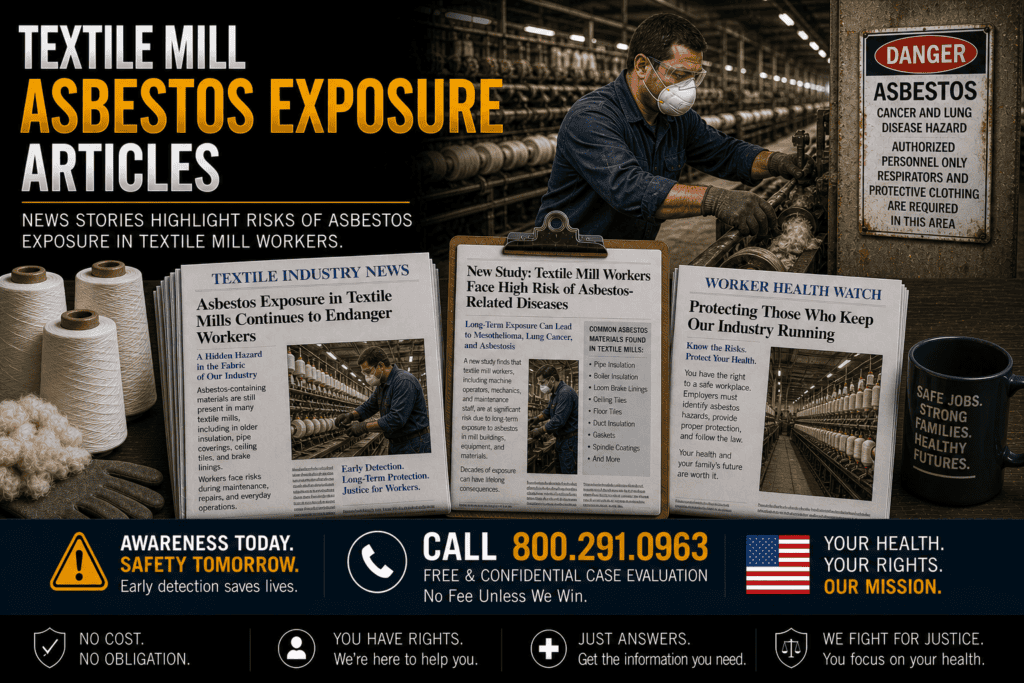
Textile Mill Asbestos Exposure Articles
Textile Mill Asbestos Exposure Articles brings together information about historical asbestos exposure in asbestos textile spinning rooms, carding areas and related work areas. Different facilities used different materials, so exposure must be evaluated by site, task and period rather than assumed from the industry name.
This guide connects specific workplace operations with articles about equipment, workers, medical risks and possible legal options. It is intended to help people diagnosed with mesothelioma or asbestos-related lung cancer identify useful questions and preserve relevant records.
🏭 Textile Mills And Asbestos-Product Production
Industrial production was not a single exposure setting. A worker assigned to asbestos textile spinning rooms could encounter very different materials from someone stationed in cutting and sewing departments. Historical building plans, manufacturing formulas, safety data and contractor records can show whether asbestos-containing products were handled or disturbed. The broader Textile Mill Asbestos Exposure page gives context for the industry, while the individual plant records remain decisive.
The production sequence is important. Raw ingredients arrived in receiving areas, moved through preparation and fabrication, and left through finishing and shipping. Dust from a particular process could reach adjacent workstations, but proximity alone does not establish asbestos exposure. Compare carding areas with weaving floors, especially when maintenance crews opened machinery or removed older insulation. The operations discussed in Asbestos Textile Manufacturing Plants Asbestos Exposure may help identify relevant work orders and dates.
Older facilities often changed equipment and building layouts repeatedly. A plant might have replaced one asbestos yarn and cloth line while continuing to operate older steam systems elsewhere. The age of the building does not establish the composition of every product; procurement documents, specifications and sampling are more reliable. Readers examining the facility type can consult Spinning & Carding Operations Asbestos Exposure for another part of the production history.
An article index is most useful when it separates product manufacturing from exposure to asbestos installed in the building. A production worker may have directly handled an asbestos ingredient; a contractor may instead have disturbed thermal insulation during repairs. Those are different pathways requiring different evidence. The related Textile Mill Maintenance & Repair Workers Asbestos Exposure discussion addresses a neighboring part of the facility, not proof that every employee encountered the same material.
For an accurate chronology, record the plant name, street address, department, employer and approximate years of each assignment. Identify whether the worker was present during construction, ordinary operation, shutdowns or demolition. Facilities with several buildings may have distinct maintenance contractors and material suppliers. The Textile Mechanics & Electricians Asbestos Exposure article can help organize a specific work-area history without substituting assumptions for documentation.
👷 Spinning, Weaving And Maintenance Workers
Job titles do not describe every task. Machine operators generally worked near production equipment, while millwrights, electricians, pipefitters and mechanics entered machinery spaces for inspection and repairs. In asbestos textile spinning rooms, the tasks performed during a breakdown could be more important than routine operation. The occupational discussion in Textile Mill Dust & Airborne Asbestos Exposure should be compared with payroll records, union assignments and supervisor logs.
Maintenance personnel could remove covers, open valves, replace seals or strip thermal coverings from pipes. If the disturbed materials contained asbestos, fibers could be released during scraping, cutting or dry cleanup. The exact product and work method matter; a repaired machine is not automatically an asbestos source. Secondary Asbestos Exposure from Textile Mills describes a related equipment or workforce setting that may clarify the relevant duties.
Production employees working beside maintenance crews may have experienced a different potential pathway: dust from nearby disturbance rather than direct handling. A useful account records the distance from the task, whether the area was enclosed, the duration of work and whether ventilation was operating. Textile Asbestos Exposure Mesothelioma Lawsuit provides additional context for evaluating those work-area differences.
Contractors and temporary workers are often missing from a company’s ordinary personnel list. Shutdown rosters, gate passes, purchase orders and contractor invoices may establish who was present when insulation, flooring or machine parts were replaced. Family members reconstructing an older work history can compare these records with Textile Asbestos Trust Funds and preserve the original dates rather than reconstructing a more certain story than the evidence supports.
Cleaners, warehouse staff and supervisors may have been near contaminated debris, but the exposure question depends on where they worked and whether asbestos-containing material was actually disturbed. The tasks, work location and duration should be assessed individually. A worker who moved between departments may find Textile Asbestos Exposure Wrongful Death Lawsuit helpful for identifying which operations deserve closer examination.
🧵 Asbestos Textiles, Equipment And Utilities
Potential asbestos-containing products in this setting included certain historical forms of asbestos yarn and cloth, carding equipment, and associated thermal or sealing components. These materials were not necessarily present at every plant, and many later replacements used asbestos-free alternatives. Purchase records, original labels and analytical reports are the best way to establish product identity. Textile Plant Boiler Rooms & Powerhouses Asbestos Exposure discusses a relevant machinery or materials category.
Industrial utilities were sometimes overlooked because they operated outside the main production room. Boilers, steam distribution, pumps and hot-water systems could use historical insulation, gaskets and packing. Repair work could disturb those materials even when the finished product contained no asbestos. The Textile Mill Mesothelioma Lawsuits & Compensation article helps distinguish utility-system work from direct manufacturing exposure.
When investigating loom machinery, the most useful evidence is a dated maintenance record tied to a model, equipment tag or specific installation. Equipment photographs can identify a location, but cannot by themselves prove the composition of an internal gasket or insulating layer. A complementary discussion appears in Textile Mill Dust & Secondary Asbestos Exposure; it should be read alongside plant specifications and purchase orders.
Building materials present a separate question from machinery. Older ceilings, fireproofing, flooring, wall panels and pipe coverings may have contained asbestos, depending on the product and installation. Routine use of a room generally differs from cutting, drilling, demolition or removal of an asbestos-containing material. Textile Mill Workers & Occupations Asbestos Exposure can help place these building-system tasks within the larger workplace history.
The distinction between original installation and replacement parts is particularly important. A worker may remember servicing the same equipment for years even though gaskets, packing and insulation were changed several times. Record the supplier, part number, dates and any surviving samples. The related Textile Mill Facilities, Equipment & Operations Asbestos Exposure article offers another starting point for evaluating materials without treating appearance or age as conclusive.
🌫️ Fiber Dust And Secondary Exposure
Asbestos exposure requires a plausible route by which fibers from an asbestos-containing material became airborne and reached a person. Direct handling, cutting, grinding, removal, repairs and contaminated cleanup can present different opportunities for exposure. Dust generated by ordinary carding areas activity may contain many substances; visible dust alone cannot identify asbestos. The Aircraft Manufacturing Plants discussion covers a related work practice that should be matched to the worker’s own duties.
Airflow and timing affect the reconstruction of a historical event. A mechanic repairing fabric cutting tables during a scheduled shutdown may have worked near other trades, but the relevant questions include whether the part contained asbestos, how it was disturbed and who was present. Work permits, industrial-hygiene surveys and witness accounts may provide details. Construction Material Manufacturing Plants supplies additional context for the particular process or area.
Housekeeping practices also changed over time. Dry sweeping and compressed-air cleaning can resuspend settled dust, while properly selected wet methods and HEPA-filtered equipment are designed to reduce airborne contamination. The presence of a broom or air hose does not prove asbestos was in the debris. The related Plastic Manufacturing Plants Asbestos Exposure topic can help identify the cleanup records to seek.
Workers could carry contaminated dust on clothing or equipment if asbestos-containing materials had been disturbed. A secondary-exposure history should document the primary worker’s tasks, laundering arrangements and time period rather than assuming all industrial clothing carried asbestos. Manufacturing Plants Asbestos Exposure addresses another aspect of the site or workforce, while household and employment records can help clarify the actual pathway.
For current work, follow applicable asbestos identification and control requirements rather than attempting to inspect or disturb suspect materials yourself. OSHA rules depend on the type of work, and qualified professionals should evaluate sampling, engineering controls, respiratory protection and regulated work areas. For historical claims, preserve the original evidence and clearly distinguish personal recollection from later inference.
🩺 Mesothelioma After Occupational Exposure
Mesothelioma is a cancer associated with asbestos exposure that can affect the lining of the lungs or abdomen. It often appears many years after the relevant exposure. A diagnosis does not by itself identify which workplace product was involved; a specialist can evaluate the medical findings while employment and product records are reviewed separately.
Workers with unexplained pleural fluid, persistent chest discomfort, shortness of breath or concerning imaging should discuss symptoms with a qualified clinician. Diagnosis may require imaging, pathology and specialist review. Keep pathology reports, imaging interpretations and treatment summaries together, since they may be requested for benefits or legal evaluations.
Exposure histories should include previous jobs, military service, home renovation and any secondary contact with contaminated work clothing. A thorough history is more useful than assuming the most recent employer was responsible. Families can help assemble a timeline when the patient cannot recall every work assignment.
A specialist evaluating a former worker from asbestos textile spinning rooms should receive a complete occupational history, not just the most recent employer. Mesothelioma can arise after a long latency period, so older assignments may matter even when the person has been retired for decades.
Symptoms such as persistent shortness of breath, chest pain or fluid around the lung warrant medical attention, but symptoms alone cannot diagnose mesothelioma. Imaging and pathology interpreted by qualified clinicians are central to diagnosis.
🫁 Asbestos-Related Lung Cancer
Asbestos exposure can also contribute to lung cancer risk, and smoking can further increase that risk. Lung cancer has multiple causes; the diagnosis alone cannot establish occupational causation. Medical professionals consider imaging, pathology, smoking history, work history and other relevant factors.
Someone who worked around suspect materials should provide their care team with the job dates, work tasks and any known asbestos products. A person should not delay medical evaluation while trying to reconstruct decades-old employment records.
For legal or benefit review, preserve the precise diagnosis and treatment records. An asbestos-related lung cancer claim can have different evidentiary and eligibility requirements from a mesothelioma claim.
A worker from weaving floors may have encountered several different airborne hazards during a career. The presence of those hazards does not establish which factor caused a later cancer; medical assessment and documented asbestos exposure history are both important.
Smoking and asbestos exposure can interact to increase lung cancer risk. Medical care should not be delayed while trying to identify historical manufacturers or employment records.
📋 Work History And Exposure Evidence
Start with a chronological work history: employer, site address, department, job title, dates, shift and the equipment or building area involved. Include contractor names and coworkers who can describe the same tasks. A dated description of a specific repair or demolition activity is more informative than a general statement that the site was dusty.
Useful documents can include union records, Social Security employment histories, payroll records, purchase orders, product manuals, safety surveys, asbestos inspection reports, work permits, maintenance tickets and witness statements. Availability varies by site and era. If a product label or part number is remembered, preserve the exact wording rather than replacing it with a guess.
Distinguish firsthand recollections from conclusions drawn later. An employee may remember stripping a white covering but not know its composition. That uncertainty should be recorded openly and evaluated against reliable material evidence.
For a deceased worker, relatives may be able to obtain job histories, service records and medical records through appropriate procedures. Keep copies of documents and note where each record originated.
For this topic, ask whether plant blueprints identify asbestos textile spinning rooms, whether maintenance tickets describe work on loom machinery, and whether procurement files identify a supplier. A chronological table of employers, departments, shifts and coworkers often makes inconsistencies easier to resolve.
Preserve original photographs, pay stubs, union cards, safety notices and pathology reports. If witnesses disagree about dates or products, record each account separately and do not rewrite recollections to force agreement.
Historical asbestos surveys and industrial-hygiene samples can be helpful, but sampling from a later renovation may not establish what materials were present decades earlier. Look for a clear chain between the document, date, location and alleged exposure event.
⚖️ Compensation And Legal Options
People diagnosed with mesothelioma or asbestos-related lung cancer may wish to ask a qualified asbestos attorney about lawsuits, bankruptcy trust claims and other possible compensation. Eligibility depends on the diagnosis, evidence of exposure, responsible entities, applicable law and filing deadlines. A particular job title does not guarantee a claim.
Some asbestos manufacturers established bankruptcy trusts with their own proof requirements and payment procedures. A trust claim is not automatically available merely because a worker was employed at a plant or demolition site. The product, manufacturer, exposure history and trust criteria must align.
Deadlines vary by jurisdiction and claim type, and the relevant event for calculating a deadline can differ between personal injury and wrongful death. Prompt legal advice matters because waiting to collect every document may create deadline risks.
Veterans may have separate VA benefit options if service-related asbestos exposure is supported. Civilian employment and military exposure should be documented distinctly. An attorney or accredited VA representative can explain how the relevant processes interact.
Lawsuits and asbestos bankruptcy trust claims use different eligibility rules. A claim may require a documented disease, evidence connecting the worker to a particular asbestos product or company, and compliance with the applicable deadlines.
A person diagnosed with mesothelioma or asbestos-related lung cancer can ask a qualified attorney about potentially responsible manufacturers, premises claims, bankruptcy trusts and the effect of any prior claims. No particular payment or outcome is guaranteed.
Wrongful-death claims may be available to eligible survivors under applicable state law. Filing periods and who may bring the claim vary by jurisdiction. Prompt advice is important because a deadline may run before all historical documents have been found.
❓ Frequently Asked Questions
Did Every Worker In Asbestos Textile Spinning Rooms Encounter Asbestos?
No. Material composition, plant era, task and location vary. A job title or industry label is not enough to establish exposure.
Could Someone Near Asbestos Yarn And Cloth Have Been Exposed?
Possibly, if asbestos-containing material was disturbed and fibers reached that area. Product identity, timing, distance and work practices matter.
Does Ordinary Visible Plant Dust Prove Asbestos Exposure?
No. Dust may contain many materials. Reliable product records or analytical testing are needed to identify asbestos.
What If The Plant Closed Decades Ago?
Union records, Social Security earnings histories, old equipment manuals, contractors, photographs and former coworkers may help reconstruct the history.
Can A Family Seek Legal Help After A Worker Has Died?
Depending on the state and circumstances, eligible survivors may have options. A qualified attorney can explain deadlines and required proof.
🧭 Summary
Textile Mill Asbestos Exposure Articles connects specific industrial operations, job duties and historical materials with information about mesothelioma, lung cancer and possible compensation. Start with the actual facility, dates and work tasks; identify asbestos-containing products through reliable evidence; and seek timely medical and legal guidance when needed.
📚 Confirmed Sources
These government sources provide general health, occupational and regulatory context; they do not establish the asbestos content of a particular worksite product.
Get The Compensation You Deserve
Find out if you may qualify for asbestos compensation today. Call 800.291.0963. Help is available 24/7/365. 25+ years of experience.
Mesothelioma Help Center is not a law firm or medical provider and does not determine legal or VA eligibility.