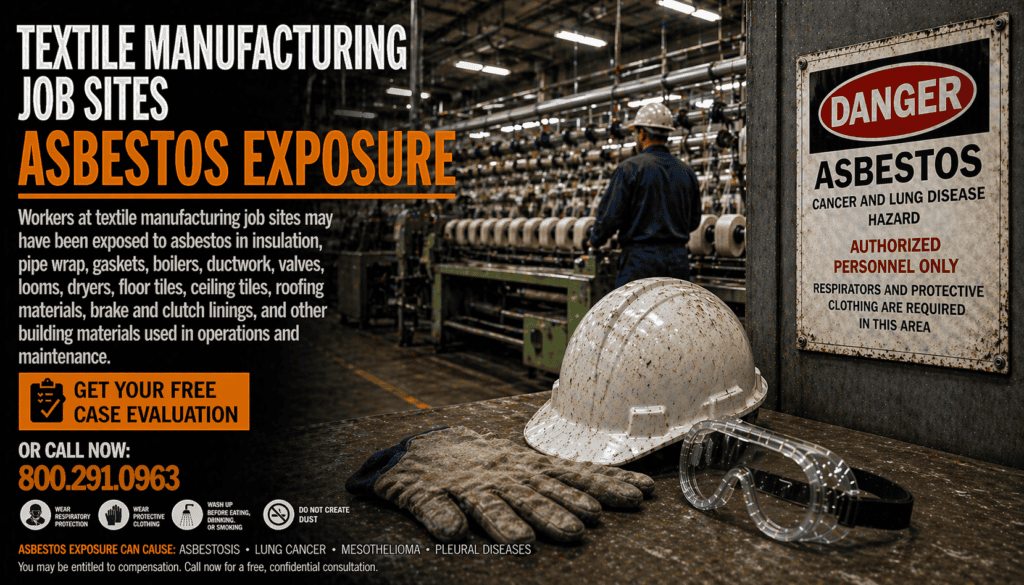
🧵 Textile Mills Asbestos Exposure Lawsuit
Textile mills used asbestos fibers in spinning, weaving, and fabric production for industrial and fire-resistant materials.
Textile mills were among the earliest and most intense sources of occupational asbestos exposure in the United States. For decades, textile manufacturing facilities processed raw asbestos fibers directly into yarns, threads, fabrics, and industrial textiles. Unlike other industries where asbestos was used mainly as insulation, textile mills handled asbestos as a primary raw material, creating constant airborne fiber exposure throughout production floors.
Workers inhaled asbestos fibers during nearly every stage of textile manufacturing—carding, spinning, weaving, cutting, sewing, and finishing. Because asbestos fibers are microscopic and lightweight, they remained suspended in the air for long periods, contaminating entire facilities and exposing workers daily over long careers.
Read more articles about Textile Mill Asbestos Exposure.
🧱 Why Asbestos Was Used in Textile Mills
Asbestos was widely used in textile mills because of its unique physical properties:
-
🔥 Fire resistance for heat-proof and flame-retardant fabrics
-
🧵 Flexibility that allowed fibers to be spun into yarn
-
⚙️ Durability for industrial and mechanical applications
-
🛡️ Chemical resistance in harsh environments
-
💲 Low cost and widespread availability
These properties made asbestos ideal for producing textiles used in factories, ships, power plants, refineries, military equipment, and fire-resistant clothing.
🧪 Common Asbestos-Containing Materials Produced in Textile Mills
Textile mills manufactured or handled asbestos in many forms, including:
🧵 Raw Fiber Processing
-
Loose asbestos fiber bales
-
Carded asbestos fibers
-
Spun asbestos yarns
🧶 Finished Textile Products
-
Asbestos cloth and fabric
-
Asbestos rope and packing
-
Asbestos tape and sleeves
🧱 Industrial & Fire-Resistant Products
-
Insulation blankets
-
Welding curtains
-
Fireproof gloves and garments
Handling these materials released asbestos fibers continuously into the air.
⚠️ How Asbestos Exposure Occurred in Textile Mills
Asbestos exposure occurred during nearly every textile production activity, including:
-
Opening and handling raw asbestos fiber bales
-
Carding and combing fibers
-
Spinning asbestos yarns
-
Weaving asbestos-blended fabrics
-
Cutting and sewing finished products
-
Cleaning machinery and sweeping floors
Because ventilation systems often recirculated air, asbestos fibers spread throughout entire mill buildings.
🧑🏭 Textile Mill Workers Most at Risk
🧵 Carding & Spinning Workers
Handled loose asbestos fibers that became airborne easily.
🧶 Weavers & Loom Operators
Inhaled fibers released as asbestos yarns flexed and broke.
✂️ Cutters & Sewing Operators
Generated fine asbestos dust while trimming and assembling fabrics.
🧹 Janitorial & Support Staff
Re-aerosolized asbestos dust during daily cleaning.
🛠️ Maintenance Workers
Disturbed asbestos dust while repairing textile machinery.
🧬 Health Risks Linked to Textile Mill Asbestos Exposure
Long-term asbestos exposure in textile mills has been linked to some of the highest mesothelioma rates of any industry, including:
🧠 Mesothelioma
A rare and aggressive cancer affecting the lining of the lungs or abdomen, almost exclusively caused by asbestos exposure.
🫁 Asbestosis
A chronic lung disease caused by asbestos scarring, leading to progressive breathing difficulty.
🫁 Lung Cancer
Asbestos exposure significantly increases lung cancer risk, especially with prolonged inhalation.
Because asbestos-related diseases have latency periods of 20–50 years, many textile workers are diagnosed long after leaving the mills.
📜 Employer Responsibilities in Textile Mills
Textile mill operators were required to:
-
Control airborne asbestos fiber levels
-
Warn workers about asbestos hazards
-
Provide protective equipment and training
-
Implement dust control and ventilation systems
Despite this, many mills continued operations with minimal protections, even after the dangers of asbestos were known.
❓ Frequently Asked Questions (FAQs)
1️⃣ Were textile mills more dangerous than other asbestos jobs?
Yes. Textile mills handled raw asbestos fibers daily, creating extreme exposure.
2️⃣ Could workers see asbestos dust?
Often no. Fibers were microscopic and invisible in the air.
3️⃣ Were women exposed in textile mills?
Yes. Many textile workers, including women, were heavily exposed.
4️⃣ Did ventilation systems help?
Often no. Many systems spread asbestos fibers throughout facilities.
5️⃣ Can illness appear decades later?
Yes. Most asbestos-related diseases appear many years after exposure.
⚖️ How a Lawyer Can Help Get Compensation
Textile mill workers exposed to asbestos may have legal options. An experienced asbestos lawyer can help by:
-
Identifying textile mills and job roles linked to exposure
-
Tracing asbestos textile products and manufacturers
-
Filing claims against asbestos textile companies
-
Pursuing compensation for medical costs, lost income, and suffering
-
Assisting families with wrongful death claims
Because textile exposure often involved direct fiber handling, these cases are well-documented and may support strong claims.
📞 Free Case Evaluation – Get Help Today
If you or a loved one worked in a textile mill and later developed mesothelioma or another asbestos-related illness, help is available.
📞 Call Now for a FREE Case Evaluation: 800-291-0963
There is no obligation, and compensation may be available.
📌 Key Takeaways
-
Textile mills processed raw asbestos fibers daily
-
Airborne asbestos contaminated entire facilities
-
Workers faced continuous, long-term exposure
-
Health effects may appear decades later
-
Legal options may be available for exposed workers