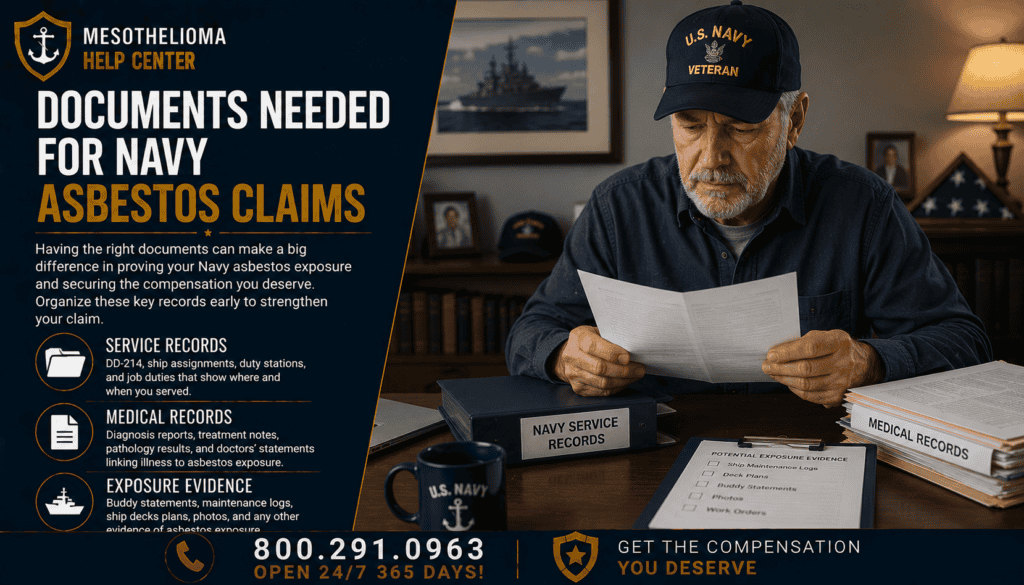
📂 Documents Needed for Navy Asbestos Claims
Navy asbestos claims often involve exposure that occurred decades before a diagnosis. The documents used to investigate a claim can therefore be especially important. Service records may establish where a veteran served and what work was performed, medical records document the diagnosis, and ship, base, equipment, product, or witness evidence may help reconstruct how asbestos exposure occurred.
No single document automatically proves every part of an asbestos claim. The records needed depend on whether the veteran is pursuing VA disability compensation, an asbestos lawsuit, an asbestos trust claim, or another legal option. This guide explains the major evidence categories and connects veterans and families with the appropriate resources throughout our U.S. Navy Asbestos Exposure silo.
⚓ Navy Asbestos Claim Documents Overview
A well-supported Navy asbestos claim usually needs evidence addressing several separate questions: Was the claimant a Navy veteran? Where and when did the veteran serve? What duties were performed? What asbestos-containing materials or products may have been encountered? How could fibers have been released? What disease was diagnosed? And, depending on the type of claim, what evidence connects the exposure to the disease or to a legally responsible company?
The Department of Veterans Affairs states that an asbestos disability claim requires medical records showing the health condition, service records listing the veteran’s job or specialty, and a doctor’s statement connecting military asbestos exposure with the health condition. VA also states that the evidence must show asbestos exposure during military service and may include the veteran’s military occupation or where the veteran was stationed.
Civil lawsuits and bankruptcy trust claims operate under different rules. They may require more detailed evidence identifying products, manufacturers, suppliers, job sites, ships, equipment, witnesses, or other facts connecting exposure to a legally responsible company or qualifying trust.
The Navy Asbestos Legal Options hub explains the different claim paths. The Navy Records & Documentation for Asbestos Exposure page focuses specifically on reconstructing Navy service and exposure history.
🎖️ Service and Personnel Records
Service records establish the foundation of a Navy exposure timeline. The National Archives states that most veterans and next of kin can request copies of the DD Form 214 and the Official Military Personnel File, along with certain medical and health records. These records can help establish dates of service, ratings, assignments, training, and other information relevant to an exposure investigation.
Useful service records may include:
- DD Form 214: documents separation and provides important service information.
- Official Military Personnel File: may contain assignments, ratings, promotions, training, transfers, and other personnel history.
- Duty-station and assignment information: helps establish when a veteran was assigned to a ship, base, squadron, or other command.
- Training records: may help identify technical schools and occupational specialties.
- Performance or personnel records: may provide additional context about duties and work responsibilities.
A rating or rank alone does not prove asbestos exposure, but it can help narrow the likely work performed. Veterans can use the Navy Occupations Asbestos Exposure hub and U.S. Navy Ranks Asbestos Exposure hub to organize this part of the service history.
🚢 Ship, Base, and Assignment Records
Once service records identify where a veteran served, Navy operational records may help reconstruct the environment. Naval History and Heritage Command explains that a commissioned Navy ship’s deck log is its official chronological record. Deck logs can establish certain ship movements and events, but they have important limitations: they generally do not document individual sailors’ routine daily work assignments, and during shipyard overhaul they may record the ship’s presence at the yard without identifying the work performed or materials used.
That distinction is important for asbestos research. A deck log may help place a ship at a shipyard during a particular period, but additional evidence may still be needed to show what asbestos-related maintenance occurred and whether the veteran worked near it.
Other useful Navy records can include:
- Command Operations Reports: annual command histories that summarize operations and activities.
- Deck logs: official chronological records for commissioned ships.
- Muster rolls or crew records: potentially useful for establishing personnel presence depending on the period and record set.
- Shipyard and repair records: useful when investigating overhaul, maintenance, or modernization periods.
- Base or facility records: relevant when exposure may have occurred in shore facilities, shops, barracks, utilities, or maintenance buildings.
NHHC states that unclassified deck logs from 1941 through 1983 are held by the National Archives, while NHHC currently holds unclassified deck logs from 1984 to the present. Public requests for deck logs held by NHHC are submitted under FOIA, and NHHC recommends specifying the ship and dates as precisely as possible.
Our Navy Ships Asbestos Exposure hub, Navy Bases Asbestos Exposure hub, Navy Ship Exposure Evidence Guide, and Requesting Shipyard & Base Work Records page can help identify which records are most relevant.
🔧 Work, Equipment, and Product Evidence
Service aboard a Navy ship or at a Navy base may establish where a veteran worked, but a civil asbestos claim often requires a more detailed investigation into how exposure occurred. Evidence may need to identify the machinery, insulation, gasket, packing, valve, pump, boiler, electrical component, friction product, or other material that was handled or disturbed.
Useful evidence can include:
- Technical manuals: may identify equipment, maintenance procedures, component specifications, and replacement parts.
- Equipment specifications and drawings: can help identify systems installed aboard a ship or at a facility.
- Procurement and purchase records: may help connect manufacturers or suppliers to particular products.
- Maintenance records: may document repair, replacement, overhaul, or modernization work.
- Manufacturer literature: historical catalogs, manuals, specifications, or product documentation may help establish material composition.
- Shipyard records: can help investigate work performed during overhaul or repair periods.
The How to Obtain Navy Bureau of Ships Technical Manuals page addresses an especially useful record category. Veterans can also use the Navy Equipment Asbestos Exposure hub to connect remembered machinery or systems to more focused research.
Product identification should be evidence-based. The fact that asbestos was historically used in a category of equipment does not establish that every manufacturer, model, replacement part, or service period used asbestos.
🩺 Medical and Diagnostic Records
Medical evidence establishes the disease being claimed. Depending on the diagnosis and claim, useful records can include pathology reports, biopsy results, imaging, pulmonary testing, oncology records, operative reports, treatment records, physician notes, and death records.
VA specifically requires medical records stating the health condition for an asbestos disability claim. VA also requires evidence connecting the in-service asbestos exposure to the current condition. For an original disability claim more generally, VA explains that medical or lay evidence must support a current disability, an in-service event or exposure, and a link between the two; medical records or medical opinions commonly support that connection.
Veterans should preserve complete diagnostic records rather than only a brief problem-list entry. A pathology report or specialist record may provide substantially more detail about the diagnosis than a general medical summary.
The Navy Medical & Health Asbestos Exposure hub provides additional health information, while the Navy Asbestos Exposure Timeline page helps explain why a diagnosis may occur many years after service.
👥 Shipmate and Witness Evidence
Witness statements can help fill gaps when old Navy or company records are incomplete. A shipmate or coworker may remember the veteran’s work area, specific machinery, maintenance procedures, insulation removal, repair periods, product packaging, contractors, or other details relevant to exposure.
Useful statements are generally specific. Instead of merely saying that asbestos was present, a witness can explain what work was performed, where it happened, what the material looked like, how often the work occurred, whether dust or debris was created, and why the witness remembers the veteran being present.
VA states that lay evidence, including a buddy statement, may be accepted for some disability claims. The role and weight of witness evidence differ in civil lawsuits and trust claims, so statements should be truthful, based on personal knowledge, and as precise as possible.
🇺🇸 Documents for VA Asbestos Claims
For asbestos-related VA disability compensation, VA currently identifies three core evidence categories:
- Medical records stating the veteran’s health condition.
- Service records listing the veteran’s job or specialty.
- A doctor’s statement connecting the veteran’s military asbestos exposure with the health condition.
VA’s compensation guidance further states that evidence must show asbestos exposure during military service and may include the veteran’s military occupation specialty or where the veteran was stationed. Exposure alone is not a compensable disability; the claim must involve a disease or disability related to the exposure.
For Navy veterans, supporting records may therefore include personnel files, ship or base assignments, rating information, medical records, and other evidence that helps establish the exposure circumstances.
See Navy VA Benefits for Mesothelioma for the Navy-specific benefits path and Veterans’ Rights Under Federal Asbestos Compensation Laws for additional background.
⚖️ Documents for Navy Asbestos Lawsuits and Trust Claims
Civil lawsuits and asbestos bankruptcy trust claims can require evidence beyond what VA requests. A claimant may need to connect exposure to particular companies, products, work sites, or approved trust criteria.
Depending on the case, documents may include service and employment records, ship or facility records, technical manuals, invoices, product records, witness statements, medical records, pathology reports, Social Security or employment histories, and other evidence establishing exposure and diagnosis.
Trust requirements differ from one asbestos trust to another. A document sufficient for one trust may not satisfy another trust’s exposure or medical criteria. Similarly, civil lawsuit evidence requirements vary by jurisdiction, defendants, and case facts.
Our Navy Veterans Mesothelioma Lawsuit page explains the civil-claim path, while Navy Asbestos Trust Fund Claims addresses bankruptcy trusts. Families dealing with a veteran’s death can review Navy Wrongful Death Asbestos Lawsuits.
Deadlines also matter. Gathering records can take time, but a claimant should not assume that requesting documents pauses a legal filing deadline. The Navy Asbestos Statute of Limitations page explains why prompt, case-specific deadline review is important.
❓ Navy Asbestos Claim Documents FAQ
What are the most important documents to start with?
A practical starting set is the veteran’s DD-214, personnel or service records, ship/base assignments, medical diagnostic records, and any documents identifying work duties, equipment, products, or repair periods.
Does a DD-214 prove asbestos exposure?
No. A DD-214 can help establish military service, but additional evidence is generally needed to show where and how asbestos exposure occurred.
Can Navy deck logs prove asbestos exposure?
Deck logs can help establish ship chronology and certain events, but NHHC states that they do not record individual sailors’ routine daily work assignments. During shipyard overhaul they may record the ship’s presence at the yard without identifying the work or materials used. Other evidence is often necessary.
Where can veterans request their military personnel records?
The National Archives provides a process for veterans and next of kin to request DD-214s and Official Military Personnel Files. The appropriate repository can depend on the type and age of the record.
Are medical records required for a VA asbestos claim?
VA states that asbestos disability claimants need medical records stating the health condition, service records showing the job or specialty, and a doctor’s statement connecting military asbestos exposure to the condition.
What if the veteran cannot remember the asbestos product name?
A claim investigation may use technical manuals, equipment records, shipyard documents, manufacturer literature, procurement records, and witness statements to help identify products. Whether that evidence is sufficient depends on the claim.
Should I wait until every record arrives before asking about a legal deadline?
No. Statutes of limitations can apply even while records are being collected. A qualified attorney can evaluate the deadline that may apply to a particular case.
📂 Get Help Gathering Navy Asbestos Claim Documents
If you or a family member served in the U.S. Navy and has been diagnosed with mesothelioma, asbestos-related lung cancer, or another asbestos-related disease, begin by gathering the service, assignment, work, medical, and exposure records already available. Missing records can then be identified more systematically.
Call 800.291.0963 to discuss the Navy service and exposure history. Live chat is available 24/7, 365 days a year. You can also Submit Your Case. No compensation, VA benefit, settlement, trust payment, or legal outcome is guaranteed.
⚕️ Legal & Medical Information Disclaimer
This page provides general educational information and is not legal or medical advice. Record requirements vary by claim, jurisdiction, trust, and individual circumstances. Consult a qualified medical professional about health concerns and a licensed attorney about legal rights, evidence requirements, and filing deadlines.