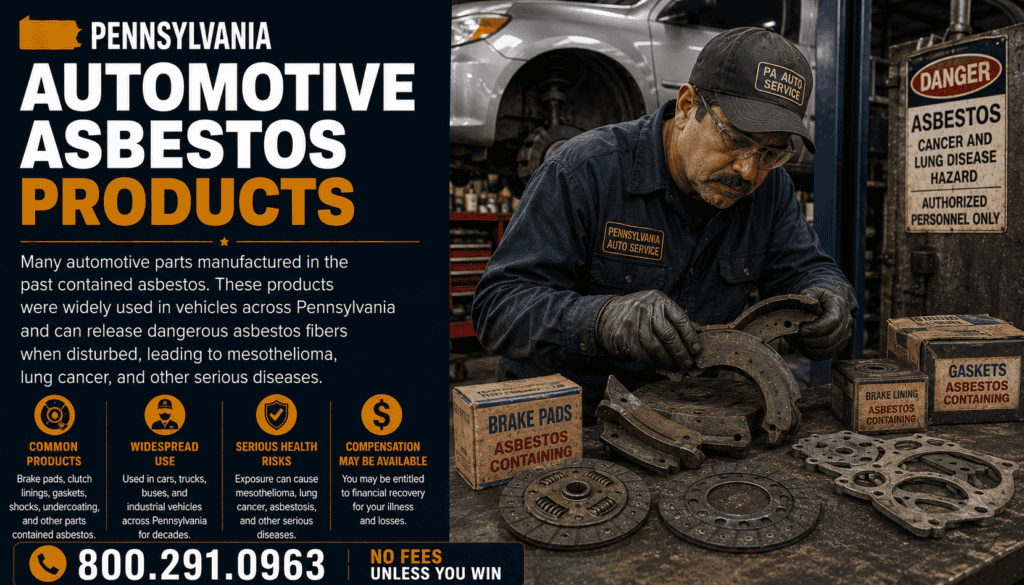
Pennsylvania Automotive Asbestos Products
🚗 Pennsylvania Automotive Asbestos Products Exposed Thousands of Mechanics and Automotive Workers
For decades, asbestos was used extensively in automotive parts because it resisted heat, reduced friction, and increased the durability of components exposed to extreme temperatures. Millions of asbestos-containing automotive products were installed in passenger vehicles, commercial trucks, buses, construction equipment, farm machinery, emergency vehicles, military vehicles, and industrial fleets throughout Pennsylvania.
Automotive mechanics, brake technicians, clutch repair specialists, dealership service technicians, fleet maintenance workers, truck mechanics, transmission technicians, body shop employees, and do-it-yourself vehicle owners often handled asbestos-containing automotive products during routine maintenance and repairs. Removing worn brake shoes, sanding brake linings, replacing clutches, cleaning brake drums, grinding gaskets, or repairing engines frequently released microscopic asbestos fibers into the surrounding air.
Many workers performed these jobs daily for years without knowing they were inhaling dangerous asbestos dust. Because asbestos diseases often develop 20 to 50 years after exposure, many Pennsylvania automotive workers are only now being diagnosed with mesothelioma, asbestos-related lung cancer, asbestosis, and other asbestos diseases resulting from occupational exposure decades earlier.
Today, automotive asbestos products remain an important source of asbestos litigation, particularly for mechanics and maintenance workers who repaired vehicles before asbestos-containing replacement parts were phased out.
🔧 What Are Automotive Asbestos Products?
Automotive asbestos products are vehicle components manufactured with asbestos fibers to improve heat resistance, reduce friction, strengthen materials, and increase service life. These products were widely installed by original equipment manufacturers and sold as aftermarket replacement parts for many years.
Common automotive products that contained asbestos include:
- Brake shoes
- Brake pads
- Brake linings
- Disc brake components
- Drum brake linings
- Clutch facings
- Clutch discs
- Clutch pressure plates
- Transmission friction materials
- Engine gaskets
- Exhaust gaskets
- Cylinder head gaskets
- Intake manifold gaskets
- Exhaust manifold gaskets
- Valve cover gaskets
- Muffler insulation
- Heat shields
- Hood liners
- Firewalls
- Underbody insulation
- Engine compartment insulation
- Adhesives
- Sealants
- Friction materials
Many Pennsylvania mechanics handled these products every day while performing routine vehicle maintenance and repairs.
Learn more by visiting our Pennsylvania Industrial Asbestos Products page.
🔥 Why Asbestos Was Used in Automotive Products
Vehicle manufacturers relied on asbestos because few other materials could withstand the extreme temperatures and constant friction generated by automotive braking and clutch systems.
Manufacturers added asbestos because it provided:
- Excellent heat resistance
- Superior friction control
- Fire resistance
- Long-lasting durability
- Wear resistance
- Reduced brake fade
- Noise reduction
- Improved mechanical strength
- Chemical resistance
- Lower manufacturing costs
These qualities made asbestos an industry standard for many automotive products throughout much of the twentieth century.
Unfortunately, whenever brakes, clutches, gaskets, or insulation materials were removed, sanded, ground, drilled, or cleaned with compressed air, dangerous asbestos fibers could become airborne and be inhaled by workers.
👨🔧 Pennsylvania Automotive Workers Most Frequently Exposed
Workers throughout Pennsylvania’s automotive industry routinely encountered asbestos-containing products while repairing and maintaining vehicles.
Higher-risk occupations include:
- Automotive mechanics
- Brake repair technicians
- Clutch repair technicians
- Dealership service technicians
- Fleet maintenance mechanics
- Diesel mechanics
- Truck mechanics
- Bus mechanics
- Heavy equipment mechanics
- Farm equipment mechanics
- Transmission technicians
- Engine rebuilders
- Automotive machinists
- Muffler technicians
- Suspension technicians
- Tire and brake technicians
- Auto restoration specialists
- Body shop technicians
- Vehicle inspectors
- Service station mechanics
- Municipal fleet mechanics
- Military vehicle mechanics
- Railroad maintenance mechanics
- Industrial vehicle mechanics
Many workers experienced exposure without directly manufacturing asbestos products. Simply servicing vehicles that contained asbestos brake linings, clutch components, engine gaskets, or insulation materials could release hazardous asbestos dust into repair shops.
Additional occupational information is available through:
- Pennsylvania Mechanics Mesothelioma
- Pennsylvania Industrial Asbestos Exposure
- Pennsylvania Asbestos Exposure Sites
🚙 Where Pennsylvania Automotive Asbestos Exposure Commonly Occurred
Automotive asbestos products were used in virtually every type of vehicle repair and maintenance facility throughout Pennsylvania.
Common exposure locations include:
- Automobile dealerships
- Independent repair shops
- Fleet maintenance garages
- Truck repair facilities
- Bus maintenance garages
- Heavy equipment repair shops
- Farm equipment dealerships
- Municipal maintenance facilities
- State vehicle maintenance garages
- Railroad maintenance shops
- Industrial maintenance facilities
- Construction equipment repair shops
- Mining equipment maintenance facilities
- Military vehicle maintenance facilities
- Emergency vehicle repair shops
- Fire department garages
- Police vehicle maintenance shops
- School bus maintenance facilities
- Transportation company garages
- Automotive vocational schools
- Service stations
- Tire and brake shops
- Transmission repair shops
- Engine rebuilding shops
Many of these facilities routinely performed brake replacements, clutch repairs, engine overhauls, and gasket replacements that released airborne asbestos fibers into enclosed work areas.
⚙️ Common Automotive Products That Contained Asbestos
Pennsylvania automotive workers frequently handled asbestos-containing replacement parts during routine maintenance and repairs.
Common products included:
- Brake shoes
- Brake pads
- Brake linings
- Drum brakes
- Disc brake components
- Clutch facings
- Clutch discs
- Clutch pressure plates
- Transmission friction discs
- Cylinder head gaskets
- Exhaust gaskets
- Intake manifold gaskets
- Valve cover gaskets
- Engine gasket sets
- Muffler insulation
- Heat shields
- Engine insulation
- Firewalls
- Hood insulation
- Adhesives
- Sealants
- Friction materials
- Heat-resistant packing materials
- Thermal insulation
Whenever these components were removed, drilled, sanded, machined, cleaned, or replaced, microscopic asbestos fibers could become airborne, placing mechanics and nearby workers at risk of long-term occupational exposure.
🔎 How Pennsylvania Automotive Asbestos Product Exposure Is Investigated
After a diagnosis of mesothelioma, asbestos-related lung cancer, asbestosis, or another asbestos disease, one of the most important steps is determining which asbestos-containing automotive products were handled and which manufacturers supplied those products. Because asbestos diseases often develop 20 to 50 years after occupational exposure, many Pennsylvania mechanics and automotive workers no longer remember every vehicle, repair shop, dealership, fleet, or replacement part they worked with decades earlier.
A comprehensive asbestos investigation reconstructs a worker’s employment history by reviewing employment records, union records, Social Security earnings histories, military service records, dealership records, fleet maintenance records, repair invoices, parts catalogs, service manuals, and coworker testimony. These records frequently identify the asbestos-containing automotive products used during repairs and the manufacturers responsible for supplying them.
Many Pennsylvania mechanics worked for several repair shops, dealerships, trucking companies, municipalities, or industrial maintenance departments throughout their careers. A detailed investigation often identifies exposure to asbestos products manufactured by numerous companies, resulting in multiple potential sources of compensation.
🚗 Pennsylvania Automotive Facilities Commonly Investigated
Automotive asbestos investigations frequently involve workers employed at a wide variety of vehicle repair and maintenance facilities throughout Pennsylvania.
Facilities commonly investigated include:
- Automobile dealerships
- Independent repair shops
- Fleet maintenance garages
- Truck repair facilities
- Bus maintenance garages
- Heavy equipment repair shops
- Farm equipment dealerships
- Construction equipment maintenance facilities
- Municipal vehicle garages
- State government fleet maintenance shops
- School bus maintenance facilities
- Railroad maintenance shops
- Mining equipment repair facilities
- Industrial maintenance garages
- Emergency vehicle maintenance facilities
- Fire department repair shops
- Police fleet maintenance facilities
- Delivery company garages
- Automotive vocational schools
- Tire and brake service centers
- Transmission repair shops
- Engine rebuilding facilities
- Service stations
- Automotive restoration shops
Many of these facilities routinely replaced brakes, clutches, engine gaskets, and insulation materials that released asbestos fibers into enclosed work areas.
Learn more by visiting our Pennsylvania Asbestos Exposure Sites page.
👨🔧 Occupations Frequently Investigated
Pennsylvania automotive asbestos investigations often focus on workers who routinely serviced vehicles containing asbestos components.
Occupations commonly investigated include:
- Automotive mechanics
- Brake technicians
- Clutch repair specialists
- Dealership service technicians
- Fleet maintenance mechanics
- Diesel mechanics
- Truck mechanics
- Bus mechanics
- Heavy equipment mechanics
- Farm equipment mechanics
- Engine rebuilders
- Transmission technicians
- Automotive machinists
- Muffler technicians
- Suspension technicians
- Tire and brake technicians
- Automotive restoration specialists
- Body shop technicians
- Municipal fleet mechanics
- Railroad mechanics
- Industrial vehicle mechanics
- Military vehicle mechanics
- Shop supervisors
- Service managers
Many workers experienced repeated asbestos exposure while replacing worn brakes, servicing clutch assemblies, rebuilding engines, replacing gaskets, and cleaning brake drums with compressed air.
Additional occupational information is available through:
🔧 Automotive Products Frequently Investigated
One of the primary goals of an asbestos investigation is identifying which asbestos-containing automotive products were handled throughout a worker’s career.
Products commonly investigated include:
- Brake shoes
- Brake pads
- Brake linings
- Drum brake linings
- Disc brake components
- Clutch facings
- Clutch discs
- Clutch pressure plates
- Transmission friction materials
- Cylinder head gaskets
- Exhaust gaskets
- Intake manifold gaskets
- Valve cover gaskets
- Engine gasket sets
- Muffler insulation
- Heat shields
- Hood insulation
- Firewall insulation
- Engine compartment insulation
- Adhesives
- Sealants
- Friction materials
- Thermal insulation
- Heat-resistant packing materials
Because automotive repair facilities often used replacement parts manufactured by many different companies, mechanics frequently encountered asbestos products from multiple manufacturers throughout their careers.
Additional information is available through:
- Pennsylvania Industrial Asbestos Products
- Pennsylvania Asbestos Insulation Products
- Pennsylvania Asbestos Products Used in Construction
📂 Records That Help Identify Automotive Asbestos Exposure
Even if a worker cannot remember every repair completed decades ago, historical records frequently help identify asbestos-containing automotive products and manufacturers.
Helpful records include:
- Employment records
- Personnel files
- Union membership records
- Social Security earnings history
- Military service records
- DD-214 discharge papers
- W-2 forms
- Fleet maintenance records
- Repair orders
- Vehicle service records
- Parts invoices
- Manufacturer parts catalogs
- Shop work orders
- Equipment maintenance logs
- Historical photographs
- Medical records
- Coworker statements
These records often establish where a mechanic worked, which vehicles were serviced, and the manufacturers of the asbestos-containing replacement parts used during repairs.
🏦 Automotive Products and Asbestos Trust Fund Claims
Many manufacturers of asbestos-containing automotive products later filed for bankruptcy and established asbestos trust funds after facing thousands of asbestos lawsuits.
Trust fund investigations commonly identify manufacturers of:
- Brake linings
- Brake shoes
- Brake pads
- Clutch facings
- Clutch discs
- Gaskets
- Engine gasket sets
- Heat-resistant insulation
- Friction materials
- Mechanical sealing products
- Industrial adhesives
- Thermal insulation materials
Because Pennsylvania mechanics often installed replacement parts from numerous manufacturers throughout their careers, many qualify to pursue compensation through multiple asbestos trust funds in addition to other legal claims.
Learn more by visiting our Pennsylvania Asbestos Trust Fund Claims page.
⏳ Why Beginning an Investigation Early Is Important
Beginning an asbestos investigation soon after diagnosis helps preserve important evidence that may become more difficult to locate over time.
An early investigation may identify:
- Former employers
- Automotive repair facilities
- Pennsylvania dealerships
- Fleet maintenance garages
- Vehicle manufacturers
- Parts manufacturers
- Historical repair records
- Former coworkers
- Available asbestos trust funds
- Additional legal claims
Even when exposure occurred decades earlier, employment records, repair documentation, and historical product information frequently identify the asbestos-containing automotive products responsible for occupational exposure.
📚 Learn More About Pennsylvania Automotive Asbestos Exposure
Additional Pennsylvania resources include:
💰 Financial Compensation May Be Available for Exposure to Pennsylvania Automotive Asbestos Products
Thousands of Pennsylvania automotive mechanics, brake technicians, clutch specialists, dealership service technicians, fleet maintenance workers, truck mechanics, bus mechanics, and heavy equipment mechanics developed asbestos-related diseases after years of working around asbestos-containing automotive products. Many were repeatedly exposed while replacing brakes, rebuilding clutches, installing gaskets, repairing engines, servicing transmissions, and maintaining commercial vehicle fleets.
If you were diagnosed with mesothelioma, asbestos-related lung cancer, asbestosis, or another asbestos disease after working with automotive asbestos products, you may qualify for financial compensation. Even if your exposure occurred decades ago, legal options may still be available.
Depending on your work history and the automotive products involved, compensation may be available through:
- Mesothelioma lawsuits
- Asbestos-related lung cancer lawsuits
- Asbestos trust fund claims
- Multiple asbestos trust fund claims
- Wrongful death lawsuits
- Other available legal claims
Financial compensation may help cover:
- Medical expenses
- Hospital bills
- Surgery
- Chemotherapy
- Radiation therapy
- Immunotherapy
- Prescription medications
- Lost wages
- Future loss of earning capacity
- Home healthcare
- Travel expenses for medical treatment
- Pain and suffering
- Funeral expenses
- Financial support for surviving family members
Many Pennsylvania automotive workers handled replacement parts manufactured by numerous companies throughout their careers. A detailed investigation often identifies multiple manufacturers and several potential sources of compensation.
🏦 Pennsylvania Automotive Products and Asbestos Trust Fund Claims
Many manufacturers of asbestos-containing automotive products later entered bankruptcy after facing thousands of asbestos lawsuits. During the bankruptcy process, these companies established asbestos trust funds to compensate individuals diagnosed with asbestos-related diseases.
Trust fund investigations frequently identify manufacturers of:
- Brake shoes
- Brake pads
- Brake linings
- Drum brake linings
- Disc brake components
- Clutch facings
- Clutch discs
- Clutch pressure plates
- Transmission friction materials
- Engine gaskets
- Cylinder head gaskets
- Exhaust gaskets
- Intake manifold gaskets
- Valve cover gaskets
- Muffler insulation
- Heat shields
- Engine compartment insulation
- Hood insulation
- Adhesives
- Friction materials
Because automotive repair shops routinely installed replacement parts from many different manufacturers, Pennsylvania mechanics often qualify to pursue compensation through multiple asbestos trust funds in addition to other legal claims.
Learn more by visiting our Pennsylvania Asbestos Trust Fund Claims page.
👨👩👧 Wrongful Death Claims Involving Automotive Asbestos Exposure
Unfortunately, mesothelioma and other asbestos-related diseases often are not diagnosed until decades after occupational exposure. If a Pennsylvania mechanic or automotive worker dies from an asbestos-related disease caused by exposure to automotive asbestos products, surviving family members may have the right to pursue compensation through a wrongful death claim.
Depending on the circumstances, compensation may include:
- Funeral expenses
- Burial costs
- Outstanding medical bills
- Loss of financial support
- Loss of household services
- Loss of companionship
- Other damages available under Pennsylvania law
Beginning an investigation promptly helps preserve employment records, repair shop records, fleet maintenance documentation, parts identification evidence, and coworker testimony that may strengthen a family’s claim.
Learn more by visiting our Pennsylvania Wrongful Death Mesothelioma Lawsuits page.
📄 Records That May Help Support an Automotive Asbestos Claim
Although many automotive repairs were completed decades ago, historical records often help identify the asbestos-containing products handled throughout a mechanic’s career.
Helpful records include:
- Employment records
- Personnel files
- Union membership records
- Social Security earnings history
- Military service records
- DD-214 discharge papers
- W-2 forms
- Fleet maintenance records
- Repair orders
- Vehicle service records
- Parts invoices
- Manufacturer parts catalogs
- Shop work orders
- Equipment maintenance logs
- Historical photographs
- Medical records
- Coworker statements
These records frequently identify the manufacturers that supplied asbestos-containing automotive products and help document occupational exposure throughout a worker’s career.
❓ Frequently Asked Questions
Which automotive products commonly contained asbestos?
Many automotive components manufactured before asbestos was phased out contained asbestos, including brake shoes, brake pads, brake linings, clutch facings, clutch discs, transmission friction materials, engine gaskets, exhaust gaskets, heat shields, and insulation materials.
Why was asbestos used in automotive parts?
Manufacturers used asbestos because it provided excellent heat resistance, friction control, durability, fire resistance, and long service life for components exposed to extreme operating temperatures.
Which Pennsylvania automotive workers faced the greatest asbestos exposure?
Higher-risk occupations included automotive mechanics, brake technicians, clutch specialists, truck mechanics, diesel mechanics, fleet maintenance mechanics, bus mechanics, heavy equipment mechanics, dealership service technicians, transmission technicians, and engine rebuilders.
Can automotive asbestos products cause mesothelioma and asbestos-related lung cancer?
Yes. Removing brakes, replacing clutches, grinding gaskets, sanding friction materials, and cleaning brake assemblies could release microscopic asbestos fibers that may cause mesothelioma, asbestos-related lung cancer, asbestosis, and other asbestos diseases.
Can I qualify for compensation if I only worked near brake or clutch repairs?
Yes. Many workers developed asbestos-related diseases without directly replacing brakes or clutches. Working nearby while asbestos-containing automotive components were serviced may have resulted in significant occupational exposure.
Can I file claims against more than one automotive product manufacturer?
Yes. Most automotive repair facilities installed replacement parts manufactured by numerous companies. Depending on your work history, you may qualify to pursue compensation through multiple asbestos trust funds and other legal claims.
Can family members develop asbestos-related diseases from automotive workers?
Yes. Mechanics often carried asbestos dust home on work clothing, boots, gloves, and tools. This secondary or household exposure has caused mesothelioma and other asbestos-related diseases in spouses and family members.
How long do I have to file an asbestos claim in Pennsylvania?
Pennsylvania law establishes deadlines for filing asbestos-related personal injury and wrongful death claims. Beginning an investigation as soon as possible after diagnosis helps preserve evidence and protect your legal rights.
Learn more by visiting our Pennsylvania Mesothelioma Statute of Limitations page.
📚 Learn More About Pennsylvania Automotive Asbestos Exposure
Additional Pennsylvania resources include:
- Pennsylvania Asbestos Exposure Lawsuits
- Pennsylvania Mechanics Mesothelioma
- Pennsylvania Industrial Asbestos Exposure
- Pennsylvania Asbestos Exposure Sites
- Pennsylvania Industrial Asbestos Products
- Pennsylvania Asbestos Products Used in Construction
- Pennsylvania Asbestos Trust Fund Claims
- Pennsylvania Wrongful Death Mesothelioma Lawsuits
📞 Free Case Evaluation
If you or a loved one developed mesothelioma, asbestos-related lung cancer, asbestosis, or another asbestos disease after working with asbestos-containing automotive products in Pennsylvania, you may qualify for financial compensation.
Our experienced asbestos legal team can help investigate:
- Employment history
- Pennsylvania automotive repair facilities
- Vehicle maintenance records
- Asbestos-containing automotive products
- Product manufacturers
- Available asbestos trust fund claims
- Potential legal options
📞 Call 800-291-0963
Why Families Contact Mesothelioma Help
- Free case evaluation
- Nationwide legal representation
- No upfront attorney fees
- No fees unless compensation is recovered
- Help identifying asbestos-containing automotive products and exposure sources
- Assistance pursuing asbestos lawsuits and asbestos trust fund claims
Helping asbestos victims and their families since 1999!